
Official FIFA World Cup Qatar 2022 emblem — Credit: FIFA
As with the 2018 competition, the 2022 hosting rights were decided on December 2nd, 2010, twelve years before the start of this tournament. The bidding process began in 2009, with the USA, Australia, Japan, South Korea, and Qatar competing for the right to host the tournament. When the vote took place, FIFA’s Executive Committee selected Qatar which was considered as shocking a decision as ever. They defeated the United States in the final round which everyone thought would be impossible. Critics quickly pointed to concerns about Qatar’s extreme summer heat, lack of major soccer infrastructure, and limited history in hosting large international sporting events. The unexpected nature of the decision led to intense scrutiny of FIFA’s voting procedures and raised questions about transparency and fairness. Soon after the announcement, allegations of corruption and vote-buying began to emerge, casting a shadow over the legitimacy of the selection process.
Investigations by journalists and governing bodies revealed claims that certain FIFA officials had accepted bribes in exchange for supporting Qatar’s bid, although definitive legal conclusions were difficult to establish across all cases. Several FIFA executives were later indicted or banned from soccer-related activities as part of broader corruption probes that rocked the organization in the mid-2010s. Additional controversies arose over labor conditions in Qatar, particularly regarding migrant workers involved in building stadiums and infrastructure, drawing widespread international criticism. Concerns about player safety due to extreme heat ultimately led FIFA to move the tournament from its traditional summer schedule to November–December 2022, marking the first such change in World Cup history. Together, these issues made the lead-up to the tournament one of the most controversial periods in FIFA history, raising lasting questions about governance, ethics, and accountability in global sports.
In the 12 years before the start of the tournament, Qatar invested a gargantuan $220 billion in infrastructure and stadium construction. Most of it was overwhelmingly focused on long-term infrastructure rather than the tournament itself, with only about $6–10 billion used to build seven new stadiums and extensively renovate one existing venue. This also included advanced cooling technology to make outdoor play possible in extreme heat. The largest share went into transportation, including the $36 billion Doha Metro system, expanded highways, and major airport upgrades to handle global travel demand. Tens of billions more were invested in hotels, resorts, and fan accommodations to rapidly scale Qatar’s tourism capacity. The country also spent heavily on urban development, including building Lusail City and expanding Doha with new residential and commercial districts. Significant funds were directed toward utilities such as power, water systems, and telecommunications networks to support both the event and future growth. Additional billions covered event operations like security, logistics, and global broadcasting. Overall, more than 90% of the money went toward infrastructure projects tied to Qatar’s long-term national development strategy rather than the matches themselves. In essence, Qatar used the World Cup as a catalyst to transform its economy, modernize its infrastructure, and position itself as a global tourism and business hub.
But all of this came at a tragic human cost. The figures are widely debated because there is no single agreed-upon death toll, with estimates ranging from a few dozen officially recognized work-related deaths to several thousand when broader data is considered. Qatari officials initially reported very low numbers but later acknowledged that hundreds of migrant workers may have died, while investigations estimated at least 6,500 migrant worker deaths in the country during the preparation period. Injuries were also widespread, with tens of thousands of workers experiencing accidents ranging from mild to severe, often linked to construction hazards and extreme heat. Overall, while the exact number remains uncertain, there is broad agreement that the tournament involved significant human costs, including deaths, injuries, and serious concerns about labor conditions.
Qatar had very little in terms of an international soccer track record or reputation, but they did not wait until the last minute to prepare their team for the tournament. They had a long-term strategy centered on developing players from a young age, especially through the Aspire Academy, which produced most of the squad. The team benefited from continuity, as many players trained together for years under the same coach, building strong chemistry and a consistent playing style. Qatar also gained international experience by competing in major tournaments like the Copa América and Gold Cup, despite not needing to qualify as hosts. Their preparation culminated in winning the 2019 AFC Asian Cup and holding extended training camps and friendlies before the tournament.
Despite the controversies, in host selection, labor conditions, and questions about its ability to accommodate a multi-cultural event of this magnitude, the competition would become one of the most superb spectacles both on and off the pitch, as well as impeccable organization and security.
The world had come to the middle east with all its passionate fans, color, cheers, diversity, and, of course, the sports’ super stars. Would this be the tournament when Lionel Messi would finally be crowned the GOAT? What happened during the 2022 World Cup would go down as an epic show of resilience, dazzling skills, shocking results, and a heart pounding frenetic finale.
Qualifying
Once again 32 teams would participate in the 2022 World Cup. The President of FIFA, Gianni Infantino, had wanted to expand it to 48 teams but logistical limits (Qatar is a very small country), time constraints (preparations were already far advanced), and political issues (tensions and a regional blockade made it difficult to partner with nearby countries as co‑hosts) ultimately nixed this idea and would be implemented in 2026.
All 211 FIFA countries registered to qualify for the event. Qatar as the host didn’t have to play any qualifying games so as before, 210 nations would compete for 31 spots. However, several countries withdrew or were suspended. Specifically:
- Saint Lucia, which initially entered CONCACAF qualification, withdrew from it before their first match.
- North Korea withdrew from the AFC qualifying round due to safety concerns related to the COVID-19 pandemic.
- American Samoa and Samoa withdrew before the OFC qualification draw due to travel restrictions following the pandemic.
- Tonga withdrew after the 2022 Hunga Tonga–Hunga Ha’apai eruption and tsunami.
- Vanuatu and Cook Islands also withdrew due to travel restrictions forced on them because of COVID-19 outbreaks in their squads.
- Russia was suspended due to its invasion of Ukraine and the refusal of several Eastern European teams to play Russia.
The allotted slots for the 32 teams were as follows for qualification purposes:
- Asia AFC: 4 or 5 places *(plus Qatar, the host)
- Africa (CAF): 5 places*
- North, Central America and Caribbean (CONCACAF): 3 or 4 places*
- South America (CONMEBOL): 4 or 5 places*
- Oceania (OFC): 0 or place*
- Europe (UEFA): 13 places
*One team from AFC and one from CONMEBOL, and one team from CONCACAF and one from OFC would meet in respective playoff away/home matches to determine who would attend the World Cup.
The same tiebreaker criteria as four years before was used but each confederation had certain flexibility to apply it depending on their conditions. This is how it broke down by soccer confederation:

Table courtesy of Jose F Guerra
*Used for playoff or knockout stages in qualifying within their regions.
**Fair play points were deducted according to the following hierarchy:
- first yellow card: minus 1 point
- indirect red card (second yellow card): minus 3 points
- direct red card: minus 4 points
- yellow card and direct red card: minus 5 points
***No drawing of lots was required to determine which nations qualified within their federations.
The final list of qualified nations was the following:

Table courtesy of Jose F Guerra
Amazingly, there was only one nation that debuted for this World Cup: the host, Qatar.
But there were major teams who shockingly did not qualify. Among them were Italy (2020 Euro champions), Colombia (quarter-finalists in 2014), Chile (golden generation of Vidal and Sánchez, and missing a second straight World Cup), Sweden (2018 quarterfinalists), Norway (had stars like Erling Haaland), Egypt (led by Mohamed Salah), Nigeria (typically one of Africa’s strongest teams), and Algeria (2019 African champions).
While every confederation and every nation battled to win a spot in the tournament, one question on the minds of many fans around the world was whether or not Lionel Messi would finally win a World Cup and once and for all put to rest the ghost of Maradona that his home country keep comparing him against. While Argentina qualified with ease and entered the tournament on a 36 match unbeaten streak with 25 wins and 11 draws, there were questions surrounding his mental toughness, his ability to “win the big one”, and whether or not the Argentina head coach, Lionel Scaloni, who had never had a cop-level head coaching experience, could assemble a team that would take them through the brutal competition. The world was about to find out.
The Tournament
For the first time since its inception the World Cup would be held in November and December to avoid the extreme heat of the summer. This caused major disruptions across the regular season calendars in multiple geographic regions and a recalibration of how teams would prepare for the event.
The tournament was held in five cities using eight venues, seven of which were new construction, and one heavily remodeled. All included state-of-the-art cooling systems that managed to lower the temperatures inside the stadiums in the lower 70s Fahrenheit. The largest stadium was the Lusail Stadium in the city of Lusail with a capacity of 88,966 and the smallest one was the Stadium 974 in the city of Doha with a capacity of 44,089.
The draw was again designed in a way in which the host country would be seeded even though they were ranked 51st in the world, followed by the next seven ranked teams which included, in order of ranking Brazil, Belgium, France, Argentina, England, Spain, and Portugal. Of note is that Italy, at the time of the drawing, was ranked 6th but had not qualified, leaving once again the question as to the validity of FIFA rankings to seed teams during World Cup draws to form the competition groups.
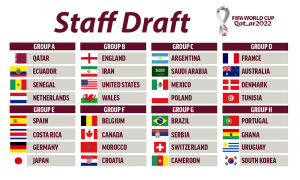
The final groups were:


Tables courtesy of Jose F Guerra
After the 2022 World Cup draw, pundits picked Brazil, Argentina, France, and England as the four main favorites. Brazil were widely considered the strongest squad overall, combining attacking flair and depth, and entered the tournament as the bookmakers’ top pick. Argentina were seen as a serious challenger thanks to their long unbeaten run and Lionel Messi’s form, with many believing they had the balance and momentum to win it. France, the defending champions, were still viewed as elite contenders because of their world‑class talent, although injuries and the “champion’s curse” created some hesitation. England rounded out this top group, coming off a Euro 2020 final appearance and boasting a young, talented squad that analysts felt could finally deliver on the big stage.
Among the dark horses, pundits most often highlighted Denmark, Uruguay, Senegal, and Croatia as teams capable of surprising the favorites. Denmark were probably the most popular pick, praised for their cohesion and recent strong performances, including wins over France before the tournament. Uruguay were seen as dangerous due to their mix of experienced stars and emerging talent, making them a potential knockout-stage threat. Senegal entered as African champions and were widely tipped as the continent’s best chance to make a deep run thanks to their defensive solidity and organization. Croatia, while already a proven side after reaching the 2018 final, were often framed as a “dark horse” again due to their experienced core and tournament know‑how, giving them the potential to outperform expectations and go deep once more.
The Netherlands in Group A progressed smoothly under Louis van Gaal, looking organized and efficient throughout the group. Senegal recovered from losing Sadio Mané pre-tournament and still qualified, with strong defensive performances and key goals from Ismaïla Sarr and others. Ecuador impressed early, especially Enner Valencia’s standout scoring performances, but narrowly missed out on qualification. Qatar struggled as hosts, losing all three matches in a disappointing campaign.
In Group B England started explosively with a 6–2 win over Iran, with Bukayo Saka one of the standout performers in the group stage. The USA showed consistency and resilience, holding England to a 0–0 draw and advancing unbeaten but with few goals. Iran’s dramatic win over Wales was a highlight, keeping qualification hopes alive until the final match. The group had some tension-filled moments, but no major VAR controversies dominated.
Group C produced one of the biggest shocks in World Cup history as Saudi Arabia stunned Argentina 2–1 in their opening match, despite a controversial early VAR-disallowed Argentine goal. Argentina bounced back strongly, led by Lionel Messi, to top the group. Poland advanced largely thanks to disciplined defense and goal difference, despite a missed Lewandowski penalty in one game. Mexico failed to advance for the first time since 1978, struggling to convert chances despite a crucial late win vs Saudi Arabia.
France seemed t a lock in Group D but had to overcome injuries to key players and still managed to dominate the group, with Kylian Mbappé delivering standout performances. Australia surprised many by qualifying after bouncing back from a heavy opening loss to France. Denmark, widely tipped as a dark horse, underperformed and exited early. Tunisia’s shock win over France (with a rotated squad) was a highlight, though it wasn’t enough to see them through.
Group E was one of the most dramatic groups, with Japan shocking both Germany and Spain to win the group. Their win over Spain included a controversial VAR moment where a goal was allowed despite the ball appearing nearly out of play. Germany were eliminated in the group stage for the second tournament in a row, despite finishing level in points with Spain, but undone by their opening loss to Japan. Spain started strongly with a 7–0 win but faltered late, creating chaos in group standings and needing goal difference to advance.
Morocco emerged as one of the stories of the tournament in Group F, topping the group with disciplined defending and clinical counterattacks. Croatia were solid and experienced, drawing with Morocco and advancing comfortably. Belgium’s “golden generation” disappointed, exiting early amid internal tensions and lackluster performances. Canada scored their first-ever World Cup goal but failed to convert promising play into results.
As expected in Group G, Brazil looked dominant, winning their first two matches with Neymar sidelined after injury. Switzerland consistently performed well to secure second place, including a decisive win over Serbia. Cameroon provided excitement late, stunning Brazil 1–0 in one of the tournament’s memorable upsets, though it wasn’t enough to advance. Serbia showed attacking flair but defensive weaknesses cost them.
In Group H, Portugal topped the group with strong attacking displays, though Cristiano Ronaldo’s influence was more limited. South Korea delivered late drama, beating Portugal with a stoppage-time goal to advance on goals scored. Uruguay fell just short despite a late surge, and there were complaints about VAR decisions in their final match (including unawarded penalty appeals). Ghana showed flashes of promise, including a high-scoring win over South Korea, but couldn’t progress.
The Round of 16 delivered drama and upsets, most notably Morocco eliminating Spain on penalties after a disciplined defensive performance and heroic goalkeeping from Yassine Bounou. Croatia also advanced via penalties, knocking out Japan, while Brazil produced one of the best displays of the tournament in a dominant 4–1 win over South Korea. Argentina survived a scare against Australia but advanced thanks to Lionel Messi’s brilliance, while England comfortably beat Senegal 3–0. France edged past Poland with Kylian Mbappé in top form, and the Netherlands beat the USA in a tactically sharp performance. One of the biggest shocks came when Portugal crushed Switzerland 6–1, with Gonçalo Ramos scoring a hat trick after Cristiano Ronaldo was benched.
The quarterfinals featured high-quality clashes, with Argentina defeating the Netherlands in a fiery and controversial match that included late drama and a penalty shootout. Croatia stunned Brazil on penalties after equalizing late in extra time, eliminating one of the favorites. Morocco continued their historic run by beating Portugal 1–0, becoming the first African team ever to reach a World Cup semifinal. France edged England 2–1 in a tightly contested match that included a missed late penalty from Harry Kane.
In the semifinals, Argentina delivered a dominant 3–0 victory over Croatia, with Lionel Messi orchestrating the attack and Julián Álvarez scoring twice. France overcame Morocco 2–0, ending the underdog’s historic run despite another resilient performance. The stage was set for a blockbuster final between Argentina and France, widely seen as the two best teams of the tournament. Morocco, despite the loss, left a lasting legacy with one of the greatest underdog runs in World Cup history.
The Final
A legend of the game, Lionel Messi, was about to face off against a phenom of our time, Kylian Mbappé. One with his last shot at glory, another with glory already won four years before. The past and the future would collide. And both teammates at the French club Paris Saint‑Germain. No one could have written a better script. And both had arrived using very different tactical setups and styles.
Argentina played a structured, balanced style built around control and moments of brilliance from Lionel Messi, combining patient buildup with sudden attacking bursts and strong midfield work. They were tactically flexible, capable of defending compactly and then transitioning quickly, with players like Julián Álvarez and Di María providing energy and directness. France, in contrast, relied more on pace, power, and individual quality, often sitting deeper and striking quickly through Kylian Mbappé and their dynamic attack. While Argentina emphasized cohesion and control, France’s style was more explosive and opportunistic, thriving in transition and big moments rather than sustained dominance.
Argentina completely controlled the first half, dictating tempo with calm possession and sharp movement through midfield led by Messi. They took the lead with a penalty from Messi and then doubled it with a brilliant team goal finished by Ángel Di María after a flowing counterattack. British broadcaster Peter Drury, always poetic in his calls, yelled into the microphone “Glorious goal!” as Di Maria scored. France struggled to get into the game, unable to create chances and looking disjointed in attack. By halftime, Argentina led 2–0 and seemed firmly in control.
For much of the second half, Argentina continued managing the game comfortably, limiting France’s opportunities and slowing the tempo. However, everything changed late in the match when France won a penalty that Mbappé converted, sparking a sudden comeback. Just minutes later, Mbappé scored again with a superb volley to level the match 2–2 in a stunning turnaround. The momentum shifted completely as France surged forward and Argentina were pushed onto the defensive. The last several minutes plus added time were played at a frenetic pace as both teams seemed to want to win in regular time, with plays happening at a dizzying pace.
In extra time, everyone expected the teams to e cautious but despite tired legs and drained minds, both teams continued their frenetic pace. Argentina regained control and took the lead again through Messi after a chaotic goalmouth scramble. France responded once more when Mbappé completed his hat trick with a penalty, making it 3–3 in an extraordinary final. In the dying moments, Randal Kolo Muani broke through one-on-one, but Emiliano Martínez produced a crucial, reflex save with his leg, blocking what would likely have been the winning goal, one of the most important saves in World Cup history. But it didn’t end there as Argentina countered after that save and almost scored what would have undoubtedly been the winning goal. The match went to penalties, where Martínez’s presence and Argentina’s composure secured a 4–2 shootout victory. When Gonzalo Montiel scored the winning PK, Messi felt to his knees and several of his teammates surrounded him, finally having achieved what many had said he would never do: be a World Champion with Argentina. In the words of Peter Drudy, “Scaloni will be feted, Messi will be sainted”.
The 2022 World Cup was over. A tournament that was awarded under the shadow of corruption, whose build-up was scrutinized for its unsafe construction and labor practices, that caused major shifts in calendars due to holding it in November and December instead of the traditional summer months, and that created human rights and free speech controversies during the event, had been held with brilliant execution, dazzling stadiums, and impressive security. But the main spectacle had been on the pitch, with memorable matches, heroic performances, sentimental favorites that captured the imagination of the soccer world, and the crowing of what is now considered the Greatest Of All Time, the GOAT, Lioenl Messi.
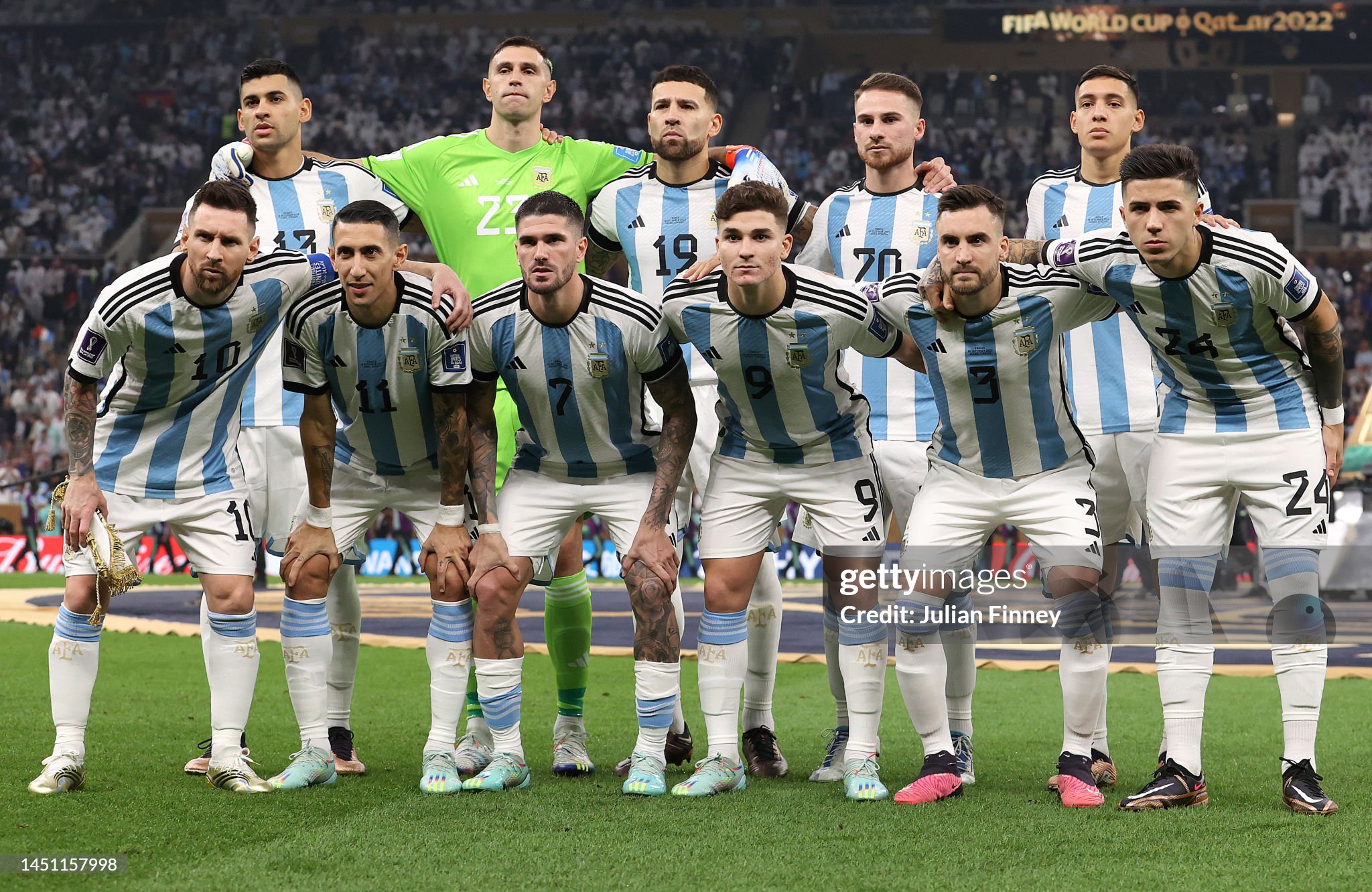
Argentina starting lineup before the FIFA World Cup Qatar 2022 Final — Credit: Julian Finney / Getty Images

Kylian Mbappé and Lionel Messi in action during the FIFA World Cup Qatar 2022 Final — Credit: Getty Images
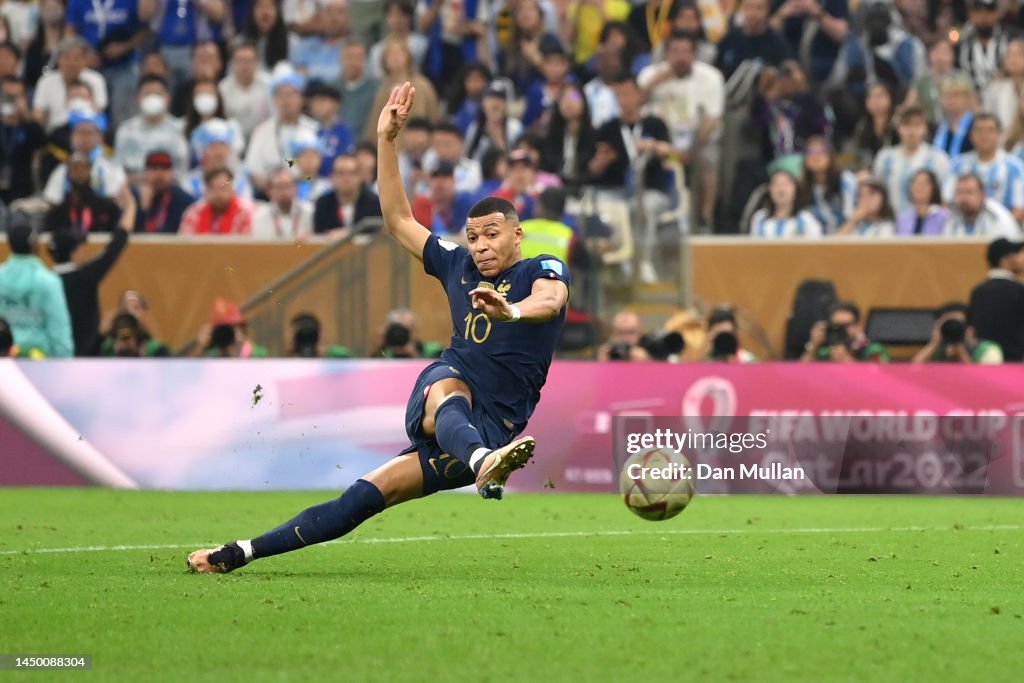
Kylian Mbappé scoring his second goal during the FIFA World Cup Qatar 2022 Final — Credit: Dan Mullan / Getty Image
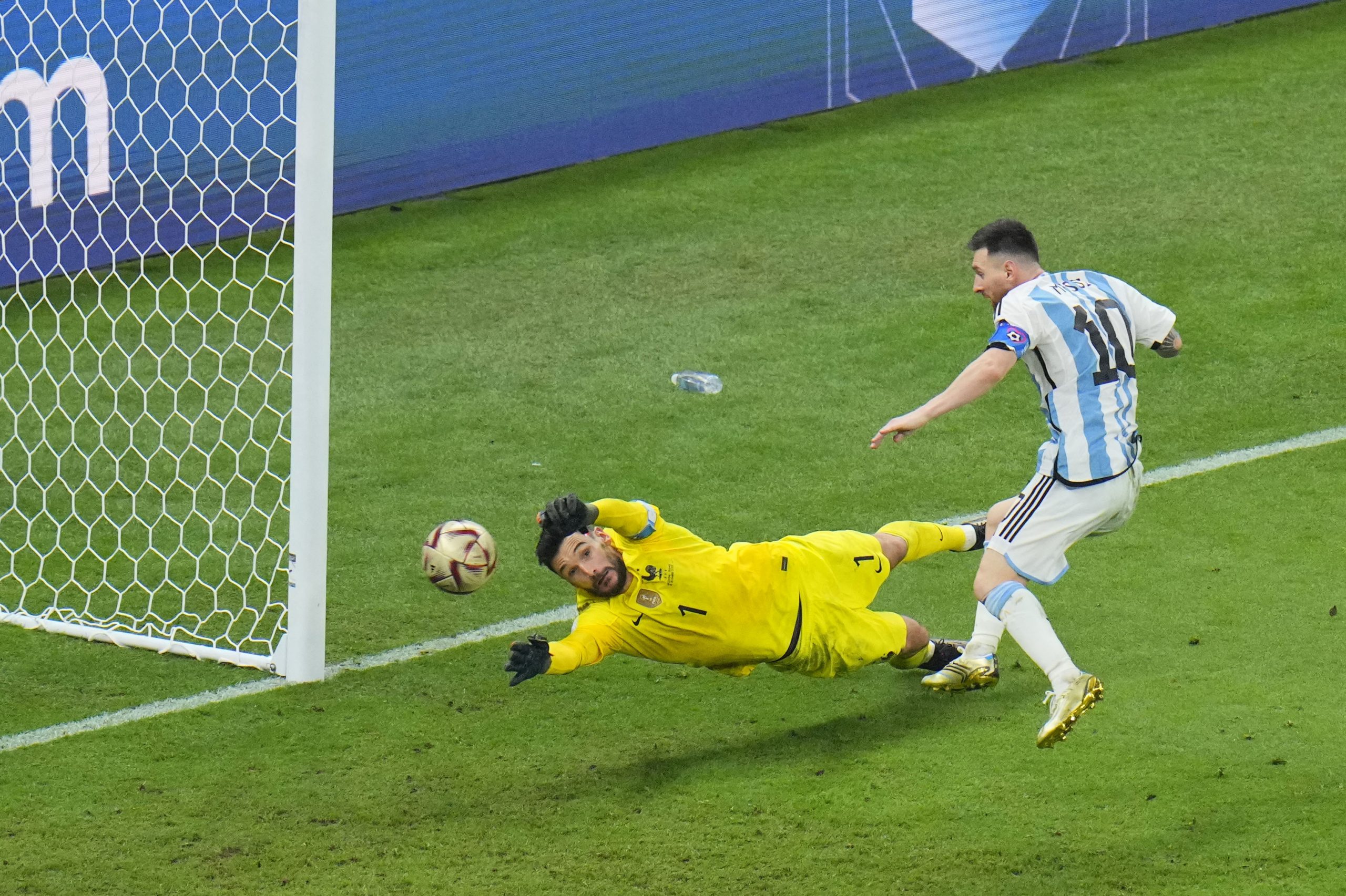
Lionel Messi scoring in overtime during the FIFA World Cup Qatar 2022 Final — Credit: Getty Images

Argentina players celebrate after scoring final PK during the FIFA World Cup Qatar 2022 Final — Credit: Getty Images

Argentina players celebrate with the FIFA World Cup trophy after the final in Qatar 2022 — Credit: Getty Images
Firsts in the tournament
- First World Cup in the Middle East and Arab world.
- First World Cup held in November–December.
- First time a host nation lost its opening match (Qatar lost 2–0 to Ecuador).
- First African and Arab team to reach the semifinals (Morocco).
- First World Cup with female referees (Stéphanie Frappart, Salima Mukansanga, and Yoshimi Yamashita).
- First use of semi-automated offside technology (AI-assisted system introduced).
- First “compact” World Cup (all eight stadiums were within about a 34-mile radius).
- First World Cup claimed to be carbon-neutral.
- First World Cup with strict alcohol restrictions in stadium.
Relevant Players
- Lionel Messi (Argentina) – Tournament’s standout star, led Argentina to the title and won the Golden Ball.
- Kylian Mbappé (France) – Top scorer (Golden Boot) with 8 goals, including a hat-trick in the final.
- Luka Modrić (Croatia) – Key leader in Croatia’s run to the semifinals, continuing his elite midfield performances.
- Achraf Hakimi (Morocco) – Crucial in Morocco’s historic semifinal run, scored the decisive penalty vs Spain.
- Jude Bellingham (England) – Breakout young star, dominant midfield displays and a goal vs Iran.
- Cody Gakpo (Netherlands) – One of the tournament’s breakout attackers with three goals in the group stage.
Three nations, 48 dreams, one champion, and billions will watch…but at what cost?
In 2026, the World Cup explodes beyond anything we’ve ever known, spanning nations, shattering tradition, and pushing the game to a scale never seen before. Forty-eight teams will chase a single trophy, but only one will lift it, while the rest will wither under the weight of expectation, pressure, and history itself. This will be more than a tournament; it will test whether the beautiful game can withstand the forces of expansion, money, and politics. And when it’s over, one team and a handful of players will rise as legends on the world stage.
 Bienvenue à la Coupe du Monde 2026—trois nations, un seul jeu, un seul monde.

Bienvenidos al Mundial 2026—tres naciones, un solo juego, un solo mundo.
Welcome to the 2026 World Cup—three nations, one game, one world.

Recommended for you