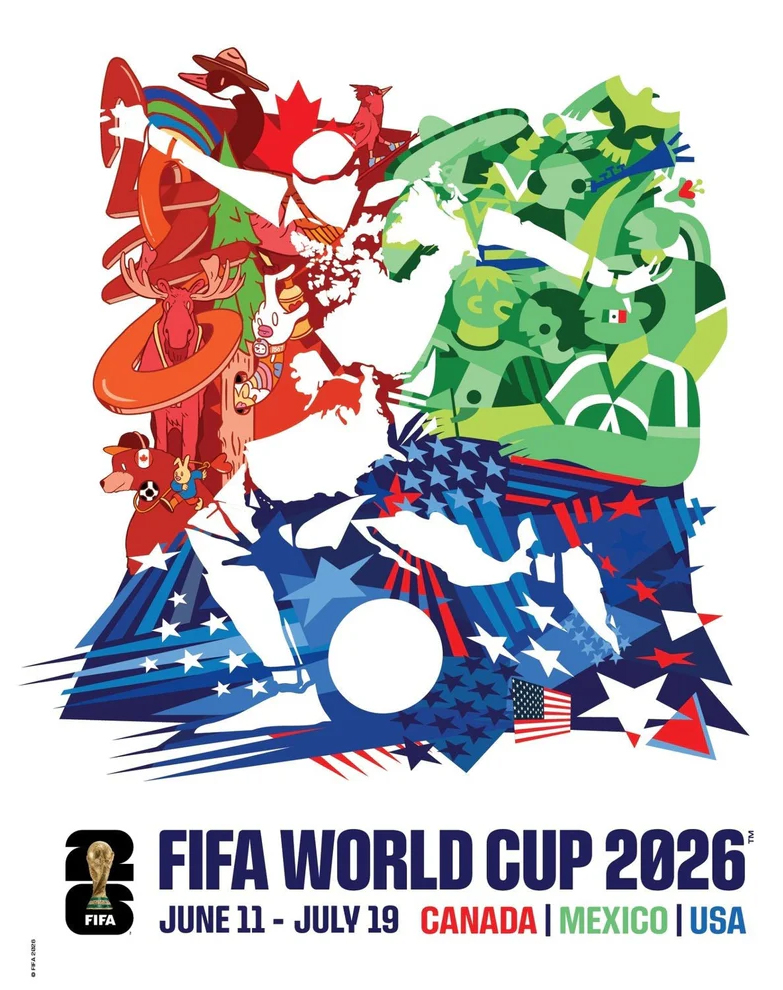
Official FIFA World Cup 2026™ poster image. Copyright © FIFA. All rights reserved.
This is the last of the weekly series of World Cup histories. This journey has been one of reminiscing from watching all World Cup since 1970, of reflection, and of discovery as well. What follows is a different kind of report where I will again describe how the 2026 World Cup was awarded and then dive into a set of lists of past winners, changes in tactics, and attendance and revenue figures since 1930. Then I’ll do a review of qualifying for the 2026 World Cup, group configurations, favorites, players to watch, firsts for this tournament, and some final thoughts.
The World Cup has now lasted almost 100 years, suffered its suspension for 12 years due to a global war, spanned four continents (the Americas, Africa, Asia, and Europe), and became a cultural and sporting phenomenon. From its humble beginnings in Montevideo, Uruguay, in 1930, where all the games we held in one city with three venues and 13 teams participated (some of which had to be coaxed) with no qualifying required, to the now three-country tournament (Canada, Mexico, and the USA) with 48 teams who will play in 16 cities and 16 stadiums.
Even though there were no scandals in the bidding process, FIFA itself had been consumed in controversy after 14 senior officials were indicted and FIFA’s president Sepp Blatter resigned. The charges included racketeering, wire fraud, money laundering, and bribery. Their indictments and resignations did drive necessary reforms in transparency and decision making. However, a detailed investigation on the bidding process for the 2018 (Russia) and 2022 (Qatar) World Cups developed by Michael J. Garcia, a former U.S. federal prosecutor, at the request of FIFA, was initially not released, causing Mr. Garcia to strongly condemn the organization’s actions. Eventually it was leaked by the German newspaper Bild and while no clear-cut smoking gun was found in terms of bribes for those two World Cups, it further crated more suspicion of FIFA as a closed-wall center of power that would never reveal its inner workings.
The bidding process had little controversy this time around. Neither Europe (UEFA) or Asia could bid given that they would host the next two World Cups (Russia in 2018 and Qatar in 2022). This left CONCACAF (North America, Central America, the Caribbean), Africa (CAF), South America (CONMEBOL), or Oceania (OFC) as possible bidders. Two bids were received: a joint CONCACAF one from Canada. Mexico, and the USA, and another one from CAF (Africa) member Morocco. The vote was overwhelmingly in favor of the CONCACAF bid. Out of 202 nations voting, 134 voted for the three-country bid, 65 for Morocco, and 3 abstained.
Past Champions, Attendance, and Revenues
Eight nations have won the tournament, all of them from either Europe or South America. Some of them have won multiple times, and others just once, but all of them achieved immortality the moment that whistle blew to declare a new champion.
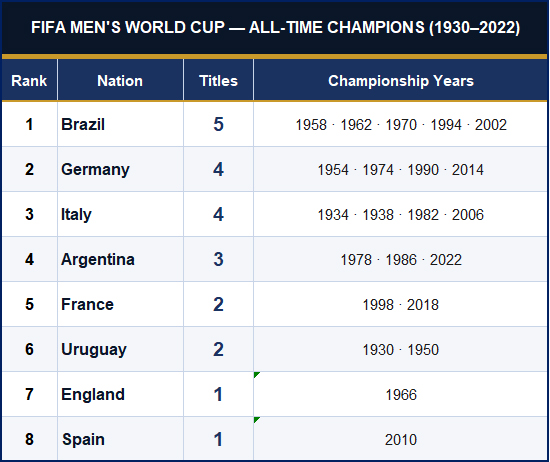
Table courtesy of Jose F Guerra
The tactical evolution has also been significant in the last 96 years. From open chaos to high pressing/transitioning/hybrid systems. For those that enjoy tactics, here’s a table that highlights at a high-level how the game has evolved through the lifespan of the World Cup competition.
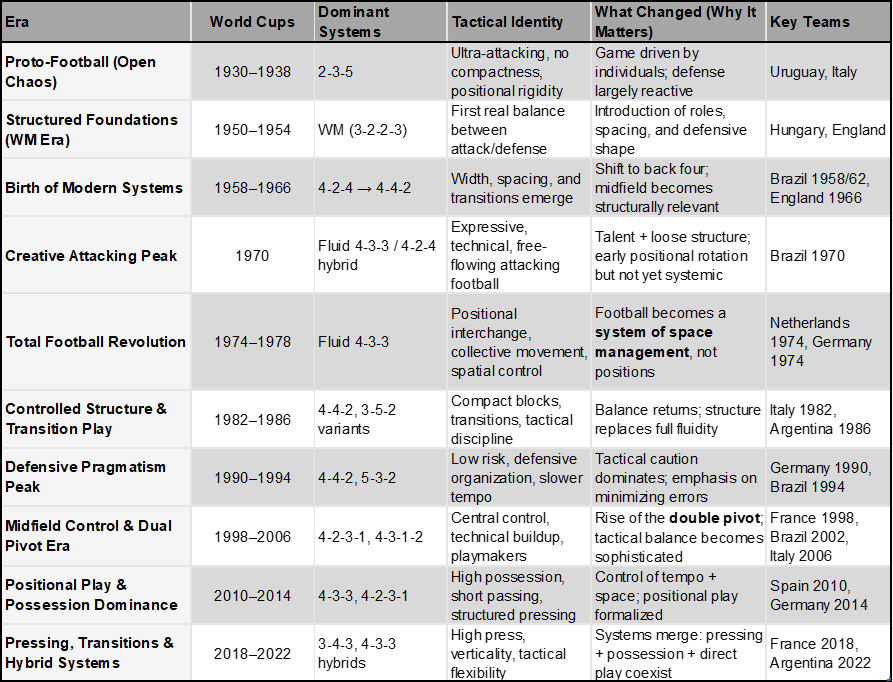
Table courtesy of Jose F Guerra
Attendance steadily increased through 1994 when the USA hosted it for the first time, setting a still standing record number of 3,587,000 fans over 52 games. Global viewers have grown from 600 million in 1986 to 39.6 billion in 2022, an astounding 6500% growth. Revenue figures for FIFA are not available until 1998, but starting in that competition, they grew by double-digit percentages, except 2010 where it grew by an incredible 187%.
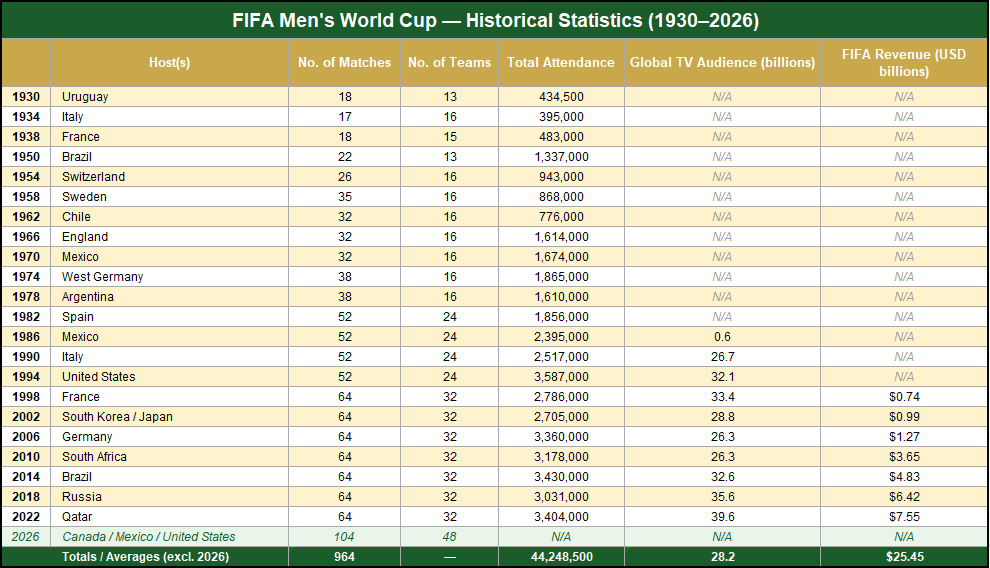
Table courtesy of Jose F Guerra
Qualifying
Of the 48 teams participating, 45 had to qualify through grueling rounds of matches among 206 nations. As before, each soccer confederation managed qualifying within its region, with the following team allocation:
- Asia (AFC): 8 or 9 places*
- Africa (CAF): 9 or 10 places*
- North America, Central America, and Caribbean (CONCACAF): 3 or 5 places* (in addition to the three hosts)
- South America (CONMEBOL): 6 or 7 places*
- Oceania (OFC): 1 or 2 places*
- Europe (UEFA): 16 places
*The additional slot for each of these confederations would be determined through Inter-confederation playoffs
Similar tiebreakers were used as in 2022:

Table courtesy of Jose F Guerra
*Used for playoff or knockout stages in qualifying within their regions.
**Fair play points were deducted according to the following hierarchy:
- First yellow card: minus 1 point
- Indirect red card (second yellow card): minus 3 points
- Direct red card: minus 4 points
- Yellow card and direct red card: minus 5 points
***No drawing of lots was required to determine which nations qualified within their federations.
The final list of participants is as follows:
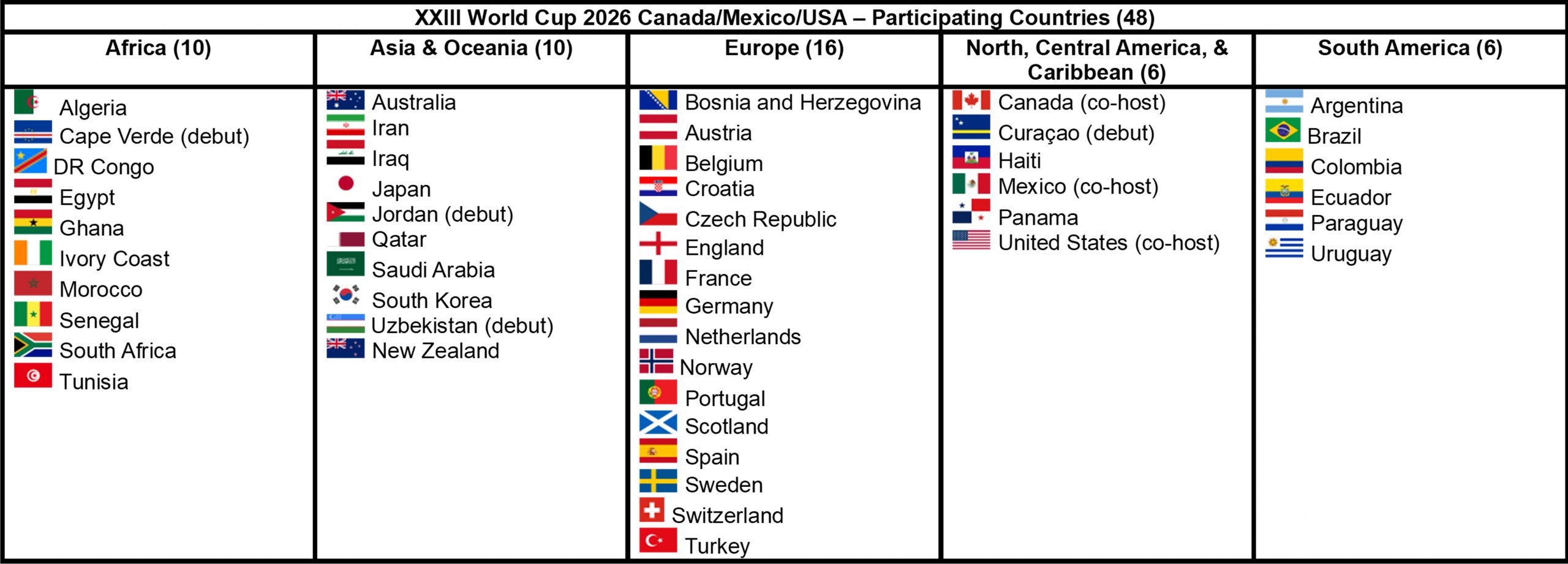
Table courtesy of Jose F Guerra
Four teams will make their debut: Cape Verde from CAF (Africa), Jordan and Uzbekistan from AFC (Asia), and Curacao from CONCACAF (the Caribbean).
Italy, Nigeria, and Chile, all regular participants in previous World Cups, failed to qualify. For Italy, this will be the third straight World Cup they did not qualify which coupled with their two previous appearances where they didn’t get out of the group stage, points to some serious issues within Italian “calcio” (Italian word for soccer). Nigeria is a typically strong African team, and Chile was two-time Copa America Champion in 2015 and 2016.
Other surprising teams that did not qualify were Denmark, Poland, Cameroon, and Peru, all who qualified for the 2022 World Cup. This was especially painful for these proud soccer nations given that the field had been expanded from 32 to 48 teams.
Venues and Group Configuration
The tournament will be held across three countries, in 16 cities, and 16 stadiums. No new stadiums were built as the region already had a richness of facilities that most confederations do not have. These consisted mostly of NFL stadiums (USA), MLS/Liga MX stadiums, and multi-use venues. Many were already huge and modern, such as SoFi Stadium (Los Angeles, opened 2020) and Mercedes-Benz Stadium (Atlanta, 2017). However, many had to undergo significant modifications in the form of upgrades or changes from artificial turf to natural grass. Of the 16 stadiums, 11 required replacing its artificial turf to natural grass.
The draw was again a gymnastics exercise of the three host teams (Canada, Mexico, USA) being seeded (regardless of their FIFA ranking), nine additional FIFA ranked teams being seeded (Spain, Argentina, France, England, Brazil, Portugal, Netherlands, Belgium, Germany), and the rest of the 36 teams split up in pots such that two teams from the same confederation could not be placed in the same group, with the exception of UEFA for which there had to be at least one but no more than two teams in each group. FIFA also announced that, “in the interest of ensuring competitive balance”, two separate pathways to the semifinals (sides of the knockout bracket) were established. Based on this, the teams ranked first (Spain) and second (Argentina) in the ranking were randomly drawn into groups in opposite pathways, as were the teams ranked third (France) and fourth (England). Therefore, should these pairs of teams win their groups, they will be unable to meet until the final, while all four will be unable to meet until the semifinals.
The final group configurations were as follows:


Tables courtesy of Jose F Guerra
As of this writing, the four main favorites (France, Spain, Argentina, England) stand out because of a combination of recent success, squad depth, tactical balance, and consistent performance at major tournaments. France has reached two straight finals and still possess one of the deepest squads in the world, giving them both experience and elite quality across multiple positions. Spain comes in with a modern, possession-based system and a strong blend of youth and peak-age talent that makes them extremely balanced. Argentina carries the confidence and experience of being the defending champions, which historically gives teams a psychological edge in tight knockout matches. England round out this top tier because of their immense attacking talent and depth, even if questions about tournament execution remain.
However, there are questions about match fitness for key stars from France and Spain. If they are not 100% ready, this could complicate things for them. Argentina has an aging core and questions remain as to whether Messi can go the entire tournament without suffering fatigue or injury (that would be eight games for 90 minutes or more if they go to overtime in the knockout stages and reach the final). England have talent, but they continue to underperform.
Four other teams (Brazil, Netherlands, Portugal, Germany) are still highly dangerous but come with noticeable flaws that prevent them from being clear favorites. Brazil still has individual talent but lack the dominance and cohesion of past generations, making them less feared than before. The Netherlands are consistently organized and difficult to beat, though they sometimes lack the superstar firepower needed to win the biggest matches. Portugal has a deep pool of talent and attacking options, but tactical inconsistency has been an issue in recent tournaments. Germany, while historically one of the strongest teams, have been unpredictable in recent years, showing flashes of brilliance but also vulnerability that makes them less reliable than the top four.
Brazil is also dealing with match fitness issues, especially with Neymar whose injury a few weeks ago is still shrouded in mystery even if he did make the trip with the team. The Netherlands may not have any match fitness issues, but they remain an enigma given their tendency to not quite make it over the hump. Germany have done a phenomenal job turning over a roster that had become old, predictable, and unimaginative. However, now the question will be whether that combination of large turnover with young and exciting talent mixed in with some veterans can once again produce championship caliber performance. Finally, Portugal, the perennial underperformers will be looking to make an extra effort to finally give their star player, Ronaldo, his World Cup championship. But will it be enough?
And what about the hosts?
The three have real, but limited, chances, and none are considered top-tier title contenders going into 2026. Historically, hosts tend to outperform expectations thanks to crowd support, familiarity with venues, and less travel, which gives them a meaningful edge in the group stage and early knockouts. All three hosts were placed in favorable positions in the draw (Groups A, B, and D), which should help them advance to the round of 32, especially since eight best third place teams will advance along with the top two teams in each group. But after that, should they advance, it will depend on how the bracket lines up.
Realistically, their true title chances are relatively low compared to the elite teams. The United States has the strongest roster of the three and could realistically reach the quarterfinals with the right draw, but they are not viewed as a top contender. Mexico benefits from massive home support and World Cup experience but has struggled to break past the Round of 16 historically. Canada is the least experienced at this level and would likely need a favorable path to go deep. Overall, the hosts are best viewed as “dangerous outsiders” rather than favorites, with a realistic ceiling of a quarterfinal or semifinal run if everything goes right.
Who to Watch and Why
Every tournament has a player or two that stands out. Every tournament also has a player or two who disappoints. It’s impossible to know which ones will be the standouts and the disappointments, but we do know that these players will be ones to watch:
- Kylian Mbappé (France) – Forward: Explosive pace, elite finishing, and proven ability to dominate World Cup matches make him the most decisive attacking player in the tournament.
- Lamine Yamal (Spain) – Winger: Creative, unpredictable dribbler with elite vision who could emerge as the breakout young star driving Spain’s attack.
- Lionel Messi (Argentina) – Forward/Playmaker: Master playmaker with unmatched vision and experience, capable of controlling games and delivering in high-pressure moments.
- Jude Bellingham (England) – Midfielder: Complete, box‑to‑box presence who scores, creates, and dictates tempo, making him central to England’s success.
- Vinícius Jr. (Brazil) – Winger: Dynamic 1v1 attacker with pace and flair who carries Brazil’s offensive threat in a new generation.
- Erling Haaland (Norway) – Striker: Dominant physical forward and elite finisher who can turn limited chances into goals consistently.
- Bruno Fernandes (Portugal) – Attacking Midfielder: Creative engine who orchestrates play, creates chances, and contributes goals from midfield.
- Federico Valverde (Uruguay) – Midfielder: High‑energy, versatile player who impacts both attack and defense and drives Uruguay’s overall performance.
There will also be many young players who will be making their debut, and which may make their mark. Among them are:
- Jamal Musiala (Germany) – Attacking Midfielder: Elite dribbler and creative force who can unlock defenses and is stepping into his first real World Cup spotlight as Germany’s main attacking engine.
- Florian Wirtz (Germany) – Attacking Midfielder: High-level playmaker with vision and goal threat, making his World Cup debut after missing the last tournament and now central to Germany’s offense.
- Endrick (Brazil) – Striker: Natural goalscorer with huge potential and the responsibility of leading Brazil’s new generation in his first World Cup appearance.
- Xavi Simons (Netherlands) – Attacking Midfielder/Winger: Dynamic, technically gifted attacker who thrives between lines and is expected to have his first major World Cup impact.
- Benjamin Šeško (Slovenia) – Striker: Tall, fast forward with a rare mix of physicality and finishing ability, making his World Cup debut with breakout potential.
- Folarin Balogun (USA) – Striker: Clinical finisher and primary goal threat for the U.S., making his first World Cup appearance after emerging as the team’s starting No. 9.
- Ismaël Koné (Canada) – Midfielder: Energetic box‑to‑box player who links defense and attack, making his World Cup debut as a key piece of Canada’s midfield.
- Gilberto Mora (Mexico) – Attacking Midfielder/Winger: One of the youngest players in the tournament, bringing creativity and unpredictability as a bold inclusion in his first World Cup.
Firsts – Tournament and Rules
There will be many “firsts” in this World Cup, including rule changes.
Tournament
- First World Cup with 48 teams, 104 total matches
- First World Cup requiring eight matches to win
- First World Cup hosted by three countries (USA, Canada, Mexico)
- First country to host three World Cups (Mexico)
- First World Cup for Uzbekistan, Jordan, Curaçao, Cape Verde
- Record number of players (1200+)
- First to use advanced AI-powered semi-automated real time offside system
- First to use referee body cameras
- First to provide AI analytics tools for teams
- First World Cup final with a halftime show (not something that has been received positively)
- First with multiple mascots (one per host)
- First using a “debut patch” for players
Rules
- Anti time‑wasting rules
- 5-second countdown for throw‑ins → If time expires, possession goes to the opponent
- 5-second countdown for goal kicks → If delayed, opponent is awarded a corner kick
- Goalkeeper time limit (≈8 seconds holding the ball) → Violation results in a corner kick
- Substitutions
- Players must leave the field within 10 seconds
- Must exit at the nearest sideline (if delayed, replacement must wait and tam temporarily plays with fewer players)
- Injury / medical rules
- Player receiving treatment must leave the field and stay off for about 1 minute before returning
- Exceptions: serious injuries, goalkeepers, head injuries
- VAR (Video Assistant Referee) expansion can now review and intervene in more situations:
- Incorrect second yellow cards (leading to red)
- Mistaken identity (wrong player penalized)
- Wrongly awarded corner kicks
- Fouls before set‑piece restarts
- VAR timing / intervention changes
- VAR can now Intervene before restarts and set pieces and review actions earlier in the sequence of play
- Player conduct rules
- Covering mouth during confrontations can result in a red card
- Walking off the field to protest decisions can result in red card and possible team forfeit
Final Word
Despite the very challenging, chaotic, uncertain, and even violent phase that the world is experiencing, starting June 11th when the ball gets rolling in the Estadio Azteca in Mexico City in the opening match between Mexico and South Africa, and continuing through July 19th, when the two finalists will face off in at MetLife stadium in East Rutherford, New Jersey, soccer (or football or fútbol or calcio or fußball or sokker or sakkā or chukgu or fotboll or however it is said in any of the 48 participating countries) will be on billions of people’s minds.
The world will continue to revolve around its axis and move forward on its trip around the sun. But for the over 1200 players, 48 coaches and their assistants, trainers, medical staff, officials, thousands of volunteers, and fans around the world, this competition will be their world, even if it’s for only 39 days. Glory and immortality will be given to only one nation. And in that instance, the soccer world will celebrate the sporting heroics, the awe-inspiring athleticism, the drama, the shocks, the memorable games and plays, but above all, the celebration of what is indeed the beautiful game.
Three nations will see two finalists arrive on July 19th and one will win glory.
Thank you all who have given me the privilege of providing even if it was just a glimpse of how the World Cup has evolved for close to 100 years. For me it has been a welcome distraction from all the noise around us. IT has also been a lot of fun to uncover parts of the history what were completely unknown to me as I did research for each weekly article. I for one will be submerging in what will surely be another memorable World Cup.

Recommended for you