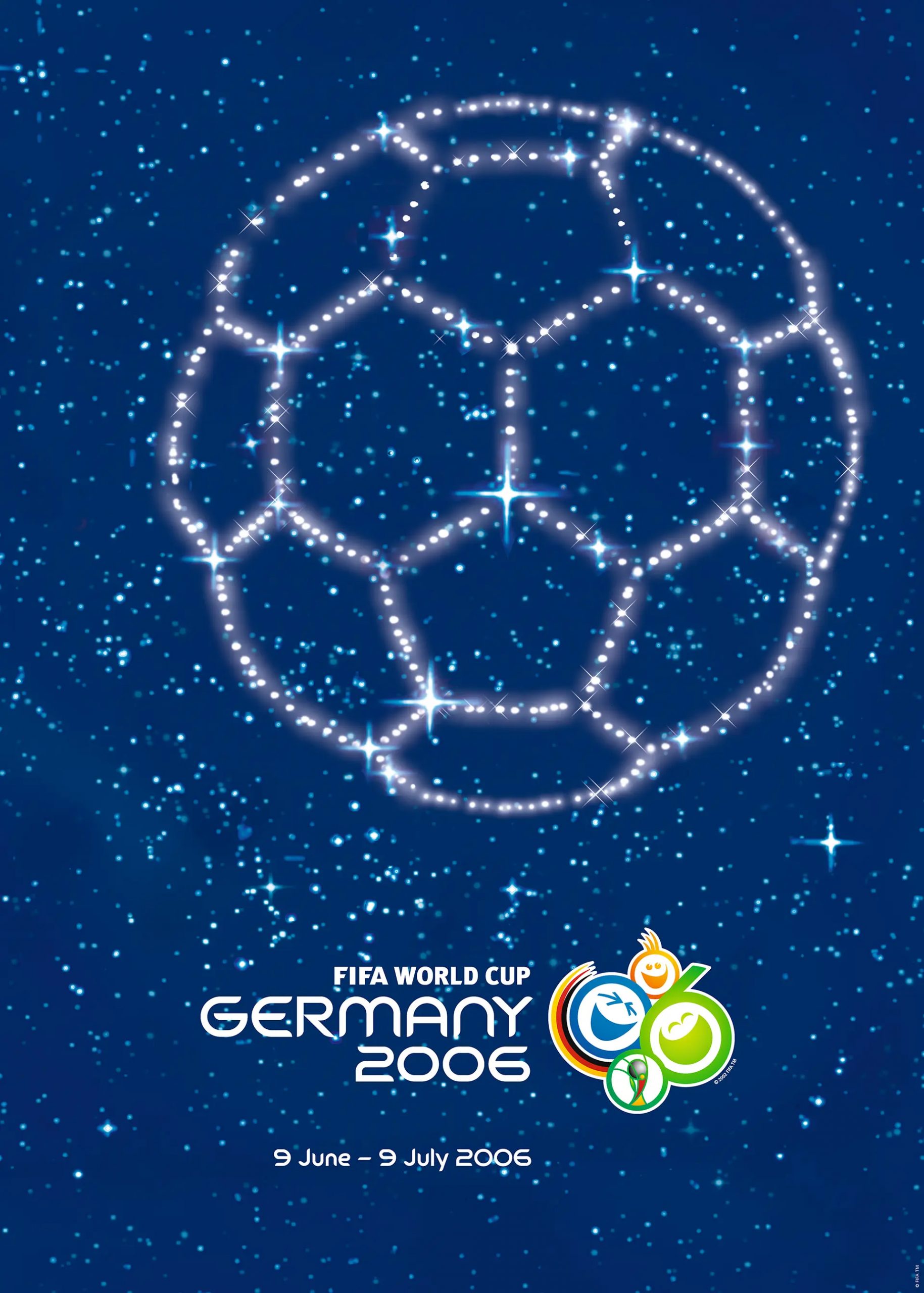
© FIFA. Official poster for the FIFA World Cup Germany 2006™
The World Cup was returning to a country that had been the focal point of a 20th century global conflict the likes of which the world had never seen. Also, the tragedy of the Summer Olympics of Munich 1972 had not been completely erased despite the very successful and thrilling 1974 World Cup hosted in West Germany. The newly unified Germany was determined to once and for all erase the stigma and present itself as open, welcoming, and modern, consciously moving away from older stereotypes of coldness or rigidity. The emphasis on friendship, hospitality, and unity, not dominance or nationalism, was evident in the memory of fans as well as the images broadcast around the world. Scenes of streets full of international fans celebrating together, public viewing becoming a global cultural phenomenon, and a relaxed, joyful atmosphere (even amid intense matches), would become the image that this World Cup would leave.
But as with every tournament, there was activity behind the scenes to land the event that raised eyebrows. Ten years later, an investigation was opened amid strong indications of bribery. The accusations surrounding the 2006 World Cup center on claims that Germany improperly influenced the 2000 FIFA vote that awarded it hosting rights. In 2016, investigations revealed that €6.7 million, supplied by Adidas CEO Robert Louis‑Dreyfus, was sent through a slush fund allegedly used to secure votes from FIFA Executive Committee members. German soccer officials denied direct bribery, arguing the money was intended for a failed cultural program, but records showed it was later reimbursed to Adidas via FIFA payments. While no definitive proof of vote‑buying was legally established, the scandal damaged Germany’s image, led to resignations and inquiries, and became part of broader revelations about systemic corruption within FIFA.
This may explain the repeated votes to decide hosting rights. Germany, South Africa, England and Morocco submitted bids (with Brazil withdrawing three days before the official bidding process). Three rounds of voting were required, each round eliminating the nation with the fewest votes. The first two rounds were held on 6 July 2000, and the final round was held on 7 July 2000, which Germany won over South Africa by a vote of 12 to 11. One delegate, Charlie Dempsey, President of the Oceania Football Confederation, was considered a swing vote but he abstained citing tremendous pressure. This gave the win to Germany by one vote.
This situation was very unfortunate since Germany had the transportation infrastructure, the hotel capacity, the stadiums, the great soccer tradition of its national teams (who had won three world championships, three European championships, and six club level European championships), and a superb organizational culture.
The bribery rumors did play a part in South Africa winning the 2010 World Cup hosting rights since there was a feeling that they had tried to play by the rules and were denied because of the scandals. FIFA to this day denies this was one of the reasons and that they were eventually awarded the 2010 event on their own merits.
Regardless, the 2006 World Cup in Germany would have memorable high-pressure games, world class plays, ugly violent ones, the introduction of a player that would eventually capture the imagination over the span of this career, and the farewell of another legend, albeit in a rather dramatic and sad manner.
The world was about to experience the “Summer Fairy Tale” (Sommermärchen).
Qualifying
For the 2006 World Cup, FIFA decided that the title holders would no longer automatically qualify. This meant that Brazil, the 2002 champion, would need to earn its place in CONMEBOL through regular qualifying rounds. The official reason given was that friendly matches to which previous champions were restricted did not provide sufficient preparation that others played during qualification. This made sense but there was also a suspicion that by making this decision it freed up one additional space to the always contentious continental soccer confederations allocation for World Cup participation.
One hundred ninety-seven teams registered to fight for 31 places, with the host, Germany, automatically qualifying. Three withdrew before playing a single match (Nepal and Guam from Asia, and São Tomé and Príncipe from Africa), leaving 194 to fight for the 31 available spots.
The distribution by confederation for the 2006 FIFA World Cup was:
- Asia (AFC): 4 or 5 places*
- Africa (CAF): 5 places
- North, Central American and Caribbean (CONCACAF): 3 or 4 places*
- South America (CONMEBOL): 4 or 5 places*
- Oceania (OFC): 0 or 1 place(s)*
- Europe (UEFA): 13 places (+ Germany qualified automatically as host nation for a total of 14 places)
UEFA and CAF had guaranteed number of places, whereas the number of qualifiers from other confederations was dependent on play-offs between AFC’s fifth-placed team and CONMEBOL’s fifth-placed team, and between CONCACAF’s fourth-placed team and OFC’s first-placed team.
As before, there was some general standardization of tie breakers but other than total points at the end of qualifying, tiebreakers were still decided by rules set by each confederation. In the 2006 qualification cycle, FIFA set only high‑level constraints (points system, number of berths, playoffs) but allowed each confederation to define its own tie‑breaking philosophy.
This produced the following approach for various confederations:
- UEFA, AFC, CONMEBOL, and CONCACAF favored overall statistical performance (goal difference, goals scored) before revisiting head‑to‑
- OFC minimized complexity, resolving ultimate qualification through playoffs, not table math.
- CAF was unique in prioritizing head‑to‑head results immediately after points, even before goal difference, a rule that directly changed qualifiers.
This created some unfair situations. For example, during this qualifying round, Nigeria scored more goals and had better overall goal difference but lost out to Angola because of their head-to-head results (which was the first tiebreaker criteria for CAF instead of goal difference). As a result, Nigeria did not qualify but Angola did despite having less number of total goals scored and worse goal difference compared to Nigeria.
Contrast that with UEFA which had a very comprehensive list of tiebreakers:
- Points
- Goal difference (all matches)
- Goals scored (all matches)
- Points in head‑to‑head matches
- Head‑to‑head goal difference
- Head‑to‑head goals scored
- Fair play record
- Drawing of lots
Since 2006 FIFA has been working towards standardizing qualification tiebreakers in all confederations but there are still differences to this day.
The final list of qualifying teams was:
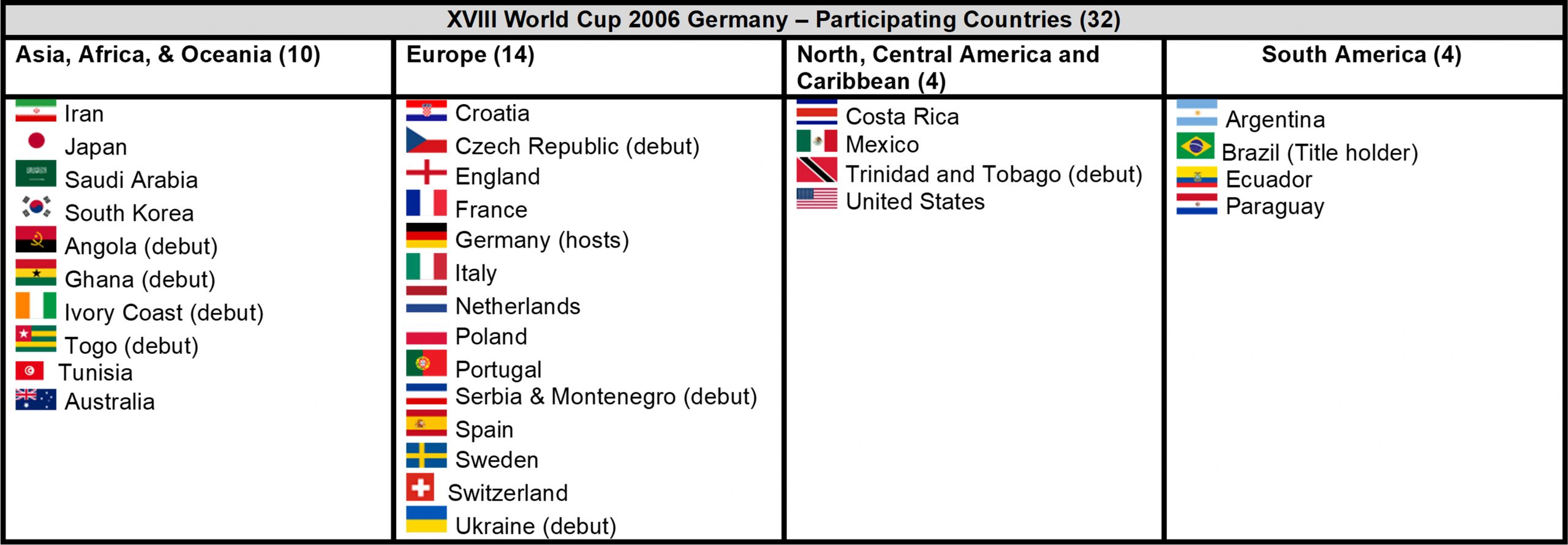
Table courtesy of Jose F Guerra
Eight teams qualified for the first time: Angola (as a result of the unfair tiebreaker with Nigeria), Ghana, Togo, Czech Republic, Serbia & Montenegro, Ukraine, and Trinidad & Tobago. This was a record.
In addition to Nigeria’s unfortunate elimination during qualifying, Cameroon, another one of Africa’s most consistent and successful teams. Greece, the 2004 European champions also did not qualify. Two-time world champion Uruguay finished fifth in CONMEBOL qualifying and was forced into a playoff against Australia who eliminated them in penalty kicks after each one of them winning their home game in a two-legged playoff with identical scores of 1-0.
The Tournament
Germany used 12 stadiums in 12 cities, spread across the country, to host the 2006 World Cup. However, the Olympiastadion in Munich with a capacity of 69,250, the venue for the 1974 final match, was not used for the tournament because it was already conspired obsolete. The largest stadium was the Olympiastadion in Berlin with a capacity of 72,000 and the smallest one the Frankenstadion in Nuremberg, Bavaria with a capacity of 41,000.
The draw for the competition to determine the group stage was held in Leipzig on 9 December 2005. As before, eight seeds were determined beforehand, one for each group. Germany, as the host, was seeded in Group A. The remaining seven seeds were awarded based on various FIFA ranking formulas which included overall ranking as well as performances in the previous two world cups. The first eight teams ranked based on these criteria were Brazil, England, Spain, Germany, Mexico, France, Italy, and Argentina. Germany, of course, was already seeded regardless of the position in which they may have been ranked.
An interesting detail is that had the host country, in this case, Germany, not been in the top eight ranked teams, the next team down would have been the United States who was ranked ninth at the time. This would have made them a seed but as luck would have it, Germany was in the top eight and also happened to be the host.
The group stage was set with the following configuration.

 Tables courtesy of Jose F Guerra
Ever since the 1970 World Cup when the first “Group of Death” was created with England, Brazil, Czechoslovakia, and Rumania in it, ever competition since then, has tried to promote a “Group of Death” within its tournament. The reality is that few have actually been that. However, in 2006, Group C was a definite Group of Death with two heavyweights in Argentina and The Netherlands along with Africa’s strongest team at the time, Ivory Coast.
Brazil was the clear No. 1 favorite as defending champions (2002), star studded squad (Ronaldinho, Ronaldo, Kaká, and Cafu). Germany was among the top four favorites due to their home boost, coached by legendary player Jürgen Klinsmann, and a strong core from 2002 that took them to the final. Argentina was also one of the favorites because of an elite core group of players with Riquelme, Crespo, and Ayala, while having strong tactical coherence. Surprisingly, England was also one of the favorites because of what was then considered the golden generation of Beckham, Lampard, Rooney, and Gerrard, in addition to having had a strong qualifying campaign. Dark horses in this World Cup were Italy (defensive pedigree, tournament know how, and ability to perform strongly once out of the group stage), France (core from 1998 champions with Zinedine Zidane and Thierry Henry), Spain (talent rich, strong qualifying record, and a core group of players that would soon conquer the world), and The Netherlands (high quality squad, deep talent pool).
In Group A, hosts Germany set the tournament’s tone by defeating Costa Rica 4–2 in the opening match and never looked back, winning all three games including a 3–0 victory over Ecuador. Ecuador surprised many by qualifying second, helped by an early 2–0 win against Poland. Poland exited but salvaged pride with a dramatic 2–1 stoppage‑time win over Costa Rica. The group was straightforward, but Germany’s attacking confidence here laid the foundation for their deep run.
England qualified unbeaten in Group B but was unconvincing, edging Paraguay 1–0 and drawing 2–2 with Sweden after leading late. Sweden’s calm persistence paid off, particularly that equalizer which secured second place. Trinidad & Tobago, tournament debutants, stole hearts by earning a historic 0–0 draw against Sweden through extraordinary defensive resolve. Paraguay exited despite a 2–0 win over Trinidad in their final match.
Group C, the Group of Death, opened with Argentina’s explosive 6–0 win over Serbia & Montenegro, featuring one of the greatest team goals in World Cup history with 25 consecutive passes, stretched across nearly a full minute of possession. The Netherlands beat Serbia 1–0 and Ivory Coast 2–1, while Argentina also defeated Ivory Coast 2–1 to secure qualification early. Ivory Coast beat Serbia 3–2 but still went out, arguably one of the tournament’s cruelest eliminations. Argentina and the Netherlands played a cautious 0–0 draw once progression was assured.
Portugal topped Group D with three wins, including a composed 2–0 victory over Iran and a 1–0 win against Angola. Mexico advanced despite inconsistency, sealing qualification with a 0–0 draw versus Angola. Angola impressed on debut, drawing 1–1 with Iran and remaining competitive throughout. Iran exited bottom, unable to convert possession into results.
Early shocks were produced in Group E, one of the tournament’s toughest groups, as the Czech Republic thrashed the USA 3–0 while Italy drew 1–1 with Ghana. Ghana then stunned the Czechs 2–0, dramatically reshaping the standings. Italy ultimately eliminated the Czech Republic with a 2–0 win, sending the world’s then second‑ranked team home early. Ghana defeated the USA 2–1 in the decisive match to advance, marking a historic moment for the African team.
Brazil progressed smoothly in Group F with wins over Croatia (1–0), Australia (2–0), and Japan (4–1), prioritizing control over spectacle. The defining moment came when Australia overturned Japan 3–1, with two late Tim Cahill goals transforming the group into a nail biting final day in that group’s competition. Australia clinched qualification with a dramatic 2–2 draw against Croatia. Japan exited after surrendering their opening‑match advantage.
France staggered through Group G, drawing 0–0 with Switzerland and 1–1 with South Korea, leaving them on the brink. They recovered just in time with a 2–0 victory over Togo to qualify. Switzerland topped the group unbeaten, highlighted by a 2–0 win over Togo and without conceding a goal. South Korea narrowly missed out after losing 2–0 to Switzerland.
The final Group, H, was dominated by Spain, opening with a crushing 4–0 win over Ukraine and finishing with three victories. Ukraine recovered well, beating Saudi Arabia 4–0 and Tunisia 1–0 to take second place. Tunisia and Saudi Arabia exited after a chaotic 2–2 draw that settled nothing decisively. Spain’s perfect record masked defensive issues that would later be exposed.
The knockout stage in the round of 16 opened with Germany beating Sweden 2–0 and Argentina edging Mexico 2–1 after extra time, the latter sealed by a sublime Maxi Rodríguez volley. Italy squeezed past Australia 1–0 via a controversial late penalty, while France eliminated Spain 3–1, marking a resurgence led by Zidane. Brazil dispatched Ghana 3–0, England beat Ecuador 1–0, Portugal overcame the Netherlands 1–0 in the notorious “Battle of Nuremberg” featuring four red cards, and Ukraine advanced by drawing Switzerland 0–0 and winning on penalties (the tournament’s first shootout).
The quarterfinals delivered heavyweight tension as Italy defeated Ukraine 3–0, and France stunned Brazil 1–0, with Thierry Henry’s goal ending the champions’ reign. Germany and Argentina drew 1–1 in a ferocious match decided by penalties, where Jens Lehmann’s note‑assisted saves sent the hosts through. England vs Portugal finished 0–0, but the contest turned when Wayne Rooney was sent off, and Portugal prevailed 3–1 on penalties, deepening English heartbreak.
The most dramatic match of the tournament saw Italy defeat Germany 2–0 after extra time, scoring twice in the dying minutes to silence Dortmund and redefine defensive patience as a winning virtue. The following night, France beat Portugal 1–0, Zidane converting a penalty after a controversial handball decision against Ricardo Carvalho. These results set up a final between Italy and France, symbolizing composure versus artistry, while Germany and Portugal were left to contest third place, which the hosts won 3-1. Across both semifinals, the margins were razor‑thin, and discipline, not spectacle, ultimately prevailed.
The Final
So it was that two teams who had not been favorites, Italy and France, found each other in the final on July 9th, 2006. A packed Olympiastadion in Berlin were about to witness one of the dramatic final ever held, not because of the play itself but because of what would happen in overtime between two opposing players.
The final exploded in the early minutes when Zinedine Zidane converted a Panenka penalty in the 7th minute, the ball dropping over the line after striking the crossbar following a foul on Florent Malouda. Italy equalized in the 19th minute, as Marco Materazzi powered in a header from an Andrea Pirlo corner. The match then settled into a tense tactical battle, punctuated in the 62nd minute by Luca Toni heading the ball into the net from a Pirlo free kick, only for the goal to be correctly ruled out for offside. Regulation ended 1–1, with neither side able to seize control.
France came inches from victory in extra time when Zidane’s towering header was tipped onto the crossbar by Gianluigi Buffon, one of the great saves in World Cup final history. Then in minute 110, drama occurred on the pitch. In a seemingly innocuous interaction between Italian defender Marco Materazzi and Zidane after a play on the French side of the pitch, Zidane turned to Materazzi and head-butted him hard on the chest. Zidane claimed that as they were walking away from the French box, the Italian defender insulted the Frenchman’s sister and he reacted without thinking. He received a straight red card. Reduced to ten men and without their captain in his final match, France retreated into damage limitation. Extra time finished with a draw at 1–1, sending the final to penalties.
Italy were flawless in the shootout, scoring all five penalties, while David Trezeguet struck the crossbar, the decisive miss in a 5–3 Italian victory. The triumph delivered Italy’s fourth World Cup title, grounded in defensive discipline, mental resilience, and collective balance rather than attacking dominance. For France, the final became inseparable from Zidane’s tragic exit. For Italy, it confirmed the enduring power of structure and composure. Together, the match came to embody Germany 2006 itself: brilliant, tense, and decided by the finest of margins.
Italy lifted its fourth World Cup trophy, adding to its 1934, 1938, and 1982 triumphs. They were not given much of a chance but once again showed that once they were able to get out of the group stage, they were a dangerous side that knew how to win in knockout stages. But this would be their high-water mark in World Cups. After that they began a precipitous decline that continues to this day.

© FIFA / Getty Images. Italy team lineup photograph prior to the FIFA World Cup Final, Germany 2006.
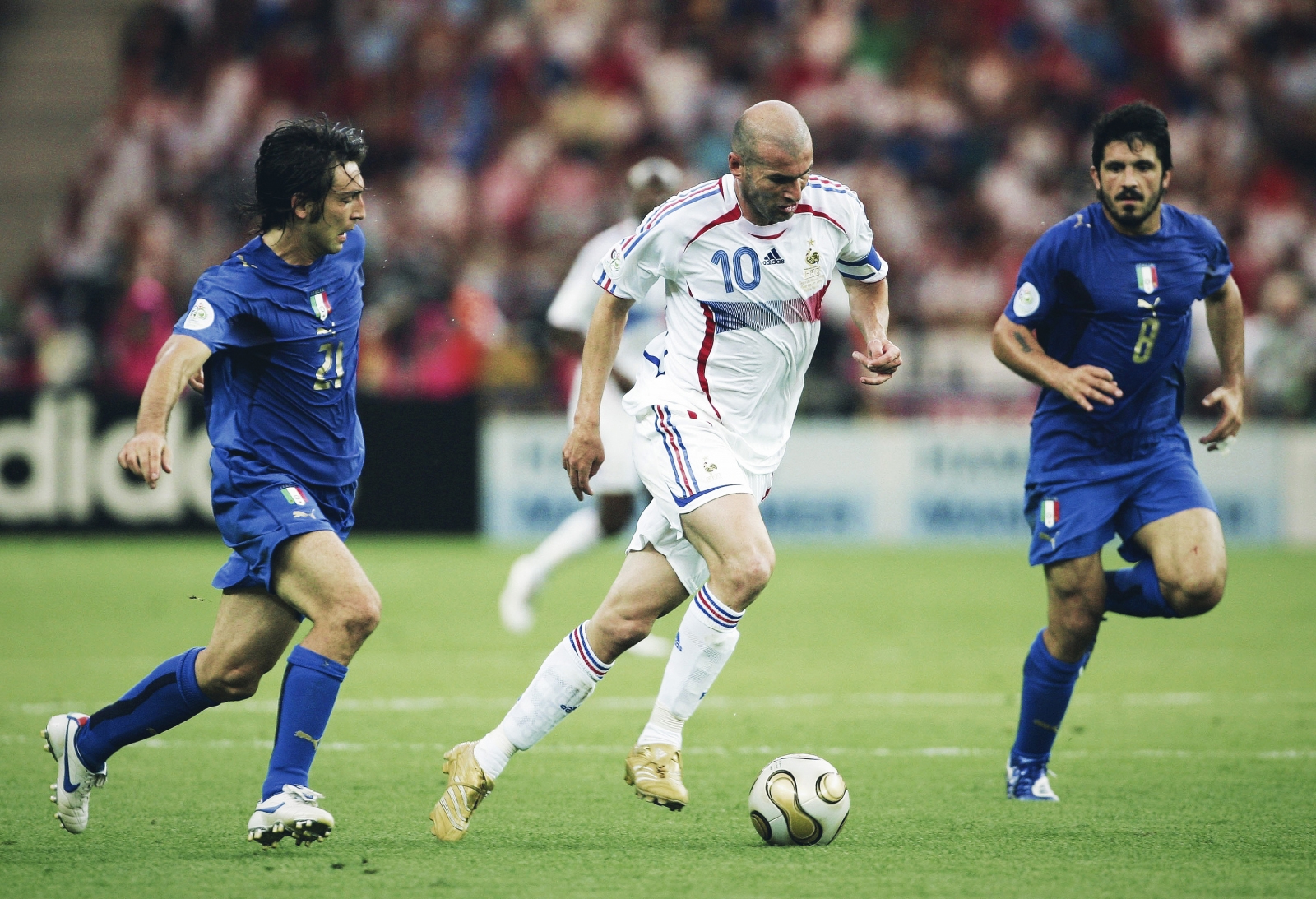
© Getty Images / FIFA. Match action from the FIFA World Cup Final, Italy vs France, Olympiastadion Berlin, 2006.
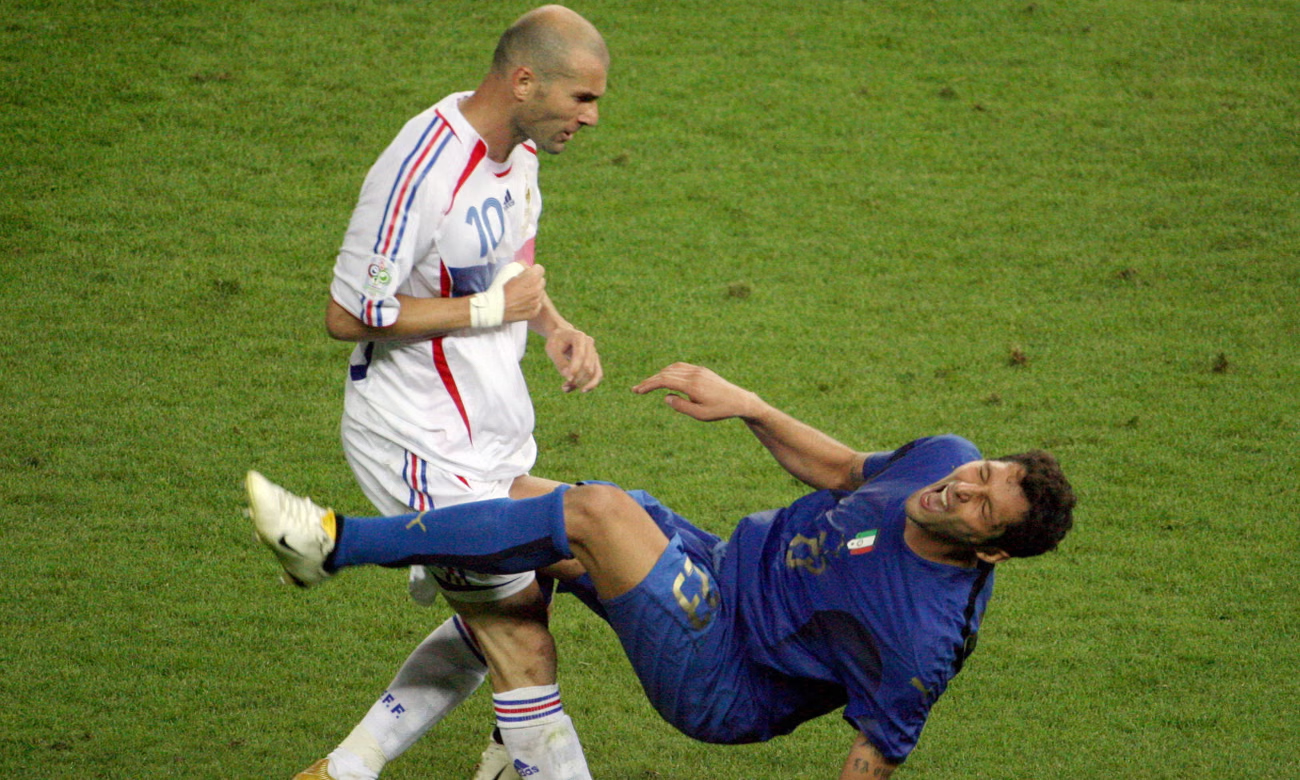
© AP Photo / FIFA. Extra time incident during the FIFA World Cup Final, Italy vs France, Berlin, 9 July 2006.
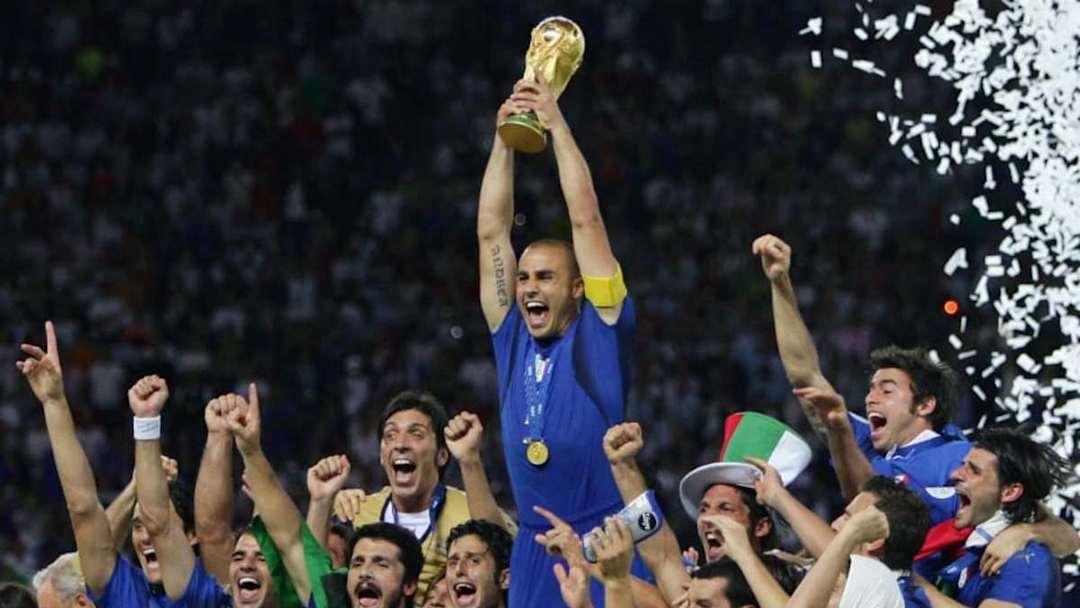
© FIFA / Getty Images. Trophy ceremony following the FIFA World Cup Final, Berlin, 9 July 2006.
Tournament Firsts:
The 2006 World Cup In Germany had many firsts.
- First red card in a World Cup final with Zinedine Zidane’s head-butting of Marco Materazzi in extra time
- First time four African debutants qualified simultaneously (Angola, Ghana, Côte d’Ivoire, and Togo).
- First World Cup held in a reunified Germany including a former East German host city.
- First World Cup where the defending champion had to qualify (Brazil, 2002 champions).
- First World Cup final where both goals were scored by team captains (Zidane for France, Materazzi for Italy).
- First World Cup with electronic referee headsets to communicate with assistants throughout matches.
- First World Cup in which all confederations reached at least the round 16.
- First World Cup where four knockout matches were decided by penalty shootouts
Relevant Players
- Zinedine Zidane (France) – Player of the Tournament, scorer in the final, and participant in one of the most iconic and tragic moments in World Cup history.
- Gianluigi Buffon (Italy) – Tournament‑defining goalkeeper, whose save from Zidane in extra time and overall dominance anchored Italy’s title run.
- Miroslav Klose (Germany) – Golden Boot winner with 5 goals, energizing the host nation and becoming the face of Germany’s attacking revival.
- Deco (Portugal) – Midfield leader of Portugal’s run to fourth place, delivering creativity and control throughout the tournament.
- Ronaldinho (Brazil) – The pre‑tournament global superstar and reigning FIFA World Player of the Year, emblematic of Brazil’s expectations even as the team fell short.
- Didier Drogba (Côte d’Ivoire) – Leader of Africa’s strongest debutant side, whose performances and post‑tournament influence transcended football.
Africa Beckons
Four years from 2006, the tournament would finally land, after multiple attempts by various African countries, in the continent that is considered the cradle of civilization. South Africa would showcase its organizational capabilities, its ongoing modernization, its integration after ending apartheid barely 10 years before, and a coming out party of some sorts after having been shunned by the world precisely because of its now defunct apartheid policies. The world was also about to be treated to a spectacle of red Tiki-Taka, as a nation that had never won the World Cup, would finally get to do so.
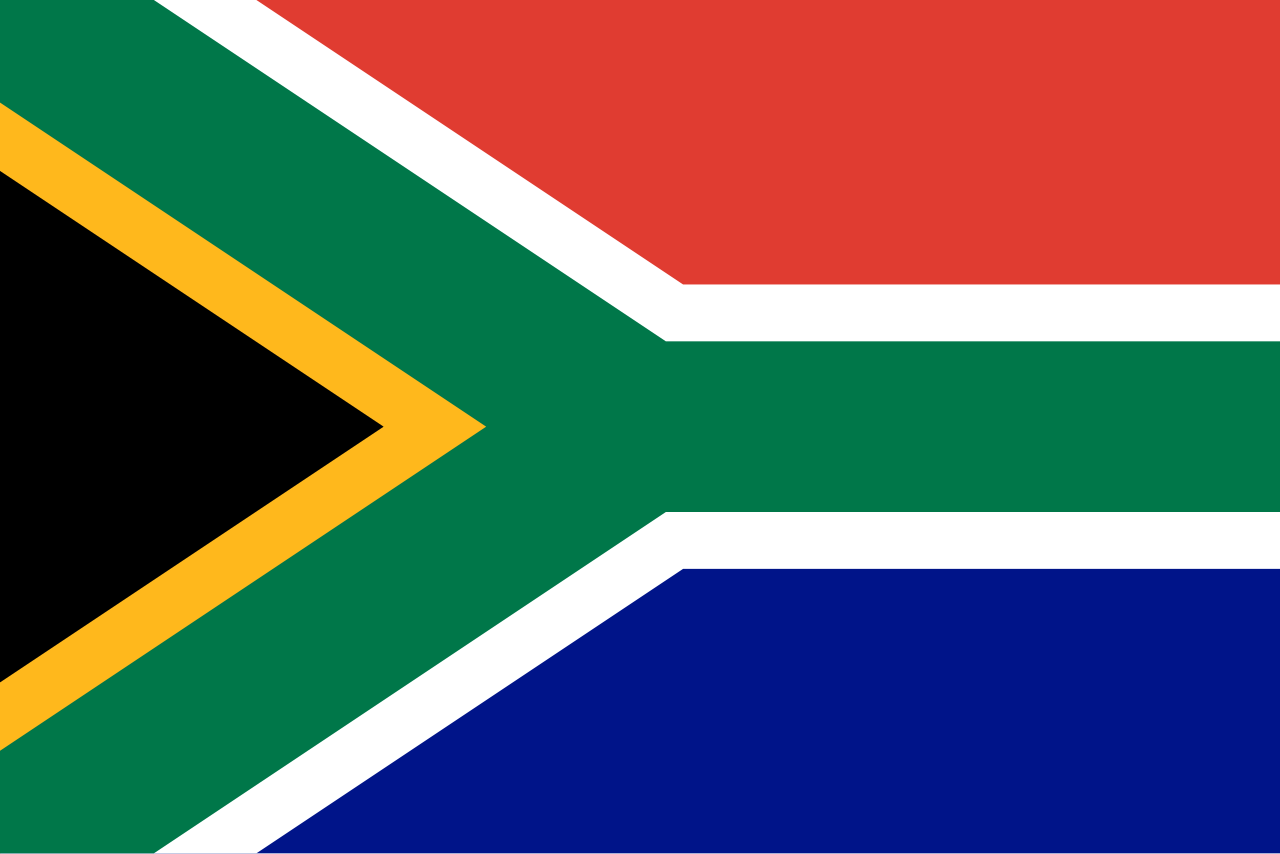 Ons verwelkom die wêreld in Suid-Afrika!

Recommended for you