 What do Argentina, Brazil, England, France, Germany, Italy, and Spain have in common? On the surface, not much. But view them through the lens of soccer history and you get all the champions from previous FIFA men’s World Cups in one tournament, something that had never happened before. Spain, apart from being the defending champion, had just two years before won its second consecutive Euro Cup, making it the first team to ever win three consecutive major tournaments in a row (2008 and 2012 Euro Cup winners, and 2010 World Cup Champions).
The road to Brazil was more straightforward this time around with little to no scandals or rumors of bribery. However, given FIFA’s policy of rotating the competition among continents, it was the Americas’ turn to host the event. So it was a bygone conclusion that it would be held somewhere in that continent, almost surely in South America. Three countries from CONMEBOL (the South America soccer federation) initially announced their candidacy: Argentina, Brazil, and Colombia. The Argentinians and the Colombians withdrew, leaving Brazil as the sole “bidder”.
But there were concerns from Sepp Blatter, the President of FIFA, as to Brazil’s readiness in overall infrastructure and organizational capabilities. He had said that the country did not have any stadiums ready to host the event, especially now that it had been increased to 32 teams. On September 28th, 2006, he met with Brazilian President Lula, and was quoted as saying he wanted the country to prove its capabilities before making a decision, saying “the ball is on Brazil’s court now.” Lula confirmed Blatter’s opinion, declaring: “We don’t have any stadium which is in a condition to host World Cup games. We’re going to have to build at least 12 new stadiums in this country.”
On July 31st, 2007, Brazil’s bid became official, when the Brazilian Football Confederation President, Ricardo Teixeira, delivered personally to FIFA president, Sepp Blatter, a document containing Brazil’s hosting stadiums and other required information concerning plans in improvements for general infrastructure and about finances. Among the reasons Brazil gave that they were ready to host was that they hosted the 1950 World Cup as well as the Copa América six times (1919, 1922, 1949, 1989, 2019, and 2021).
FIFA officially awarded the 2014 World Cup to Brazil on October 30th, 2007. With no rival bidders remaining, the decision was less a competitive vote than a formal endorsement by the Executive Committee which voted unanimously to award the hosting rights to Brazil. The World Cup was back in South America after a 36-year absence, the last one being in 1978 when Argentina both hosted and won the competition.
But the fears of Blatter were well founded, not just because of Brazil’s ability to be ready. A year before the World Cup, Brazilians had grown frustrated and upset at the staggering costs spent on both stadiums and other infrastructure initiatives. During the Confederations Cup, thousands of Brazilians took to the streets to protest the cost overruns while the government neglected schools and hospitals. In January of 2014, Blatter criticized the hosts to a gathering of Swiss reporters saying that he had “…never seen a country that was so far behind in its preparations since I have been in FIFA even though it’s the only host nation which has had so much time, seven years, in which to prepare.”
The Brazilian government admitted to spending $14 billion ($4.2 billion of that on stadiums alone), a cost overrun of at least $3 billion. The tourism minister, Vinicius Lages, downplayed these numbers saying the tourism would bring in $4 billion (an astonishing tone-deaf statement given the more than three times that amount that had been spent and the increasingly restless population). Corruption and mismanagement became very visible contributing to the Brazilian population’s rising anger and frustration at their government.
It became so visible that English singer-songwriter Declan McKenna wrote a song a year later called “Brazil” as his the debut single. It was about the 2014 FIFA World Cup, the dismal poverty in the country and the corruption surrounding Sepp Blatter and other FIFA officials.
Regardless of all these conditions, the world was about to see a spectacle of dance, song, breathless vistas, partying, dramatic games, shocking results, and a final that had two soccer super powers that went into overtime to determine the winner.
In the USA, it would also introduce two characters that would bring a whimsical but well-informed segment on ESPN in the evenings that would enthrall viewers with their lighthearted and on point commentary about the day’s events. The Men in Blazers would debut on TV, with Roger Bennet and Michael Davies bursting through the roof in popularity after having spent four years in their niche (and obscure podcast) by that same name.
Qualifying
The 2014 competition again reached the highest level of countries registered at 207 out of 211 registered at FIFA. Only Bhutan, Brunei, Guam, and Mauritania did not register to compete in the qualifying rounds but eventually 203 actually went through the entire qualification cycle. The sport had certainly come a long way from 1930 when barely 13 teams competed (with no qualifying) in the tournament and several had to be aggressively wooed to participate. For several world cup cycles, the need to have draws within several of the larger soccer federations (Asia, Africa, Europe and North America/Central America/Caribbean) was now a necessity given the large number of teams registered in those regions. For example, UEFA wound up with nine groups with a total of 53 nations.
As before, the defending champion, Spain, also had to qualify so the 203 nations that went through the entire qualification process competed for 31 spots.
Each confederation was awarded the following number of spots for the 2014 tournament:
- Asia (AFC): 4 or 5 places*
- Africa (CAF): 5 places
- North, Central American and Caribbean (CONCACAF): 3 or 4 places*
- South America (CONMEBOL): 4 or 5 places (plus Brazil qualified automatically as host nation so the total number would be five or six)*
- Oceania (OFC): 0 or 1 place(s)*
- Europe (UEFA): 13 places
*UEFA and CAF had a guaranteed number of places, whereas the number of qualifiers from other confederations was dependent on play-offs between AFC’s fifth-placed team and CONMEBOL’s fifth-placed team, and between CONCACAF’s fourth-placed team and OFC’s first-placed team. A draw determined the pairings between the four teams involved.
Tie-breakers during qualifying were now very uniform except for CONMBEOL (given the smaller number of teams they had, it was a more straightforward process).
This is how tie-breakers broke down for every soccer federation:
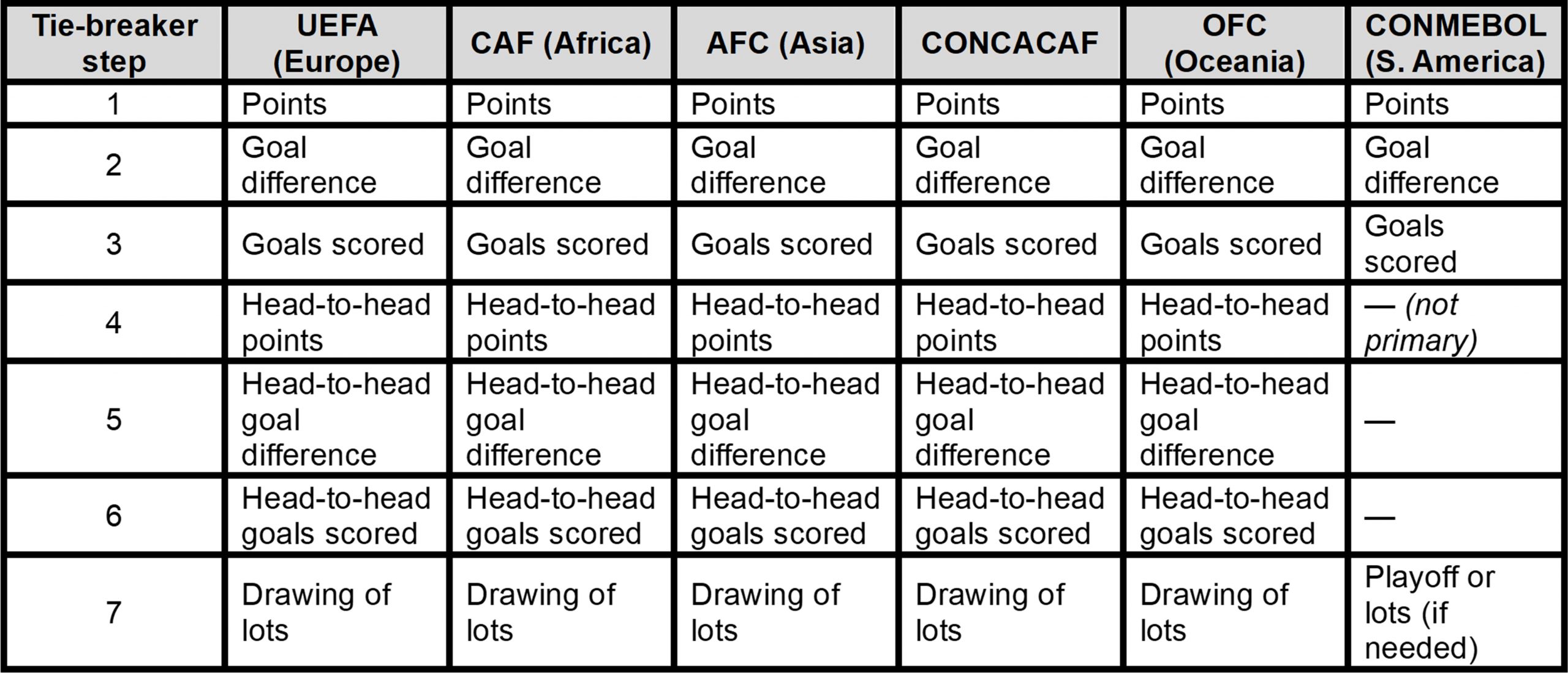
Table courtesy of Jose F Guerra
No confederation required drawing of lots and no internal playoff was required within CONMBEOL. The qualification across the regions was straightforward.
The final list of qualified teams was the following:
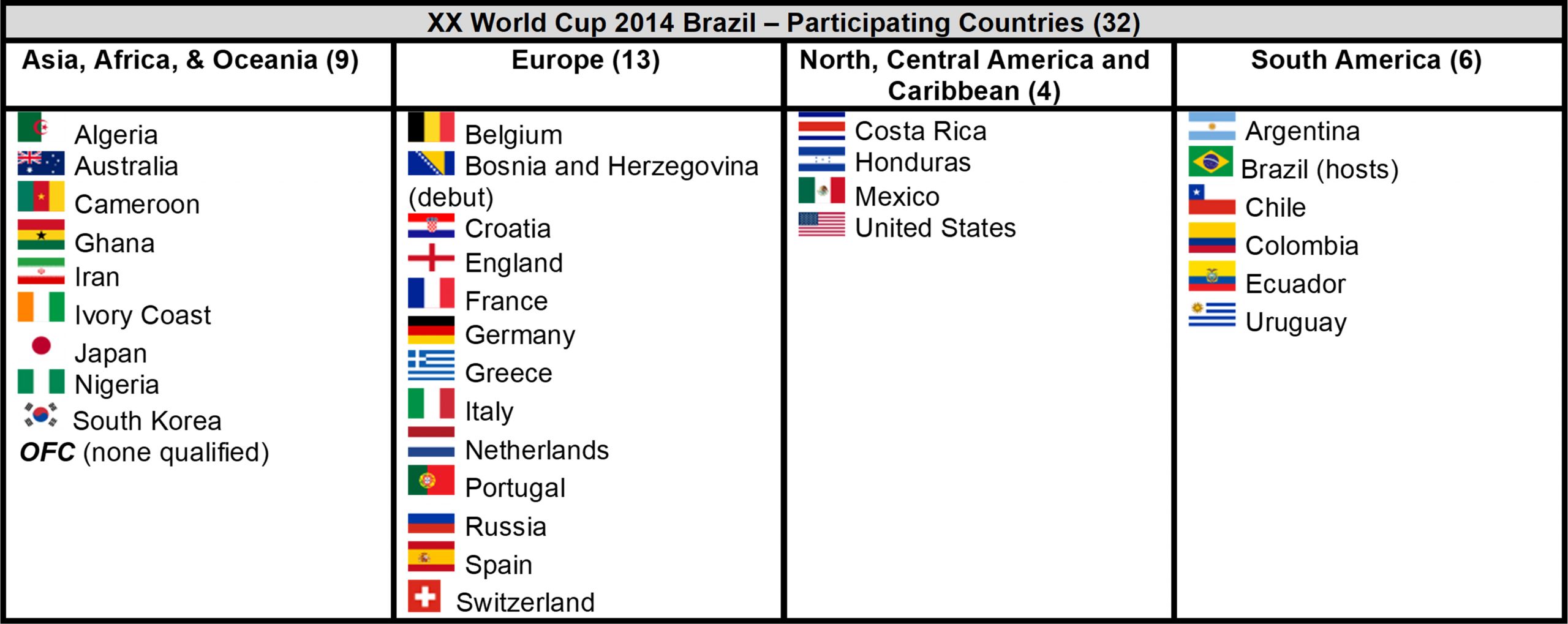
Table courtesy of Jose F Guerra
There was only one team that debuted for this World Cup, Bosnia and Herzegovina. And there were only two surprise non-qualifying teams: Paraguay who had competed in four straight World Cups (including reaching the quarterfinals in 2010 and forcing the eventual winner of that tournament, Spain, to the maximum to beat them) and Sweden who had a talented squad including the always colorful Zlatan Ibrahimović.
The Tournament
Brazil used 12 stadiums in 12 different cities spread out across the country’s geography, making it one of the most geographically spread tournaments in history. Of these venues, seven were newly built and five were renovated or upgraded, reflecting a major national investment in infrastructure. The largest stadium was the Maracanã in Rio de Janeiro, with a capacity of about 74,700, while the smallest was Arena da Baixada in Curitiba, with roughly 38,000 seats. FIFA typically prefers fewer host cities, but Brazil expanded to 12 to ensure nationwide representation and economic impact. However, the tournament became controversial because several of the newly built stadiums were located in regions with less soccer demand, raising concerns about their long-term use and high construction costs. These issues, combined with large public expenditures, contributed to criticism that resources were diverted from social needs like healthcare and education.
Of note is that the legendary Maracanã stadium had been gradually reduced from its 1950 capacity of 200,000 people to its present size. This was due to several factors, including safety, comfort, modernization, and maintenance. This was also the stadium that had witnessed the infamous “O Maracanaço” in the 1950 final where Brazil, hosting the tournament for the first time, had lost against Uruguay. It was the greatest tragedy for a proud and soccer mad nation in the history of its sport. At least until this tournament.
The seeding for the 2014 FIFA World Cup draw was based primarily on the October 2013 FIFA World Rankings, with the top seven ranked teams plus host nation Brazil placed as seeds. Interestingly, Brazil was ranked 11 and in any other tournament that used FIFA rankings to determine seeds, they would not have been seeded. The remaining 24 teams were distributed into three additional pots largely according to geographic regions, grouping teams from Africa and South America, Asia and CONCACAF, and Europe. To balance the pots, FIFA randomly moved one European team (Italy) into a different pot so that each pot contained eight teams. During the draw, teams were assigned to groups while following rules limiting how many teams from each confederation could be placed together. Overall, the system aimed to spread top teams across groups and maintain regional diversity, though it was somewhat controversial because strong teams like the Netherlands and Italy were not seeded.
The final groups were as follows:


Tables courtesy of Jose F Guerra
Before the 2014 World Cup, most analysts and bookmakers agreed on a small group of clear favorites. The top tier included Brazil (host nation), Germany, Argentina, and defending champions Spain, all of whom had strong squads, recent success, and high FIFA rankings or betting odds. Brazil was often seen as the main favorite due to playing at home, while Germany and Argentina were viewed as the strongest challengers, with Spain still respected despite concerns about maintaining their dominance.
A second tier of contenders—sometimes called “strong outsiders” rather than true favorites—included teams like Belgium, Italy, France, Netherlands, Portugal, and Colombia, all of whom had talent but were considered slightly less consistent or proven. Belgium in particular was seen as a rising power with a “golden generation,” while Colombia generated interest despite the injury to star Radamel Falcao.
On a personal note, I did not consider Spain to be a strong contender because their core squad was aging, teams around the world had started to figure out how to neutralize their tiki-taka style, and their motivation was not going to be as strong given that they had won everything in sight in the last several years. I also didn’t consider Brazil a favorite because even though they had great talent, they had not shown team cohesion and would be under impossible pressure to deliver on their home turf and avoid another “O Maracanaço”. My forecasts would turn out to be true in more ways than one.
In Group A, Brazil opened with a 3–1 win over Croatia, helped by a highly controversial penalty awarded to Fred that was widely criticized as a soft call. Mexico impressed defensively, drawing 0–0 with Brazil, with goalkeeper Guillermo Ochoa delivering one of the performances of the tournament. Croatia beat Cameroon 4–0, aided by a red card to Alex Song after an elbow, showing discipline issues for Cameroon. Mexico then defeated Croatia 3-1, silencing Croating fans, players, and coach who had put down Mexican players before the match, going as far as saying Mexico’s forwards’ knees would shake in front of the Croatian backline. Brazil and Mexico advanced, with Brazil finishing top after a 4–1 win over Cameroon led by Neymar.
There was huge expectation as the opening match of Group B was a repeat of the final four years before between Spain and the Netherlands. The defending champions Spain suffered one of the biggest shocks ever, losing 5–1 to the Dutch, highlighted by Van Persie’s iconic flying header. Chile then defeated Spain 2–0, eliminating them early in a stunning collapse. The Netherlands continued strong with a 2–0 win over Chile to top the group. Arjen Robben was outstanding throughout, showcasing pace and clinical finishing.
In Group C, Colombia emerged as one of the most exciting teams, defeating Greece 3–0 and Ivory Coast 2–1, with James Rodríguez shining. Ivory Coast’s late collapse against Greece (2–1 loss) included a decisive last-minute penalty. Greece advanced based on that dramatic win, despite scoring very few goals overall. Colombia finished top with a perfect record, confirming their attacking quality even without Radamel Falcao.
Group D, the “Group of Death”, produced the biggest surprises, with Costa Rica stunning Uruguay 3–1 and Italy 1–0. Luis Suárez starred for Uruguay with two goals in a 2–1 win over England, effectively eliminating them. The group’s biggest controversy came when Suárez bit Italy’s Giorgio Chiellini, an incident missed by the referee but punished later with a 9-match ban (international matches which meant he was out of the World Cup), a 4-month ban from all soccer-related activity (which meant he would not be able to play with his club, Liverpool FC), a stadium ban (he was also not allowed to enter any stadium during this period), and a fine of 100,000 Swiss francs (~$100k+). Costa Rica topped the group, while England were eliminated without a win.
France dominated Group E, defeating Switzerland 5–2 in one of the most entertaining matches of the group stage. Switzerland advanced after a dramatic 3–0 win over Honduras, including a hat trick by Xherdan Shaqiri. Ecuador narrowly missed out despite competing strongly, including a 0–0 draw with France. France looked revitalized compared to 2010, with Karim Benzema playing a key role.
In Group F, Argentina won all three games but were not dominant, relying heavily on Lionel Messi’s brilliance, including a dramatic late winner vs Iran (1–0). Bosnia played competitively but narrowly lost key matches, including 2–1 to Nigeria. Nigeria advanced with solid defensive play and tactical discipline. Messi’s individual performances stood out as he carried Argentina offensively.
Germany opened its Group G competion with a dominant 4–0 win over Portugal, featuring a Thomas Müller hat trick and a red card for Pepe. The group produced a thrilling 2–2 draw between USA and Portugal, with Ronaldo assisting a last-second equalizer. The USA advanced after a narrow 1–0 loss to Germany, benefiting from an earlier win over Ghana. This was widely called the toughest group, and it lived up to expectations.
Belgium topped Group H with three wins, including a comeback 2–1 victory over Algeria led by substitutes. Algeria advanced after a high-scoring 4–2 win over South Korea, showcasing attacking flair. Russia’s elimination included a costly goalkeeping error by Igor Akinfeev against South Korea (1–1). Belgium showed promise but often relied on late goals rather than dominant play.
The Round of 16 featured several dramatic finishes, including Brazil’s 1–1 draw with Chile, where Brazil advanced on penalties after Gonzalo Jara struck the post. Colombia defeated Uruguay 2–0, highlighted by James Rodríguez’s spectacular volley, while Germany needed extra time to beat Algeria 2–1, with Manuel Neuer’s sweeping performance drawing praise. Costa Rica continued their shock run by eliminating Greece on penalties despite playing with 10 men for much of the match. One of the most controversial games saw the Netherlands beat Mexico 2–1, scoring in the 88th minute and then winning via a stoppage‑time penalty earned by Arjen Robben, a call widely debated and remembered by the phrase “No era penal,” as Mexico were eliminated yet again at this stage.
The Round of 16 featured several dramatic finishes, including Brazil’s 1–1 draw with Chile, where Brazil advanced on penalties after Gonzalo Jara struck the post on the last kick of the penalty kick shoot-out that sent Brazil to the quarterfinals. Colombia defeated Uruguay 2–0, highlighted by James Rodríguez’s spectacular volley, while Germany needed extra time to beat Algeria 2–1, with Manuel Neuer’s sweeping performance drawing praise. Costa Rica continued their shock run by eliminating Greece on penalties despite playing with 10 men for much of the match. One of the most controversial games saw the Netherlands beat Mexico 2–1, scoring in the 88th minute and then winning via a stoppage‑time penalty earned by Arjen Robben, a call widely debated and remembered by the phrase “No era penal,” as Mexico were eliminated yet again at this stage.
Germany edged France 1–0 in a disciplined match, while Argentina beat Belgium 1–0 with Gonzalo Higuaín scoring early and the defense holding firm. Brazil defeated Colombia 2–1 in a highly physical and controversial match where referees were criticized for allowing rough play, culminating in Neymar suffering a tournament‑ending back injury. The Netherlands faced Costa Rica and, after a 0–0 draw, won on penalties following a dramatic late substitution of goalkeeper Tim Krul specifically for the shootout. Costa Rica’s run to the quarterfinals remained one of the biggest surprises of the tournament.
The first semi-final pitted Germany against the hosts. The Estádio Mineirão in the city of Belo Horizonte was packed with 58,259 screaming fans, their passion and excitement visible through the TV screens around the world. Brazil didn’t have Neymar due to his broken vertebrae from the match against Colombia. But the roster was deep. In less than 30 minutes the score was 5-0…in favor of the Germans. The players seemed paralyzed and shellshocked at how quickly they melted down after the first goal barely 11 minutes into the match. The final score was 7-1. It was the most humiliating defeat in Brazil’s storied history in these tournaments. The German head coach, Joachim Löw, later said he had told his players at half-time to stay focused, keep their discipline, and not to get carried away with the score. He emphasized respect for Brazil and avoiding humiliation or excessive showboating. There was a conscious effort not to “overdo it” or embarrass Brazil unnecessarily in the second half. Nonetheless, due to the total collapse of Brazil, Germany still scored two additional goals in the second half. The defeat is now known in Brazil as “o Mineiraço”, after the name of the stadium where they collapsed.
In the other semifinal, a rather non-event after the shocking first one, Argentina and the Netherlands played a tense 0–0 draw, with Argentina advancing 4–2 on penalties. Javier Mascherano delivered a standout defensive performance, including a crucial last-ditch tackle that preserved the result.
The Final
Germany entered the 2014 World Cup final with a high-tempo, possession-based attacking style, built on teamwork, quick passing, and fluid movement, while Argentina relied on a compact, defense-first approach focused on organization and discipline. Germany emphasized collective play and pressing, using coordinated midfield control and intelligent runs to create chances, whereas Argentina often absorbed pressure and looked to counterattack. Much of Argentina’s offensive threat depended on Lionel Messi’s individual brilliance, while Germany spread responsibility across the team. In essence, the final was seen as a clash between Germany’s proactive, system-driven attack and Argentina’s cautious, defensively structured strategy centered around Messi.
Before the match, Argentina newspapers were filled with headlines mocking their arch-rival and asking “Brazil, decime qué se siente tener en casa a tu papá” (Brazil, tell me how it feels to have your daddy in your house). Brazilian fans’ worst nightmare was to see Argentina lift the cup in the same stadium where Brazil had lost the final in 1950. They had now suffered two tragedies: o Maracanaço in 1950 and now o Mineiraço in 2014. A third tragedy was almost unbearable to think about.
The final was held in a full Maracanã stadium with most of the fans supporting Germany. It began as a tense, tactical battle, with Germany controlling possession but Argentina creating the more dangerous chances on the counter. Gonzalo Higuaín missed a major opportunity early after a Kroos miscue put him through on goal, shooting wide, and he later had a goal disallowed for offside. Argentina looked sharp breaking forward, while Germany came closest late in the half when Höwedes hit the post with a header from a corner. The half ended 0–0, with both teams creating chances but failing to convert.
Argentina started the second half strongly, and Lionel Messi had a crucial chance early on when he broke into the box but curled his shot just wide of the far post. Germany gradually regained control with sustained possession but struggled to penetrate Argentina’s compact defense led by Mascherano. Both teams showed signs of fatigue as the match became more cautious and evenly balanced. The second half ended 0–0, with Messi’s miss standing out as Argentina’s best opportunity.
Germany increased their attacking pressure in extra time and finally broke through in the 113th minute, when substitute Mario Götze controlled Schürrle’s cross on his chest and finished brilliantly. Argentina pushed forward late but lacked precision, unable to generate a clear equalizing chance. The match featured no major refereeing controversies in this period, with the decisive moment coming purely from individual quality. Germany held on to win 1–0, claiming their fourth World Cup title. And Messi would be again frustrated in his quest to win his first World Cup.
In the aftermath, Brazilian newspapers printed headlines such as “Tell me how it feels…to be runner ups again!” or “They played like never before, they lost like always!” or “Do cry for you, Argentina!”.
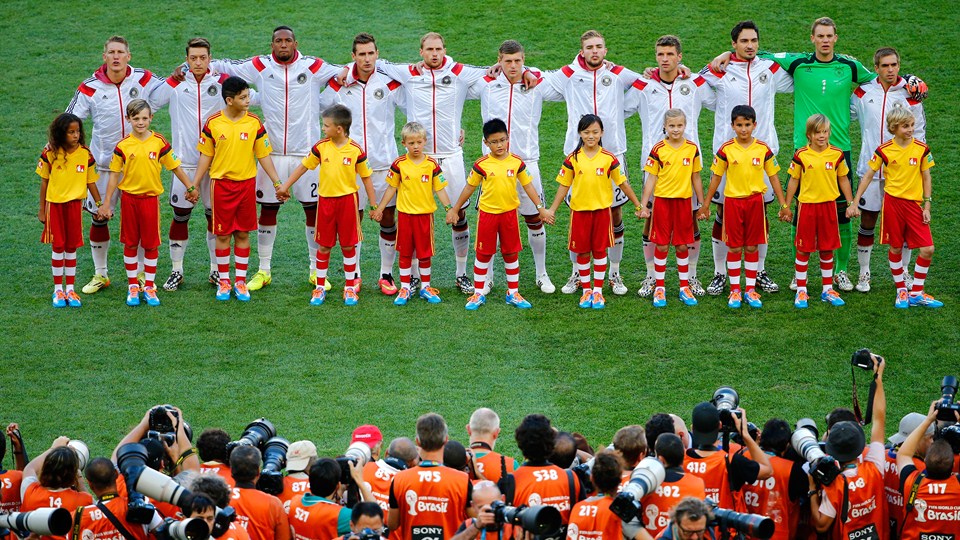
Germany national team lines up before a 2014 FIFA World Cup match. Photo credit: Getty Images
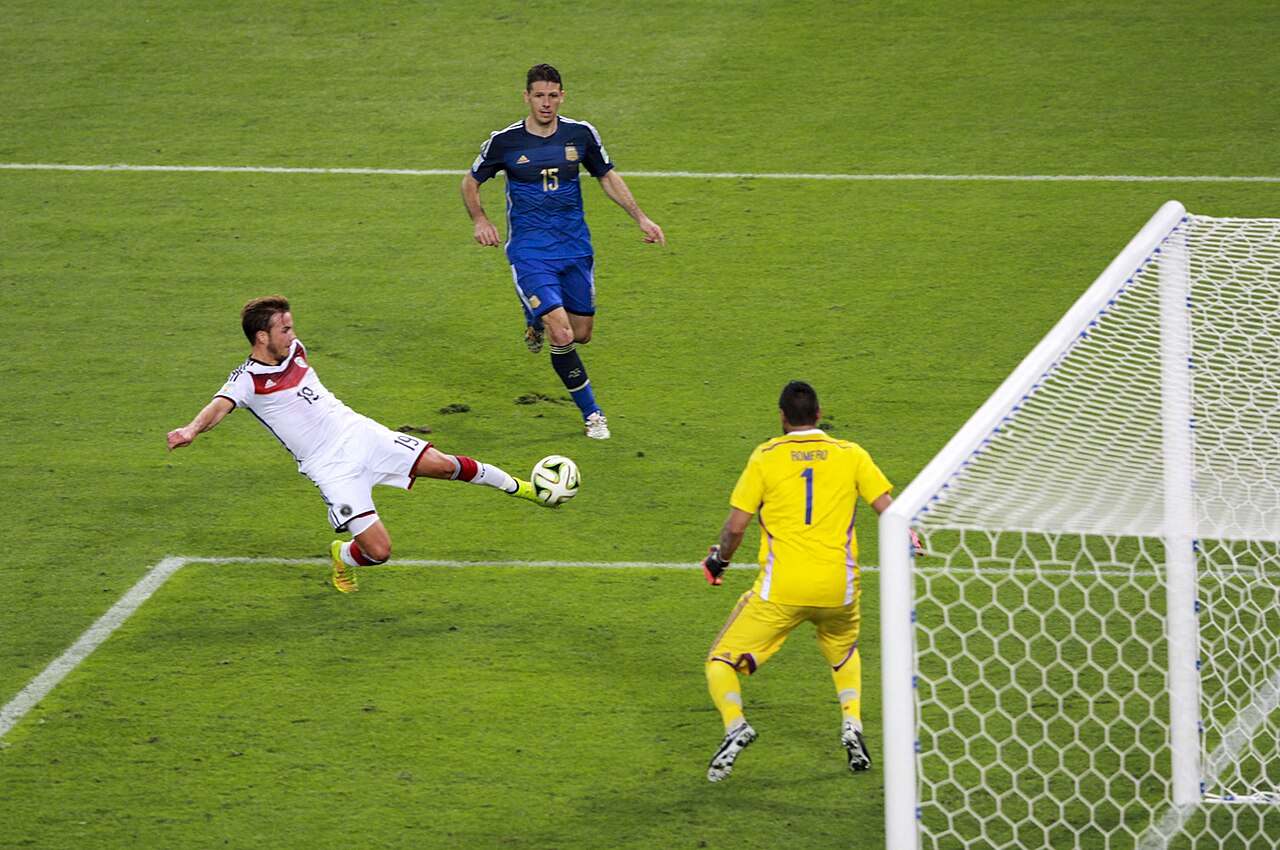
Germany’s Mario Götze scores the winning goal in overtime against Argentina in the 2014 FIFA World Cup Final. Photo credit: Getty Images.
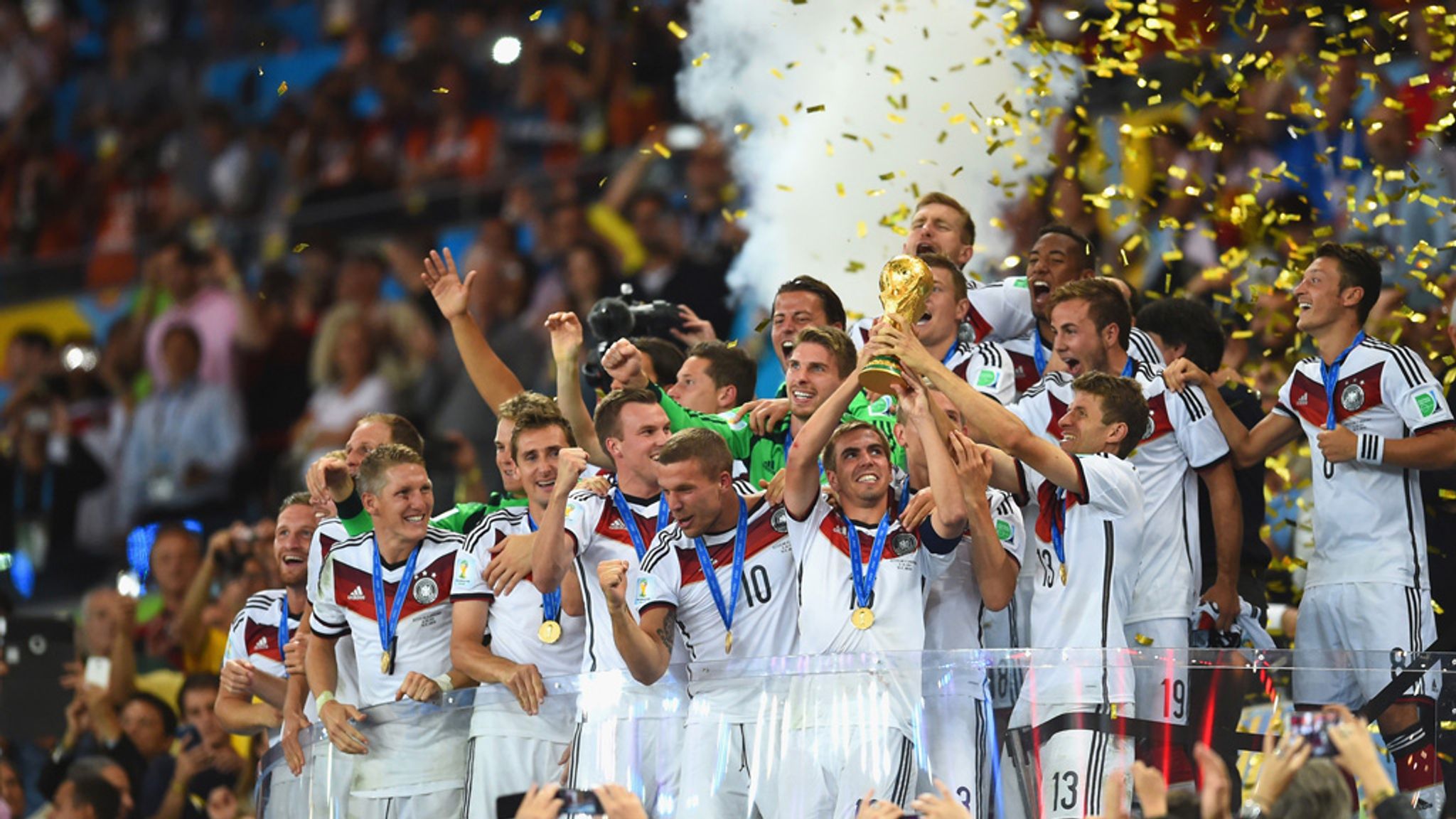
Germany celebrates winning the 2014 FIFA World Cup final at the Maracanã. Photo credit: Getty Images
Men In Blazers Final Note
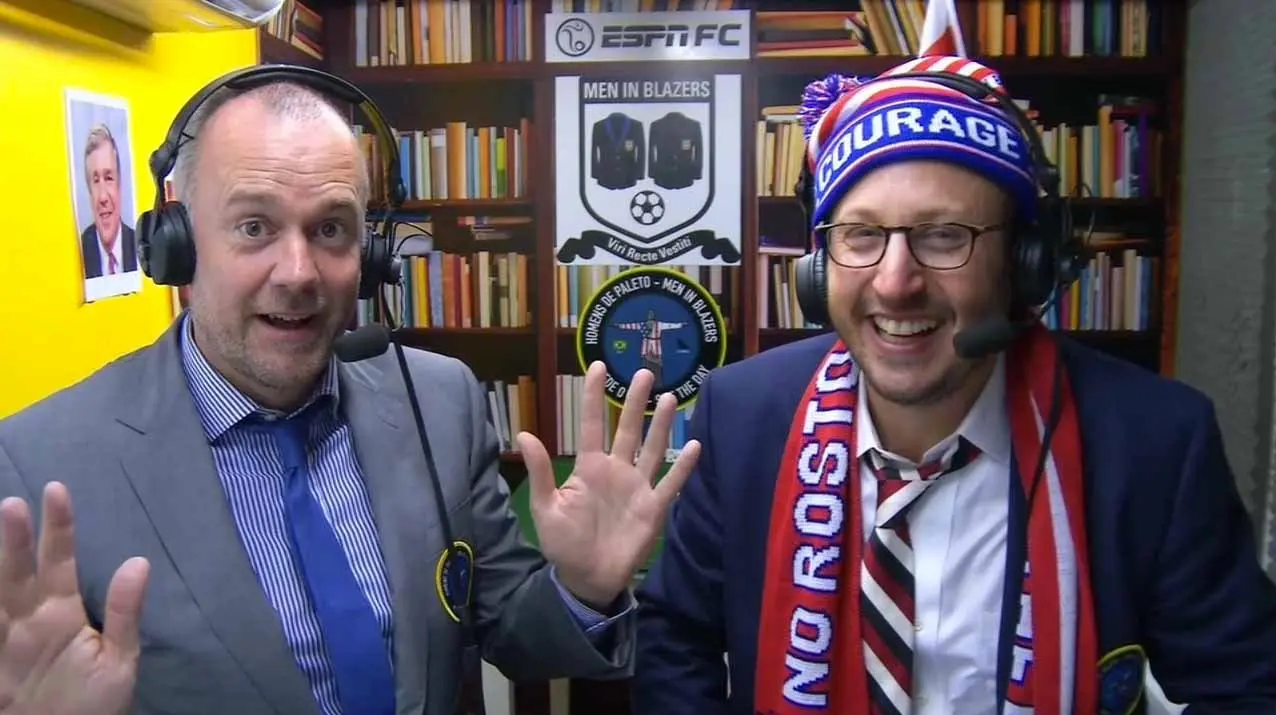
Men In Blazers analysts Michael Davies and Roger Bennet during World Cup coverage. Image source: ESPN FC / Men in Blazers.
During ESPN’s final broadcast for this tournament, the Men In Blazers in the personas of Michael Davies and Roger Bennet talked about their experiences and mentioned some of the most memorable moments of the tournament. One individual in their whimsical point of view stood out: Mexican head coach and extreme frantic personality Miguel Herrera. They summed it up by saying that “Herrera had singlehandedly expressed more joy than the entire English nation has experienced since Queen Victoria passed away in 1901”. Cheers to the Men In Blazer for also giving us much joy during a memorable 2014 World Cup!
Tournament Firsts
- First World Cup won by a European team in the Americas.
- First use of goal‑line technology (a major technological milestone in soccer officiating).
- First time Brazil conceded 7 goals in a World Cup match (worst loss ever for them in World Cup play).
- First goalless semifinal decided entirely by penalties (Netherlands–Argentina).
- First time all CONMEBOL teams participating in a World Cup reached the Round of 16.
- First ever “cooling breaks” in World Cup matches.
- First World Cup match played in the Amazon region.
Relevant Players
- Miroslav Klose (Germany) – Forward, crucial for Germany and made history by becoming the all-time World Cup top scorer (16 goals).
- Lionel Messi (Argentina) – Forward, the country’s key player, carrying the team offensively with 4 goals in the group stage and creative play throughout. He won the Golden Ball (best player of the tournament) despite Argentina losing the final.
- Neymar (Brazil) – Forward, was Brazil’s main attacking threat, scoring 4 goals and leading the team before his tournament-ending injury vs Colombia.
- Arjen Robben (The Netherlands) – Forward, was one of the most dynamic players, known for his speed, dribbling, and decisive plays, scoring key goals and won the controversial penalty vs Mexico that sent the Netherlands through.
- James Rodríguez (Colombia) – Midfielder, a breakout star of the tournament, winning the Golden Boot with 6 goals. His spectacular volley against Uruguay became one of the most famous goals in World Cup history.
- Keylor Navas (Costa Rica) – Goalkeeper, instrumental in Costa Rica’s surprise run to the quarterfinals, delivering outstanding goalkeeping performances and multiple crucial saves, especially in knockout matches.
From Maracanã to Mother Russia: A New Football Chapter Begins
Four years after the drama in Brazil, Europe would carry the torch in the form of Russia. The country had never bid before for the World Cup and on its first attempt, it won the rights to host the event (to the astonishment of the world but also apparently to various FIFA officials). There would be unease and concerns about human rights when it was announced. But the tournament would go on under impeccable organization and with the introduction of new technology that would cause great controversy during the competition: the use of Video Assisted Referee or VAR).
От богатства своей истории до яркости своей культуры Россия приветствует мир на величайшей футбольной сцене.