The 2026 World Cup is over. An unprecedented 48 teams participated over the course of 38 days across three host countries (Canada, Mexico, and the USA) and 16 host cities, competing in 104 matches. The last week of the tournament saw four final matches played: two semi-finals, one third place competition, and the final.
CST’s final World Cup report will give you a review of these final matches which gave us a new reigning champion and plenty of more controversies.
RACE TO THE FINAL
SPAIN vs FRANCE
Spain reached the 2026 World Cup Final with a controlled 2–0 victory over France at Dallas Stadium. Mikel Oyarzabal opened the scoring from the penalty spot in the 22nd minute after Lamine Yamal drew a foul from Lucas Digne. France arrived with attacking stars Kylian Mbappé, Ousmane Dembélé, and Michael Olise, but Spain’s defense gave them little room to operate. Rodri dictated the tempo, while Yamal and Dani Olmo repeatedly caused problems for the French back line.
Spain sealed the win in the 58th minute when Pedro Porro finished a clever combination with Olmo. Yamal later had a goal disallowed for a marginal offside call, denying Spain a larger margin of victory. France pushed forward through Mbappé, Désiré Doué, and Rayan Cherki, but Unai Simón and Spain’s disciplined defense stood firm. The result sent Spain to the final and ended France’s hopes of reaching a third consecutive World Cup title match.
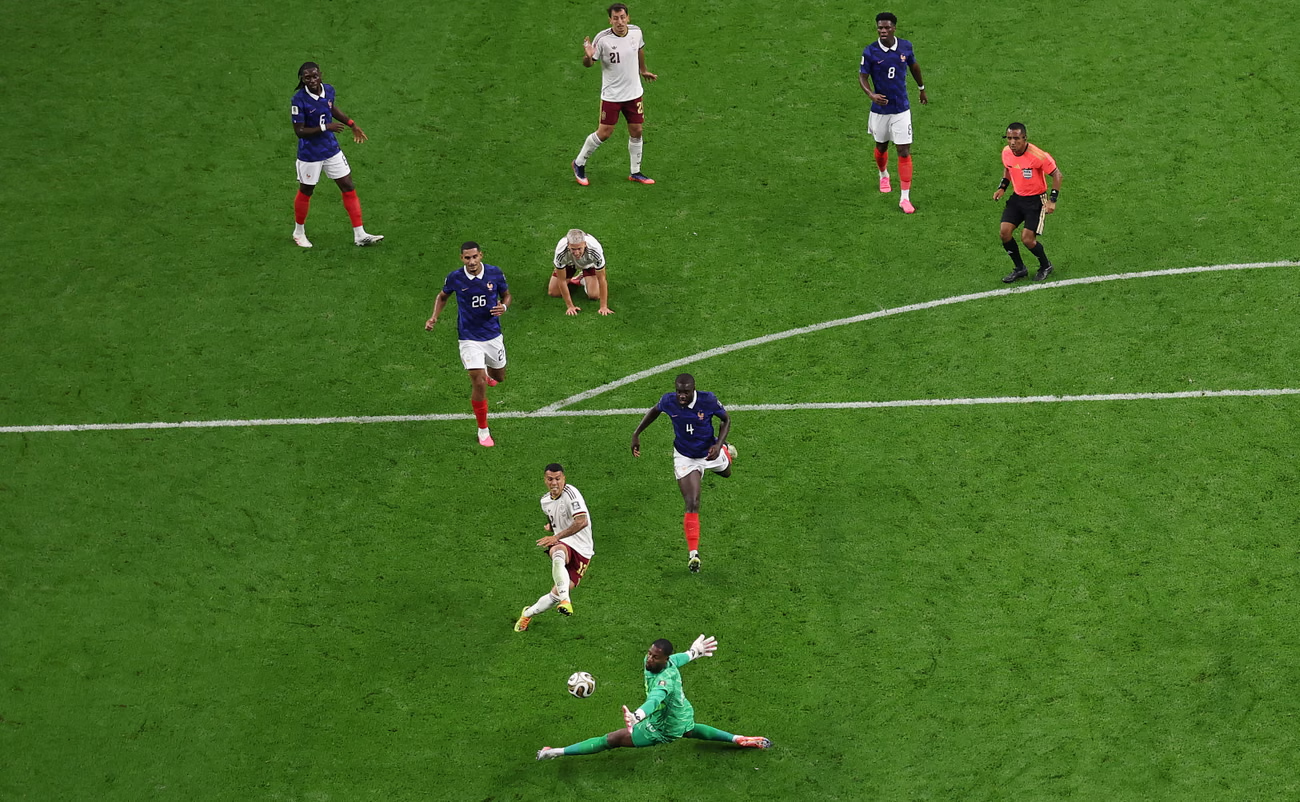
Spain’s Pedro Porro slots in the second goal to put the game beyond France’s reach. Photograph: Ryan Pierse/Fifa/Getty Images
ENGLAND vs ARGENTINA
England looked set for their first World Cup Final since 1966 after taking the lead against Argentina in Atlanta. Following a tense first half, Anthony Gordon scored in the 55th minute after a move involving Harry Kane and Morgan Rogers. England’s pace on the counter caused problems, while Lionel Messi was closely marked and Argentina struggled to create clear chances. Even so, Alexis Mac Allister hit the woodwork and Argentina continued to grow into the match.
The turning point came when Thomas Tuchel shifted England into a defensive shell after taking the lead. England eventually had six defenders on the field and surrendered control of possession to Argentina. Enzo Fernández equalized in the 85th minute, and Messi then set up Lautaro Martínez’s stoppage-time winner to complete a dramatic 2–1 comeback. The result sent Argentina to a second straight World Cup Final and left England facing criticism for becoming too passive when protecting its lead.
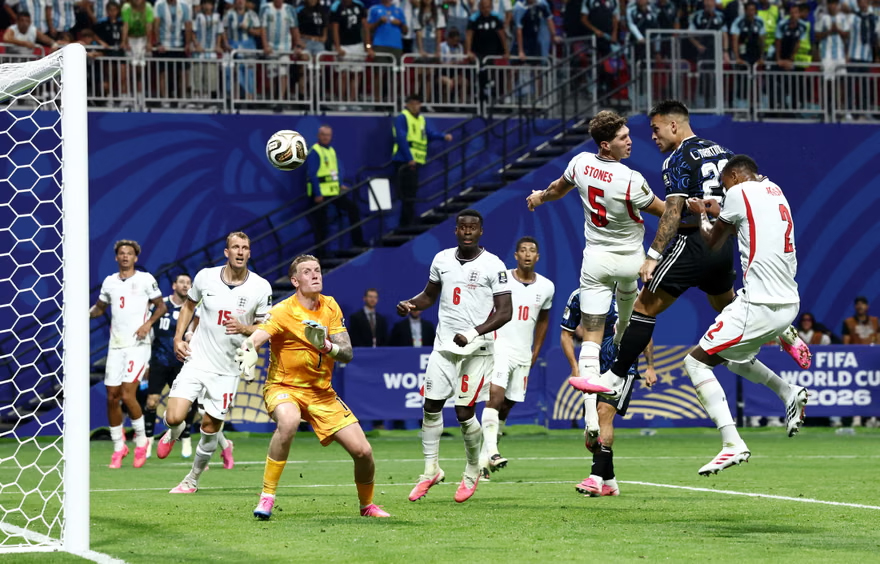
Enzo Fernández scores the go-ahead goal for Argentina. Photograph: Shaun Botterill/Getty Images
STANDOUT PERFORMANCES
Pedro Porro (Spain) – Scored the second goal, shut down his side of the field defensively, and was named FIFA’s Player of the Match.
Lionel Messi (Argentina) – Assisted both goals, orchestrated Argentina’s late comeback, and once again proved decisive in the biggest moments.
THIRD PLACE – FRANCE vs ENGLAND
The third-place match in Miami became one of the most entertaining games in World Cup history, with England defeating France 6–4 in a ten-goal thriller. England raced to a 4–0 halftime lead through goals from Declan Rice, Ezri Konsa, and a Bukayo Saka brace. France looked overwhelmed defensively as England repeatedly exploited space on the counterattack. Despite rotating several key players, Thomas Tuchel’s side played with pace, freedom, and attacking fluidity.
What followed was complete chaos. Kylian Mbappé scored twice, while Bradley Barcola and Ousmane Dembélé helped France fight back and cut the deficit to a single goal. Mbappé’s brace moved him ahead of Lionel Messi as the World Cup’s all-time leading scorer and strengthened his claim to the Golden Boot. England finally put the game away through Saka’s hat-trick-clinching penalty and a stoppage-time strike from Jude Bellingham, securing a record-setting 6–4 victory and the first World Cup bronze medal in the nation’s history.
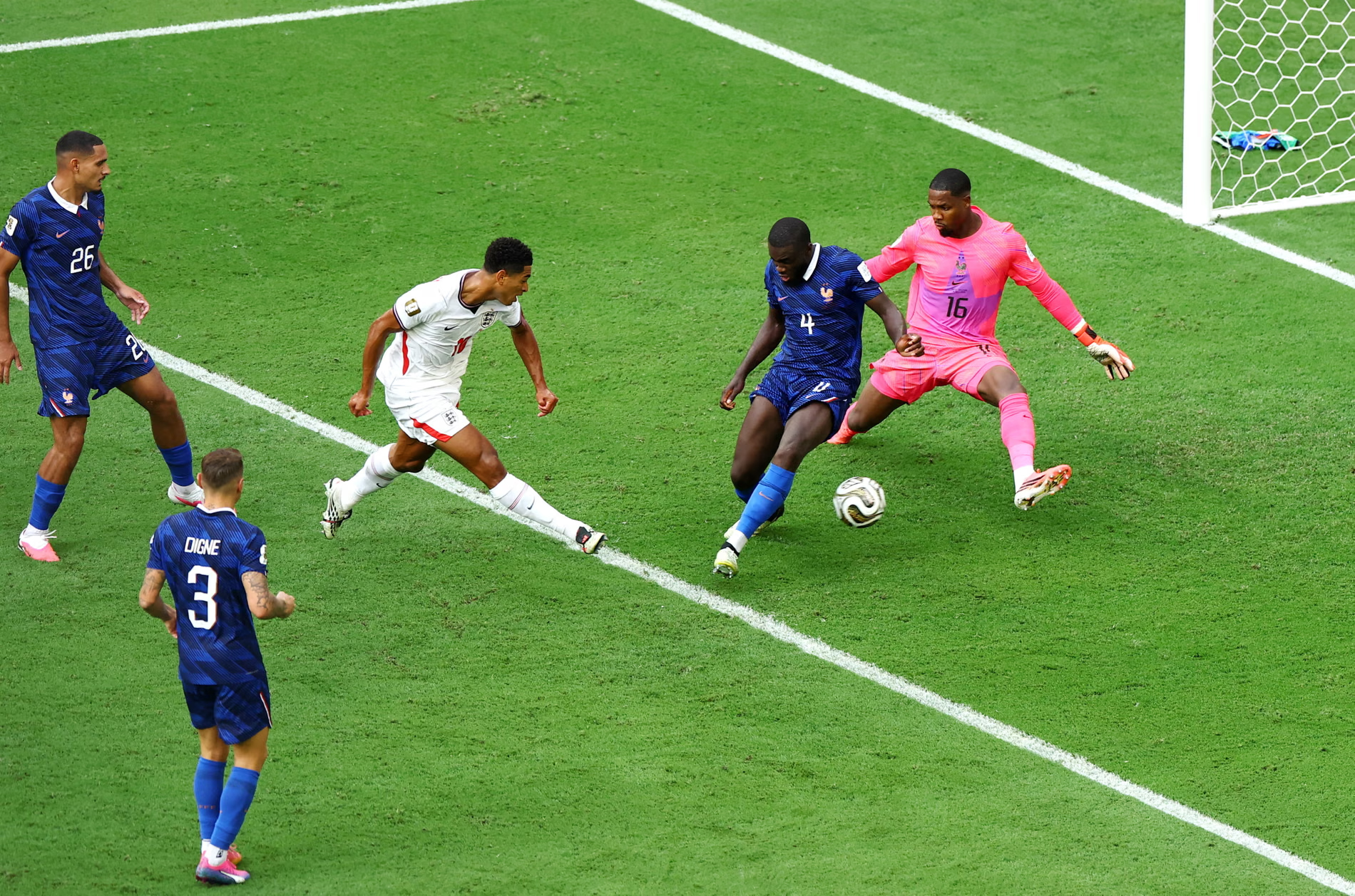
Jude Bellingham completes the scoring in the 10-goal game. Photograph: Marco Bello/Reuters
STANDOUT PERFORMANCES
Bukayo Saka (England) – Recorded a hat trick and was the standout performer in the highest-scoring third-place match in World Cup history.
Kylian Mbappé (France) – Scored twice, led France’s comeback effort, and became the World Cup’s all-time leading scorer.
THE FINAL – SPAIN vs ARGENTINA
Over 80,663 fans were in attendance in New Jersey, with the vast majority supporting the reigning world champions, Argentina. Would Spain’s tactical discipline and finely tuned team play be enough to overcome Argentina’s heart, grit, and deep talent pool? The stadium attendees and two billion fans around the globe would witness this battle.
First Half
The opening 45 minutes were tense and highly tactical, with Spain controlling possession while Argentina focused on defensive organization and quick transition opportunities through Lionel Messi. Lamine Yamal and Nico Williams repeatedly stretched Argentina’s back line, but clear chances were limited as both teams showed considerable caution in football’s biggest match.
Spain appeared the more dangerous side, forcing Emiliano Martínez into several important interventions, while Argentina struggled to sustain attacks and found little space between Rodri and Spain’s defensive unit. A key statistic illustrated Spain’s dominance: Messi’s first touch after kickoff did not arrive until roughly 15 minutes into the match, highlighting how effectively Spain restricted Argentina’s captain. Despite Spain’s territorial advantage, the teams went into halftime scoreless, with the final still finely balanced.
Second Half
Spain increased the pressure after the break, pushing Argentina deeper and maintaining control of possession, while Rodri continued to dictate the tempo from midfield. Argentina remained compact and disciplined, hoping that Messi could unlock the game with a moment of brilliance, but opportunities were scarce as Spain’s defense remained exceptionally organized.
The biggest controversy of regulation time came in stoppage time when Enzo Fernández received a second yellow card and was sent off for a heavy challenge on Pau Cubarsí, leaving Argentina with ten men. Messi tried to get the central referee to red card Cucurella who he claimed had covered his mouth but the ref didn’t take any action.
The dismissal fundamentally altered the tactical landscape by forcing Argentina into an even more defensive posture. By the end of regulation, Spain had clearly been the better side, yet the score remained 0–0 and extra time was required.
Extra Time
With the numerical advantage, Spain dominated extra time and looked increasingly likely to find the breakthrough. They briefly thought they had scored when Nico Williams found the net, but the goal was disallowed because of a foul in the buildup, creating another moment of controversy in an already tense final. Argentina survived that scare largely thanks to Emiliano Martínez, whose performance kept the defending champions alive despite relentless Spanish pressure.
The decisive moment arrived in the 106th minute when Williams created the opening and substitute Ferran Torres finished clinically to give Spain a 1–0 lead. Spain comfortably managed the closing stages, finishing with a remarkable 20–2 advantage in shots, securing their second World Cup title, while Messi’s quest for back-to-back championships ended in what is widely expected to be his final World Cup appearance.
Aftermath
Spain was the World Champion, but they had to overcome a very physical and sometimes dirty Argentina squad that Spain suspected would play in this manner. Spain’s center-back Laporte said in the days before the match that they had seen actions gone unpunished and the team left “…a lot of little messages with their challenges”. Spain managed to overcome it all by smothering Argentina with their immensely talented midfield and solid backline (their goalkeeper didn’t receive a single shot he needed to parry).
During the immediate celebrations by the Spaniards, a handful of Argentinian players provoked them and physically assaulted them (which resulted in Argentina defensive midfielder Leandro Paredes supposedly being shown a red card, the first one ever to be given after a World Cup final had ended). And while even after that incident Spain’s players formed Guard of Honor Wall for the Argentinian players as they went to receive their second-place medals, the Argentinian players and staff turned their backs to Spain as they received their first-place medals and the World Cup trophy. A very undignified performance from the 2022 champions.
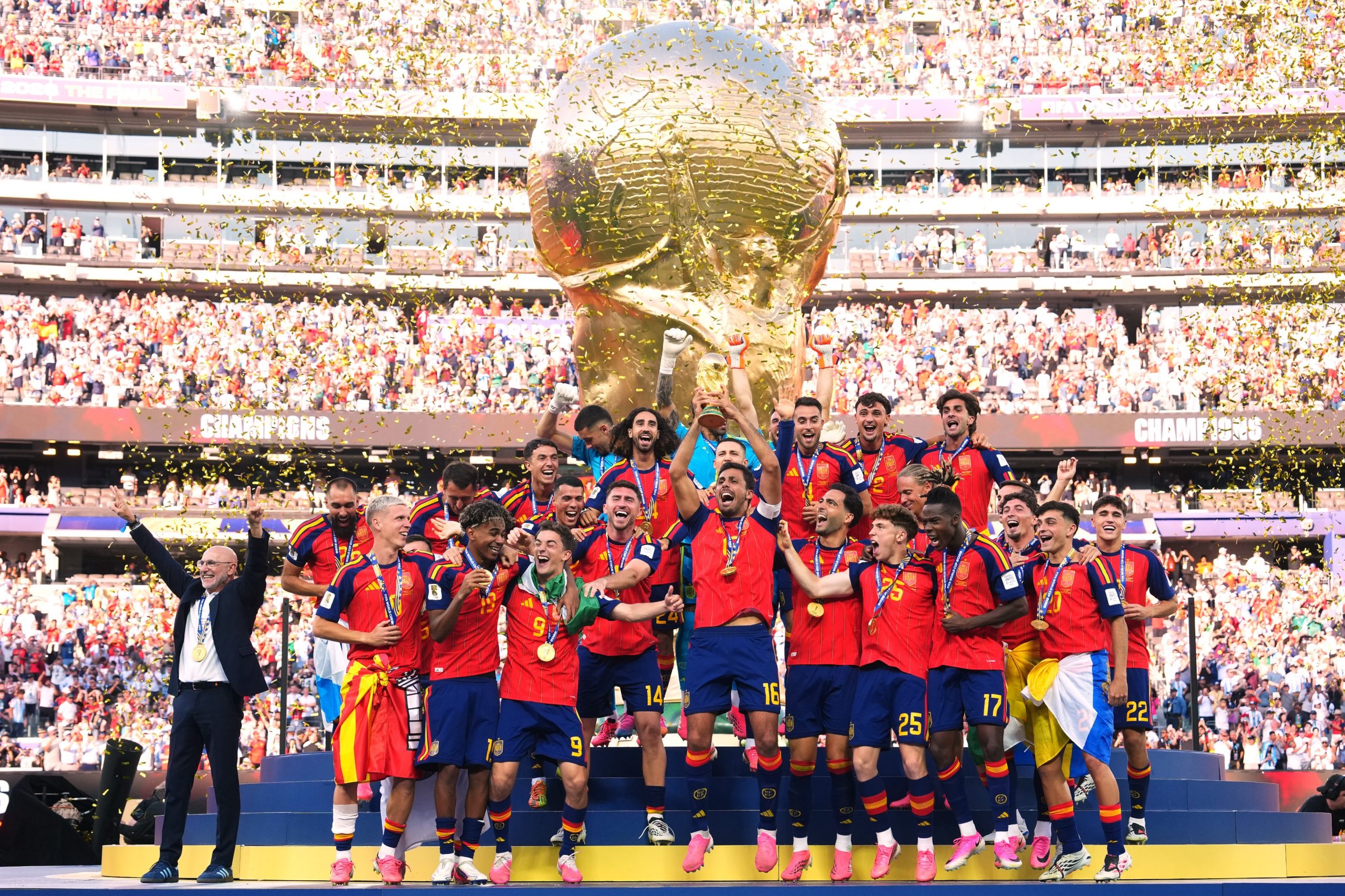
Rodri lifts the trophy with his teammates. A second star for Spain and a World Cup to defend as co-hosts in 2030. Photograph: © Real Federación Española de Fútbol (RFEF), posted via the official Selección Española Masculina de Fútbol X account (@SEFutbol).
STANDOUT PERFORMANCES
Rodri (Spain) – Controlled the midfield, dictated the tempo, and capped a tournament-winning campaign that earned him the Golden Ball.
Ferran Torres (Spain) – Came off the bench and scored the extra-time winner that secured Spain’s second World Cup title.
Emiliano Martínez (Argentina) – Despite the loss, Martínez was outstanding and arguably Argentina’s best player. He made a series of crucial saves to keep the match scoreless deep into extra time and was the primary reason Spain did not win by multiple goals.
PLAUDITS
The race for the Golden Boot was decided when Messi was unable to score in the final. Kylian Mbappé’s brace in the third-place match made him the top scorer not only of this World Cup with 10 scores, but he is also the leading scorer in World Cups with 22 goals.
Spain ran away with several individual awards including:
- Golden Ball (Best Player): Rodri
- Golden Glove (Best Goalkeeper): Unai Simón
- Best Young Player: Pau Cubarsí
Spain allowed only one goal during this longer tournament. No champion had ever done that before, and this one was done over eight games. Previous World Cup champions played six (and even less in the early tournaments).
A MEMORABLE WORLD CUP
Three host countries, 16 host cities, 16 host stadiums, 104 games, 307 goals, 65,000 volunteers, over 6.8 million spectators, and two billion viewers just for the final match.
There were epic matches, great athletic achievements, shocking results, and great battles from tiny nations that captured the hearts of the world–we’re looking at you, Cabo Verde. There were fans from around the world that made each host city a party, and fans from the USA, Canada, and Mexico, that saw and embraced a diverse demographic visiting their countries. In very red Kansas, the tiny city of Lawrence went out of their way to welcome Alegría who had made their city their home base.
Fan Fests that generated goodwill, positive and joyful interaction among fans from around the world, and sportsmanlike conduct from rival fans that after matches would just hug and go celebrate together. In particular, England was so impressed with the Mexican fans’ positive attitude towards them even after they defeated Mexico that they have invited the Mexican national team to play a friendly in Wembley sometime in the future.
Fans from around the world that gave the tournament a special flavor: the Norwegian Viking Row, the Tartan Army with their kilts and bagpipes (and their traffic cones), the Dutch with their coordinated sideways dancing, the Brazilians with their samba drums, the Japanese cleaning up their parts of the stadium, and so much more.
But the US fans also got to do their part, welcoming the world, showing that there is a different side to us that if given a chance, comes out in the most positive manner. Algeria would know as they were embraced by tiny Lawrence, Kansas, as they made that place their base camp.
There were controversies as well. Questionable refereeing decisions, inconsistent use of VAR, hydration breaks that were used across all matches (even when the climatic conditions were did not call for them), visa issues for certain nations, their players, staff, and families, and, of course, the incredibly high-priced tickets that made it difficult if not impossible for the regular fan to attend.
Congratulations to all three host nations and felicidades, España!

Recommended for you