
Official emblem of the 2018 FIFA World Cup Russia™. Image: © FIFA.
The 2018 host tournament had been decided on December 2nd, 2010, almost eight years in advance from its start. The process had been changed in 2007 with FIFA and its governing bodies deciding that any soccer federation that hosted either of the previous two events would not be eligible to bid during the next bidding cycle. This meant that for the 2018 edition no nation from either CONMEBOL (Brazil hosted in 2014) or Africa (South Africa hosted in 2010) would e able to bid on the 2018 tournament. This seemed straightforward, but as with everything FIFA related, there was more than met the eye.
The formal bidding competition was launched by FIFA in 2009. Multiple countries expressed interest, but by the final stage the contest for 2018 was limited to four European bids: Russia, England, a joint Spain‑Portugal bid, and a joint Belgium‑Netherlands bid. Russia’s bid emphasized long‑term development, promising major investments in stadiums, transportation, and infrastructure across a vast geographic area. The campaign was strongly backed by the Russian government, including then‑Prime Minister Vladimir Putin, who saw the World Cup as an opportunity to showcase Russia’s global status and modernize the country. This combination of political backing, large-scale investment promises, and the appeal of hosting the tournament in a new region helped position Russia as a serious contender.
The 22 voting members of FIFA’s Executive Committee met in Zurich to select the hosts for both the 2018 and 2022 tournaments. The voting was conducted in rounds, eliminating the lowest‑scoring bid each time until one candidate achieved a majority. In the first round, Russia led with the highest number of votes, and by the second round it secured an absolute majority with 13 votes, defeating Spain‑Portugal, Belgium‑Netherlands, and England. FIFA president Sepp Blatter emphasized that choosing Russia aligned with a broader strategy to expand football into “new lands,” as Eastern Europe had never hosted a World Cup before. The decision was widely interpreted as part of FIFA’s effort to globalize the sport, following earlier tournaments in South Africa (2010) and Brazil (2014). At the time, Russia presented its plan as both ambitious and transformative, aiming to leave a lasting legacy through infrastructure upgrades and increased tourism.
However, the awarding of the 2018 World Cup to Russia soon became controversial due to allegations of corruption and irregularities in the bidding process. Even before the vote, two FIFA Executive Committee members were suspended over claims they were willing to trade votes for money. In the years after the decision, broader investigations into FIFA uncovered widespread corruption, with many of the officials involved in the 2010 vote later accused, sanctioned, or prosecuted for bribery-related offenses. Various reports and legal actions, including U.S. Department of Justice indictments, alleged that bribes may have been offered to secure votes for hosting rights, though Russia has consistently denied wrongdoing. A FIFA ethics investigation later concluded there was insufficient evidence to overturn the result, even though it found that some bidding conduct had pushed ethical boundaries (again, no surprise given FIFA’s opaqueness, corruption, and need to squeeze as much money as possible from the sport). As a result, while Russia officially retained the hosting rights and successfully staged the tournament in 2018, the background of its selection remains one of the most debated and scrutinized episodes in modern sports governance.
Russia was criticized for alleged abuse of migrant laborers in the construction of World Cup venues, with Human Rights Watch reporting cases where workers were left unpaid, made to work in dangerously cold conditions, or suffering reprisals for raising concerns. In May of 2017, FIFA president Gianni Infantino admitted there had been human rights abuses of North Korean workers involved in the construction of Saint Petersburg’s Zenit Arena. By June 2017, at least 17 workers had died on World Cup construction sites, according to Building and Wood Workers’ International. In August, a group of eight US senators called on FIFA to consider dismissing Russia as the World Cup host if an independent investigation verified allegations of North Koreans being subjected to forced labor.
A record $14.2 billion was spent in new stadiums, upgrades to existing ones, transportation infrastructure, telecommunications, lodging, and security. This spending would be surpassed by Qatar four years later but at that time it was seen as an unprecedented amount of money that was being used to whitewash Russia’s track record in human rights in their country as well as neighboring ones.
Nonetheless, the tournament was superbly organized, producing shocking surprises, memorable matches, high scoring clashes, and heroic performances by some teams that had not been given much of a chance to even get beyond the group stage.
Qualifying
As with previous World Cups starting in 1998, 32 teams would participate, with 31 spots available for the 210 registered federations (the 211th was Russia who automatically qualified as hosts). This as the first time that all FIFA registered soccer federations were eligible to registered for the preliminary competition, but Zimbabwe and Indonesia were disqualified before playing their first matches. Bhutan, South Sudan, Gibraltar and Kosovo made their FIFA World Cup qualification debuts, while Myanmar participated after successfully appealing against a ban from the competition, although the team had to play its qualifying home matches outside the country (due to lack of security guarantees and violence within the country).
Before qualifying round started, the President of UEFA, Michel Platini, had proposed that the competition be expanded from 32 to 40 teams. The group stage would be structured with eight groups of five instead of four. The format would have been the same, but in groups of five instead of four. This was in response to FIFA President Sepp Blatter’s push to expand the presence of African countries. However, FIFA general secretary Jérôme Valcke said that expansion in 2018 would be “unlikely,” while Russian sports minister Vitaly Mutko said that the country had been planning for 32 teams and not 40. The proposal was tabled until January of 2017 when the FIFA Council voted unanimously to expand to 48 teams starting in the 2026 FIFA World Cup.
The allotted slots for each soccer confederation were:
- Asia (AFC): 4 or 5 places*
- Africa (CAF): 5 places
- North, Central American and Caribbean (CONCACAF): 3 or 4 places*
- South America (CONMEBOL): 4 or 5 places*
- Oceania (OFC): 0 or 1 place(s)*
- Europe (UEFA): 13 places (plus Russia as the host nation, for a total of 14 places)
*One team from AFC and one from CONCACAF, and one team from CONMBEOL and one from OFC would meet in respective playoff away/home matches to determine who would attend the World Cup.
Tiebreakers’ criteria continued to evolve during qualifying but were still not 100% uniform across all confederations. CONMEBOL still had the simpler criteria given the smaller number of teams they had compared to other confederations.
This is how tiebreakers were decided:
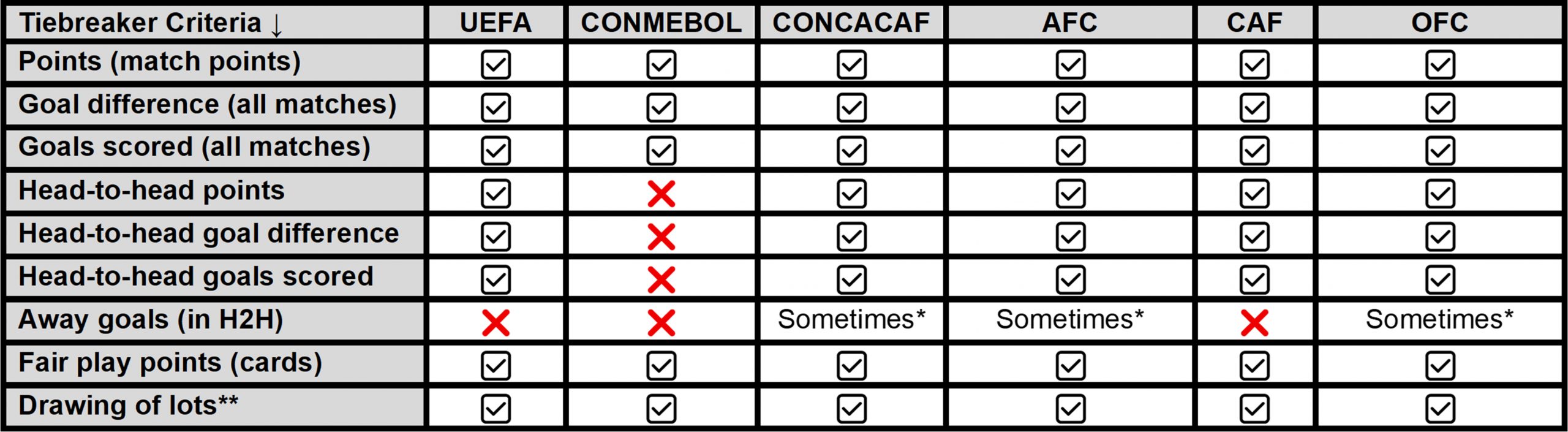
Table courtesy of Jose F Guerra
*Used for playoff or knockout stages in qualifying within their regions.
**No drawing of lots was required to determine which nations qualified within their federations.
The final list of qualified nations was the following:
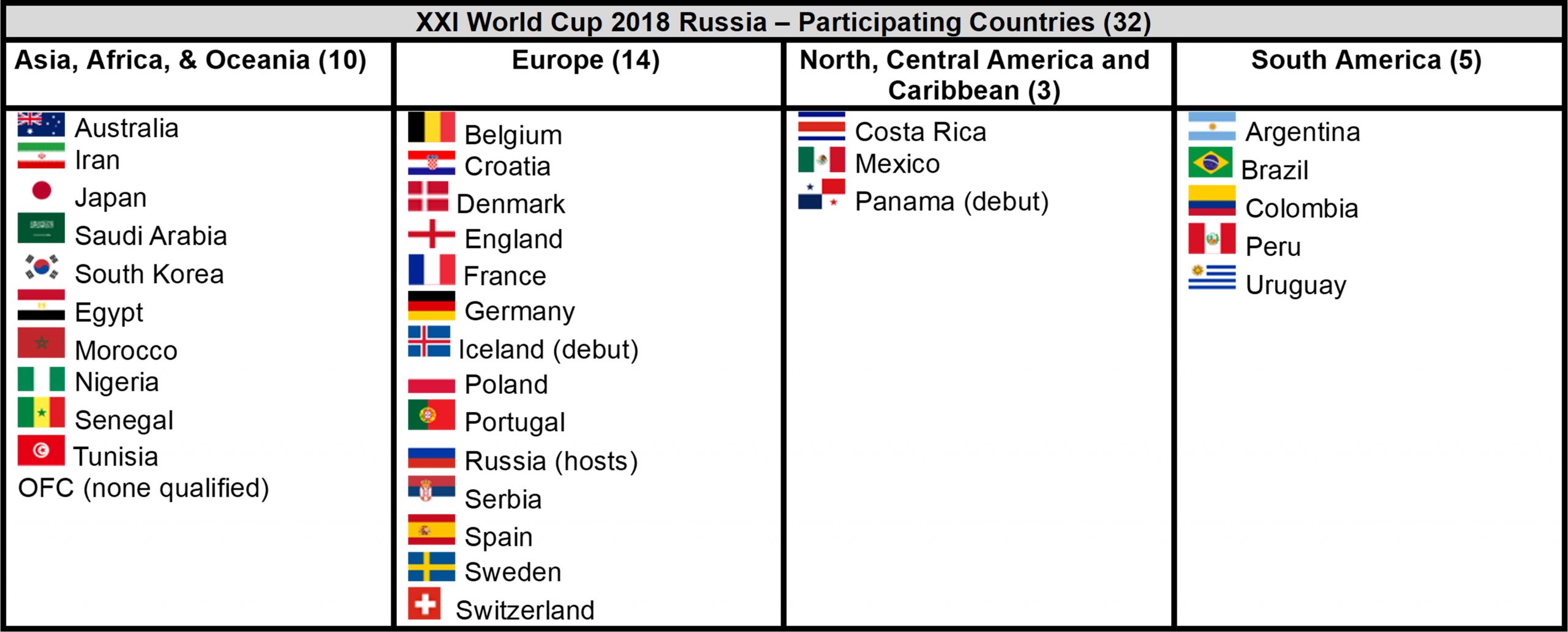
Table courtesy of Jose F guerra
Two countries debuted in Russia 2018: Panam from CONCACAF and Iceland from UEFA.
Major shocks of nations not qualifying for the 2018 World Cup included The Netherlands, Italy, Chile, Cameroon, and the United States. Italy, which had not advanced from the group stage in the last two World Cups, continued their downward slide. The Netherlands had “exhausted” their golden generation through retirements and aging players, Italy was done in by overall mismanagement, Chile had what was considered their best generation of players ever but were run down by playing intense club seasons in Europe and back-to-back Copa América tournaments (2015 and 2016, which they had won), Cameroon was placed in a brutally competitive group within CAF (Africa, and the United States suffered from over-confidence, coaching instability, and underestimating their rivals in away games. The latter was especially evident when they played their last qualifying game at Trinidad & Tobago needing only a draw against the home team that fielded mostly a youth team since they had already been eliminated: the USA lost 2-1 and were eliminated from the 2018 Russia World Cup.
I would like to add a personal insight on the US collapse in this qualifying. As someone that roots for Mexico, I saw that same overconfidence and even arrogance from the Mexico Men’s National Team during the entirety of the 1970s and 1980s. They assumed that because they were the “giants” of CONCACAF, qualification would be almost automatic. They failed to qualify for the 1974, 1982, and 1990 World Cups, only qualifying for the 1978 one. For the 1986 competition they didn’t have to play qualifying games since they hosted the event. And while it was painful to watch the USA collapse for 2018 (I also root for them now since I’ve been living in the USA well over 40 years now), the good news for the USA is that they learned their lesson quickly and were soon back on track (not so for Mexico who took 20 years to make deep structural changes).
The Tournament
Russia held the tournament across 11 cities in 12 stadiums, nine of them brand new and the other three with extensive renovations. The cities were also chosen to be as close to Europe as possible as well as to each other given the enormity of the Russian country. The largest stadium was the renovated Luzhniki Stadium in the city of Moscow with a capacity of 78,011 and smallest was the Central Stadium in the city of Yekaterinburg with a capacity of 33,06. The Luzhniki Stadium was chosen to hold the opening and final matches.
The draw again honored the now traditional seeding of allowing the host nation to be seeded and then using FIFA rankings to determine the next seven teams to be group seeds. This again made for some controversy since Russia was ranked 65th in the world while Spain, at 8th place in the rankings, wound up not being seeded.
As before, the drawing to form groups was designed so that no group would have more than one team from any continental confederation except for UEFA, which had at least one, but no more than two in a group. In general, the drawing to form the groups did no have any controversies other than some complaints in the seeding system because it was argued that it didn’t accurately reflect team strength and that seeding Russia didn’t make sense given their low ranking.
The final groups were configured as follows:

 Tables courtesy of Jose F Guerra
The usual favorites to win the tournament were again picked with some caveats.
- Germany – Defending champions with a deep, balanced squad and a perfect qualifying campaign; widely seen as the most complete team.
- Brazil – Dominated South American qualifying and had a revitalized squad under Tite, combining attacking flair with defensive stability.
- Spain – Technically elite and unbeaten in qualifying, with a strong midfield core expected to control games (they would be undone by actions out of the control of the players).
- France – Possibly the most talented squad in the tournament with a core of Griezmann, Pogba, and the teenage sensation Mbappé, but there were doubts about their cohesion.
- Argentina – Picked mostly because of Lionel Messi but the team was heavily dependent on him and considered tactically unbalanced.
Dark horses usually wind up being the sentimental favorites and this World Cup would not be the exception.
- Belgium – Their “Golden Generation” team was still filled with stars, capable of beating anyone but still unproven in major tournaments.
- Croatia – The tiny nation, while imploding four years before, still had very strong players led by world-class midfielder Luka Modrić and Ivan Rakitić, was seen as a high-upside team if they could stay consistent.
- Uruguay – A compact, disciplined side with elite strikers in Luis Suárez and Roberto Cavani that had a strong defensive identity.
- Colombia – Technically strong and creative, with enough quality to upset top teams on a good day.
- Denmark – Entered in good form after playoffs, with Eriksen as the key playmaker capable of driving a deep run.
A new technology was introduced in this world Cup: Video Assisted Referee (VAR). This would be limited to four categories of plays:
- Goals (and build‑up to goals)
- Penalty decisions
- Direct red card incidents but only for straight red card offenses
- Mistaken identity if the referee gives a card to the wrong player
In Group A Russia shocked expectations by opening with a dominant 5–0 win over Saudi Arabia. Russia was not expected to make a deep run but this result made the pundits wonder if they had been wrong. Uruguay quietly won all three matches, including a 3–0 win over hosts Russia (which reset expectations for the pundits), showing efficiency rather than flair. Egypt disappointed but were without their star striker, Mohamed Salah, for the first two matches. His return from injury in the final match did not impact their performance and they crashed out, failing to earn a point. Uruguay won the group with Russia in second.
Group B turned out to be one of the most dramatic groups but not before controversy struck Spain. A few days before the start of the tournament, the Spanish Soccer Federation fired their head coach, Julen Lopetegui, one day before their first match. He had secretly agreed to become Real Madrid’s manager after the World Cup. Real Madrid announced the deal publicly without informing the Spanish Football Federation first. This violated an unwritten rule in Spanish soccer. However, the move was seen as a major mistake because in his place they promoted Fernando Hierro, a former standout player for Spain but with practically no experience coaching at this level (not even in Spain’s La Liga). Regardless, Spain did manage to come out on top of the group, which included an exciting 3–3 draw against Portugal (who finished second), which included a Cristiano Ronaldo hat trick, including a late free kick. Spain and Portugal both advanced, but Iran nearly caused a major upset and were eliminated narrowly. VAR played a role in tight decisions, including late penalties and disallowed chances.
France topped Group C without fully convincing, relying on moments like a VAR-awarded penalty vs Australia and a narrow win over Peru. The final France–Denmark match (0–0) was widely criticized as dull, as both teams were content to advance. Peru impressed with attacking play but lacked finishing in their first World Cup in decades. VAR had a big impact early, especially in France’s opening match. Denmark also qualified coming in second place.
Group D had Argentina as the favorite to win it. But they struggled massively, including a shocking 3–0 loss to Croatia, raising doubts about their ability to make a deep run, let alone, win the World Cup. Croatia dominated the group with three wins and emerged as a serious contender behind Luka Modrić’s leadership. Argentina barely qualified after a dramatic final win over Nigeria with Messi scoring a crucial goal. In fact, Argentine players had revolted after the first two games and between Messi and Mascherano demanded their coach step down but the Argentine Soccer Federation was not swayed.
This group was one of the early shocks due to Argentina’s near elimination.
Brazil was the favorite in Group E and grew into the tournament, with Neymar under scrutiny but with decisive late goals (notably vs Costa Rica). Switzerland were solid and hard to beat, drawing with Brazil and advancing steadily. There were VAR controversies in Brazil’s opening game, including a debated push leading to a Swiss equalizer. Serbia showed promise but lacked consistency in key moments. Costa Rica were unable to replicate their spectacular run from four years earlier and crashed out with only one point. Brazil topped the group followed by Switzerland.
One of the biggest shocks in World Cup history happened in Group F. Mexico beat Germany, defending champions, in their opening match of the group. Hirving Lozano scored the decisive goal and took that match 1-0, playing the best game generations had ever seen from them. Sweden topped the group with disciplined play and a big win over Mexico. VAR contributed to late drama, including Germany’s emotional last-second winner vs Sweden before their eventual collapse when they lost against South Korea in their last game 2–0 . This group proved to be the real Group of Death since three of the teams had a chance to advance to the next round in the last game. Germany became the 4th defending champions from the last four World Cups to not advance from group stage.
Belgium and England both dominated their weaker opposition in Group G, with high-scoring games (Belgium 5–2 against Tunisia and England 6–1 against Panama). The two teams effectively played a strategic match for second place, with England losing 1–0 to Belgium in a surprisingly low-intensity game. Harry Kane emerged as a top scorer with multiple goals. Little controversy, but tactical maneuvering raised eyebrows since both teams seemed to be looking for a result that would land them against an easier opponent in the round of 16.
Group H saw very tight competitive matches, with every win by a one-goal difference and several draws. Japan beat Colombia early (helped by a red card), setting up the tight group. The biggest story was Japan advancing over Senegal on fair play points, the first time ever used as a tiebreaker. Colombia recovered to win the group despite early setbacks, with Japan in second place.
The Round of 16 delivered high drama, with several matches going to extra time and penalties, including Russia upsetting Spain and eliminating them on penalties. This is where Spain’s lack of an experience head coach showed up. They passed the ball over 1,000 times but with no sense of tactics, urgency, or imagination. England finally broke their “shootout curse” by defeating Colombia (England had crashed out three times in previous World Cups when they lost a shootout). Croatia also advanced via penalties against Denmark. France beat Argentina 4–3 in one of the tournament’s best matches, showcasing Mbappé’s breakout performance. Overall, this stage was defined by tight games, defensive resilience, and multiple upsets.
The quarterfinals saw the exit of several traditional powers as the tournament opened up. France overcame Uruguay, while Belgium shocked Brazil in a fast-paced 2–1 victory. Croatia continued their run by beating hosts Russia on penalties after a dramatic 2–2 draw. England comfortably defeated Sweden 2–0, reaching their first semifinal since 1990.
The semifinals featured two contrasting matches, with France defeating Belgium 1–0 in a tactical, defensive battle decided by a set-piece goal. Croatia staged another comeback, beating England 2–1 in extra time after trailing early, with Mandžukić scoring the winner. Croatia’s run was remarkable, having played extra time in all three knockout matches.
The final was set. Croatia arrived showing a possession‑oriented, midfield‑dominant style, built around Modrić and Rakitić, showing great resilience and endurance, while winning multiple knockout games after extra time through composure and mental toughness. France used a pragmatic, reactive style, focusing on defensive solidity and explosive counterattacks rather than controlling possession, prioritizing efficiency, physicality, and structure.
The Final
The first half was chaotic and unusually high-scoring, with France taking the lead through a Mandžukić own goal from a free kick. Croatia responded quickly via Perišić, but VAR played a decisive role when a controversial handball by Perišić led to a penalty, which Griezmann converted. Croatia arguably played better overall, dominating possession and creating chances, but France were clinical in key moments. The half ended 2–1, with debate centered on the correctness of the VAR penalty decision.
France took control through efficiency, scoring twice in quick succession via Pogba and Mbappé, effectively deciding the match. Croatia continued to attack but struggled with finishing, showing fatigue after playing three consecutive extra-time matches. A rare mistake from Lloris gifted Mandžukić a goal, giving Croatia brief hope. However, France remained composed and saw out the match to win 4–2.
The final reflected the overall tournament theme: France’s pragmatic efficiency vs Croatia’s technical control, with France proving more clinical. VAR was a defining feature of the World Cup, especially in key moments like the final’s penalty decision. The tournament also marked the rise of a new generation, highlighted by Mbappé’s breakout performance. Overall, 2018 was remembered for shocks (like Germany’s exit), tactical diversity, and the successful introduction of major new technology.
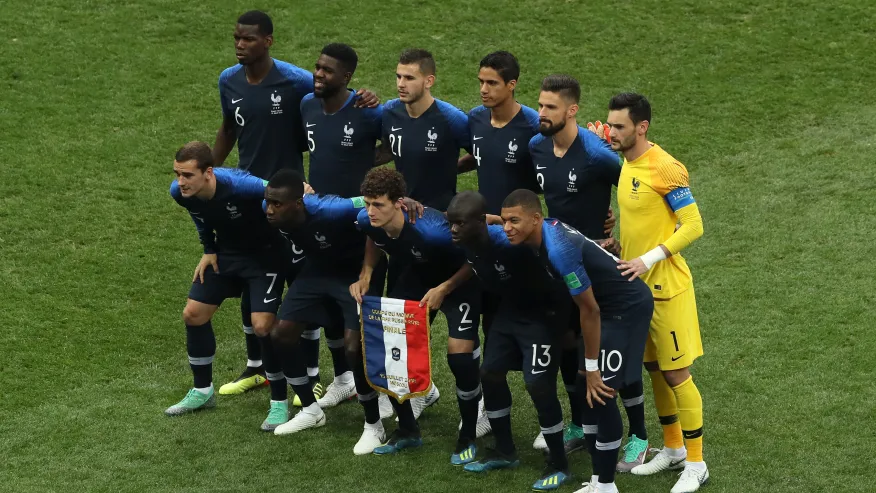
France national team before the FIFA World Cup Final, Russia 2018. Photo: © FIFA / Getty Images.

Match action with Mbappé during the FIFA World Cup Final (France vs Croatia), Russia 2018. Photo: China News Service / Getty Images.
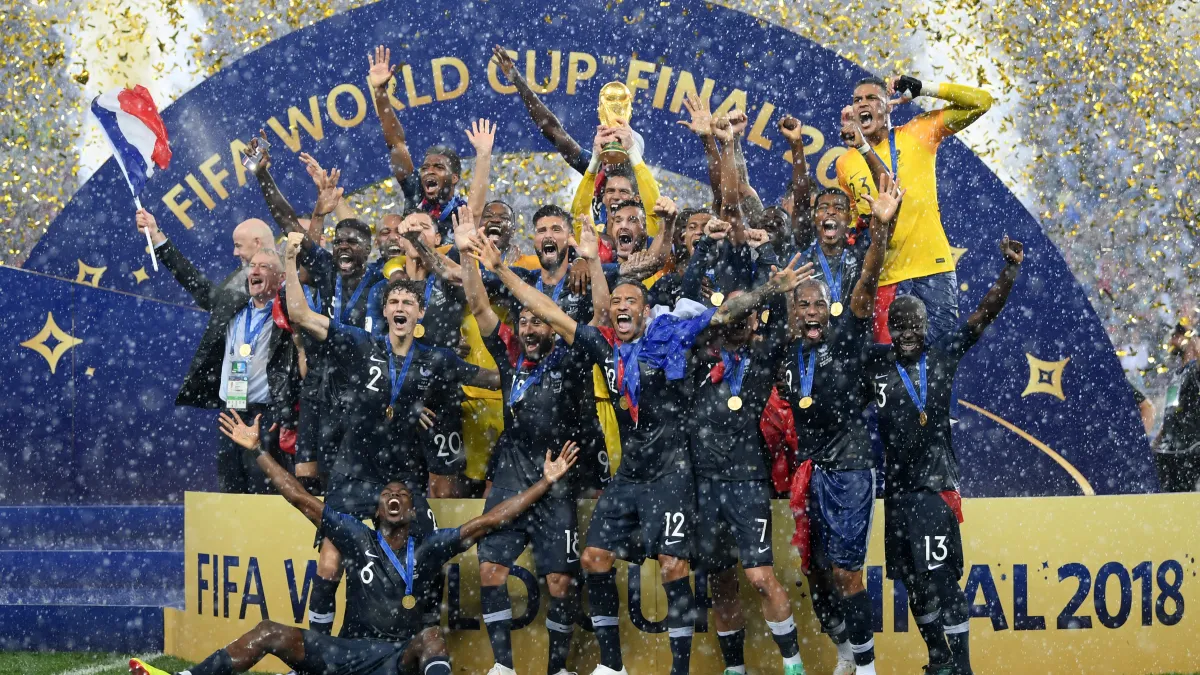
France celebrating after winning the FIFA World Cup, Russia 2018. Photo: © FIFA / Getty Images.
Tournament Firsts
- First time all games were produced in 4K high definition TV.
- First time VAR used in a World Cup.
- First time Japan won in Europe during World Cup play.
- First time fair play (yellow cards accumulated) used to determine tiebreaker in group stage (Japan and Senegal had identical records and goal difference).
- First time England won a shootout game in World Cup after they had failed in three previous attempts (1990, 1998, and 2006).
- First time Germany, Argentina, or Brazil had not reached the semi-finals.
- First time set piece goals reached 27%, highest ever (if you include PKs but not shootouts, the percentage is even higher at 43%).
- First team to come back from behind three times in a row (Croatia) in the knockout stages (round of 16, quarterfinals, and semifinals) and win.
- First ever own goal (Mandžukić for Croatia) in a World Cup final.
- First ever PK given by VAR during a World Cup final.
Relevant Players
- Luka Modrić (Croatia) – Midfield controller and Golden Ball winner who carried Croatia to the final.
- Kylian Mbappé (France) – Explosive young star who emerged as one of the best players in the world, and was the youngest player for France to score in a World Cup.
- Eden Hazard (Belgium) – Creative leader and standout performer in Belgium’s third-place finish.
- Harry Kane (England) – Golden Boot winner and focal point of England’s attack.
- Cristiano Ronaldo (Portugal) – Scored a hat trick vs Spain and led Portugal’s attack, showing world-class individual quality.
- Denis Cheryshev (Russia) – A surprise stars, scoring key goals and helping Russia reach the quarterfinals.
The Middle East awaits its turn amid much controversy
The 2022 World Cup in Qatar promised a historic shift as the first tournament held in the Middle East and the first to take place in November–December instead of summer. It was expected to showcase new technological innovations, including further developments following VAR, alongside evolving tactical trends after the surprises of 2018. At the same time, the tournament generated global attention not only for football but also for debates around climate, infrastructure, the use of labor under terrible conditions, and the significance of hosting the World Cup in a new region.
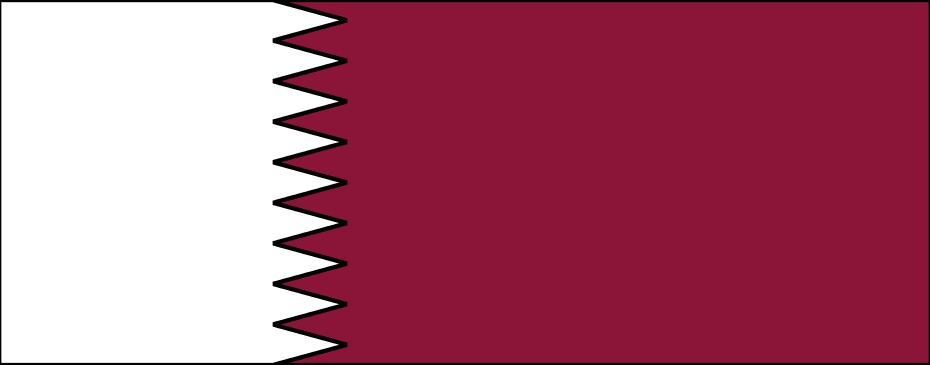
مرحبًا بكم في قطر، حيث تتحول الصحراء إلى قلب أعظم عرض كروي في العالم.

Recommended for you