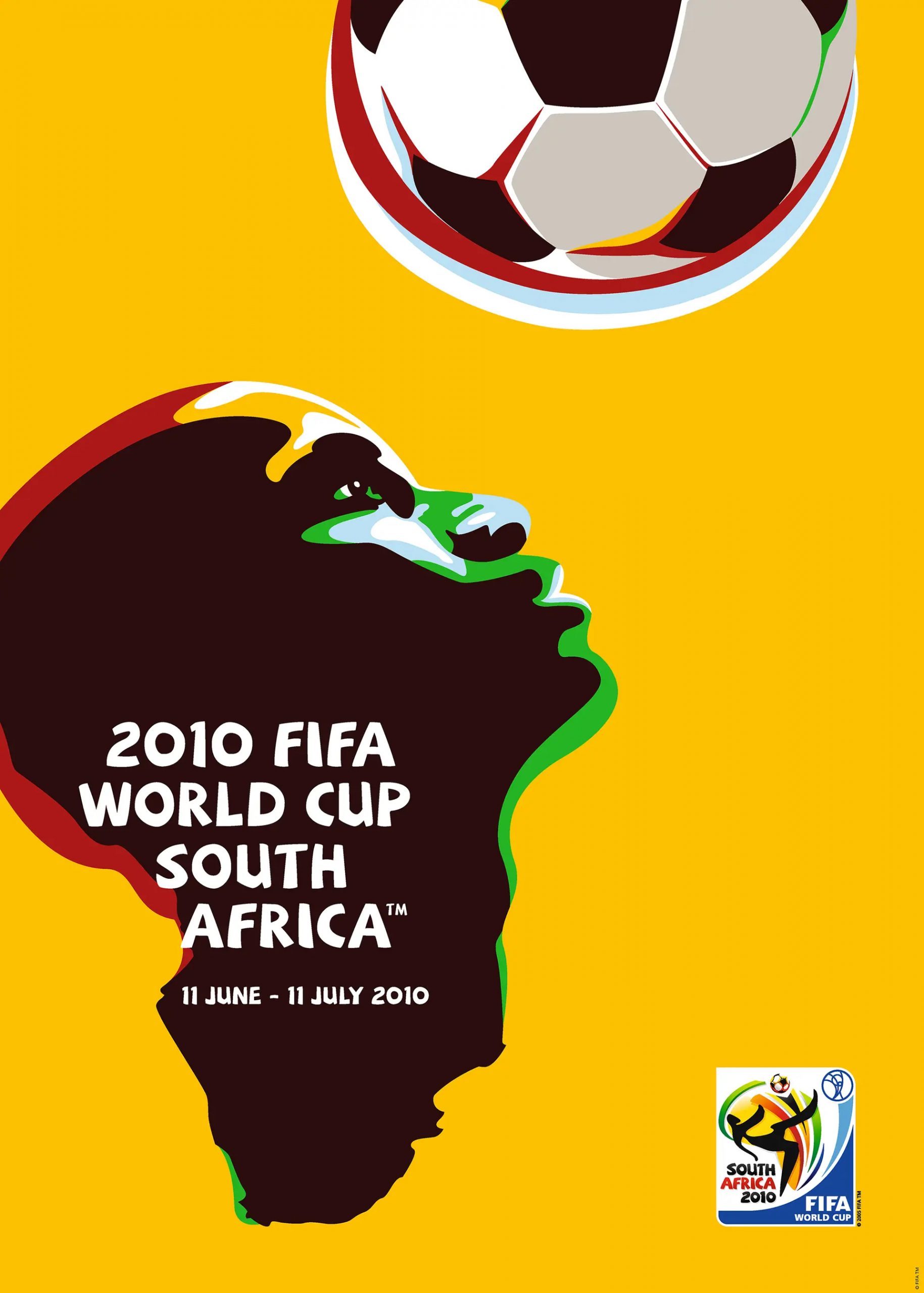
© FIFA Official Poster – 2010 FIFA World Cup South Africa™
In 2010 the World Cup visited the second largest continent by land mass, the place of the origin of our species: Africa. After several attempts to land the world’s most popular sporting event in that region, it was Africa’s turn. Four continents had held the event up to that time: the Americas, Europe, and Asia. It was now time for a continent that had shown strong growth both in participation as well as results to showcase its culture, its progress, and its ability to organize and host an event that was watched by billions around the world.
But the path to this World Cup had been tortuous. South Africa had been under the horrible system of apartheid for 46 years, starting in 1946. It was only in 1994 with the election of Nelson Mandela that the system was finally and officially dismantled. However, the world and various soccer federations had doubts about the nation’s ability to organize such a global event, given their recent acceptance back into the global community after being banned due to their racist policies. There was condescending talk about an African country, especially one that had been cut off from the world for decades, being able to mount such a global event. This despite the country’s very successful hosting of the 1995 Rugby World Cup and in which they even won it against all odds.
The bidding process included the countries of Egypt, Morocco, a joint bid from Libya and Tunisia, and South Africa. But the FIFA Executive Committee decided to not allow co-hosted tournaments since their rules specifically said that only one country could host (the 2002 Korea/Japan World Cup was conveniently described as a “one-off” event). Following this decision Tunisia withdrew and Libya was unable to meet the official List of Requirements. That left Egypt, Morocco, and South Africa to compete for the 2010 World Cup. On a related note, FIFA would eventually modify its official rules to allow co-hosting bids that would re-shape the event once more.
The winning bid was announced by then FIFA president Sepp Blatter on May 15th, 2004, in Zürich. In the first round of voting, South Africa received 14 votes, Morocco received 10 and Egypt no votes. South Africa, which had narrowly failed to win the right to host the 2006 event, was awarded the right to host the tournament.
A key personality that many think pushed South Africa’s bid over the line was Nelson Mandela, who spoke to the Executive Committee one day before the vote. He told them that South Africa was “ready, able, willing and capable,” framed the World Cup as the symbolic completion of South Africa’s post‑apartheid reintegration, and spoke emotionally about soccer’s role in sustaining hope for him and his fellow prisoners while on Robben Island. His appearance was even more remarkable given that Mandela was 85 years old and in fragile health, underscoring how seriously South Africa treated the bid.
Unfortunately, as with other World Cups, there were accusations of bribery. This was confirmed through a US Department of Justice corruption investigation which proved that a $10 million payment linked to South Africa’s 2010 bid did occur and was directed at then CONCACAF President Jack Warner from Trinidad & Tobago. Part of this money eventually found its way to Chuck Blazer, a US citizen who was part of the FIFA Executive Committee who was responsible for reviewing and voting on bids. He later admitted that it was a bribe to buy votes, pleaded guilty to Racketeering conspiracy, wire fraud, and tax evasion in November of 2013, but agreed to cooperate fully with the FBI and U.S. Department of Justice (DOJ). Because of this he did not appear as a defendant in the later 2015 indictment.
The bottom line is that South Africa’s bid operated within a FIFA system that was already corrupt, and money linked to the bid was misused by FIFA power brokers, but the extent to which this was coordinated by the South African bid itself remains disputed.
The 2010 World Cup was about to be viewed by billions around the world who would not only witness more shocks, disappointments, and epic matches, but get a glimpse of a nation rising from the horrific racist legacy and transforming itself into a modern nation with a vibrant democracy that had been ushered in by the charismatic Nelson Mandela. The world would also witness and hear the buzzing sounds of the vuvuzela, an inexpensive horn made of plastic that fans around the world found annoying but that became a memorable symbol of this first African World Cup.
Finally, billions would watch as Spain showcased its “tiki-taka” style, a soccer tactical philosophy that used quick, short passes and continuous off‑ball movement to create numerical and positional superiority, control tempo, and progressively open defensive gaps. Their ability to dominate opponents with their sublime passing through a gifted generation of players would come to dominate the tournament, but not before some surprising bumps.
Qualifying
The number of teams registering to qualify for the 31 available 2010 World Cup spots was 204. Five withdrew (Bhutan, Central African Republic, Eritrea, Guam, and São Tomé and Príncipe) and one did not meet the certification requirements (Papua New Guinea). This meant that 198 nations played at least one qualifying game with the caveat that while South Africa automatically qualified, their participation in the Africa Cup counted as a “competitive match” for purposes of qualifying for the World Cup (a convoluted way for FIFA to claim that all teams had played at least one competitive qualifying match for the 2010 competition).
Italy, as the defending champions, still had to go through the intense European qualification rounds. They passed with flying colors, winding up in first place of their group, undefeated with seven wins and three draws. An impressive showing that made them one of the favorites for the 2010 tournament.
For the 2010 World Cup, the soccer confederations were allotted the following number of places:
- Europe (UEFA): 13 places
- Africa (CAF): Five places (+ South Africa qualified automatically as host nation for a total of six places)
- Asia (AFC): 4.5 places
- South America (CONMEBOL): 4.5 places
- North, Central American and Caribbean (CONCACAF): 3.5 places
- Oceania (Oceania Football Confederation): 0.5 places
UEFA and CAF had a guaranteed number of places, whereas the number of qualifiers from other confederations was dependent on play-offs between the highest placed teams in the qualification tournaments and did not guarantee a place in the finals, with CONCACAF’s fourth-place team facing CONMEBOL’s fifth-placed team, and AFC’s fifth-placed team facing the winners from the OFC.
Tie breakers in determining qualifying winners were more uniform as compared to previous World Cups. The tiebreakers were now in order of importance:
- Points
- Goal difference
- Goals scored
- Head-to-head points
- Head-to-head goal difference
- Head-to-head goals scored
- Drawing of lots
The one exception was South America (CONMEBOL). The reason was that its format was simple: one table of 10 teams, identical opponents (every team played the other nine twice), fixed qualifying positions, and no need for comparison across groups. Head‑to‑head and extra criteria would have added complexity without adding fairness.
The final list of qualified teams for the 2010 World cup was the following:

Table courtesy of Jose F Guerra
Countries debuting this time included Slovakia (as a standalone country having previously participated as part of Czechoslovakia) and Serbia (also a standalone country having previously participated first as Republic of Yugoslavia as the country was breaking up and later as Serbia & Montenegro).
Countries that surprisingly didn’t qualify either through competitive underperformance or bad refereeing calls were:
- Egypt (CAF) – Reigning Africa Cup of Nations champions (2006 & 2008), widely considered Africa’s strongest side entering qualification.
- Colombia (CONMEBOL) – Traditional South American power, regular World Cup participant (1990, 1994, 1998).
- Russia (UEFA) – Euro 2008 semi‑
- Croatia (UEFA) – Euro 2008 quarter‑finalists, eliminated England in Euro 2008 qualifying.
- Czech Republic (UEFA) – Euro 2004 runners‑up, regular World Cup/Euro participant in the 2000s.
- Turkey (UEFA) – Euro 2008 semi‑finalists, strong tournament pedigree (WC 2002 & Euro 2008).
- Sweden (UEFA) – Qualified for five straight World Cups before 2010.
- Republic of Ireland (UEFA) – Very competitive qualifying campaign, eliminated due to decisive goal involved Thierry Henry’s handball in a UEFA playoff.
Tournament
South Africa used 10 stadiums across nine cities, with half being new venues and the other half refurbished for the World Cup. The largest one in Johannesburg and known as “Soccer City” held 84,490 spectators with the smallest one, “Free State Stadium”, holding 40,911.
The draw to select the groups took place on December 4th, 2009. The hosts, South Africa, were seeded in Group A but it created discomfort because they were ranked 85th in the world. Nonetheless, that was the practice that had been in place for World Cup draws since 1998. The other seeded teams, in order of FIFA ranking were Brazil (#1), Spain (#2), The Netherlands (#3), Italy (#4), Germany (#5), Argentina (#6), and England (#7).
The final group configuration was the following:


Tables courtesy of Jose F Guerra
Immediately the pundits christened groups D and G as the “Groups of Death” because of the high quality of the teams. However, as it turned out, the real competitive groups wound up being F and H where the margins of victory were very thin and made for much drama on the final day of competition for those groups.
In recent World Cups, the final analysis of who are the favorites and who are the dark horses winds up including factors like group difficulty, travel logistics, and potential path through the knockout stages. The draw resulted in the following favorites either confirmed or included as a result of their possible path to the final:
- Spain – Reigning Euro 2008 champions, a refinement of the “total football” philosophy, a comfortable group, and a core and stable roster at its peak with Casillas, Pique, Ramos, Pujol, Xavi, Iniesta, Xabi Alonso, Villa, among others.
- Brazil – Strong, balanced squad (Kaká, Robinho, Luís Fabiano), experience‑heavy roster, tough group but still expected to advance.
- Germany – Manageable group, young generation (Müller, Özil, Schweinsteiger), tactical clarity under head coach Löw.
- Argentina – One player: Lionel Messi. Group was manageable but expectations were cautious given question marks about their head coach, Diego Maradona.
- England – Excellent qualifying campaign (winning nine and losing only one match, with 34 goals scored, and only six against), favorable group, golden generation.
There were also the dark horses that were not expected to win but were seen as possibly going all the way. They included:
- The Netherlands – Fairly easy group, very strong attacking core (Robben, Sneijder, Van Persie), but lingering skepticism due to prior tournament underachievement.
- Chile – Attacking, fearless Bielsa system, grouped with Spain but beatable opponents otherwise, tactical novelty intrigued analysts.
- Portugal – Ronaldo was in his prime, very tough group reduced expectations, but defensive solidity under Carlos Queiroz.
- Ivory Coast – Physical, elite midfield (Yaya Touré), strong recent tournament pedigree, but brutal group.
- Ghana – Strong showing at 2006, athletic and disciplined squad, group looked navigable
The tournament opened in Group A with a 1–1 draw between hosts South Africa and Mexico, highlighted by Siphiwe Tshabalala’s iconic opening goal. Uruguay topped the group with a dominant 3–0 win over South Africa, while Mexico’s 2–0 victory over France proved decisive. France imploded amid internal turmoil, finishing bottom after losing all their games and exiting without a win. South Africa became the first host nation eliminated at the group stage despite beating France 2–1. France went home losing two of its matches and only managing a draw.
Argentina dominated Group B by winning it with three victories, including a 4–1 defeat of South Korea that showcased attacking flair but defensive lapses. South Korea progressed thanks to their opening 2–0 win over Greece and held on despite losing heavily to Argentina. Greece earned their first-ever World Cup win by beating Nigeria 2–1, keeping qualification hopes alive until the final match. Nigeria finished bottom, undone by defensive errors and disciplinary issues.
In Group C, England drew 1–1 with the USA in a match remembered for goalkeeper Robert Green’s costly error (England and the USA had played before in the 1950 World Cup where a group of mostly amateur USA players beat the English 1– 0). Slovenia briefly topped the group after beating Algeria and leading England before losing 1–0 but ultimately missed out on goal difference. England advanced alongside the USA, who won the group after beating Algeria 1–0 with a stoppage‑time goal by Landon Donovan. The group was extremely tight, with Algeria eliminated despite conceding only two goals.
Germany ran over Australia 4–0 in the Group D’s opening match, announcing themselves emphatically. Serbia upset Germany 1–0 despite playing with ten men, then fell 2–1 to Australia, creating chaos in the standings. Ghana advanced with four points thanks to a late equalizer against Australia and became the only African team to reach the knockout stage. Germany finished top after cautiously beating Ghana 1–0.
The Netherlands cruised through Group E with three wins, though all by a single‑goal margin, emphasizing control over spectacle. Japan’s disciplined 1–0 win over Cameroon and a crucial victory against Denmark secured qualification. Denmark missed out after losing both key matches despite beating Cameroon 2–1. Cameroon exited with three losses, marking a disappointing end to their tournament.
Defending champions Italy were eliminated in Group F after drawing all three matches, including a stunning 3–2 loss to Slovakia despite leading twice (this would be the start of a precipitous decline of Italy’s performance both at the World Cup as well as in their difficulties in qualifying for future ones). Paraguay topped the group, earning their first World Cup group victory by beating Slovakia 2–0 and drawing their other matches. New Zealand exited unbeaten after three draws, including a famous 1–1 result against Italy, but failed to qualify on goal difference. Slovakia advanced at Italy’s expense in what was one of the tournament’s biggest shocks.
Widely labeled the “group of death,” Brazil and Portugal advanced in Group G after a tense 0–0 draw between them. Brazil beat North Korea 2–1 and Ivory Coast 3–1, though Didier Drogba’s late return made the latter competitive. Portugal thrashed North Korea 7–0, the largest win of the tournament, which decided qualification on goal difference. Ivory Coast were eliminated despite scoring more goals than Brazil.
There were great expectations to watch Spain and its dominating tiki-taka style, especially after the way they had dominated Euro 2008. But despite overwhelming control in their opening match against Switzerland (72% possession vs 28%, 25 shots for Spain vs 9 for the Swiss, 89% passing accuracy for Spain vs 67% for Switzerland) Spain failed to score, while Switzerland scored on a chaotic counterattack finished with the ball bouncing against several Spanish and Swiss players in the box before finally being kicked in by Gelson Fernandes in the 52nd minute. Because of past underperforming by Spain in World Cups some in the Spanish media revived old World Cup ghosts and even whether Spain had the mental toughness. Most of the media reacted calmly, saying this was an aberration but a wake-up call. Spain recovered with wins over Honduras and Chile. Chile impressed with aggressive play, including a 2–1 loss to Spain that still secured qualification. Switzerland exited after failing to score in their final two matches, drawing 0–0 with Honduras. Spain topped the group and regained momentum heading into the knockouts.
The Round of 16 produced both drama and controversy, most famously Frank Lampard’s disallowed goal in England’s 4–1 loss to Germany, a refereeing error that directly accelerated the push for goal‑line technology. Argentina swept past Mexico 3–1 amid another officiating scandal when Carlos Tevez’s clearly offside goal stood, overshadowing Lionel Messi’s creative display. Spain struggled past Portugal 1–0 thanks to David Villa, completing a tight passing move that marked Spain’s shift toward greater pragmatism. Ghana eliminated the USA 2–1 in extra time to become the last African team standing, while defending champions Italy were already gone before this stage. The officiating errors in the England Mexico losses prompted Sepp Blatter to issue an extraordinary apology to both countries, saying “I deplore when you see the evident referees’ mistakes”.
The quarterfinals are remembered for one of the most extraordinary moments in World Cup history: Luis Suárez’s deliberate handball in the 120th minute against Ghana, followed by Asamoah Gyan missing the decisive penalty, before Uruguay won the shootout. Germany demolished Argentina 4–0, with Thomas Müller, Özil, and Schweinsteiger delivering a generational performance that exposed Argentina’s tactical disarray. Spain edged Paraguay 1–0 in a match of extreme tension featuring two missed penalties and a goal‑line clearance before David Villa’s shot ricocheted in off both posts. The Netherlands beat Brazil 2–1 after Wesley Sneijder scored twice, capitalizing on a rare collapse by the pre‑tournament favorites.
Spain reached their first World Cup final by defeating Germany 1–0 through Carles Puyol’s towering header on a corner kick, completing a tactical masterclass of controlled possession and defensive balance. The score was tied 0–0 at halftime. As the players went to the dressing room, Puyol told Xavi that the next time they had a corner kick, he should send it to the penalty kick spot and that he would position himself there to head the ball. And that was exactly what happened. In the other semifinal, The Netherlands overcame Uruguay 3–2 in a fast, open contest highlighted by Giovanni van Bronckhorst’s stunning long‑range goal, one of the goals of the tournament. Unlike earlier rounds, refereeing played only a minor role here, with outcomes driven more by structure and execution than controversy.
The stage was set for the final: it would be Spain’s control versus the Netherlands’ physical, transitional threat. The world awaited what was expected to be a clash of exciting styles from two teams who had never won the World Cup, and one who came tantalizingly close in 1974 and 1978.
The Final
On July 11th, 2010, Soccer city was full, with 84,490 spectators awaiting a clash between two teams who had qualified by winning all their matches. Spain won 10 matches during qualifying, scored 28 goals with 5 against. They had lost their opening game but that didn’t stop them from continuing their run all the way to the final. The Netherlands had also won all of their qualifying matches, winning eight while scoring 17 and receiving only two against. They had also won all their matches to get them to the final of this World Cup. Many of the players knew each other either because they had competed inside their respective leagues or had been or were still teammates within their clubs in Europe.
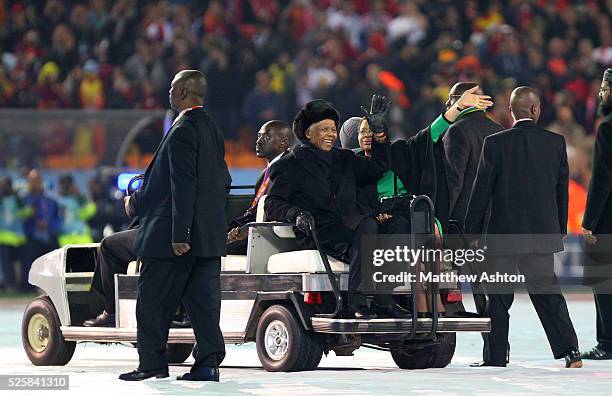
Nelson Mandela greets the fans before the final at the 2010 FIFA World Cup in South Africa (Photo by AMA/Corbis via Getty Images)
A poignant moment came before the match started when Nelson Mandela, already frail from age and health problems, was driven in a small cart across the pitch. The crowd rose to their feet, roared their homage amid the sounds of vuvuzelas and chants of ‘Madiba’ which was Nelson Mandela’s clan name in the Xhosa tradition and a sign of deep respect, affection and honor in the South African culture. It would be Mandela’s last public appearance.
The 2010 FIFA World Cup final between Spain and the Netherlands was one of the most tense and physical finals in tournament history, defined by control (Spain) versus disruption (The Netherlands). Years later, the central referee, Howard Webb from England, a very well respected official, said that he thought the physicality would go down once both teams settled down. But it never did as14 cards were issued throughout the game, nine to The Netherlands and five to Spain.
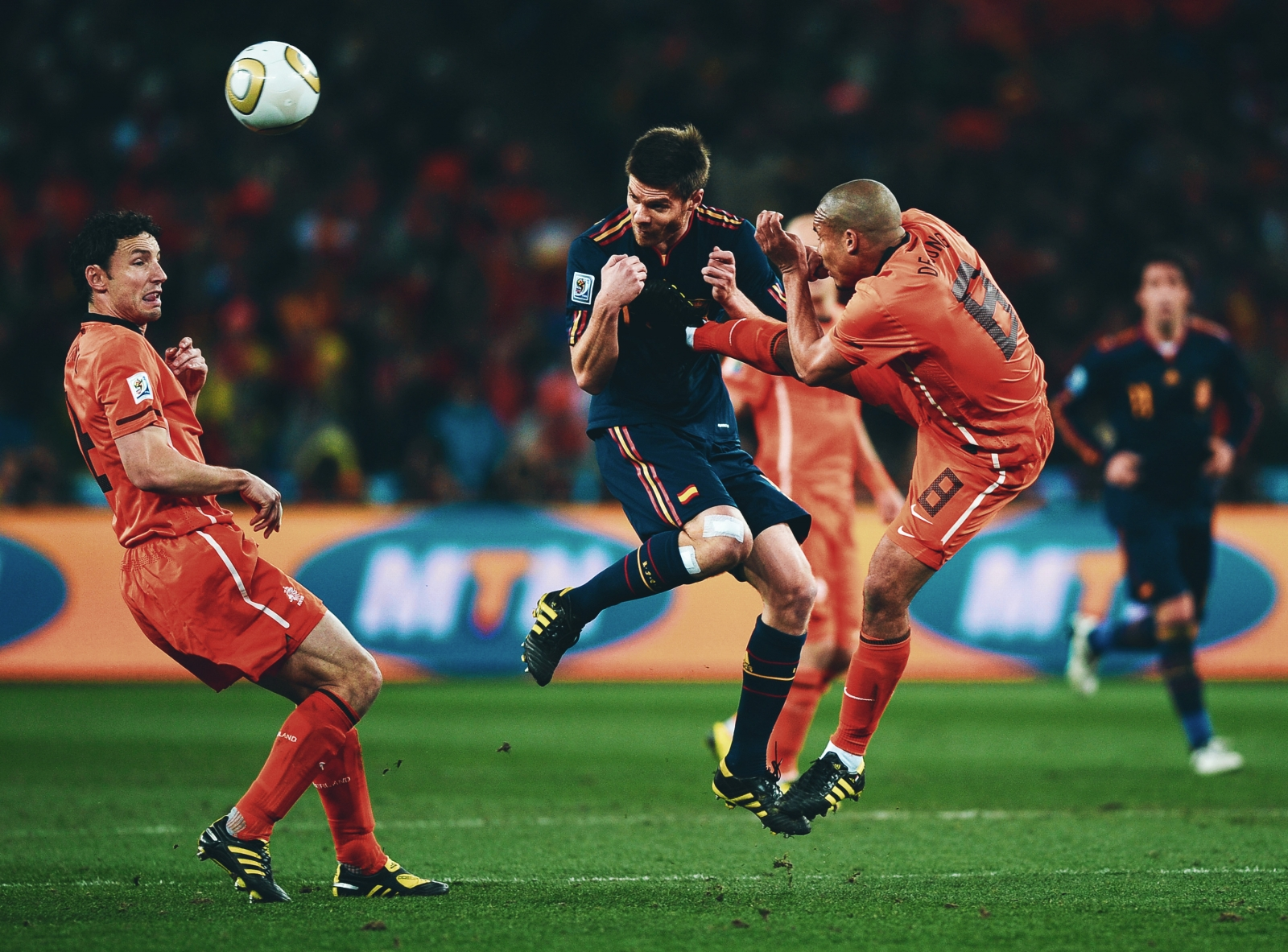
De Jong foul on Alonso – Photo © Shaun Botterill / Getty Images / FIFA
The opening half was tense and highly physical, with Spain controlling possession and the Netherlands focusing on breaking play and counter-attacking. Spain’s best chance came when Xavi slipped a pass through to David Villa, whose shot was blocked, followed later by Villa striking the post after a deflection. The Netherlands responded with danger of their own, especially through Arjen Robben’s pace on the break, though without a clear finish. The most violent incident of the half was Nigel de Jong’s studs‑up kick into Xabi Alonso’s chest, a foul widely viewed as a straight red but punished only with a yellow card (Webb also admitted years later that it should have been a red). The score remained 0–0 at halftime, despite mounting tension and missed opportunities.
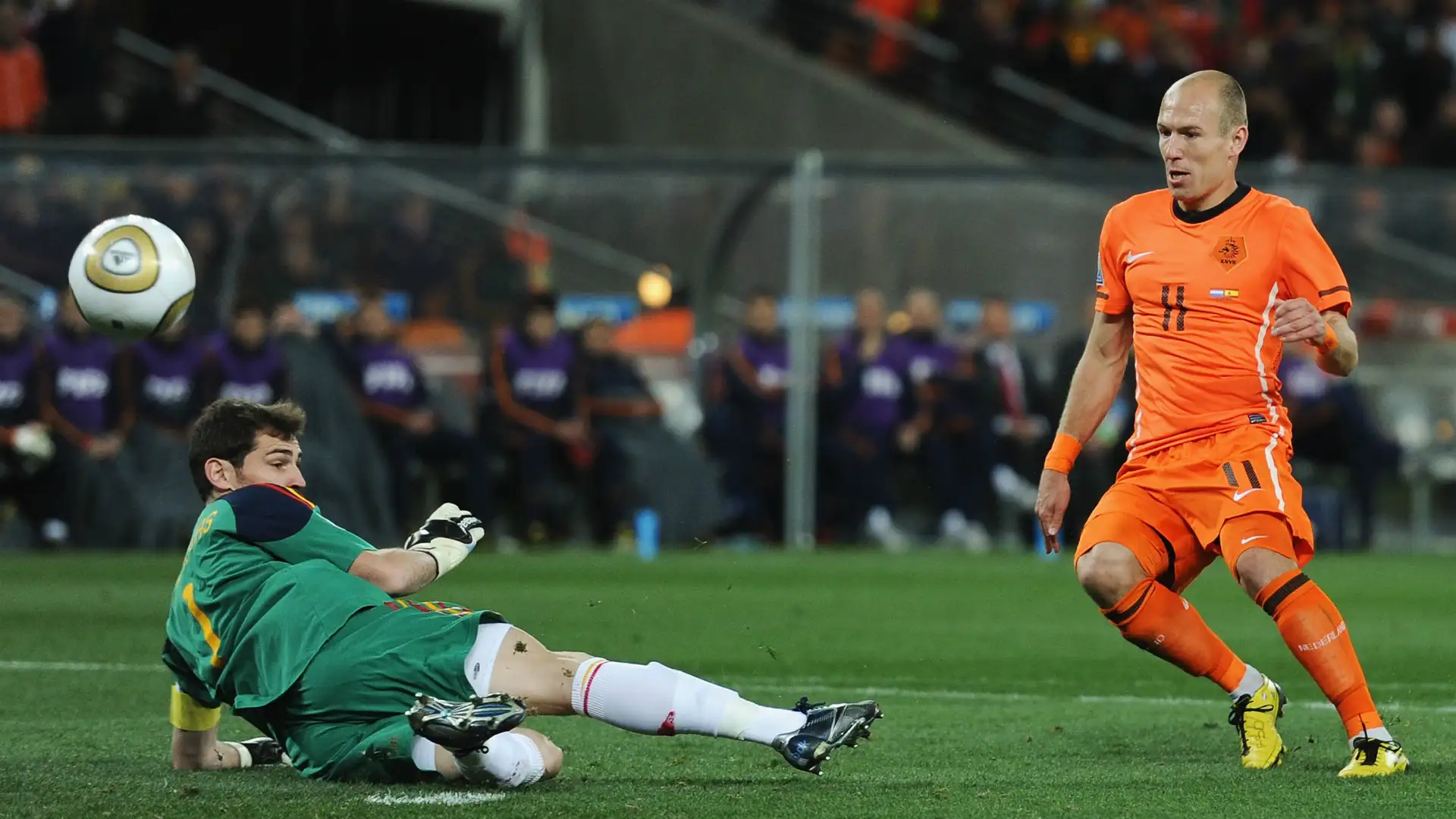
Casillas save – Photo © Shaun Botterill / Getty Images / FIFA
Spain continued to dominate the ball after the break, increasing pressure as the Netherlands sat deeper and relied on disruption. David Villa again came close, forcing a save and then failing to convert from a tight angle after sustained Spanish pressure. The Netherlands’ clearest chance of the match arrived when Arjen Robben broke through one‑on‑one, only to be denied by a crucial save from Iker Casillas with his right foot as he was diving towards his left. The Netherlands head coach said in an interview that if Casilla’s toe had been half an inch shorter, the ball would have gone in. Physical fouling escalated, with repeated tactical challenges and cautions as frustration grew on both sides. The match finished regulation time 0–0, sending the final into extra time. About eight minutes from the end of regular time, Robben again broke away and seemed to have another clear one-on-one, but center back Pujol caught up with him, pulled at his waist from behind, and gave Casillas enough time to come out and grab the ball. Pujol himself said that had Robben fallen it would have been a penalty kick and possibly even a red card for him. But the match went on.
Extra time saw fatigue expose space, finally opening the game up after long stalemate. Spain created chances through Cesc Fàbregas and Andrés Iniesta, both forcing saves or shooting narrowly wide. It was The Netherlands suffered a major setback when John Heitinga received a second yellow card, reducing them to ten men. With four minutes remaining, Iniesta finished calmly after a pass from Fàbregas to make it 1–0 to Spain in extra time. Spain then managed the closing moments carefully to see out the result.
The tournament finally gave the perennial underperformers, Spain, the trophy they had chased, to great heartbreak and disappointment, since 1934. But on this day their combined technical dominance, sublime passing, and defensive solidity finally bore fruits through a once in a generation set of players that won practically every trophy in sight during their reign. Their style emphasized patience, possession, and control rather than spectacle. The Netherlands reached the final unbeaten but increasingly relied on physicality as the tournament progressed. This was The Netherlands third final and third defeat as finalists. But they showed great class when they formed an honor guard as the Spanish players came down with their medals and the FIFA World Cup trophy, a gesture that was noted around the world. Spain’s victory completed a run as defending European champions and world champions (which would be followed up with another European championship two years later), cementing one of the most influential eras in international soccer.
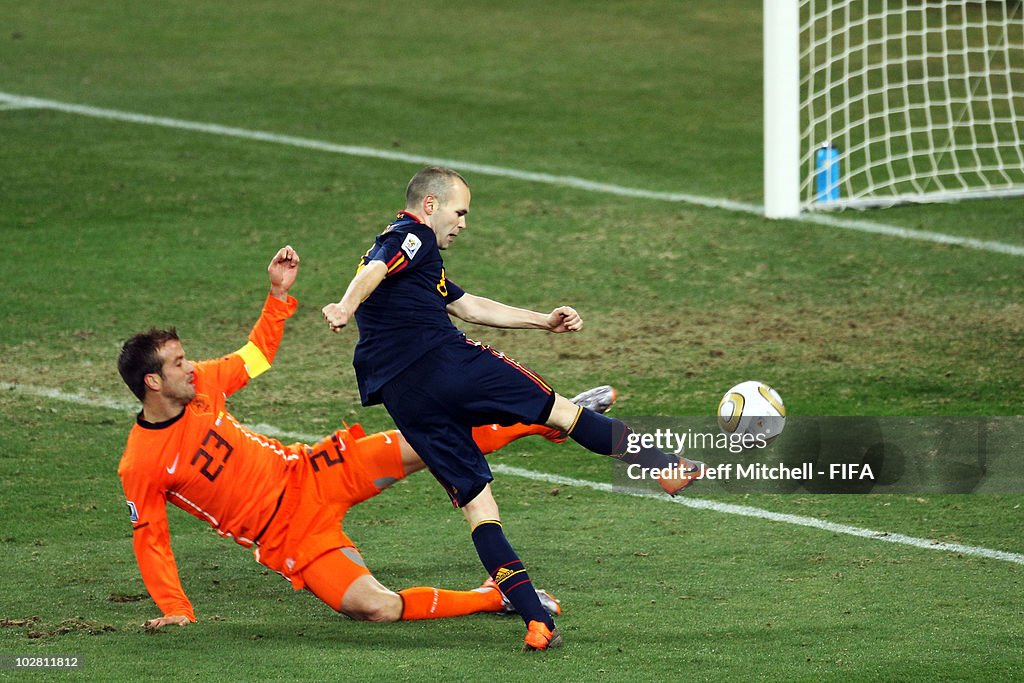
Andres Iniesta of Spain scores during the 2010 FIFA World Cup South Africa Final (Photo by Jeff Mitchell – FIFA/FIFA via Getty Images)
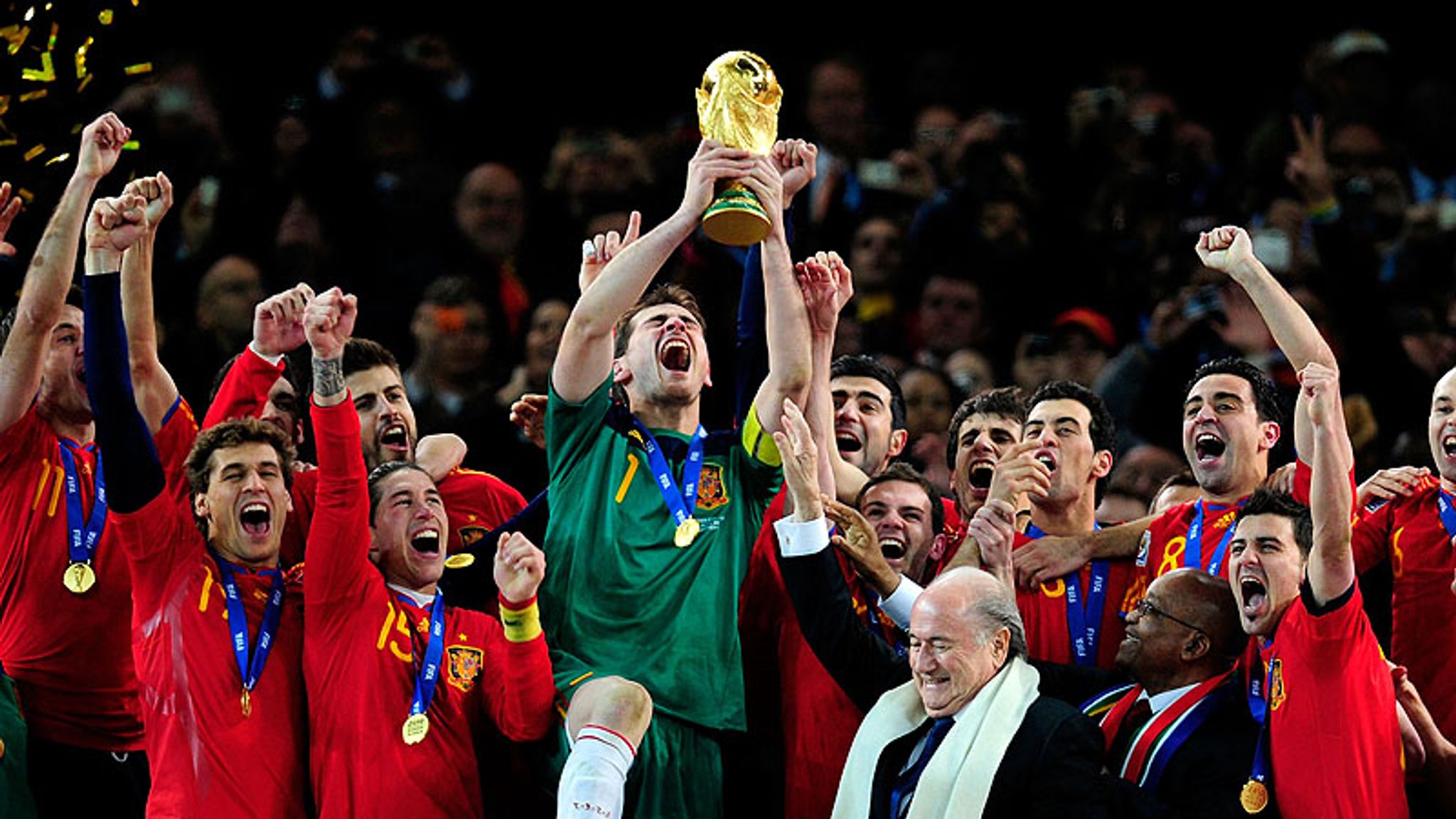
Captain Iker Casillas lifts the 2010 World Cup trophy – Photo © Shaun Botterill / Getty Images / FIFA
Tournament Firsts
- First World Cup held in Africa, a major milestone for FIFA and global soccer.
- First World Cup won by Spain, who would later win Euro 2012, completing a historic run after winning Euro 2008 and later Euro 2012, the first team to win three major championships in a row.
- First European team, Spain, to win a World Cup outside Europe.
- First World Cup where the defending champion, Italy, was eliminated in the group stage.
- First World Cup final officiated by a referee from England, Howard Webb, and relevant given that the English are considered the inventors of soccer.
- First World Cup in which the official match ball was designed specifically for high altitude play but which caused many complaints from players, especially goalkeepers, because of its “knuckleball” effect once it was in the air.
- First World Cup in which the Golden Boot was won with only five goals by German attacking midfielder Thomas Müller.
- First World Cup where a team, Spain, won the title despite scoring fewer goals (only eight) than some eliminated teams.
Relevant Players
- Andrés Iniesta (Spain) – Scored the winning goal in the final and was central to Spain’s possession‑based dominance.
- Thomas Müller (Germany) – Golden Boot winner and Best Young Player award, despite Germany finishing third.
- Wesley Sneijder (Netherlands) – Joint top scorer of the tournament and the creative engine behind the Dutch run to the final (he was beaten by Müller because the German had more assists).
- Diego Forlán (Uruguay) – Awarded the Golden Ball as the tournament’s best player, leading Uruguay to fourth place.
- Iker Casillas (Spain) – Captain and goalkeeper, crucial saves throughout the knockout rounds, including the final.
- Samuel Eto’o (Cameroon) – Key African figure at the first World Cup held on the continent.
The land of samba and “o jogo bonito” await its turn
The World cup would return to the Americas and to the soccer crazed land where the beautiful game indeed became beautiful. Brazil was ready and anxious to once again showcase their modern country. More importantly, they were excited at the possibility of winning at home and to once and for all exorcise the ghosts of 1950, the infamous “A Tragédia do Maracanã”.
 Bem‑vindos ao Brasil, casa do jogo bonito!