
© FIFA Official poster — 2002 FIFA World Cup Korea/Japan™
The men’s World Cup was getting bigger every year in terms of global coverage and revenues. FIFA, under its then president João Havelange, wanted it to become truly global. For the first time, it would be held in Asia, with the added surprise of being hosted by two countries, also for the first time. Japan and South Korea would host a competition filled with shocks, surprises, controversies, and heated rivalries, with impeccable organization and passionate hosts. Unfortunately, it would be marred by poor refereeing that would prompt major changes in the selection of World Cup referees as well as the eventual use of technology.
South Korea, Japan, and Mexico submitted bids. Mexico’s was never seriously considered even if they would have been ready to host given their experiences with hosting two events, a summer Olympics, and a strong soccer infrastructure (as well as a modernized telecommunications and transportation network). FIFA had its sights on making the sport a truly global phenomenon. At first, South Korea and Japan mounted a fierce and bitter competition to earn hosting rights. South Korea’s bid was seen as a response to its political and sporting rival, Japan. Also, the decades long political friction between the two countries did not help matters. But as time passed, both mounted a global PR campaign trying to win over large blocks of countries to support their bids which became one of the dirtiest and most costly lobbying efforts FIFA had ever seen, with open disparagement of the rival bid (which had never occurred before). This prompted the head of the Asian Football Conference, Sultan Ahmad Shah from Malaysia, to intervene because in addition to that rivalry between two potential hosts, FIFA boss João Havelange was backing the Japanese bid while his rival, UEFA chief Lennart Johansson, sought to undermine Havelange’s plans.
Shah’s intervention was a watershed moment since he realized that if nothing was done, Asia might lose the World Cup entirely. Also, FIFA’s Executive Committee was increasingly deadlocked, with strong backing for both Japan and Korea and no consensus emerging.
In short, he stepped in to save Asia’s first-ever World Cup from collapsing under its own politics. The Sultan proposed and relentlessly pushed the idea of joint hosting, something FIFA had never done before for a men’s World Cup. His intervention included:
- Mediating between Japan and South Korea, urging both federations to stop direct attacks and accept compromise for the greater continental goal.
- Lobbying FIFA leadership, including João Havelange and Executive Committee members, that co‑hosting was the only viable solution to break the stalemate and keep the tournament in Asia.
- Framing co‑hosting as a win‑win: Asia gets its first World Cup; both nations get prestige; FIFA avoids alienating either powerful bidder.
But even after getting both countries to agree to a joint bid, there was still the matter of how the tournament would be named. Up till now, only one country per tournament had hosted the event. What would it be called? How many games would be hosted in each country? Who would host the opening match and who would host the final? Japan wanted to use the English language version of country names for alphabetical purposes, so it suggested “World Cup Japan/Korea 2002. South Korea wanted to use the French spelling supposedly to honor FIFA’s French root which would have made the name “Coupe du Monde Corée du Sud/Japan 2002”. In the end FIFA intervened and they named it “Korea/Japan 2002”, the opening match would be held in South Korea, and the final in Japan.
A curious little detail was that during this process, South Korea proposed to FIFA that a small number of matches be held in North Korea to assist in reunification efforts. FIFA acknowledged the request but turned it down due to:
- Security concerns (access, crowd control, emergency response)
- Lack of FIFA‑approved stadiums
- Travel and visa impossibilities for fans, teams, media, and officials
- Broadcast and commercial restrictions
- Sanctions and political unpredictability
The global soccer fan base was about to watch an impeccably organized tournament but at odd hours: average of 5:00 am starting time for the Americas, 11:00 am for Europe, 10:00 am for Africa, and 6:00 pm for Asia. But it would be another memorable one; the audience would be served a dish of unpredictability unlike any other World cup before.
Qualifying
The sport had indeed gone global with 199 teams registered (an additional 25 teams from 1998, up 14%) for the 32 spots (the number of teams for the World Cup was maintained at the same level as four years before). Of those 32, this time three were already automatically qualified instead of the usual two: South Korea and Japan as hosts, and France as the title holder. That meant that 193 teams would compete for the remaining 29 spots, (three had withdrawn). Part of the increase in the number of teams that registered for qualification purposes were new nations that had been formed as a results of the collapse of the Soviet Union and Yugoslavia, less number of rejected applications by FIFA, and a push by FIFA to ensure nations were fully certified to have the necessary requirements to register.
This is how the various soccer federations were allotted places for qualifying:
- Europe (UEFA): 14.5 places, one of them went to automatic qualifier France, while the other 13.5 places were contested by 50 teams. The winner of the 0.5 place would advance to the intercontinental play-offs against a team from Africa (AFC).
- South America (CONMEBOL): 4.5 places, contested by 10 teams. The winner of the 0.5 place would advance to the intercontinental play-offs against a team from Oceania (OFC).
- North, Central America and Caribbean (CONCACAF): three places, contested by 35 teams.
- Africa (CAF): five places, contested by 51 teams.
- Asia (AFC): 4.5 places, two of them went to automatic qualifiers South Korea and Japan, while the other 2.5 places were contested by 40 teams, with the winner of the 0.5 place advancing to the intercontinental play-offs against a team from Europe (UEFA).
- Oceania (OFC): 0.5 place, contested by 10 teams. The winner of the 0.5 place would advance to the intercontinental play-offs against a team from South America (CONMEBOL).
For purposes of qualification, all soccer federations had to use three points for a win, one point for a draw, and zero for a loss. All soccer federations also had to use goal differences as tie breakers in case there were ties in table positioning. But after that, each soccer federation would decide its criteria for tie breakers. The most comprehensive one was Europe (UEFA) with points, overall goal difference, goals scored, head‑to‑head points, head‑to‑head goal difference, head‑to‑head goals scored, fair play ranking, and finally drawing of lots if necessary. To this day, every soccer federation uses a different way of determining tie breakers in the event teams are tied in points and goal difference.
The final list of qualified teams was:
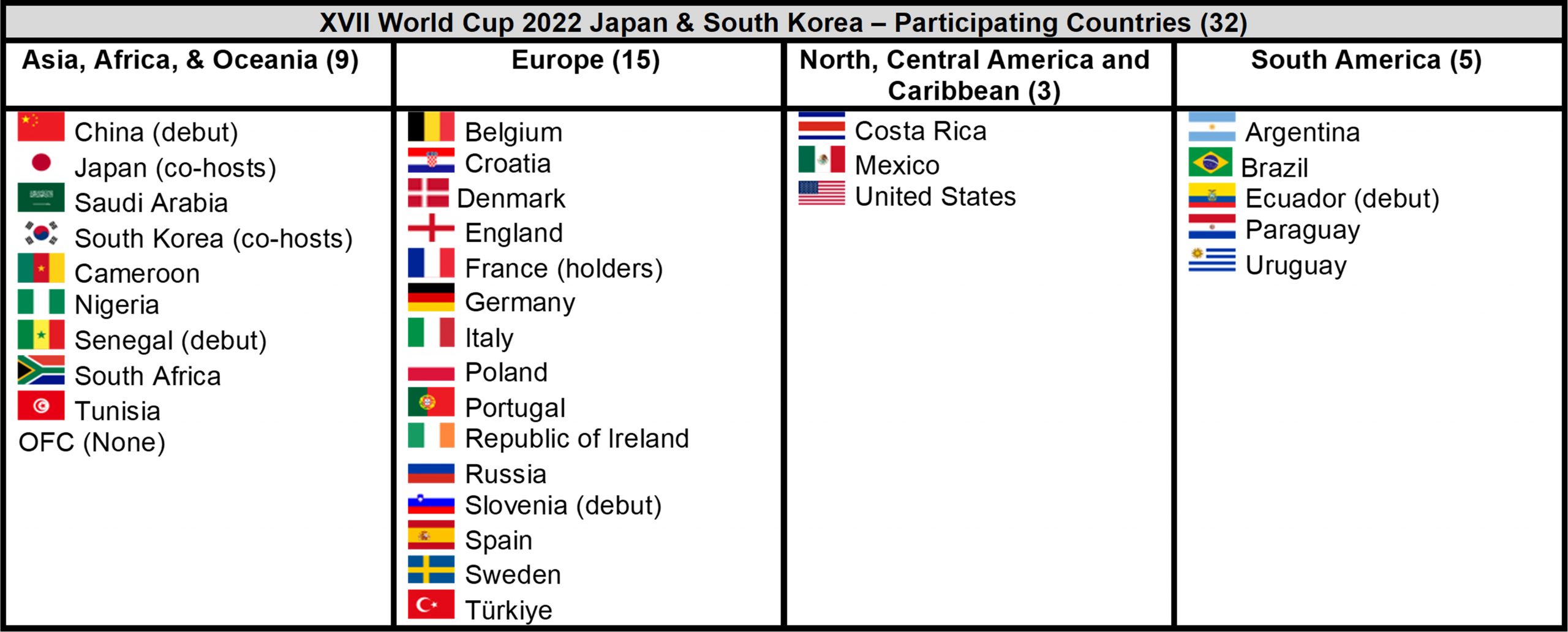
Table courtesy of Jose F Guerra
Four countries participated for the first time: Senegal, China, Slovenia, and Ecuador (all four coincidentally from four different continents).
Teams that surprisingly didn’t qualify included:
- Netherlands – European powerhouse in the 1990s and a semi-finalist in 1998.
- Colombia – One of South America’s strongest sides in the 1990, qualified for 1990, 1994, and 1998.
- Czech Republic – Euro Cup 1996 runner-up, a strong side immediately after the breakup of Czechoslovakia.
- Chile – Qualified for the 1998 and was a traditional strong South American
- Greece – Had World Cup experience from 1994 (shockingly won Euro 2004 just two years later).
The Tournament
South Korea and Japan each provided 10 venues, with one stadium each, for a total of 20 cities and stadiums. Groups A through D played all their matches in South Korea and Groups E through H played all their matches in Japan. No matches were played in Tokyo, making it the second capital of a host country not to have a World Cup venue after Bonn of West Germany in 1974. However, the cities of Saitama and Yokohama, which are part of the Greater Tokyo Area, hosted matches.
The draw had eight seeds, with the first three being the hosts (Japan and South Korea) and the third being the title holders (France). The remaining five seeds were taken from a seeding calculation that FIFA had developed for the 1998 World Cup which produced the following additional seeds:
- Brazil – ranked #1
- Argentina – ranked #2
- Italy – ranked #3
- Germany – ranked #4
- Spain – ranked #6
France was ranked #5 but because they were already seeded as title holders, the next one down, Spain, was included.
While no rules were broken, the practice of seeding the host team(s) ensured that neither Japan or South Korea would face a top ranked team during group stage which raised some eyebrows since neither of the hosts were ranked in the top 8 of FIFA’s calculations.
The final grouping after the draw was the following:


Tables courtesy of Jose F Guerra
As the news spread about the results of the draw, the pundits immediately made Argentina the favorite to not only win its group but also to win the tournament. They had a strong core base with names like Batistuta, Crespo, Verón, Zanetti, and Ayala. Not only that, they also entered the tournament by running away with their qualification in CONMEBOL and had been unbeaten in 18 matches leading into the World Cup. France, with most of their core back from their 1998 and being the title holders, were also heavily fared, especially with the group they were placed in. Brazil, as always were considered a favorite because of their previous World Cup performances and their deep talent, especially at the top with Ronaldo (the original one), Rivaldo, and Ronaldinho (known as “the three Rs”). However, there were doubts about their ability to perform given the implosion they had four years before in the final against France and overall perception that the team was not as good as some thought. Italy, a consistent dark favorite, continued to have an elite defensive structure and stars like Totti, Nesta, Maldini, Buffon, and Del Piero. Spain, always an outside contender, had excellent qualifying form and a strong technical squad but they the usual doubts about their ability to perform at the highest level persisted. And finally, Germany, while never to be discounted, were respected, but not hot favorites. They was considered a weak squad by their historical standards and weren’t looked at as a big menace.
Defending champions France suffered one of the greatest collapses in World Cup history, exiting bottom with one point and no goals scored. Senegal shocked the tournament open by beating France 1–0 in the opening match, a result that defined the group and the competition’s tone. Denmark advanced comfortably, while Uruguay narrowly missed out after a dramatic 3–3 draw with Senegal, having twice clawed their way back in the decisive match.
Spain dominated the group, winning all three matches and scoring freely. Paraguay edged South Africa for second place on goal difference after a tightly contested group battle. Slovenia exited without a point, struggling defensively throughout. Suddenly the Spaniards were the talk of the tournament and their soccer-mad nation could finally dream of a very deep run and possibly even a world championship.
Brazil won all three matches, but their progress was not without controversy. The opening 2–1 win over Türkiye featured a disputed late penalty and Rivaldo’s infamous play‑acting incident. Late in the game, the Brazilians were wasting time as they were ahead 2-1. Turkish player Hakan Ünsal kicked the ball back at Rivaldo. As the ball hit the Brazilian’s leg, Rivaldo went down dramatically and grabbed his face. The referee issued a second yellow card to Ünsal who was expelled from the match. FIFA later issued a fine to Rivaldo, recognizing the embarrassing mistake of the referee. Nonetheless, Türkiye advanced on goal difference ahead of Costa Rica, while China ended their World Cup debut without a goal or point.
Co‑hosts South Korea topped the group, driven by relentless pressing and intense home support. The United States stunned Portugal 3–2, racing to an early lead in one of the tournament’s biggest group‑stage upsets. Portugal were eliminated despite their star‑studded squad, while Poland recovered pride with a final‑match victory after two early defeats.
Germany cruised through the group, highlighted by an 8–0 demolition of Saudi Arabia, the largest scoreline of the tournament. Ireland advanced unbeaten, with Robbie Keane’s late equalizer against Germany proving decisive. Cameroon were eliminated after missed chances and disciplinary issues derailed an otherwise competitive campaign.
Dubbed the “group of death,” it delivered one of the tournament’s biggest shocks as Argentina were eliminated despite being heavy favorites. England advanced after David Beckham’s penalty secured a tense 1–0 win over Argentina, exorcising ghosts from 1998. Sweden topped the group with disciplined, efficient performances, while Nigeria exited after inconsistent playing.
Mexico won the group, continuing their tradition of strong group‑stage performances that started in 1994. Italy advanced but raised concerns after an unexpected 2–1 loss to Croatia, exposing defensive and disciplinary vulnerabilities. Croatia and Ecuador were eliminated despite each recording notable victories.
Japan made history by winning their first ever World Cup group, becoming the first Asian host to reach the knockout stage. Belgium advanced unbeaten but were criticized for conservative play. Russia and Tunisia exited after failing to match the group’s intensity and organization.
Before we get into the knockout stages, it is worth mentioning the glaring refereeing calls/mistakes that were made that would continue throughout the rest of the tournament and which would eventually drive several changes on referee selection and the use of technology.
We have already talked about the Rivaldo injury simulation and red card. The fact that FIFA acknowledged the mistake during the tournament was surprising since they rarely say anything about officiating mistakes. During the Group F England vs Argentina match, David Beckham was awarded a penalty after a teammate of his was brought down in the box by Argentinian defender Mauricio Pochettino. Many think it was a dive by the English player, but the call stood. In Group E, the match between Germany and Cameroon produced 16 yellow cards and 2 red cards. It is widely seen as a classic example of poor game management by the referee. Finally, the Group D match between hosts South Korea and Portugal was marred by uneven disciplinary actions by the referee. Two Portuguese players were shown red cards for reactions or plays that the South Koreans had also done but were not punished.
The Round of 16 began with Germany narrowly defeating Paraguay 1–0, scoring late to break a disciplined defensive performance. Spain drew 1–1 with the Republic of Ireland and advanced 3–2 on penalties after extra time failed to produce a winner. Denmark eliminated England 3–0, delivering one of the round’s most decisive results through tactical control and clinical finishing. Brazil defeated Belgium 2–0, with Ronaldo on the scoresheet as Brazil overcame an early Belgian threat.
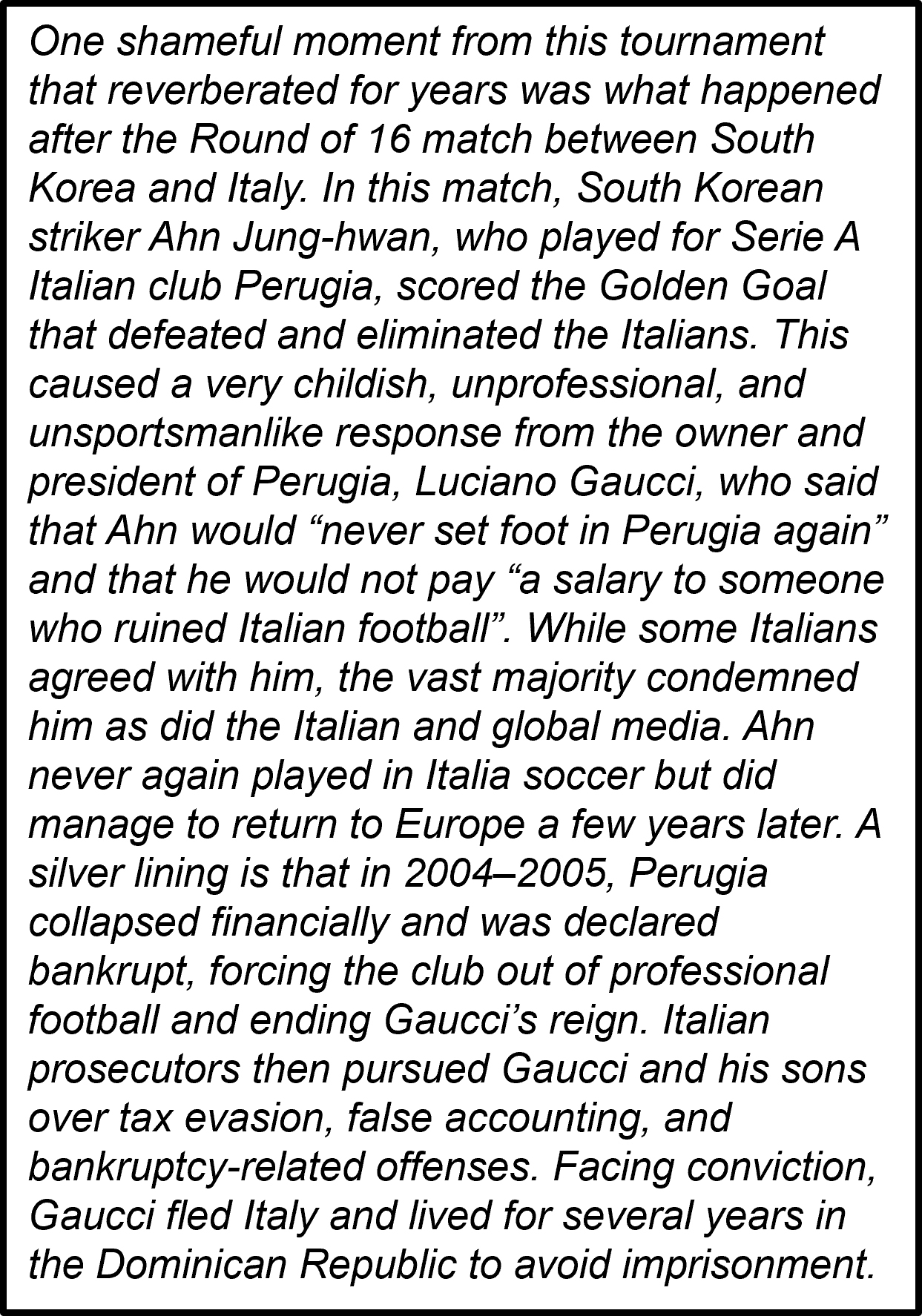
The most dramatic matches followed, beginning with Senegal’s 2–1 golden‑goal victory over Sweden, sending the tournament debutants into the quarterfinals. South Korea beat Italy 2–1 after extra time, a match remembered for disallowed Italian goals, a missed penalty, and Francesco Totti’s controversial red card. Türkiye defeated co‑hosts Japan 1–0, ending Japan’s run in a tightly balanced match. The round concluded with the United States defeating Mexico 2–0, a landmark win that sent the U.S. to the quarterfinals for the first time since 1930.
By the end of the Round of 16, the tournament had dramatically reshaped expectations. Italy, England, Sweden, and Mexico were eliminated, while South Korea, Senegal, Türkiye, and the United States advanced, highlighting the collapse of several traditional powers. Three matches were decided by extra time, golden goals, or penalties, reinforcing the volatility of the format. This round firmly established the 2002 World Cup as one of the most unpredictable, and controversial, tournaments ever played.
The quarterfinals produced a mix of elite control and deepening controversy. Germany defeated the United States 1–0, advancing after a close‑range goal and a widely cited missed handball decision on the German goal line. Brazil beat England 2–1, highlighted by Ronaldinho’s long‑range free kick after England briefly led the match. South Korea eliminated Spain on penalties (5–3) after a 0–0 draw, in a game where two Spanish goals were disallowed, intensifying scrutiny of officiating. Türkiye defeated Senegal 1–0 after extra time, ending the tournament’s major Cinderella run with a golden‑goal strike.
The semifinals marked a return to control and restraint after earlier chaos. Germany beat South Korea 1–0, exploiting fatigue in the hosts and ending their historic run without major controversy. Brazil defeated Türkiye 1–0, winning a tight, tactical match through Ronaldo’s composed finishing. Both games were low‑scoring and disciplined, reflecting cautious semifinal soccer. Notably, officiating passed without serious incident in contrast to earlier knockout rounds. The results set up a traditional final between Brazil and Germany, reframing the tournament around established powers.
The Final
On June 30th, 2002, at the International Stadium in Yokohama with 69,029 fans in attendance, two undefeated teams, Germany and Brazil would dispute their seventh and sixth final match appearances respectively. Brazil would be playing their third consecutive final tying West Germany’s record from 1982, 1986, and 1990. The first half was tense and tactical, with Germany organized defensively and Brazil probing patiently without overcommitting. A key early moment came when Ronaldo collided with goalkeeper Oliver Kahn, testing both sides’ nerves but producing no goal. Chances were limited, though Rivaldo and Ronaldo repeatedly forced Germany deep. The half ended scoreless, reflecting caution rather than control.
The match turned in the 67th minute, when Oliver Kahn, up till then and almost unpassable goalkeeper, spilled a Rivaldo shot, and Ronaldo reacted fastest to score from close range. Germany struggled to respond, increasingly stretched as they searched for an equalizer. In the 79th minute, Brazil sealed the match as Rivaldo’s deliberate dummy wrong‑footed the defense, allowing Ronaldo to score his second. Kahn’s error on the first goal is widely considered the defining mistake of the final, uncharacteristic of his tournament‑long brilliance.
There were no major refereeing controversies, an unusual calm after a volatile knockout phase earlier in the tournament. Ronaldo finished as Golden Boot winner with eight goals, completing a remarkable comeback after missing the 1998 final. Brazil secured a record fifth World Cup title, winning all of their seven matches (a record), and reinforcing their attacking identity and resurrecting, even if it was for one more World Cup, its legendary “o jogo bonito” (the beautiful game) under Luiz Felipe Scolari. The three Rs (Ronaldo, Rivaldo, and Ronaldinho) had put Brazil in the summit one more time. Germany, disciplined but limited offensively, fell short without injured midfielder Michael Ballack, suspended for the final. The game is remembered less for drama than for clinical execution and one decisive error.
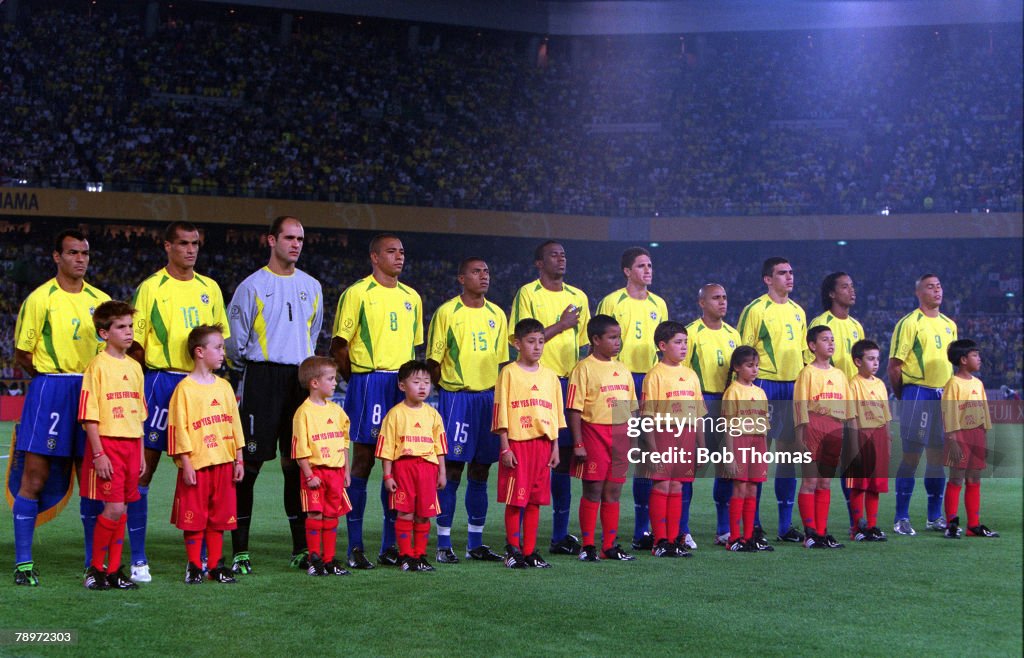
Brazil team lineup prior to a match at the 2002 FIFA World Cup Korea/Japan. © Getty Images / Bob Thomas
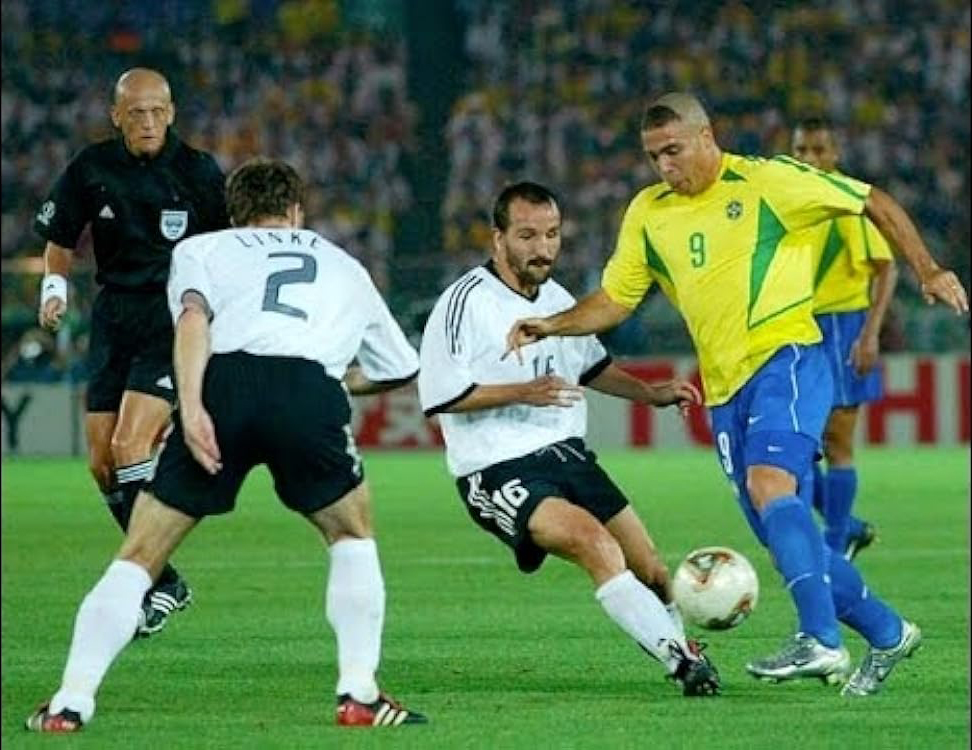
Ronaldo in action in the final against Germany with the great Italian referee Pierluigi Collina in the background. ©FIFA. Image courtesy of FIFA Films, from the official 2002 FIFA World Cup Korea/Japan™ motion picture.

Cafu lifting the cup. Celebration following the 2002 FIFA World Cup Final. © Getty Images / Damien Meyer
Tournament Firsts
This World Cup had many firsts but the most relevant were:
- First FIFA World Cup co‑hosted by two countries (Japan and South Korea).
- First World Cup held in Asia, breaking Europe/South America dominance as hosts and accelerating soccer’s global expansion.
- First time an Asian nation reached the semifinals, with South Korea’s run to fourth place remaining the best finish ever by a team from that region.
- First World Cup where the defending champion failed to win a match, with France exiting winless and scoreless in the group stage after winning in 1998.
- First World Cup with FIFA‑mandated fully modernized stadiums, with all venues were newly built or extensively rebuilt to uniform global standards.
- Final World Cup to use the “golden goal” rule, with several knockout matches were decided by sudden death, after which the rule was abandoned.
- First (and only) World Cup won by Brazil outside the Americas, completing Brazil’s record of winning the tournament on three different continents (Europe, the Americas, and Asia).
Relevant Players
- Ronaldo (Brazil) – Golden Boot winner (eight goals) and scorer of both goals in the final, completing one of the greatest personal comebacks in sports history and led Brazil to a record fifth title.
- Oliver Kahn (Germany) – The tournament’s Best Player (Golden Ball), the only goalkeeper ever to win it, carried Germany to the final, including a legendary performance against the USA in quarterfinals
- Park Ji‑sung (South Korea) – Scored the decisive goal against Portugal and symbolized South Korea’s historic run and was a key figure in the first Asian team to reach the World Cup semifinals.
- Hakan Şükür (Türkiye) – Scored the fastest goal in World Cup history (10.8 seconds) and led Türkiye to third place, their best-ever finish.
- Landon Donovan (United States) – Co-led the U.S. to the quarterfinals; named Best Young Player, and was the face of the USA’s best World Cup performance in the modern era.
- El Hadji Diouf (Senegal) – Catalyst for Senegal’s run to the quarterfinals in their World Cup debut and instrumental in the opening upset over defending champions France.
Next Tournament
Germany would host for the second time but now as a unified country. The tournament would be the last for the great “Zizou” (France’s Zinadine Zidane) in a dramatic final. The World Cup would now be consumed in real time with technology fully globalizing, digitizing, and instantly creating controversy, which drove serious debate that would lead to VAR and goal‑line technology.
 Deutschland heißt euch zur globalen Fußballparty willkommen!