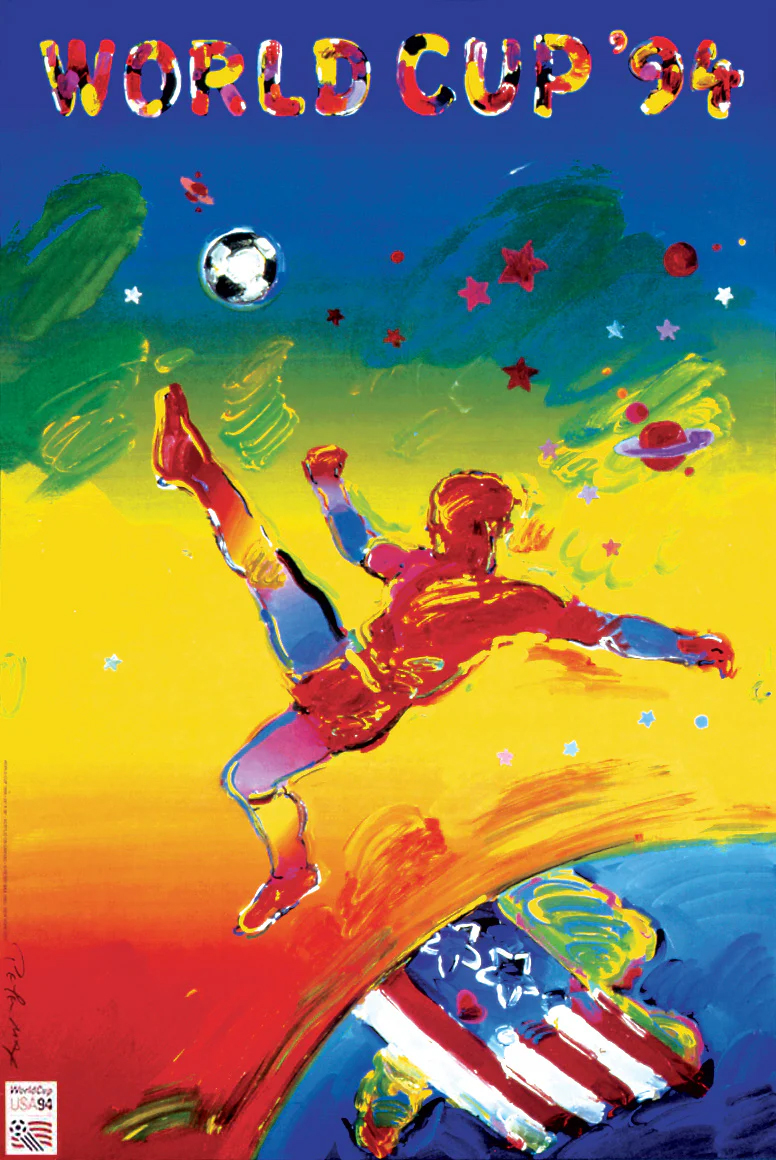
1994 FIFA World Cup USA, Official poster, Artwork by Peter Max
For the first time in the tournament’s history, the hosting rights went to a country that did not have a long and rich tradition as previous host nations. That is not to say that US soccer fans were unfamiliar with the sport. The nation had participated in World Cups starting with the 1930 edition, but their success had been mixed both in tournament play as well as in qualifying. Also, there was no top tier professional league, international soccer was barely broadcast within the country, and the media didn’t seem to have the interest or resources to properly cover the sport, both domestically as well as internationally.
Nonetheless, to the surprise of the world, the US won the bidding competition which also included Brazil and Morocco. The vote took place in Zurich on July 4, 1988 (Independence Day in the United States) and only took one round with the United States bid receiving a little over half of the votes by the FIFA Executive Committee members. FIFA also had a commercial interest in staging the World Cup in the USA since it believed it would lead to further growth and interest in the sport.
But it wasn’t just the intangibles that swayed FIFA. The US already had the stadium infrastructure in place, an outstanding communications network (both in transportation and telecommunications), plenty of lodging options, and a nation that understood commercialization like no other. Brazil, on the other hand, needed significant upgrades to its aging stadiums as well as its overall transportation infrastructure. Morocco needed to build all of its stadiums which made it impractical for FIFA to seriously consider its bid. Lastly, the US had staged an impressive soccer competition as part of the 1984 Los Angeles Summer Olympics that drew 1.4 million spectators throughout the event.
FIFA did impose one major condition to the USA in awarding the tournament: the creation of a top-tier professional soccer league. That was born in 1993, one year before the World Cup, and was originally known as Major League Professional Soccer which would eventually become Major League Soccer (MLS).
One amusing detail was that to appease US TV advertisers and make it more attractive to US audiences, American television broadcasters (and their advertising sponsors) wanted to change the game into four quarters, just like its American cousin on the gridiron. They essentially wanted the commercial breaks that had been built into football, baseball, hockey and basketball matches in the U.S. over 40 years of televising American pro sports. They also wanted unrestricted substitutions (and thus, more ad breaks), as specialist teams trooped on and off the field.
None of this happened, but several other changes were made as a result of the very defensive-minded 1990 tournament and also because broadcasters wanted a more attractive product. In essence, TV did change the sport for the better, and it produced one of the most dynamic spectacles on the pitch that the World Cup had experienced. It broke tournament records with overall attendance of 3,587,538 and an average of 68,991 per game, figures that have not yet been surpassed, despite the expansion of the competition from 24 to 32 teams starting with the 1998 World Cup.
This particular tournament also marked a turning point in how the event was marketed and sponsored. FIFA finally had an opportunity to attract global consumer brands such as McDonalds, General Motors, and others. The result was a net revenue of $100 million for FIFA plus an additional $60 million for the US Soccer Federation which would help it promote and grow the most popular sport on earth in the most capitalist society in the world.
On the pitch? The usual share of drama, shocks, sentimental favorites, and games for the ages would occur. But there would also be tragedy that still reverberates to this day.
Qualifying
Once again, 24 teams would compete for the ultimate prize in the soccer world. 149 teams registered for qualifying purposes, with two, Germany and the USA, automatically entered as title holders and hosts respectively. Of the 147 teams left to compete for 22 spots, 15 withdrew for various reasons (Liechtenstein, Cuba, Gambia, Burkina Faso, Liberia, Malawi, Mali, Mauritania, São Tomé and Príncipe, Sierra Leone, Sudan, Tanzania, Uganda, Myanmar and Western Samoa), and three were disqualified (Yugoslavia and Libya due to UN sanctions, and Chile due their goalkeeper faking injury during one of the qualifying games for the 1990 World Cup), leaving 129 teams to fight for the 22 places.
The changes that FIFA had been analyzing to make the game more dynamic had been put in place right before qualifying. They included:
- Three points for a win (instead of two)
- The back‑pass rule (goalkeepers may not handle a deliberate kick from a teammate)
- Stricter enforcement against time‑wasting
- Offside rule (player would now be onside if level with the second to the last defender)
The 24 places would be allocated as follows among the soccer federations:
- Europe (UEFA): 13 places. One of them went to automatic qualifier Germany, while the other 12 places were contested by 38 teams (including Israel).
- South America (CONMEBOL): 3.5 places, contested by nine teams.
- North, Central America and Caribbean (CONCACAF): 2.25 places, one of them went to automatic qualifier United States, while the other 1.25 places were contested by 22 teams.
- Africa (CAF): Three places, contested by 40 teams.
- Asia (AFC): Two places, contested by 29 teams.
- Oceania (OFC): 0.25 places, contested by 7 teams.
The qualifying stages used a home-and-away knockout format, with the team that has the higher aggregate score over the two legs progressing to the next round. If aggregate scores finish level, the away goals rule was applied (i.e., the team that scored more goals away from home over the two legs progresses). If away goals were also equal, then thirty minutes of extra time are played, divided into two fifteen-minutes halves. The away goals rule is again applied after extra time (i.e., if there are goals scored during extra time and the aggregate score is still level, the visiting team qualifies by virtue of more away goals scored). If no goals are scored during extra time, the tie is decided by penalty shoot-out.
The final list for the 1994 World Cup in USA was the following:
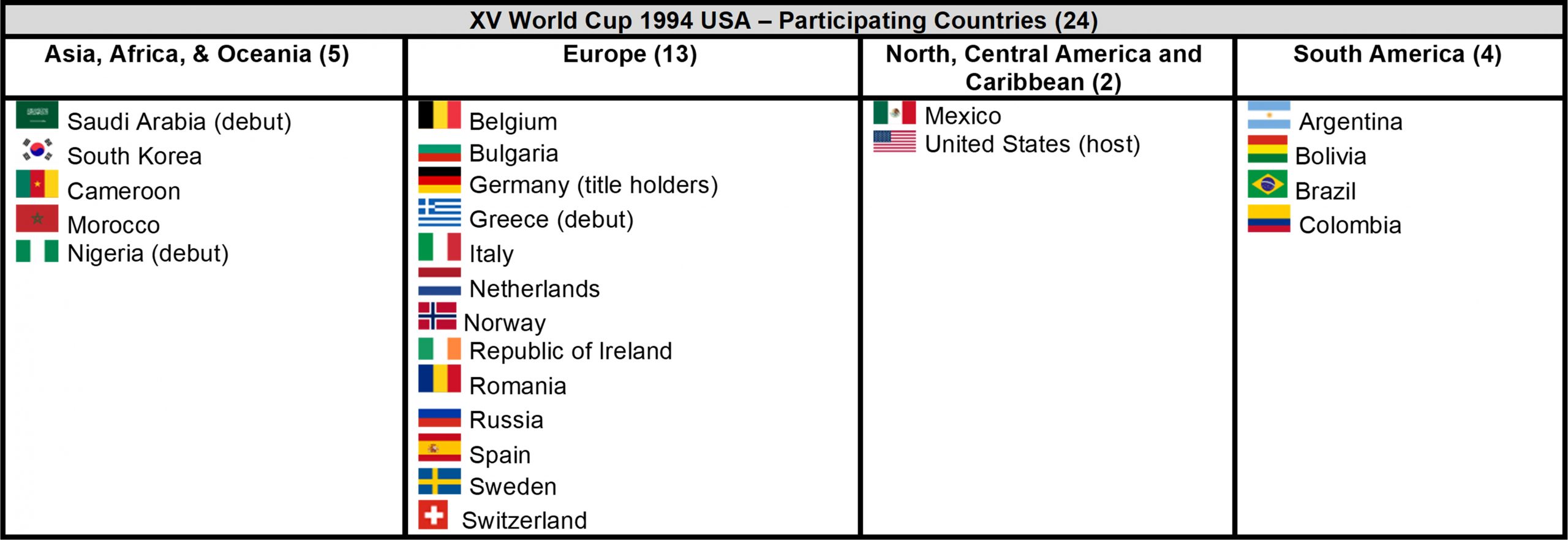
Three teams made their debut, one each from Asia, Africa, and Europe: Saudi Arabia, Nigeria, and Greece. But there were notable absences. Specifically:
- France – Failed in final home qualifier, a major power; and four years later would become world champion.
- England – Failed due to goal difference and was a recent (1990) World Cup semi‑finalist
- Denmark – The reigning European champion from 1992 failed to build on that success.
- Chile – FIFA ban due to disciplinary precedent
- Yugoslavia – UN sanctions due to ongoing civil war that broke up that nation.
- Portugal – Eliminated with their Golden Generation not yet mature.
Tournament
Nine venues in nine cities across the entire continental US hosted matches. The largest, the Rose Bowl in Pasadena, California, with a seating capacity of 94,194, hosted eight total matches including the final. The smallest, Robert F Kennedy Stadium in Washington, DC, with a seating capacity of 53,121, hosted five matches.
Because the matches were scheduled to give European audiences prime time viewing, the climate conditions were brutal in several stadiums. This included the Pontiac Silverdome in Detroit, Michigan, which did not have a working cooling system. I experienced this in person because I was at that stadium for a group stage game between Brazil and Sweden and the conditions were sweltering. Games on the east and west coasts were not as stifling but, in the south, including Texas, some matches were played in temperatures of up to 105°F (40.6°C). This wore down many teams and while there is no substantial evidence that it influenced final results, there was visible wear on some teams after some matches, such as the one between Germany and South Korea in Group C.
The usual suspects were favorites: Brazil, Germany, Argentina, and Italy. The Brazilians had the most devastating attack in Romário and Bebeto with a balanced tactical setup, mixing their usual attacking flair with solid defensive capabilities. Germany were the defending champions, and you could never rule the Germans out. Argentina were the runner ups from 1990 and even though they were not as deep as 1986 or even 1990, they were still considered a contender, especially since Maradona was in the lineup. Finally, Italy had their golden boy, striker Roberto Baggio, the reigning Ballon d’Or winner.
Dark horses for the 1994 World Cup included Spain, The Netherlands, Sweden, and Colombia. The Spaniards had a very talented and deep roster but there were doubts about their mental toughness, a flaw that would eventually end their tournament. The Netherlands had great talent and were led by the likes of Dennis Bergkamp and Marc Overmars but there were known internal tensions and their performance had been inconsistent leading up to the tournament. Sweden was considered a dark horse because traditionally they had done well in these competitions and had solid tactical discipline plus finishing efficiency. Finally, Colombia had made a lot of noise, with a deeply talented roster and the fact that during qualifying they had beaten Argentina twice on an aggregate score of 7-1.
Group Stage
The drawing took place on December 19th, 1993, in Las Vegas Nevada. The teams seeded were:
- United States (hosts) – Group A
- Brazil (traditionally a soccer power) – Group B
- Germany (1990 champions) – Group C
- Argentina (1990 runner ups) – Group D
- Italy (3rd place 1990) – Group E
- Belgium (surprise seed due to 4th place at the 1986 World Cup, round‑of‑16 appearances in 1990) – Group F
The final configuration of the six groups was as follows:


Group A was marked by expectation colliding brutally with reality. Colombia arrived heavily hyped, unbeaten in qualification and tipped by some pundits as a semifinal candidate. The USA, as hosts, had modest expectations focused more on credibility than advancement. The early tone shifted with Romania’s 3–1 demolition of Colombia, driven by Gheorghe Hagi’s brilliance and tactical sharpness. The USA earned global respect with a 2–1 win over Colombia, a match overshadowed later by tragedy: Andrés Escobar’s own goal, which contributed to Colombia’s elimination and later led to his murder upon returning home (an event that cast a dark shadow over the entire tournament). Surprisingly, Romania topped the group playing adventurous, fluid football, while Switzerland progressed steadily. The USA advanced as one of the best third‑placed teams, a breakthrough moment for American soccer, capped by Tony Meola’s inspiration and disciplined team play. Colombia exited winless, a stark reminder of how fragile hype can be under World Cup pressure.
A tragic side note to Colombia’s elimination was the assassination of Andres Escobar, one of the team’s center backs who scored an own goal in the game against the USA. His killing was because the win by the USA reportedly led to large financial losses for people connected to illegal betting by drug and criminal networks. This caused much internal soul searching in Colombia as well as major structural, legal, and player protection changes.
Group B was tactically measured rather than explosive…at least at first. Brazil, under Carlos Alberto Parreira, played unusually conservatively, prioritizing structure over flair, while Sweden emerged as quietly efficient. The much‑anticipated Brazil–Sweden match ended in a draw at 1-1 at the Pontiac Silverdome in Detroit, Michigan, and hinted early that this group would be about balance and discipline. The group’s defining moment came late: Russia’s 6–1 rout of Cameroon, in which Oleg Salenko scored five goals, the only player ever to do so in a World Cup match. Cameroon, heroes of 1990, collapsed defensively and emotionally, while Russia crashed out despite the historic performance. Sweden’s organization, led by Tomas Brolin and Martin Dahlin, proved enough to finish second, unbeaten. Brazil topped the group without brilliance but without panic, reflecting their more balanced and pragmatic approach.
Group C revolved around control rather than chaos. Germany, the defending champions, were competent but rarely dominant, while Spain impressed aesthetically but struggled to convert superiority into wins. Spain dropped points early by twice surrendering leads, most notably in a 2–2 draw with South Korea, revealing a recurring Spanish fragility in game management. Germany’s narrow opening win over Bolivia and a balanced 1–1 draw with Spain secured top spot without spectacle. Bolivia, competing in their first World Cup since 1950, earned historical respect by scoring their first-ever World Cup goal, though they never truly threatened qualification. Spain advanced playing technically refined football, with Fernando Hierro and Pep Guardiola influential, but the group reinforced an old narrative: Spain looked capable of more than they delivered. South Korea’s resilience won admirers, particularly their late comeback attempts, even as they exited bottom. Of note was their game against Germany. They fell behind 0-3 in the first half but came roaring back in the second, losing 2-3. At the end of the game, the Germans left the pitch limping, looking defeated while the South Koreans, who never stopped running looked fresh and walked off looking like winners.
Group D was the tournament’s emotional and narrative epicenter. Argentina started brilliantly, dismantling Greece 4–0 with Maradona scoring his last World Cup goal, only for everything to unravel days later. After a hard‑fought win over Nigeria, Maradona tested positive for ephedrine and was expelled from the tournament, an event seismic enough to redefine the World Cup overnight. Freed psychologically, Nigeria surged, using pace and athleticism to overwhelm Bulgaria early and top the group. Bulgaria, however, staged one of the great turnarounds in World Cup history by beating Argentina 2–0, led by Hristo Stoichkov, sending shockwaves through the competition. Despite chaos, Argentina survived as a best third‑placed team, but Maradona’s exit drained them of belief. He had gone from hero (1986), to villain (1990), to tragic disgrace (1994). Bulgaria advanced emboldened and unburdened, setting the stage for a legendary knockout‑round run.
Group E entered history as arguably the tightest World Cup group ever: all four teams finished on four points, with advancement decided by goal difference. Italy began disastrously, losing 1–0 to Ireland and confronting early elimination pressure. Mexico, after a disastrous 20 years of not qualifying or being disqualified in 1990 because of cheating uncovered in one of their youth teams, came into the tournament with some buzz given their surprising performance in Copa America in 1993 where they finished as runner-up, losing to Argentina 2-1 in the final. They proved the most consistent side, drawing with Italy and grinding out results with collective discipline. Norway shocked Italy 1–0, exploiting Italian inefficiency rather than outplaying them, before all four teams ended level on points in a mathematical rarity. Mexico won the group, the Republic of Ireland in second, with Italy advancing only as a third‑place qualifier, but the group stage forged their identity: resilience under siege. Roberto Baggio, yet to explode, conserved energy, a quiet prelude to his heroic knockout‑round performances.
Group F steadily evolved into one of the tournament’s most unexpected stories. Belgium and the Netherlands were viewed as the group’s heavyweights, but Saudi Arabia stunned both, defeating Morocco and Belgium to qualify for the knockout stage in their debut World Cup. The group’s signature moment arrived when Saeed Al‑Owairan scored an extraordinary solo goal against Belgium, dribbling from deep inside his own half, instantly enshrined as one of World Cup history’s great goals. Belgium recovered composure but lacked attacking edge. The Netherlands topped the group on goal difference, carried by Dennis Bergkamp and Marc Overmars, while Saudi Arabia advanced ahead of Belgium, a result few had predicted. It was one of USA ’94’s clearest reminders that tactical discipline and belief could still bend history.
The Round of 16 confirmed the tournament’s growing unpredictability. Italy, having barely escaped Group E, were pushed to the brink by Nigeria, who led 1–0 until stoppage time. A late Roberto Baggio equalizer, followed by his extra‑time winner, overturned Nigeria’s inspired run and marked the true arrival of “Divine Ponytail” as Italy’s savior, while Nigeria exited with pride but heartbreak.
Defending champions Germany survived Belgium 3–2 in a frenetic match defined by attacking quality rather than control; Jürgen Klinsmann’s movement and Rudi Völler’s presence proved decisive, though Belgium were widely praised for pushing Germany closer than expected. The match was played at Soldier Field in Chicago (I had the fortune to also be there) in perfect weather for two northern European teams: cool, drizzling, and windy. Had it not been for the heroics of Belgian goalkeeper Michel Preud’homme, the score might have been higher in favor of Germany. Meanwhile, Spain dispatched Switzerland 3–0, appearing fluent and confident, setting expectations for a deep run.
The biggest statement came from Bulgaria, who beat Mexico on penalties after a 1–1 draw, with goalkeeper Borislav Mihailov playing a key role. Romania eliminated Argentina 3–2, powered by Gheorghe Hagi’s visionary play, as Argentina, still reeling from Maradona’s expulsion, collapsed defensively. Host nation USA exited honorably, losing 1–0 to Brazil after Leonardo was sent off for an elbow on Tab Ramos, an incident that overshadowed an otherwise disciplined American performance and nearly shifted momentum. In that match, and right before Leonardo’s red card, the USA had actually looked and played better than Brazil so when the Brazilians went down one man, many assumed the US would pull off an upset. Instead, Brazil took command of the game with one player down. The US looked like the team that was one player down but they would exit with their heads held high.
Quarterfinals
The quarterfinals produced both tactical classics and historic shocks. Brazil vs Netherlands (3–2) became one of the tournament’s best matches: Brazil raced ahead, the Dutch replied with two goals from Dennis Bergkamp and Aron Winter, before Branco’s missile-like free kick settled an open, emotional contest. Brazil’s balance of pragmatism and flashes of brilliance came into sharp focus.
The tournament’s defining upset occurred when Bulgaria defeated Germany 2–1, eliminating the title holders. Trailing late, Bulgaria stunned the world with a rapid turnaround: goals from Hristo Stoichkov (penalty) and Yordan Letchkov’s iconic diving header completed the comeback. Germany exited stunned, while Bulgaria’s Golden Generation fully announced itself.
Sweden defeated Romania on penalties after a dramatic 2–2 draw, highlighting Sweden’s composure and collective strength rather than star power.
Elsewhere, Italy edged Spain 2–1 in a ferociously contested match remembered less for tactics than controversy. Mauro Tassotti’s elbow on Luis Enrique, which broke the Spaniard’s nose and went unpunished, overshadowed Roberto Baggio’s late winner. Spain exited feeling robbed, while Italy advanced amid bitter debate. However, Spain had a golden opportunity very late in the match with the score tied. The momentum seemed to be shifting in Spain’s favor. In the 88th minute, Spain had a clear breakaway with Julio Salinas being one-on-one with Italy’s goalkeeper Gianluca Pagliuca. A score would have sealed a victory for the Spaniards. But Salinas hesitated and let the ball bounce one too many times which gave Pagliuca time to close down the angle and for Salins to shoot wide. One minute later, Baggio scored for Italy, securing the Azzurri’s pass to the semi-finals and once again branding the Spaniards as the under-achievers who didn’t have the mental toughness to make deep runs in the World Cup.
Semifinals
The semifinals demonstrated the value of defensive structure and clinical finishing. Brazil overcame Sweden 1–0, with Romário scoring yet again—his fifth goal of the tournament—puncturing Sweden’s otherwise flawless organization. Sweden remained competitive throughout but were undone by a single lapse, reinforcing Brazil’s efficiency-first approach.
The second semifinal saw Italy defeat Bulgaria 2–1, almost entirely down to Roberto Baggio, who scored twice in the first half despite playing through pain. Bulgaria, lacking the suspended Hristo Stoichkov, finally looked mortal; their energy and belief ran into the harsh wall of Italy’s experience. Baggio’s injury late in the match cast a shadow over Italy’s victory, while Bulgaria still left the tournament as its great romantic story.
So once again, as in 1970, the same two powerhouse would meet in the final, the Brazilians with their new pragmatic tactical approach, and the Italians with their classical catenaccio but with their golden striker in the form of Roberto Baggio.
The Final
The grand dame of college football stadiums, the historic Rose Bowl, would witness the final of what had been a vibrant, colorful, intense, and widely televised World Cup. The tournament had exceeded expectations by leaps and bounds, silencing critics around the world (and in the USA as well) and proving that the sport was capable of winning over US crowds and filling stadiums around the country. Now two of the oldest powerhouses would meet to decide who would reign as world champion.
The Brazilians were led by their dynamic front line of Romário and Bebeto, but as opposed to previous versions of the Verde‑Amarela (Green-Yellow), they were buffered by a solid defensive midfield and strong backline. Italy was led by their Ballon d’Or and FIFA World Player of the year, Roberto Baggio, who was supported by the usual strong defensive tactical system that Italy was known for.
On July 17, 1994, 94,000 spectators packed the Rose Bowl, reflecting the unprecedented popularity of the tournament in the United States. The intense California heat added to the physical difficulty of the match and influenced the cautious tempo that followed. Neither team wanted to make a mistake, partly because of the stakes at hand, but also because in the intense heat, they all knew that going behind on the score would almost certainly mean defeat.
During 90 minutes of regulation and 30 minutes of extra time, neither team managed to score, making it the first goalless final in World Cup history. Brazil created several chances through Romário and Bebeto, but Italian goalkeeper Gianluca Pagliuca kept Italy level with key saves. On the other side, Italy struggled offensively, especially with Roberto Baggio clearly affected by a thigh injury he had sustained earlier in the tournament. Tactical discipline, fatigue, and defensive focus defined the game, as both sides avoided taking risks that might open them up late in the match.
With the draw unbroken, the final was decided by a penalty shootout, marking the first time a World Cup had been decided in this manner. Brazil converted penalties through Romário, Branco, and Dunga, while goalkeeper Cláudio Taffarel saved one Italian kick. The moment that defined the final came when Roberto Baggio sent Italy’s final penalty over the crossbar, giving Brazil a 3–2 shootout victory. Brazil’s triumph secured their fourth World Cup title and cemented the 1994 final as one of the most iconic and emotionally charged endings in the history of World Cups.
Brazil was now a four-time champion, but the legacy left behind in the USA would greatly benefit the growth of the sport in both fan interest as well as Major League Soccer.
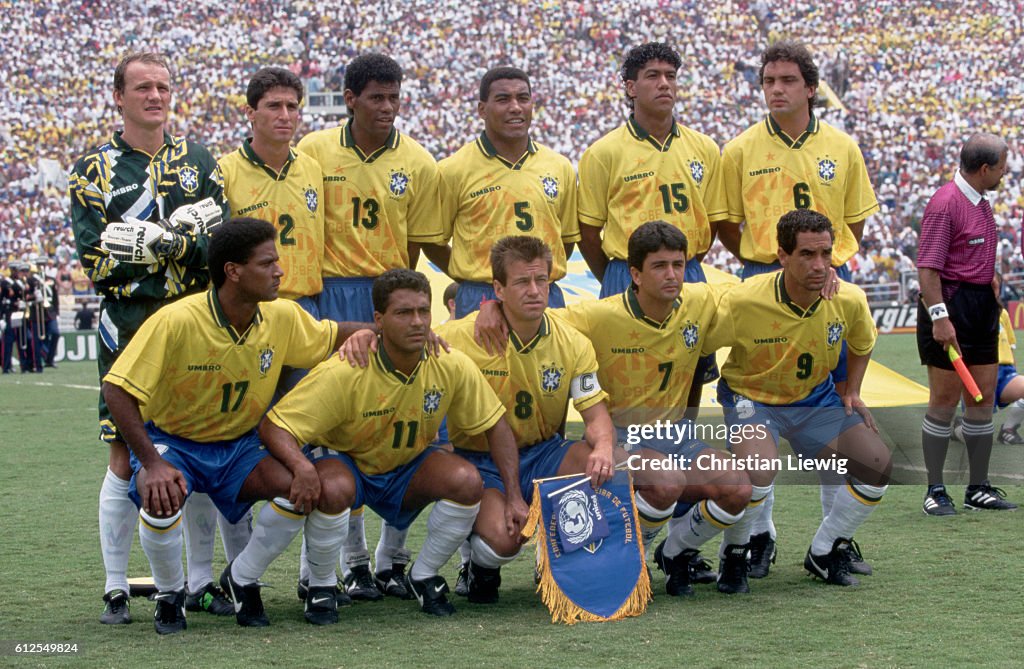
Brazil lineup before the final in 1994 against Italy (Photo by © Christian Liewig/Tempsport/CORBIS/Corbis via Getty Images)

Italian footballer Demetrio Albertini, Brazilian footballer Romario, and Italian footballer Franco Baresi in action during the FIFA World Cup Final, between Brazil and Italy, at the Rose Bowl in Pasadena, California, 17th July 1994. (Photo by Henri Szwarc/Bongarts/Getty Images)
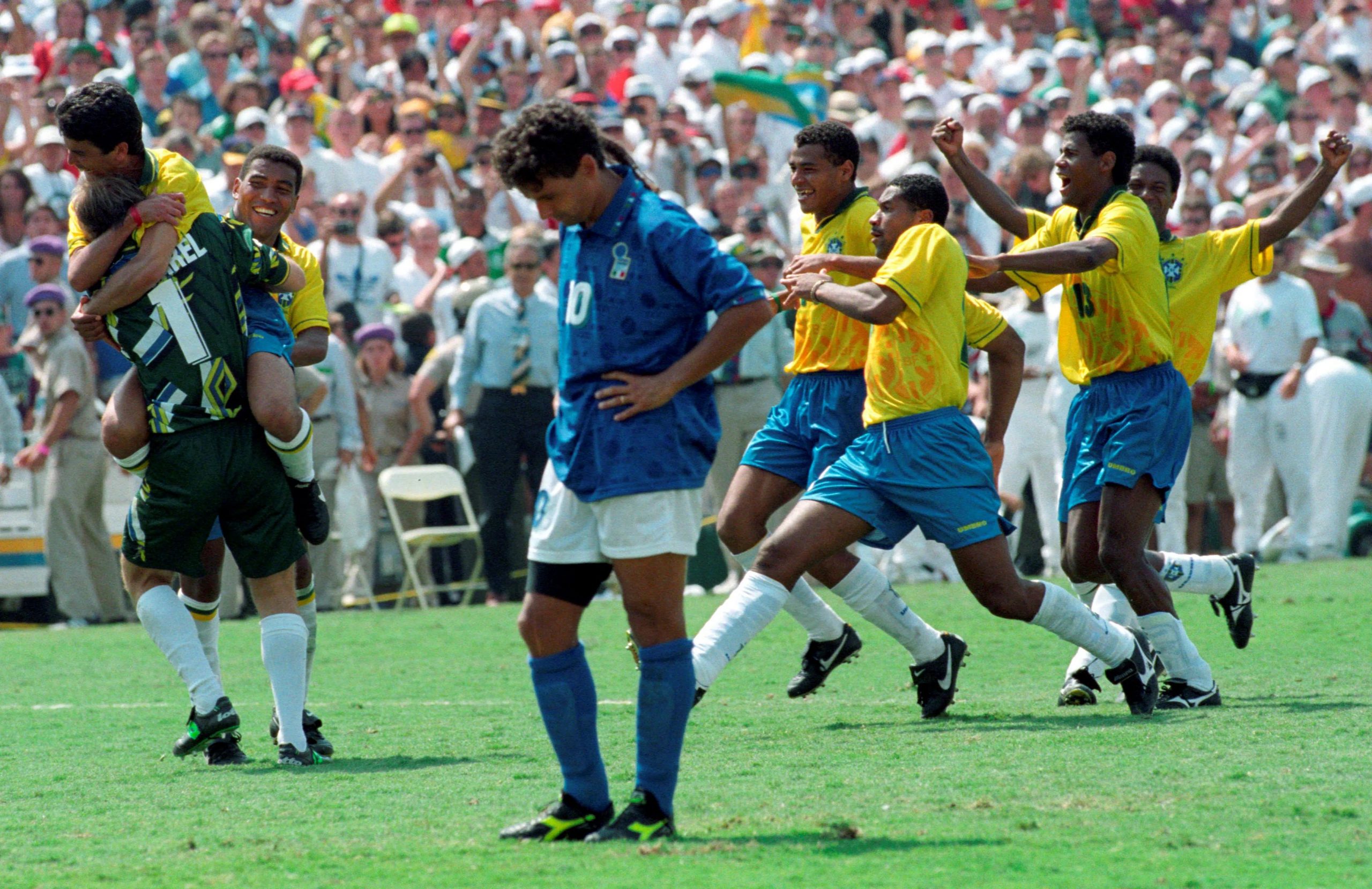
1994 World Cup, Roberto Baggio misses the last penalty kick, giving Brazil the win in the final (Photograph by Mike Hewitt, Getty Images)
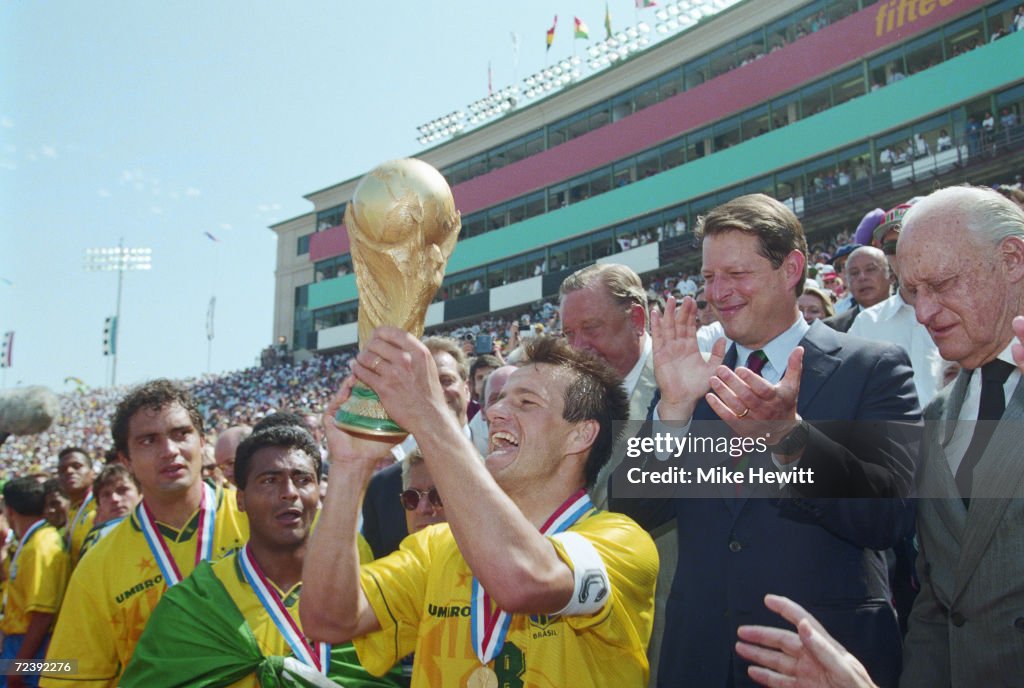
Brazilian Captain Dunga lifts the World Cup Trophy from Vice President Al Gore after defeating Italy (Photograph by Mike Hewitt, Getty Images)
Tournament Firsts:
- First World Cup hosted by a country where soccer was not the dominant sport.
- First with matches played indoors, specifically, the Pontiac Silverdome hosting four games
- First to award three points for a win
- First World Cup Final decided by a penalty shootout after a goalless draw in regular and overtime (also a first)
- First won by a team without scoring in the final
- First attendance for Nigeria, Saudi Arabia, and Greece
- First tournament where retail, fast food, and consumer brands fully integrated into stadium presence, family‑oriented promotions, and youth engagement
- First competition where yellow cards accumulated in the group stage were wiped clean after its completion.
- First World Cup where referees could wear colors other than black to avoid a clash with the two competing teams.
- First World Cup where players had names above their numbers on shirts.
Relevant Players
- Romário (Brazil) – Tournament co‑top scorer (5 goals) and key figure in Brazil winning their fourth World Cup title.
- Roberto Baggio (Italy) – Carried Italy to the final with decisive goals, despite missing the final penalty kick.
- Diego Maradona (Argentina) – Appeared in his last World Cup, remembered for Argentina’s strong early form and his dramatic tournament exit.
- Hristo Stoichkov (Bulgaria) – Golden Boot winner (6 goals) and leader of Bulgaria’s historic run to fourth place.
- Jürgen Klinsmann (Germany) – One of the tournament’s most effective forwards, anchoring Germany’s deep run as defending champions.
- Gheorghe Hagi (Romania) – Maestro of Romania’s celebrated attack, starring in their run to the quarterfinals.
Four years hence France would host what would be another electrifying tournament. “Les Bleus” (The Blues) would capture the imagination of their country, showing unselfish teamwork, orchestrated by Zinadine Zidane, in a mosaic of diversity that showed how France had managed to build a world class team from all segments of their society.