Sometimes the only thing a drawing board is good for is to return to it.
It took a full day for me to completely rewrite my opinion about 2026. There was an entire motif already determined for my MLS end-of-year award picks. I was going to treat it as a “cheating off my neighbor’s sheet” kind of theme to provide wrong answers for who should be the upper strata of the MLS season. I was ready to go “full snark mode”.
There was a lot for me to be moody about this year. I allowed media firestorms, shifting paradigms in AI, a collapsing soccer journalism bubble, and overall bad vibes to leak into my view of the 2026 MLS season. It took a second glance to realize that the sham FIFA Peace Prize was actually given last year, not this year.
I’m also writing this days after FC Cincinnati was wedged into the play-in game as the #9 seed. It hasn’t been the brightest of seasons for the Noonan-Albright Era, but it also hasn’t been worthy of a Wooden Spoon look at things.
So let’s scrap the gloomy analysis of the season and find some rays of sunshine. Each of my picks for this season’s MLS superlatives will have a personal vote for an FC Cincinnati player who fits into the same category.
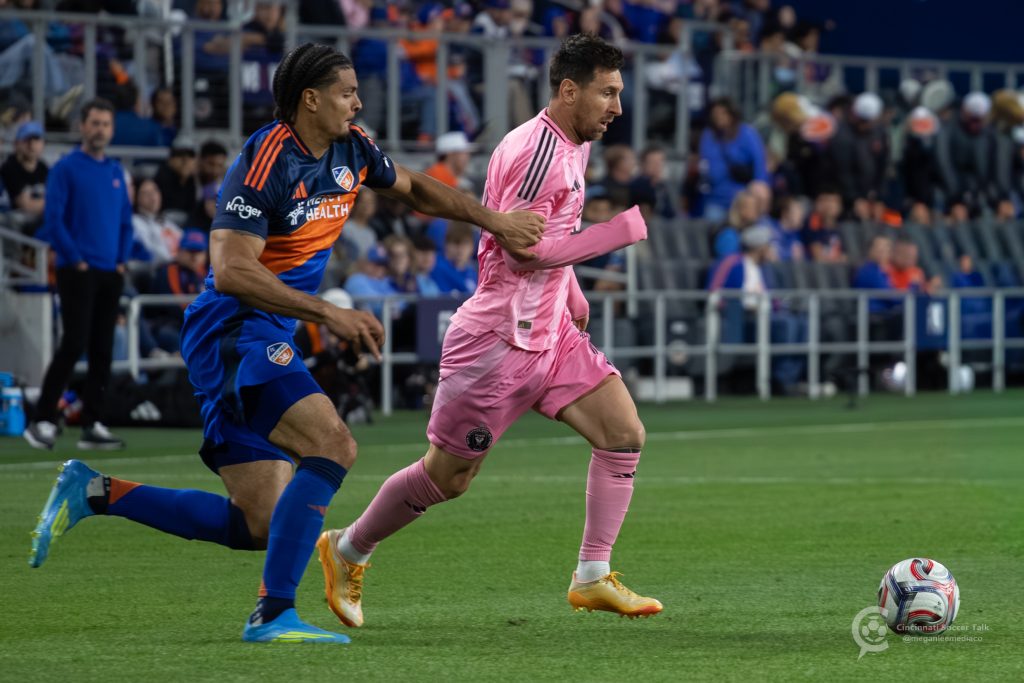
Photo: Megan Lee
MVP Award:
Lionel Messi, Inter Miami CF
Perhaps we saw this coming back when Messi joined MLS back in 2023. He’d be the talk on everybody’s ballot, regardless of his numbers.
The headscratching perhaps started in 2024 when Messi’s numbers weren’t quite comparable to the likes of Gabriel Pec and Lucho Acosta, but he won the MVP regardless. A lot of that came with the points record that Nashville smashed this season. Last season, Messi ran away with the award due to his outstanding numbers in both categories (35 goals, 23 assists).
While his numbers didn’t wow people this season (26 goals, 13 assists), not many other candidates were that close. If anything, Petar Musa from Dallas was close enough to challenge, putting up a goals-per-90 rate just ahead of Messi. However, the fact that Musa was left out of the finalists’ pool speaks volumes.
Even with Luis Suarez having a bounce-back season for Miami (17 goals, 7 assists), you’re not stealing MVP votes from The GOAT.
FCC MVP Award:
Evander, Midfielder
Remember when Alex Rodriguez won the MLB MVP Award in 2003 with the Texas Rangers? He put up massive offensive numbers, even though his team came in last in their division. The arguments behind his qualifications were quite vocal on cable television and newspapers at the time. Imagine if Twitter was around back then?
Anyways, we digress. Evander’s selection as an MLS MVP finalist may be disputed, but his numbers were still pronounced in the Queen City.
You could look at the numbers in comparison to 2025 and give a good argument for Kevin Denkey, who increased his overall goal contributions (20 in 2025 to 26 in 2026). However, Evander still was a proper conduit in 2026, scraping up 16 goals and 15 assists in 2026. This was also his first season with the captain’s band, so the leadership points count for something.
The question—does Evander’s third FCC season next year resemble Lucho’s third season with FCC, when the Argentine picked up the league MVP?
Comeback Player of the Year:
Ryan Gauld, Vancouver Whitecaps
More often than not, players are going to miss time. There are just too many matches and too many various knocks that mount over time. Of course, bucking that trend, we could see the most “Iron Men” in one MLS season (nine—including two center backs!) since the transition to 34 matches in 2011.
To be fair, any athlete returning from an extended injury or absence should be heralded. That’s partly why I hate assigning this award.
I’m reluctantly giving the award to Gauld, who missed over 500 days due to knee surgery. When he returned to the pitch with the captain’s band against Cincinnati, he contributed two goals right away. His six goals over 20 regular season matches has him tied for third in an offense that has the second-most goals in the league.
Again, I hope I don’t have to make this selection in the future. There are just too many comebacks players can make in this league, especially during a World Cup cycle.
FCC Comeback Player of the Year:
Obinna Nwobodo, Midfielder
This might now quite count as a “comeback” season for Obi. On the other hand, let’s consider the fact that FCC’s #5 missed 19 matches last year with muscle and hamstring issues. Things looked equally bleak when he missed five appearances this season before the World Cup.
There were even whispers that he was transfer bait over the summer window.
Course corrected, Obi was one of the stronger presences on the team, doubling his minutes in 2026. While most came from appearances in the CCC, Obi also provided six assists this year, a season high with FCC. Considering how leaky the defense was this season, his absence probably would mean not making the playoffs at all.
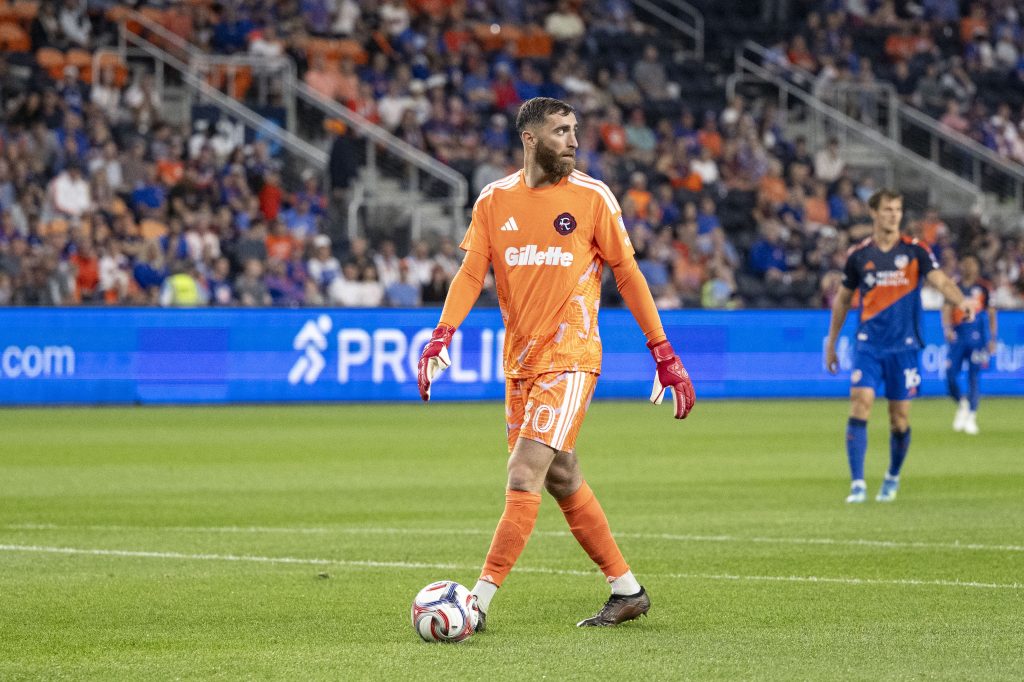
Photo: Scott Huck
Goalkeeper of the Year:
Matt Turner, New England Revolution
Honestly, it felt like a lot of picks could have gone to Nashville SC players. The disadvantage about an incredibly strong squad is that it becomes harder to recognize individual talent. Go through the Starting XI for Nashville, and you’d have eight legitimate Best XI candidates, but it’s hard to decide on who gets the accolades.
Brian Schwake has been an incredible breakthrough player this season. He was strictly used for the US Open Cup run last season. While he didn’t post great numbers, he led them to the cup in 2025. This year, Schwake leads in fewest goals allowed per 90, most clean sheets (16), and most penalty kicks saved (3).
So why vote for Turner? He allowed a little over half a goal per 90 higher than Schwake, had ten less clean sheets, and didn’t save a penalty. The numbers don’t add up in certain categories.
However, I pay more attention to the number of goals Turner prevented. Schwake faced so few shots from the stacked back line that Nashville still would have run away with the crown had he given up more goals. Turner led the league in prevented goals (14.1), a number that probably would have turned New England into a mid-table team. Turner also had more saves per 90 (4.1) than Schwake (2.8).
Tough call to make, but I’m going with Turner.
FCC Goalkeeper of the Year:
Roman Celentano, GK (and a nod to Paul Walters)
This is a default setting.
The defense stabilized over time, but this was not Celentano’s best year at all. His goals allowed per 90 (2.13) and save percentage (59.2) were career lows. The only other goalkeeper with worse combined statistics was Thomas Gillier at CF Montreal.
That being said, some shine could be given to Paul Walters for his work at Bohemian FC in the Irish Premier Division. On loan for 2026, Walters picked up six clean sheets in 24 matches across all competitions, including six matches in UEFA Europa Conference League play. Perhaps he should get the vote this year for his play in high-pressure situations already.
Defender of the Year:
Osaze Urhoghide, FC Dallas
It’s a shame that the finalists for this category all went to Nashville SC players. Yes, Maxwell Woledzi and Jeisson Palacios were practically untouchable in the center-back positions, but Andy Najar is not a defender in his fullback position.
That being said, the Nashville SC defense was so wholly complete that an individual didn’t stick out. Urhoghide, in his second season with Dallas, was a jack of all trades and master of none, ranked in the Top 10 for center backs in many categories.
Woledzi was very close for my pick. If a Nashville player does deserve the recognition, it will likely be him. However, as in the same argument for Turner as Goalkeeper of the Year, a team without Urhoghide would leave the team in a much deeper hole to dig from.
FCC Defender of the Year:
Nick Hagglund, Center back
When the defense leaks goals at the rate that FCC did, it’s hard to pick out a particular superlative from the roster. However, Hagglund’s work rate and leadership brought him back into the conversation after the departure of Matt Miazga and the extended injuries involving Miles Robinson and Julian Malatini.
Perhaps honorable mentions need to go to Samuel Gidi and Kyle Smith for keeping the leaks plugged in the hull of this ship. Still, Hagglund ranks atop the league in clearances per 90 and within the Top 10 for defensive contributions per 90 for all center backs.
Let’s not forget the fact that Hagglund has set the club record for most MLS appearances. That’s enough to celebrate with some Skyline this season.
Young Player of the Year:
Cavan Sullivan, Philadelphia Union
If the 2026 season is to be remembered for more than the demolition derby in Nashville, it should be the extraordinary evolution of young talent in MLS. As much as we joke that MLS is a “retirement league”, more of the stars that demand name recognition are in the year-end “22 Under 22” list.
While playing too many youngsters doesn’t necessarily mean success—five of the top six youngest squads missed the playoffs—Philadelphia depended on their youth to pull from the quagmire. Frankie Westfield and Neil Pierre were stalwarts on the right side of the defense, and neither can legally drink.
Hell, Cavan Sullivan can barely drive himself, yet he has my vote.
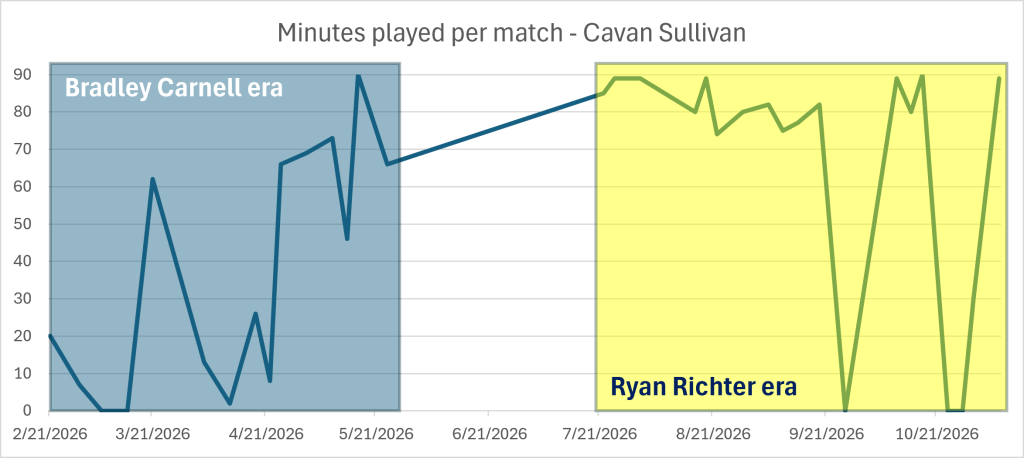
The production numbers speak volumes, but much of that came from trust. Bradley Carnell used Cavan as a starter in six of the first 15 matches of the season, and Sullivan provided only two goal contributions (one goal, one assist). Under Ryan Richter’s tutelage, he skyrocketed in his starting role. Cavan started 15 of the last 19 matches, producing eight goals and six assists.
Perhaps that’s more an argument that Richter deserves Coach of the Year, but we can tell that the younger Sullivan brother has the talent to compete and hang with the expertise on the pitch. But will that ever translate to performance at Man City?
FCC Young Player of the Year:
Ender Echenique, Wingback
Admissions need to be made here–the youth that came from the academy and FCC2 could have had more time on the first team. Dado Valenzuela, Ayoub Lahjar, Stiven Jimenez, and both Chirila brothers had promise, only for the minutes to dry up as experience took over.
The best qualifiers as a “22 Under 22” player both came from last season’s window. Sami Gidi racked up minutes as a Yuya Kubo-like switchblade, but Echenique made a name for himself as someone who could provide potential graduating from “young player” to veteran. The Venezuelan had ten goal contributions across all competitions, including seven assists in MLS play, second best on the squad.
All he needs now is a catchy nickname.
Newcomer of the Year:
Antoine Griezmann, Orlando City SC
Usually, I save this selection for a player who arrived in the preseason. I had just written Guilherme Agosto’s name in indelible ink. The Houston winger’s offensive numbers (16 goals, eight assists) were essential assets toward lifting Houston into the playoffs. The Dynamo would be nowhere near clinching a Top 4 seed without his offense.
However, with their solid defensive numbers, Houston still could have made the playoffs with a lesser player. That wouldn’t have been the case if Griezmann didn’t show up for Orlando.
Over the season, only five players have scored over 10 goals with a goals-per-90 value over 0.8. Three of them are easy MVP candidates, and one is João Klauss (10 goals, 0.8 gp90), who is not a newcomer to the league.
While Orlando still leaks goals on defense, Griezmann’s presence has made them a contender. The French striker has 14 goals and seven assists in 17 matches. Those per-90 goal contribution numbers (1.25) are second only to the reigning MVP (1.36).
That’s a game changer that cannot be ignored.
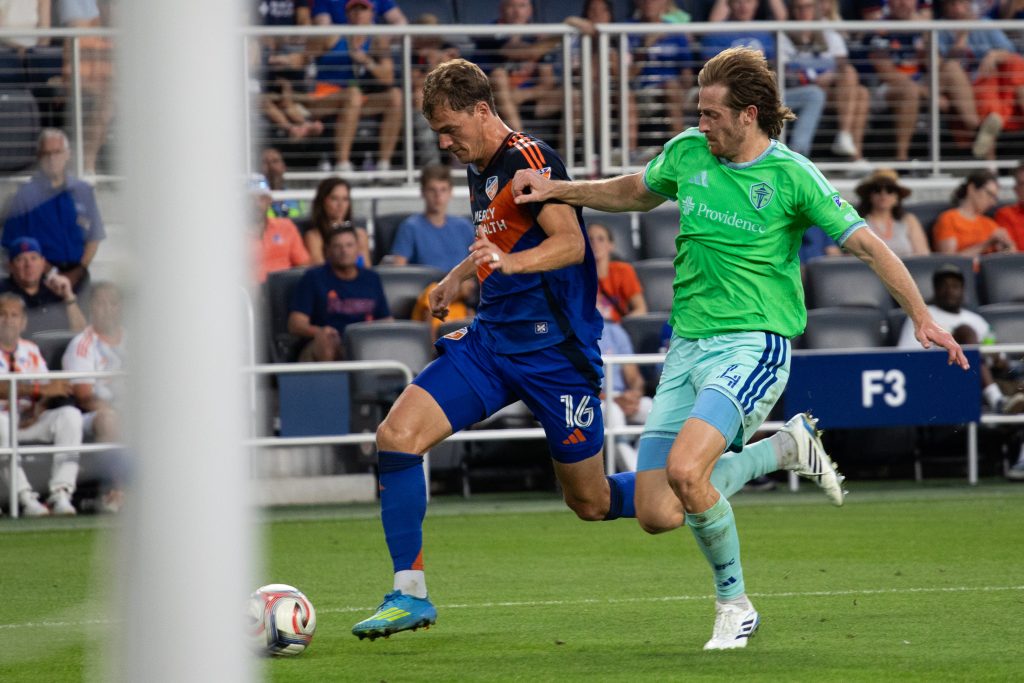
Photo: Megan Lee
FCC Newcomer of the Year:
Tom Barlow, Forward
Remember when FC Cincinnati lost in the 2018 USL Cup Eastern Conference semifinals to Red Bulls II? Who knew that one of those thorns on offense would be our third-highest scorer eight years later?
Barlow’s 13 goals this season are already higher than his totals from Red Bulls in 2023 and both seasons with Chicago combined. Furthermore, Barlow had three assists in his entire seven-year MLS career. He eclipsed that number just this year alone.
Could we make an argument that this has been one of the best free transfers in FCC history?
Coach of the Year:
BJ Callaghan, Nashville SC
I had this expectation that the candidate pool would be bigger than it appeared. However, a lot of the past winners (Pat Noonan, Tata Martino, Bradley Carnell, Oscar Pareja) had subpar years. Other overachievers were actually interim managers (Laurent Courtois, Ryan Richter, Martín Perelman).
Marko Mitrovic had an incredible first year at New England to banish the ghosts of Caleb Porter. Eric Quill, Dean Smith, and Jesper Sørensen built on productive years. Gregg Berhalter and Bruce Arena were incredibly productive with the teams they’d built.
They still could not hold a candle to the coach that led his team to a U.S. Open Cup in 2025 and a Supporters’ Shield in 2026. Even if Nashville didn’t set the points record, this title was Callaghan’s by midseason.
Perhaps this could be his last one in a while if the USMNT comes calling?
(ex)-FCC Coach of the Year:
Yoann Damet, St. Louis City SC
I’m tweaking the rules a little bit here. I need to give Damet his plaudits after an incredible midseason unbeaten streak and his own U.S. Open Cup to hoist. Yes, he was an interim coach for FCC, but the personal growth into a solid head coach is incredible to witness. If St. Louis finished higher in the table and Nashville had a few stumbles, perhaps the race would have been closer.
Let’s hope Yoann doesn’t trip up like the last St. Louis City coach of the year.
Best XI (4-1-2-1-2):
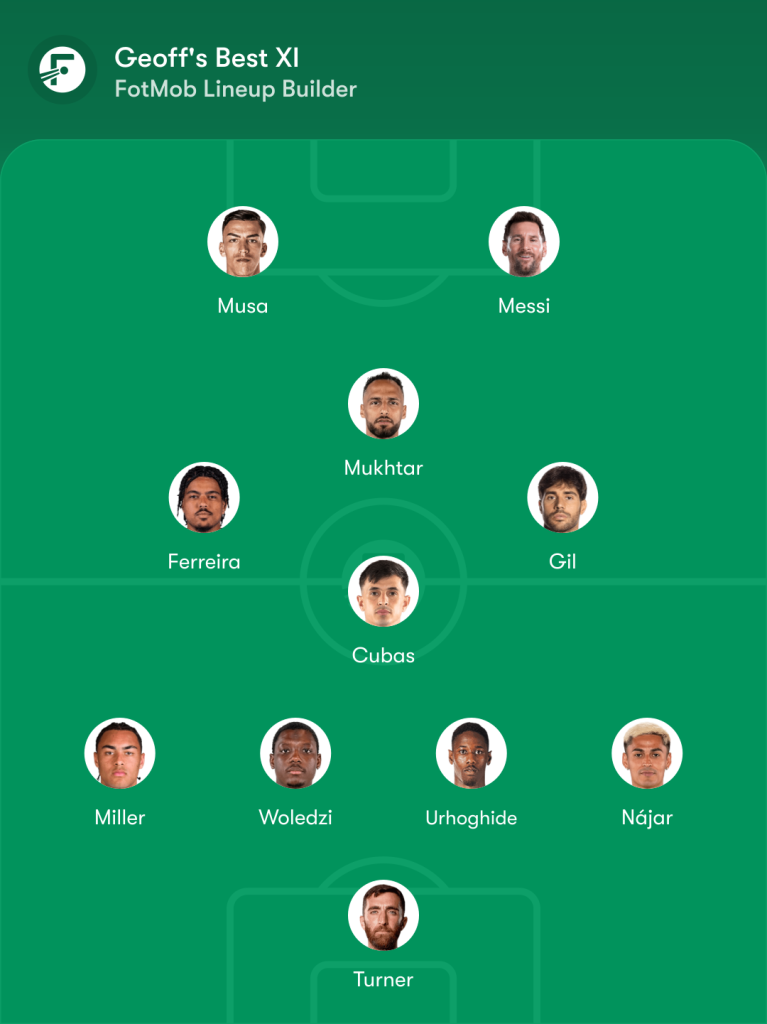
Goalkeeper: Matt Turner (NER)
Defenders: Andy Najar (NAS), Osaze Urhoghide (DAL), Maxwell Woledzi (NAS), Peyton Miller (NER)
Midfielders: Andres Cubas (VAN), Carles Gil (NER), Evander (CIN), Hany Mukhtar (NAS)
Forwards: Lionel Messi (MIA), Petar Musa (DAL)
Once the unorthodox 4-4-2 diamond formation was settled, this may have been one of the easier Best XI lineups to build.
The defending areas were easy to construct. Woledzi and Najar are two of the three short-listed for Defender of the Year, while Miller should be bound for Europe soon with his breakout year (7g/7a).
Cubas had his best MLS season to date, leading midfielders in recoveries per 90 and tackles per 90. Granted, had Casemiro arrived in Miami to begin the year and play only midfielder positions, he’d be more of a lock.
Yes, it’s awkward to pack the rest of the midfield with three #10 roles. Still, Gil (13g/7a) and Mukhtar (18g/7a) had performances that were arguably better than their MVP seasons. Evander’s there for his equally impressive numbers, but a more versatile midfielder such as a Rodrigo De Paul or Cavan Sullivan could have fit in here.
While there was a peloton of scorers behind Musa, it felt only fair to have the Dallas striker with Messi atop the formation. His 22g/5a numbers were a slight edge over the likes of Sam Surridge, Rafael Navarro, and Guilherme. In retrospect, Musa’s exclusion from the MVP race felt like this was a karmic selection.
Second Best XI (4-3-3):
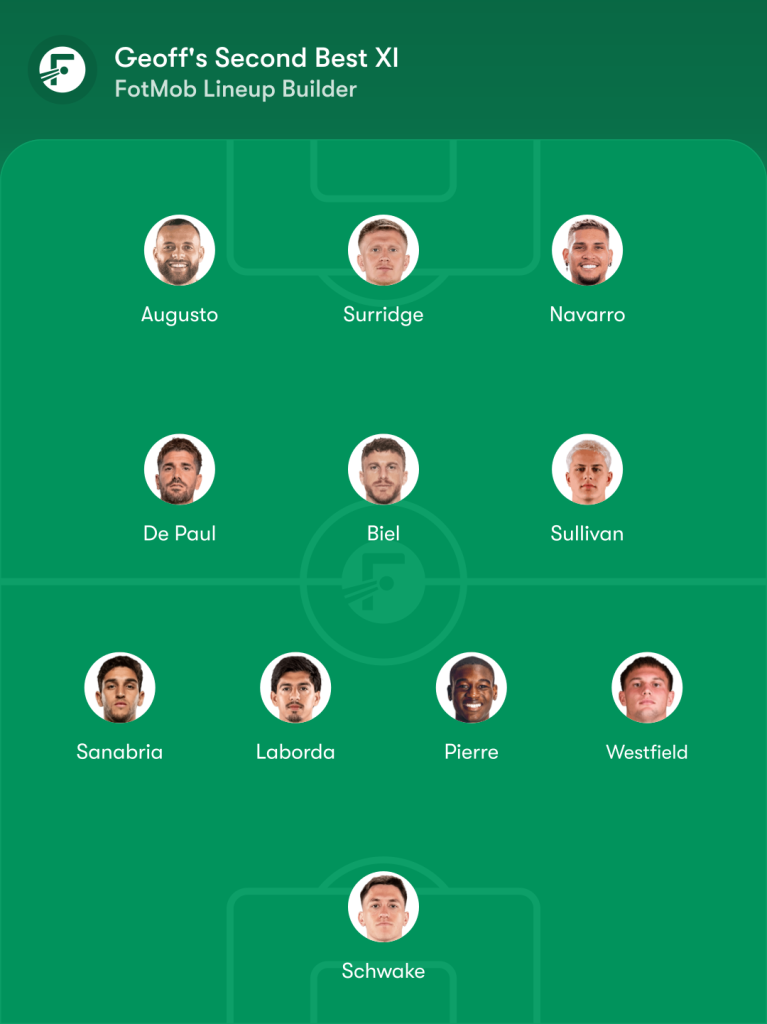
Goalkeeper: Brian Schwake (NAS)
Defenders: Frankie Westfield (PHI), Neil Pierre (PHI), Mathias Laborda (VAN), Juan Sanabria (RSL)
Midfielders: Cavan Sullivan (PHI), Pep Biel (CLT), Rodrigo De Paul (MIA)
Forwards: Sam Surridge (NAS), Rafael Navarro (STL), Guilherme Agosto (HOU)
Westfield and Pierre were unforeseen forces for Philadelphia all season, while Cavan had a stellar post-World-Cup streak. Sanabria (2g/6a) was an exceptional late-season workhorse after the departure of Zavier Gozo. I could have picked Jeisson Palacias from Nashville for the last slot. I felt he didn’t have the minutes compared to Laborda.
The rest of the formation felt pretty comfortable. The Surridge-Navarro-Guilherme front line combined for 71 goal contributions, while De Paul and Pep Biel had consistent seasons in the middle.
To be fair, I could see my second Best XI beating the first squad more often than expected. Of course, you’d have to hope that you get four of the last five MVP holders on their worst day.








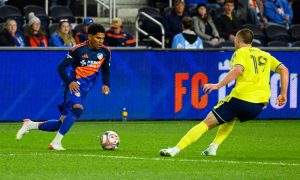



Sometimes the only thing a drawing board is good for is to return to it.
It took a full day for me to completely rewrite my opinion about 2026. There was an entire motif already determined for my MLS end-of-year award picks. I was going to treat it as a “cheating off my neighbor’s sheet” kind of theme to provide wrong answers for who should be the upper strata of the MLS season. I was ready to go “full snark mode”.
There was a lot for me to be moody about this year. I allowed media firestorms, shifting paradigms in AI, a collapsing soccer journalism bubble, and overall bad vibes to leak into my view of the 2026 MLS season. It took a second glance to realize that the sham FIFA Peace Prize was actually given last year, not this year.
I’m also writing this days after FC Cincinnati was wedged into the play-in game as the #9 seed. It hasn’t been the brightest of seasons for the Noonan-Albright Era, but it also hasn’t been worthy of a Wooden Spoon look at things.
So let’s scrap the gloomy analysis of the season and find some rays of sunshine. Each of my picks for this season’s MLS superlatives will have a personal vote for an FC Cincinnati player who fits into the same category.
Photo: Megan Lee
MVP Award:
Lionel Messi, Inter Miami CF
Perhaps we saw this coming back when Messi joined MLS back in 2023. He’d be the talk on everybody’s ballot, regardless of his numbers.
The headscratching perhaps started in 2024 when Messi’s numbers weren’t quite comparable to the likes of Gabriel Pec and Lucho Acosta, but he won the MVP regardless. A lot of that came with the points record that Nashville smashed this season. Last season, Messi ran away with the award due to his outstanding numbers in both categories (35 goals, 23 assists).
While his numbers didn’t wow people this season (26 goals, 13 assists), not many other candidates were that close. If anything, Petar Musa from Dallas was close enough to challenge, putting up a goals-per-90 rate just ahead of Messi. However, the fact that Musa was left out of the finalists’ pool speaks volumes.
Even with Luis Suarez having a bounce-back season for Miami (17 goals, 7 assists), you’re not stealing MVP votes from The GOAT.
FCC MVP Award:
Evander, Midfielder
Remember when Alex Rodriguez won the MLB MVP Award in 2003 with the Texas Rangers? He put up massive offensive numbers, even though his team came in last in their division. The arguments behind his qualifications were quite vocal on cable television and newspapers at the time. Imagine if Twitter was around back then?
Anyways, we digress. Evander’s selection as an MLS MVP finalist may be disputed, but his numbers were still pronounced in the Queen City.
You could look at the numbers in comparison to 2025 and give a good argument for Kevin Denkey, who increased his overall goal contributions (20 in 2025 to 26 in 2026). However, Evander still was a proper conduit in 2026, scraping up 16 goals and 15 assists in 2026. This was also his first season with the captain’s band, so the leadership points count for something.
The question—does Evander’s third FCC season next year resemble Lucho’s third season with FCC, when the Argentine picked up the league MVP?
Comeback Player of the Year:
Ryan Gauld, Vancouver Whitecaps
More often than not, players are going to miss time. There are just too many matches and too many various knocks that mount over time. Of course, bucking that trend, we could see the most “Iron Men” in one MLS season (nine—including two center backs!) since the transition to 34 matches in 2011.
To be fair, any athlete returning from an extended injury or absence should be heralded. That’s partly why I hate assigning this award.
I’m reluctantly giving the award to Gauld, who missed over 500 days due to knee surgery. When he returned to the pitch with the captain’s band against Cincinnati, he contributed two goals right away. His six goals over 20 regular season matches has him tied for third in an offense that has the second-most goals in the league.
Again, I hope I don’t have to make this selection in the future. There are just too many comebacks players can make in this league, especially during a World Cup cycle.
FCC Comeback Player of the Year:
Obinna Nwobodo, Midfielder
This might now quite count as a “comeback” season for Obi. On the other hand, let’s consider the fact that FCC’s #5 missed 19 matches last year with muscle and hamstring issues. Things looked equally bleak when he missed five appearances this season before the World Cup.
There were even whispers that he was transfer bait over the summer window.
Course corrected, Obi was one of the stronger presences on the team, doubling his minutes in 2026. While most came from appearances in the CCC, Obi also provided six assists this year, a season high with FCC. Considering how leaky the defense was this season, his absence probably would mean not making the playoffs at all.
Photo: Scott Huck
Goalkeeper of the Year:
Matt Turner, New England Revolution
Honestly, it felt like a lot of picks could have gone to Nashville SC players. The disadvantage about an incredibly strong squad is that it becomes harder to recognize individual talent. Go through the Starting XI for Nashville, and you’d have eight legitimate Best XI candidates, but it’s hard to decide on who gets the accolades.
Brian Schwake has been an incredible breakthrough player this season. He was strictly used for the US Open Cup run last season. While he didn’t post great numbers, he led them to the cup in 2025. This year, Schwake leads in fewest goals allowed per 90, most clean sheets (16), and most penalty kicks saved (3).
So why vote for Turner? He allowed a little over half a goal per 90 higher than Schwake, had ten less clean sheets, and didn’t save a penalty. The numbers don’t add up in certain categories.
However, I pay more attention to the number of goals Turner prevented. Schwake faced so few shots from the stacked back line that Nashville still would have run away with the crown had he given up more goals. Turner led the league in prevented goals (14.1), a number that probably would have turned New England into a mid-table team. Turner also had more saves per 90 (4.1) than Schwake (2.8).
Tough call to make, but I’m going with Turner.
FCC Goalkeeper of the Year:
Roman Celentano, GK (and a nod to Paul Walters)
This is a default setting.
The defense stabilized over time, but this was not Celentano’s best year at all. His goals allowed per 90 (2.13) and save percentage (59.2) were career lows. The only other goalkeeper with worse combined statistics was Thomas Gillier at CF Montreal.
That being said, some shine could be given to Paul Walters for his work at Bohemian FC in the Irish Premier Division. On loan for 2026, Walters picked up six clean sheets in 24 matches across all competitions, including six matches in UEFA Europa Conference League play. Perhaps he should get the vote this year for his play in high-pressure situations already.
Defender of the Year:
Osaze Urhoghide, FC Dallas
It’s a shame that the finalists for this category all went to Nashville SC players. Yes, Maxwell Woledzi and Jeisson Palacios were practically untouchable in the center-back positions, but Andy Najar is not a defender in his fullback position.
That being said, the Nashville SC defense was so wholly complete that an individual didn’t stick out. Urhoghide, in his second season with Dallas, was a jack of all trades and master of none, ranked in the Top 10 for center backs in many categories.
Woledzi was very close for my pick. If a Nashville player does deserve the recognition, it will likely be him. However, as in the same argument for Turner as Goalkeeper of the Year, a team without Urhoghide would leave the team in a much deeper hole to dig from.
FCC Defender of the Year:
Nick Hagglund, Center back
When the defense leaks goals at the rate that FCC did, it’s hard to pick out a particular superlative from the roster. However, Hagglund’s work rate and leadership brought him back into the conversation after the departure of Matt Miazga and the extended injuries involving Miles Robinson and Julian Malatini.
Perhaps honorable mentions need to go to Samuel Gidi and Kyle Smith for keeping the leaks plugged in the hull of this ship. Still, Hagglund ranks atop the league in clearances per 90 and within the Top 10 for defensive contributions per 90 for all center backs.
Let’s not forget the fact that Hagglund has set the club record for most MLS appearances. That’s enough to celebrate with some Skyline this season.
Young Player of the Year:
Cavan Sullivan, Philadelphia Union
If the 2026 season is to be remembered for more than the demolition derby in Nashville, it should be the extraordinary evolution of young talent in MLS. As much as we joke that MLS is a “retirement league”, more of the stars that demand name recognition are in the year-end “22 Under 22” list.
While playing too many youngsters doesn’t necessarily mean success—five of the top six youngest squads missed the playoffs—Philadelphia depended on their youth to pull from the quagmire. Frankie Westfield and Neil Pierre were stalwarts on the right side of the defense, and neither can legally drink.
Hell, Cavan Sullivan can barely drive himself, yet he has my vote.
The production numbers speak volumes, but much of that came from trust. Bradley Carnell used Cavan as a starter in six of the first 15 matches of the season, and Sullivan provided only two goal contributions (one goal, one assist). Under Ryan Richter’s tutelage, he skyrocketed in his starting role. Cavan started 15 of the last 19 matches, producing eight goals and six assists.
Perhaps that’s more an argument that Richter deserves Coach of the Year, but we can tell that the younger Sullivan brother has the talent to compete and hang with the expertise on the pitch. But will that ever translate to performance at Man City?
FCC Young Player of the Year:
Ender Echenique, Wingback
Admissions need to be made here–the youth that came from the academy and FCC2 could have had more time on the first team. Dado Valenzuela, Ayoub Lahjar, Stiven Jimenez, and both Chirila brothers had promise, only for the minutes to dry up as experience took over.
The best qualifiers as a “22 Under 22” player both came from last season’s window. Sami Gidi racked up minutes as a Yuya Kubo-like switchblade, but Echenique made a name for himself as someone who could provide potential graduating from “young player” to veteran. The Venezuelan had ten goal contributions across all competitions, including seven assists in MLS play, second best on the squad.
All he needs now is a catchy nickname.
Newcomer of the Year:
Antoine Griezmann, Orlando City SC
Usually, I save this selection for a player who arrived in the preseason. I had just written Guilherme Agosto’s name in indelible ink. The Houston winger’s offensive numbers (16 goals, eight assists) were essential assets toward lifting Houston into the playoffs. The Dynamo would be nowhere near clinching a Top 4 seed without his offense.
However, with their solid defensive numbers, Houston still could have made the playoffs with a lesser player. That wouldn’t have been the case if Griezmann didn’t show up for Orlando.
Over the season, only five players have scored over 10 goals with a goals-per-90 value over 0.8. Three of them are easy MVP candidates, and one is João Klauss (10 goals, 0.8 gp90), who is not a newcomer to the league.
While Orlando still leaks goals on defense, Griezmann’s presence has made them a contender. The French striker has 14 goals and seven assists in 17 matches. Those per-90 goal contribution numbers (1.25) are second only to the reigning MVP (1.36).
That’s a game changer that cannot be ignored.
Photo: Megan Lee
FCC Newcomer of the Year:
Tom Barlow, Forward
Remember when FC Cincinnati lost in the 2018 USL Cup Eastern Conference semifinals to Red Bulls II? Who knew that one of those thorns on offense would be our third-highest scorer eight years later?
Barlow’s 13 goals this season are already higher than his totals from Red Bulls in 2023 and both seasons with Chicago combined. Furthermore, Barlow had three assists in his entire seven-year MLS career. He eclipsed that number just this year alone.
Could we make an argument that this has been one of the best free transfers in FCC history?
Coach of the Year:
BJ Callaghan, Nashville SC
I had this expectation that the candidate pool would be bigger than it appeared. However, a lot of the past winners (Pat Noonan, Tata Martino, Bradley Carnell, Oscar Pareja) had subpar years. Other overachievers were actually interim managers (Laurent Courtois, Ryan Richter, Martín Perelman).
Marko Mitrovic had an incredible first year at New England to banish the ghosts of Caleb Porter. Eric Quill, Dean Smith, and Jesper Sørensen built on productive years. Gregg Berhalter and Bruce Arena were incredibly productive with the teams they’d built.
They still could not hold a candle to the coach that led his team to a U.S. Open Cup in 2025 and a Supporters’ Shield in 2026. Even if Nashville didn’t set the points record, this title was Callaghan’s by midseason.
Perhaps this could be his last one in a while if the USMNT comes calling?
(ex)-FCC Coach of the Year:
Yoann Damet, St. Louis City SC
I’m tweaking the rules a little bit here. I need to give Damet his plaudits after an incredible midseason unbeaten streak and his own U.S. Open Cup to hoist. Yes, he was an interim coach for FCC, but the personal growth into a solid head coach is incredible to witness. If St. Louis finished higher in the table and Nashville had a few stumbles, perhaps the race would have been closer.
Let’s hope Yoann doesn’t trip up like the last St. Louis City coach of the year.
Best XI (4-1-2-1-2):
Goalkeeper: Matt Turner (NER)
Defenders: Andy Najar (NAS), Osaze Urhoghide (DAL), Maxwell Woledzi (NAS), Peyton Miller (NER)
Midfielders: Andres Cubas (VAN), Carles Gil (NER), Evander (CIN), Hany Mukhtar (NAS)
Forwards: Lionel Messi (MIA), Petar Musa (DAL)
Once the unorthodox 4-4-2 diamond formation was settled, this may have been one of the easier Best XI lineups to build.
The defending areas were easy to construct. Woledzi and Najar are two of the three short-listed for Defender of the Year, while Miller should be bound for Europe soon with his breakout year (7g/7a).
Cubas had his best MLS season to date, leading midfielders in recoveries per 90 and tackles per 90. Granted, had Casemiro arrived in Miami to begin the year and play only midfielder positions, he’d be more of a lock.
Yes, it’s awkward to pack the rest of the midfield with three #10 roles. Still, Gil (13g/7a) and Mukhtar (18g/7a) had performances that were arguably better than their MVP seasons. Evander’s there for his equally impressive numbers, but a more versatile midfielder such as a Rodrigo De Paul or Cavan Sullivan could have fit in here.
While there was a peloton of scorers behind Musa, it felt only fair to have the Dallas striker with Messi atop the formation. His 22g/5a numbers were a slight edge over the likes of Sam Surridge, Rafael Navarro, and Guilherme. In retrospect, Musa’s exclusion from the MVP race felt like this was a karmic selection.
Second Best XI (4-3-3):
Goalkeeper: Brian Schwake (NAS)
Defenders: Frankie Westfield (PHI), Neil Pierre (PHI), Mathias Laborda (VAN), Juan Sanabria (RSL)
Midfielders: Cavan Sullivan (PHI), Pep Biel (CLT), Rodrigo De Paul (MIA)
Forwards: Sam Surridge (NAS), Rafael Navarro (STL), Guilherme Agosto (HOU)
Westfield and Pierre were unforeseen forces for Philadelphia all season, while Cavan had a stellar post-World-Cup streak. Sanabria (2g/6a) was an exceptional late-season workhorse after the departure of Zavier Gozo. I could have picked Jeisson Palacias from Nashville for the last slot. I felt he didn’t have the minutes compared to Laborda.
The rest of the formation felt pretty comfortable. The Surridge-Navarro-Guilherme front line combined for 71 goal contributions, while De Paul and Pep Biel had consistent seasons in the middle.
To be fair, I could see my second Best XI beating the first squad more often than expected. Of course, you’d have to hope that you get four of the last five MVP holders on their worst day.
Recommended for you