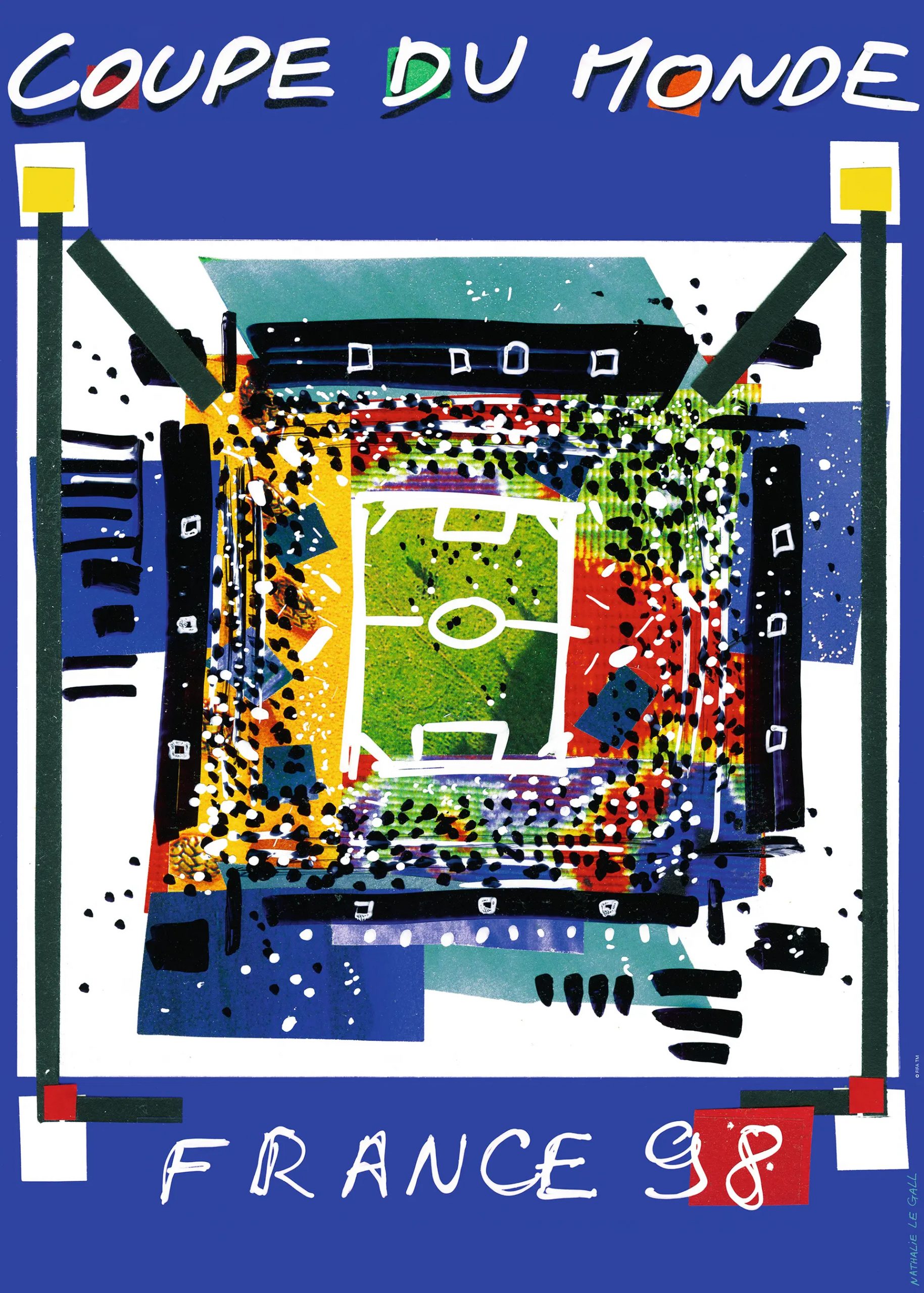
Le Gall, Nathalie. Official Poster of the 1998 FIFA World Cup France. 1998. Poster. FIFA.
The XVI edition of the World Cup would return to France who would be the third country to host it twice (after Mexico and Italy). It had been 60 years since France had hosted the event, a tournament that saw the host country eliminated in the quarterfinals by Italy, the eventual champion. Controversially, Italy had several naturalized players from South America on their squad and in addition were very aggressive in promoting their fascist government on the pitch. It had also been 12 years since France had been in a World Cup, having not qualified for the 1990 and 1998 tournaments. This was Les Bleus’ (The Blues as they were known in France) chance to show the world not just whether or not they belonged in the elite echelons of the soccer world, but to show off their nation. The tournament’s founding father, Frenchman Jules Rimet, would have been proud of how the competition had evolved into a global phenomenon, but also shocked at how gargantuan it had become.
France had competed against Morocco for the rights to host the event. England and Switzerland had also expressed interest, but the Swiss withdrew after realizing they would not be able to meet FIFA’s requirements and England withdrew to focus on (sucessfully) obtaining hosting rights for the 1996 Euro Cup tournament. France won the rights due to a very polished bid that included solid proof of an already existing stadium, transportation, telecommunications network, and lodging infrastructure. In addition, France had very strong influence politically and diplomatically on a global basis as well as within FIFA to sway the Executive Committee and vote in their favor 12 votes to 7. However, there was some level of controversy since FIFA had said they felt Africa was not yet ready to host an event which came across as paternalistic.
FIFA again made several changes to give more teams opportunities to qualify. They expanded the tournament from 24 to 32 teams, in the process giving Africa five places instead of three from the last tournament. EUFA increased their allocation to 15 to 13, Asia gained 2.5 places, CONCACAF gained one place, and CONMEBOL 0.5.
On the pitch, FIFA implemented some additional changes that included the following:
- Introduction of the Golden Goal in knockout matches. Although tested earlier, France 1998 was the first World Cup where the Golden Goal rule was fully implemented throughout the knockout stage. The first goal scored immediately ended the match with no second period of extra time was played if the goal was scored during the first overtime.
- Tighter enforcement of tackles from behind. Before 1998, tackles from behind were often punished inconsistently but as of this tournament, FIFA instructed referees to sanction tackles from behind more strictly and treat dangerous rear challenges as serious fouls, often yellow or red cards.
- Stronger protection for attackers such as shirt‑pulling & holding.
- Clarification of the back‑pass rule toward goalkeepers. While the rule had been introduced in 1992, it had not been applied consistently. This eventually, led to goalkeepers improving foot skills and faster build‑up play from the back.
- Red card sanctions for violent conduct and retaliation. FIFA explicitly instructed referees to punish retaliation, even minimal, and that off‑the‑ball incidents were to be monitored more closely.
- Substitution clarification (three subs, including goalkeeper). Teams were allowed three substitutions.
- Fair Play emphasis (cards as tie‑break culture). This additional tie-breaker was introduced to reward teams that had shown less physical and/or violent conduct when tied with other teams at the end of group stage competition.
An interesting detail about the French fan base was that in the beginning they showed interest but were lukewarm as expectations were not high. After all, they had not qualified for the previous two World Cups and they were seen as a solid but unremarkable squad. In addition, there was tension within the nation due to social unrest, labor strikes, and intense debates about national identity. This last point was accentuated because the French roster included many players of African descent, though they were thoroughly French in having been born in the country. Nonetheless, a certain segment of society didn’t see them as French and some of the uglier part of the political establishment even said they should be deported (a silly and racist proposition since they were born in France). These attitudes would dramatically change as the tournament progressed and the nation overwhelmingly threw themselves into supporting Les Bleus.
Qualifying
For this competition, 174 teams registered to qualify for 30 slots (with France as hosts and Brazil as defending champions automatically qualified), an 18% increase from the previous tournament. Part of this increase was due to expanding the number of nations, but other factors included the breakup of the Soviet Union, the dissolution of Yugoslavia, and the emergence of independent states in Eastern Europe, Africa, and Asia. In addition, more nations saw a path to qualify for the World Cup and strengthened their soccer federations which in turn gave them more resources to be certified for qualification purposes.
As already mentioned, each geographic soccer federation (except Oceania) gained places for qualifying purposes. The breakdown was the following for the 1998 World Cup:
- Asia (AFC): three or four places, contested by 34 teams.
- Africa (CAF): five places, contested by 38 teams, but two, Mali and Niger, withdrew before the start.
- North, Central America and Caribbean (CONCACAF): three places, contested by 30 teams.
- South America (CONMEBOL): four places (plus Brazil who qualified automatically), contested by 10 teams.
- Oceania (OFC): zero or one place, contested by 10 teams.
- Europe (UEFA): 14 places (plus host France who qualified automatically), contested by 50 teams.
The format was as it had been in previous qualifying tournaments. Each soccer federation would determine the composition of groups with home-and-away fixtures, three points for a win, one point for a draw, and zero for a loss. The usual tiebreakers were used in terms of goal difference and total goals scored but any other criteria (e.g., goals against adversary, away goals, other) was up to each geographic federation to decide. However, there doesn’t seem to be any instances of needing those additional criteria to determine which teams had qualified. It was a straightforward qualifying.
The final list of the 32 qualified teams was the following:
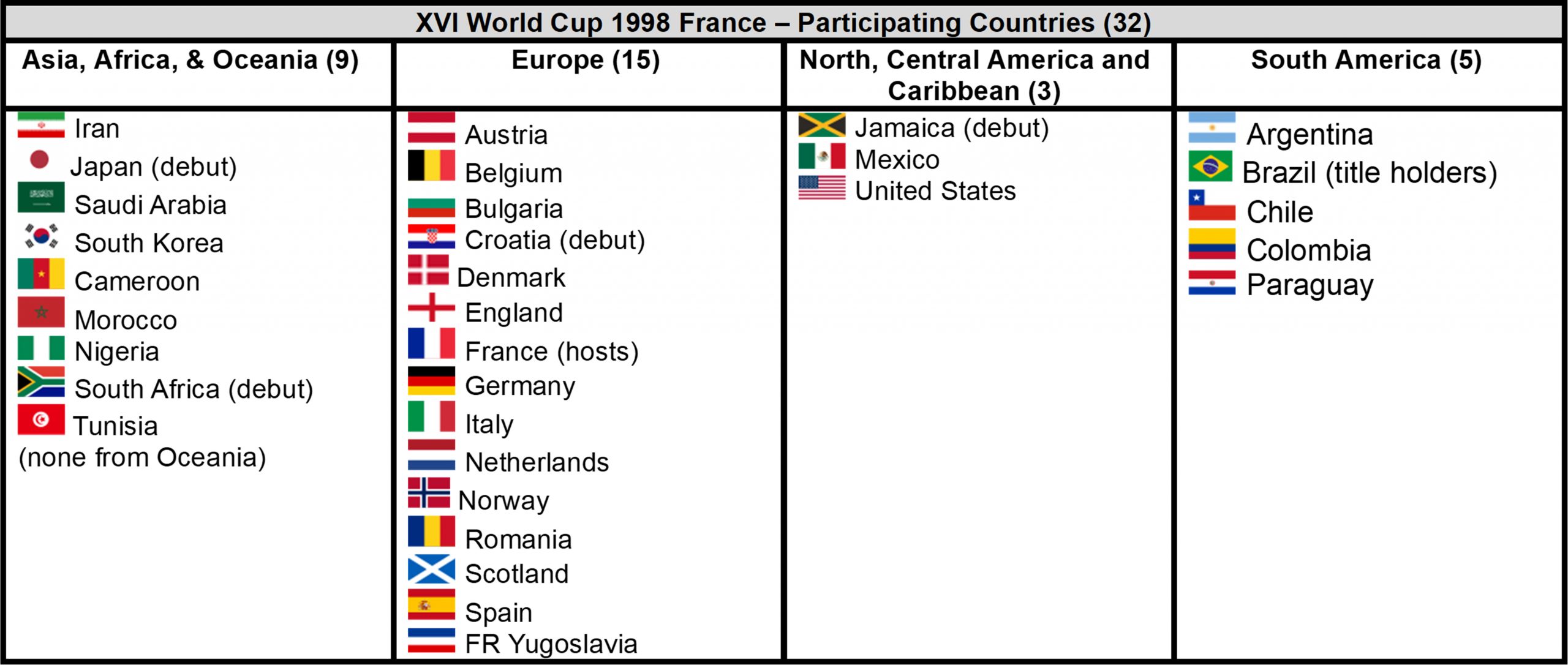
There were four teams that qualified for the first time: Japan, South Africa (who had been allowed back into the global soccer world after having been suspended due to their apartheid policies), Croatia, and Jamaica. Croatia would go on to make their mark not just in this tournament but in future ones as well.
Teams that surprisingly didn’t qualify were:
- Sweden – 1994 World Cup third‑place finish
- Portugal – Strong squad, playoff elimination
- Russia – Regular qualifier, lost playoff (the dissolution of the Soviet Union significantly weakened their team)
- Zambia – Rising African power
The Tournament
The games were played in 10 cities, with the Stade de France in Saint-Denis, located outside Paris, as the tournament’s centerpiece. It cost $430 million to build but it was the pride of France. It hosted nine matches, including the final. An additional nine stadiums were used, including the Parc des Princes in Paris which hosted six games. The other stadiums were located in Marseilles, Lyon, Lens, Nantes, Toulouse, Bordeaux, Montpellier, And Saint-Êtienne. With the expanded field, a total of 64 matches were played.
The draw had eight seeded teams, one for each of the eight groups of four. France was seeded in Group C and Brazil in Group A. The other six seeded teams were taken from the FIFA rankings at the time. These nations were: Germany (ranked 1), Italy (ranked 3), Spain (ranked 4), Argentina (ranked 5), Romania (ranked 6), and the Netherlands (ranked 7). Interestingly enough, Mexico was ranked number 8 at the time but because France, the host, was automatically seeded (and ranked 13 at the time), Mexico lost out on being seeded.
The additional six seeds were not automatically placed in the remaining six groups. Rather, they were placed in a pot from which they would be randomly selected during the actual draw. The pots were configured in the following manner:
- Pot A – Top-seeded teams (defending champion, hosts and six top FIFA rankings)
- Pot B – Europe (UEFA)
- Pot C – Asia (AFC) & Soutth America (CONMEBOL)
- Pot D – Africa (CAF) & North America, Central America, & Caribbean (CONCACAF)
Years later, Michel Platini, who was Co‑President of the French Organizing Committee for the 1998 FIFA World Cup, confesses they had rigged the draw by putting Brazil and France in pots that they knew would not meet until the final if they made it all the way to that match. This was done to keep them apart and with the hopes of having the host nation meet the defending champion in the final.
The final configuration of the groups was the following:

Table courtesy of Jose F Guerra.
 Table courtesy of Jose F Guerra.
As usual, Brazil, who also happened to be the defending champions, were the top favorite. Their roster was loaded with stars such as Ronaldo, Rivaldo, Bebeto, Cafu, and Roberto Carlos. France, as hosts, had a strong “golden generation” with Zidane, Deschamps, Thuram, Blanc, and Petit, with an excellent defensive record in the years leading up to the tournament. Italy were still an elite force at the time. They had tactical discipline and tournament pedigree with players such as Maldini, Baggio, Vieri, and Costacurta (and once they got into the knockout rounds, they tended to bring it up a notch or two). Another elite favorite was Germany. They were finalists in 1982 and 1986, champions in 1990, and their pedigree in World Cups was undeniable. While they had strong players such as Köpke, Matthäus, and Klinsman, they were an aging squad, but mentally and tactically formidable.
Dark horses are always a subject of discussion in any World Cup and 1998 was not an exception. Spain ad a very strong qualifying performance with a talented squad but there were still the question marks around their mental toughness and ability to perform at the highest level. Argentina, for the first time in several World Cups was not considered a favorite since they were in transition and were now without Maradona. Nonetheless, they also had a strong qualifying campaign with talent such as Batistuta, Verón, and Ortega but were seen as less dominant. Croatia was an enigma because it was their first World Cup as an independent nation. They had an outstanding core group of players with the likes of Šuker, Boban, and Prosinečki and many players on their roster played for top European clubs. They would go on to surprise the world with their performance at this World Cup and in subsequent ones.
Group Stage
In group A, Brazil entered as defending champions and topped the group despite a surprising 2–1 loss to Norway in the final match. Norway advanced with them after drawing Brazil and beating Morocco, edging out the Africans on points. Scotland competed well (including a draw vs Norway) but conceded too many goals early. Morocco impressed technically but lacked tournament ruthlessness.
Italy won Group B with solid, pragmatic performances, unbeaten but rarely spectacular. Chile advanced with three draws, powered by the deadly strike duo of Salas and Zamorano. Austria faded after an opening win, while Cameroon showed flashes of brilliance but defensive instability cost them. This was a classic “balanced group” with no runaway dominance.
Hosts France dominated Group C, winning all three matches without conceding a goal. Denmark comfortably took second place, aided by their win over Saudi Arabia and a draw with South Africa. Saudi Arabia and South Africa both struggled defensively and never seriously threatened qualification. France’s authority here signaled their readiness to contend for the title. This was when the people of France started paying attention to their team which was displaying string teamwork, impeccable discipline, and deadly finishing.
In Group D, Nigeria topped the group with flair and athleticism, highlighted by their famous comeback win over Spain. Paraguay advanced alongside them thanks to defensive solidity and goalkeeper José Luis Chilavert. Spain’s elimination was one of the tournament’s biggest shocks, undone by late goals and inconsistencies. They once again underperformed and would continue to do so until their breakthroughs in the late 2000s. Bulgaria looked past their peak and exited quietly.
Group E was remembered for Mexico producing one of the most remarkable group campaigns in World Cup history, coming from behind in all three matches: beating South Korea 3–1, then drawing 2–2 against Belgium after trailing 2–0, and again drawing 2–2 against the Netherlands after being down 2–0, scoring a 90th‑minute equalizer. The Netherlands won the group on goal difference after thumping South Korea 5–0 and drawing twice. Belgium were eliminated despite going undefeated with three draws, while South Korea finished bottom. Mexico’s resilience became a defining story of the tournament’s first round.
Germany won the group efficiently, though not convincingly, relying on experience rather than flair. Yugoslavia advanced with disciplined performances and physical strength. Iran made history by defeating the United States in a politically charged match, their first World Cup win. The U.S. finished bottom despite moments of promise.
Romania surprised many by winning the group, highlighted by their win over England. England advanced comfortably, powered by individual moments (notably Michael Owen’s goal against Argentina later validated their promise). Colombia were eliminated early in a sharp fall from their 1994 reputation. Tunisia competed well but lacked goals.
Argentina took the group with controlled, professional performances. Croatia emerged as the tournament’s great dark horse, advancing with attacking verve and clinical finishing. Jamaica captured hearts in their debut, earning a memorable win over Japan. Japan also debuted admirably but exited without a point, gaining invaluable experience.
The knockout stages would produce tense and exciting matches, as well as several that went all the way to penalty kicks.
The round of 16 delivered immediate drama. The match between Argentina and England, already tense due to past encounters between these two nations in World Cup tournaments, became even more dramatic when David Beckham was sent off for a retaliatory kick on Diego Simeone, a decision that sparked enormous controversy and long‑term fallout in English soccer. Argentina advanced on penalties after a 2–2 draw. France edged Paraguay 1–0 via a golden goal by Laurent Blanc, the first golden goal in World Cup history, following a spectacular performance by goalkeeper José Luis Chilavert and Paraguay’s back line. Denmark stunned Nigeria 4–1, exposing Nigeria’s defensive fragility after an impressive group stage. Croatia beat Romania 1–0 through Davor Šuker, continuing their remarkable debut World Cup run. Elsewhere, Germany narrowly defeated Mexico, with Oliver Bierhoff and Jürgen Klinsmann proving decisive after Mexico once again led late. Of note is that after Mexico went ahead in minute 47 on a Luis Hernández (El Matador) goal they had an opportunity to go ahead 2-0 when the same Hernández, in a one-on-one play against the Germany goalkeeper completely missed. This was when Germany seemed rattled and confused. That miss from Mexico gave the Germans to rally and come from behind in the final 15 minutes of the match.
Quarterfinals
The quarterfinals confirmed the tournament’s elite while producing one of its most lopsided shocks: Croatia dismantled Germany 3–0, marking the end of an era for the aging German side and announcing Croatia as a genuine power. France eliminated Italy on penalties after a 0–0 draw, in a tense, physical match remembered for defensive excellence and the send‑off of French center back Laurent Blanc. Brazil survived a high‑quality contest against Denmark, winning 3–2, driven by moments of brilliance from Rivaldo and Bebeto. The Netherlands defeated Argentina 2–1, sealed by Dennis Bergkamp’s iconic last‑minute goal, widely regarded as one of the greatest World Cup goals ever scored.
Semifinals
The semifinals featured high tactical tension and contrasting drama. France defeated Croatia 2–1, with defender Lilian Thuram scoring the only two goals of his international career, overturning Croatia’s early lead through Šuker. Brazil and the Netherlands drew 1–1 in a tightly contested match, with goals from Ronaldo and Patrick Kluivert, before Brazil advanced on penalties. The Brazil–Netherlands match was marked by physical play and tactical fouling, though no single refereeing decision dominated discussion. The finalists were set without controversy, but expectations around Ronaldo’s fitness and form were already becoming a major talking point.
The third‑place match saw Croatia defeat the Netherlands 2–1, confirming the Croatians as the tournament’s great overachievers. Davor Šuker scored again, securing the Golden Boot with six goals despite Croatia playing one fewer match than finalists France and Brazil. The Netherlands fielded a rotated side and lacked defensive sharpness after their semifinal disappointment. Croatia’s victory cemented one of the most successful World Cup debuts in history. The match also helped reframe perceptions of post‑Yugoslav soccer nations on the global stage.
The Final
On July 12, 1998, 75,000 screaming and passionate fans attended the final between the defending champion, Brazil, and the hosts, France, who had electrified and brought together a nation that at the beginning were lukewarm because of low expectations. Now they were ready to push Les Bleus forward with their support and screams.
But hours before kickoff, and with the world unaware, a drama had unfolded in the Brazilian camp. At 4:00 PM France time, Ronaldo, the team’s and tournament’s best player, its talisman, and main scorer, was in convulsions, his mouth foaming, and his teeth clenched tightly. He was rushed to a hospital where he stayed for three hours. There were rumors already floating around the media that he had fallen sick and would not play. Emotionally, this was a huge blow to Brazil and their fans. And it seemed to get worse when at 7:48 PM the head coach of Brazil, Zagallo, provided the starting lineup sheet to FIFA with Ronaldo’s name out of the lineup. But then at 8:18 PM, Zagallo submitted a revised lineup with Ronaldo in it. Brazilian fans breathed a sigh of relief, but the damage was done. The players entered the match distracted and as time went on, it was obvious their star player was not well.
France started assertively, pressing higher and playing with greater cohesion, while Brazil looked disjointed, slow in midfield, and oddly passive. The breakthrough came from set pieces: Zinedine Zidane scored twice with near‑identical headers from corners (27′ and 45+1′), exploiting Brazil’s zonal marking and a surprisingly fragile defense. Brazil created very little in open play, with Ronaldo isolated and subdued, and Rivaldo unable to impose himself. There were no major refereeing controversies in the half, but the tactical imbalance and Brazil’s flat body language were striking, especially given their pedigree.
Brazil emerged needing an early goal but never truly looked capable of mounting a comeback, continuing to struggle physically and mentally. Ronaldo appeared off the pace, rarely threatening the French back line, while France controlled possession calmly and managed the game intelligently. Even when France went down a player with their center back Marcel Desailly being given a red card at minute 68, they continued to control the game. Any remaining suspense ended when Emmanuel Petit scored a late third goal (90′) on the counterattack, symbolizing France’s total control and Brazil’s collapse. Again, there were no controversial calls of consequence; the match was decided by structure, energy, and execution rather than refereeing. In hindsight, the final became inseparable from questions about Ronaldo’s health, Brazil’s decision to play him, and the team’s lack of contingency, while France’s disciplined, balanced performance confirmed one of the most dominant World Cup final victories in history.
France had played as a highly integrated unit throughout the tournament. They displayed compact defensive lines, clearly defined midfield roles, disciplined off‑ball movement, and collective decision‑making that did not depend on one individual. Even when Zidane was quiet in open play, France functioned smoothly because Deschamps, Petit, Karembeu, Thuram, and Desailly operated within a well‑rehearsed system, and every player understood when to press, hold shape, or slow the tempo. Their cohesion was visible in how calmly they managed games (narrow wins against Paraguay and Italy, then controlled victories over Croatia and Brazil) without ever looking frantic or disjointed.
Brazil, by contrast, relied more heavily on individual quality and intuitive combinations than on structural cohesion. When Ronaldo was fit and sharp, that model worked. When he was compromised, as he was in the final, Brazil lacked a collective fallback plan. Midfield spacing was inconsistent, defensive transitions were slow, and attacking phases often depended on isolated moments from Ronaldo or Rivaldo rather than coordinated movement. Even before the final, Brazil looked vulnerable at times (Denmark, Norway, Netherlands), surviving more on experience and talent than collective control.
The difference was also psychological. France appeared emotionally synchronized (calm, patient, and resilient) while Brazil showed signs of internal uncertainty, especially surrounding Ronaldo’s health and selection. That gap in cohesion didn’t just explain the final; it explained why France looked increasingly dominant as the tournament progressed, while Brazil looked increasingly fragile.
France had its first World Cup, in a tournament that was electric because of the deep runs of dark horses and newcomers and because the hosts had shown the world how a nation had put together a team of different ethnic backgrounds and played as an integrated whole, controlling matches and dominating when it was necessary.
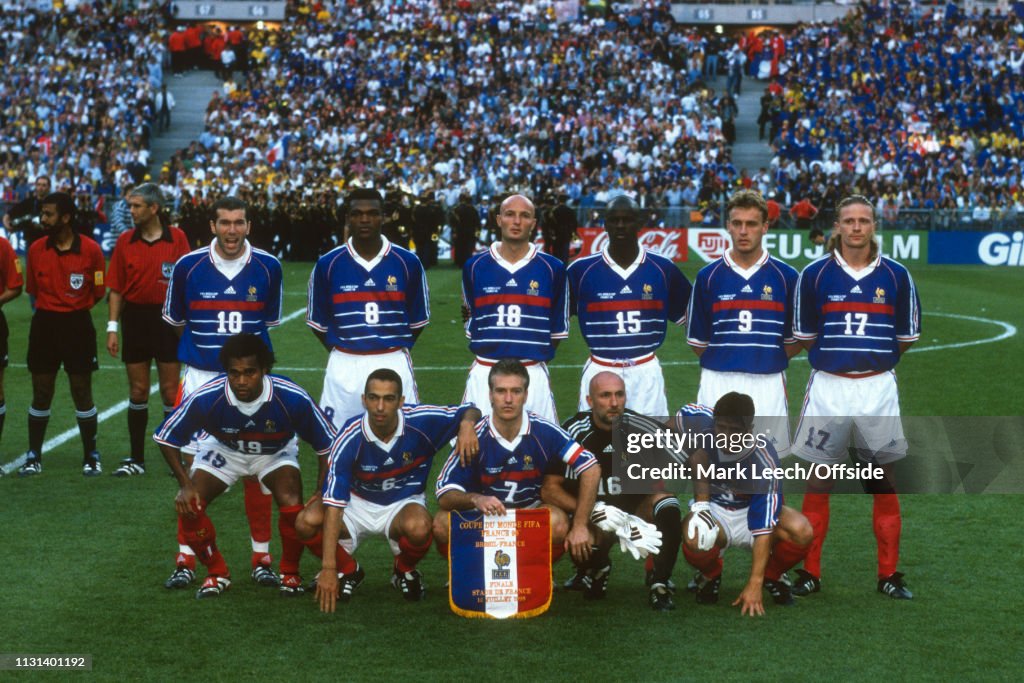
Leech, Mark. France Team Line‑Up Before the FIFA World Cup Final. 1998. Photograph. Offside / Getty Images.
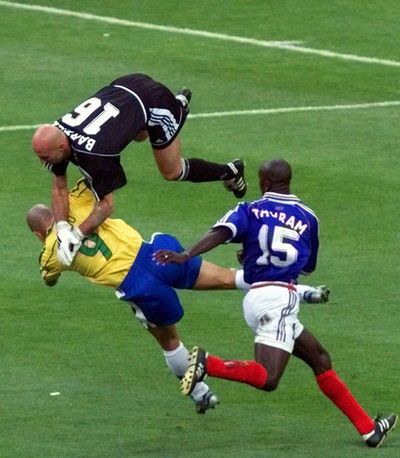
Getty Images. Match Action During the FIFA World Cup Final: France vs. Brazil. 1998. Photograph. Getty Images.
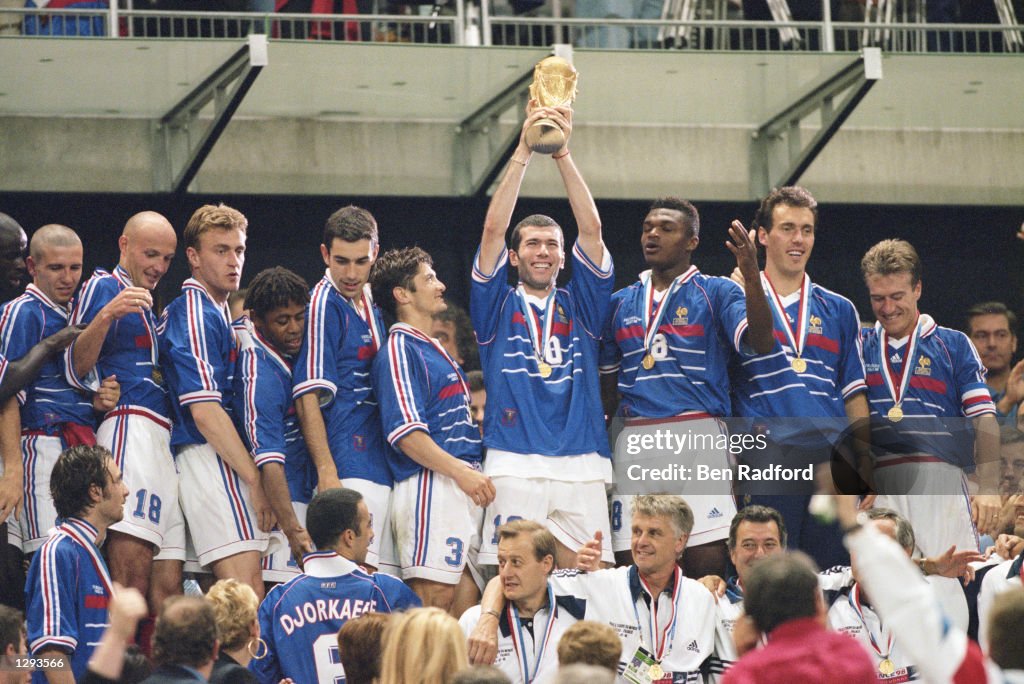
Radford, Ben. France Lifting the FIFA World Cup Trophy. 1998. Photograph. Getty Images.
Firsts In The Tournament
- First World Cup with 32 teams.
- First World Cup title for France.
- First time participants in Japan, South Africa, Croatia, and Jamaica.
- First time the Golden Goal rules was used in overtime, with France scoring the first ever in the round of 16 match against Paraguay.
- First time electronic boards were used by fourth officials on the sidelines to announce substitutions and stoppage time.
- First time that up to three substitutions were allowed instead of just two.
- First time a red card was issued in a final, with France having the distinction by seeing center back Desailly sent off for a second yellow card.
Relevant Players
- Zinedine Zidane (France) – Two goals in the final, the general on the pitch, defining figure of France’s first World Cup win.
- Ronaldo (Brazil) – Tournament top star coming in, dramatic final after the pre‑match illness; central to one of the most discussed finals ever.
- Davor Šuker (Croatia) – Golden Boot winner (six goals) and leader of Croatia’s surprise third‑place finish in their debut World Cup.
- Gabriel Batistuta (Argentina) – Scored a famous hat‑trick against Jamaica and was Argentina’s attacking reference point.
- Dennis Bergkamp (Netherlands) – Scored one of the tournament’s most iconic goals vs Argentina (quarter‑final).
- Michael Owen (England) – Announced himself globally with his solo goal against Argentina; one of the breakout stars.
The World Cup travels to the other side of the world
Four years after the 1998 competition, Asia would host the first World Cup. The honor would go to Japan and South Korea who would dazzle the world with their organization, warmth, and enthusiasm. It would also be the first World Cup, but not the last, to be hosted by more than one country.
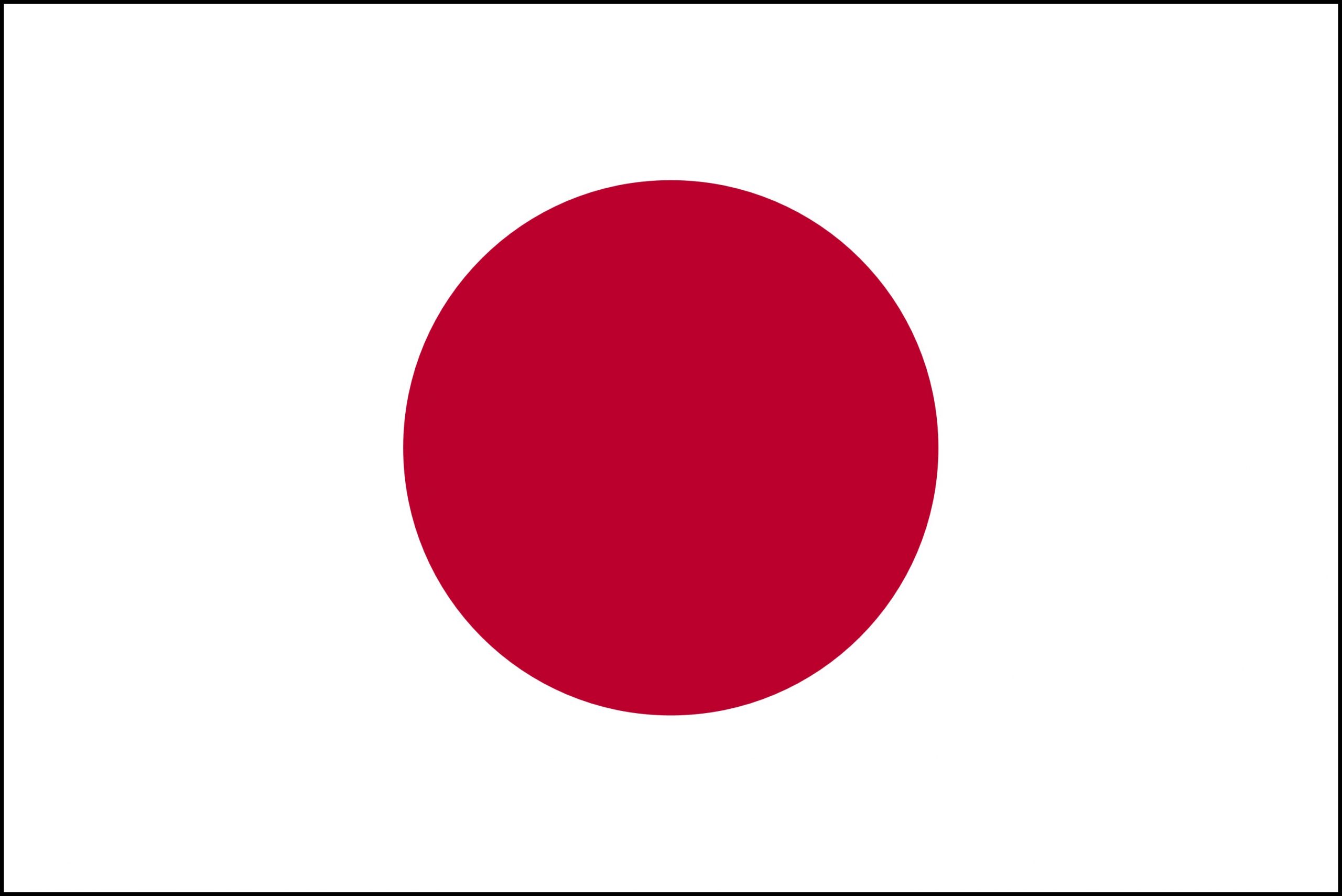 日本へようこそ
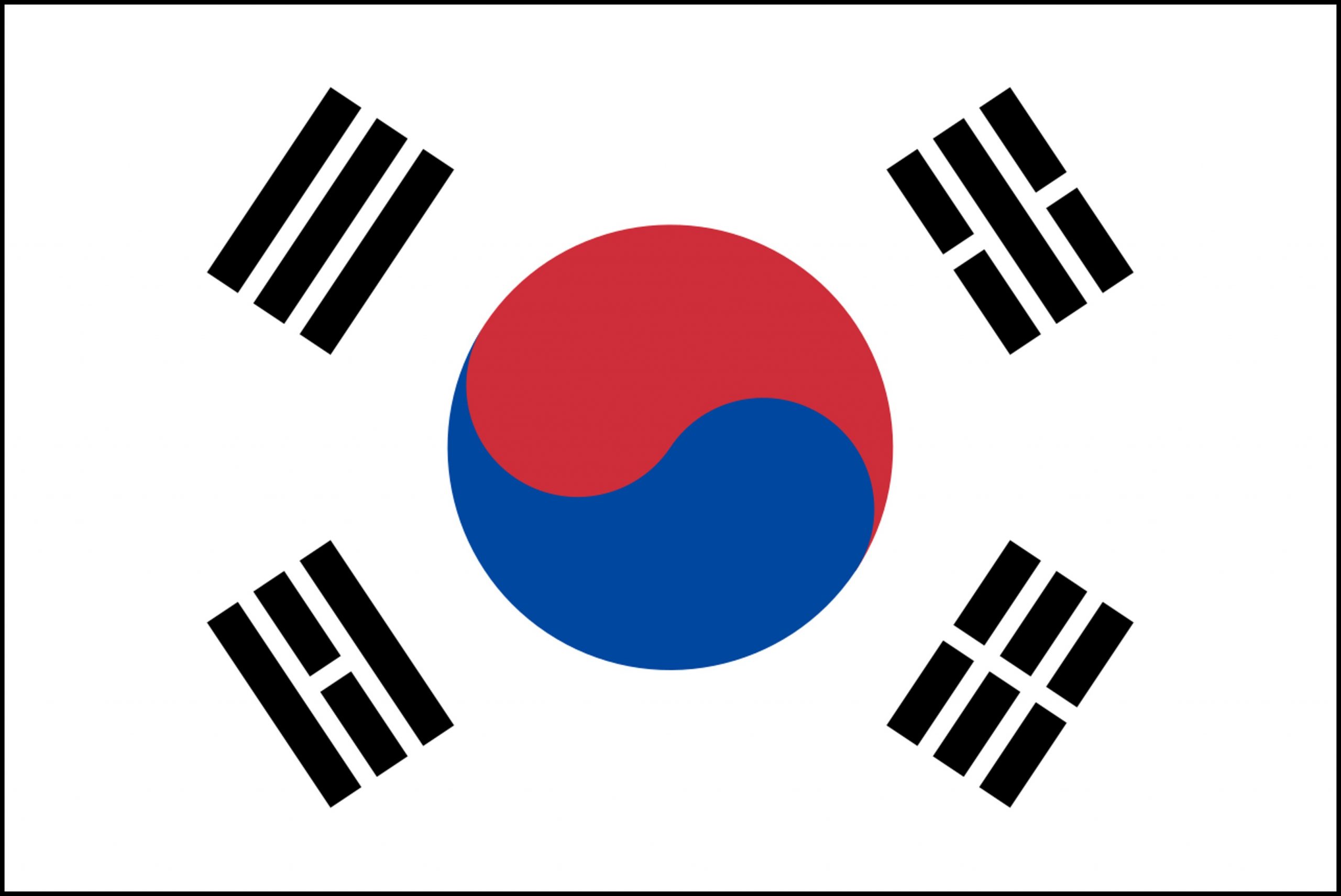 한국에 오신 것을 환영합니다