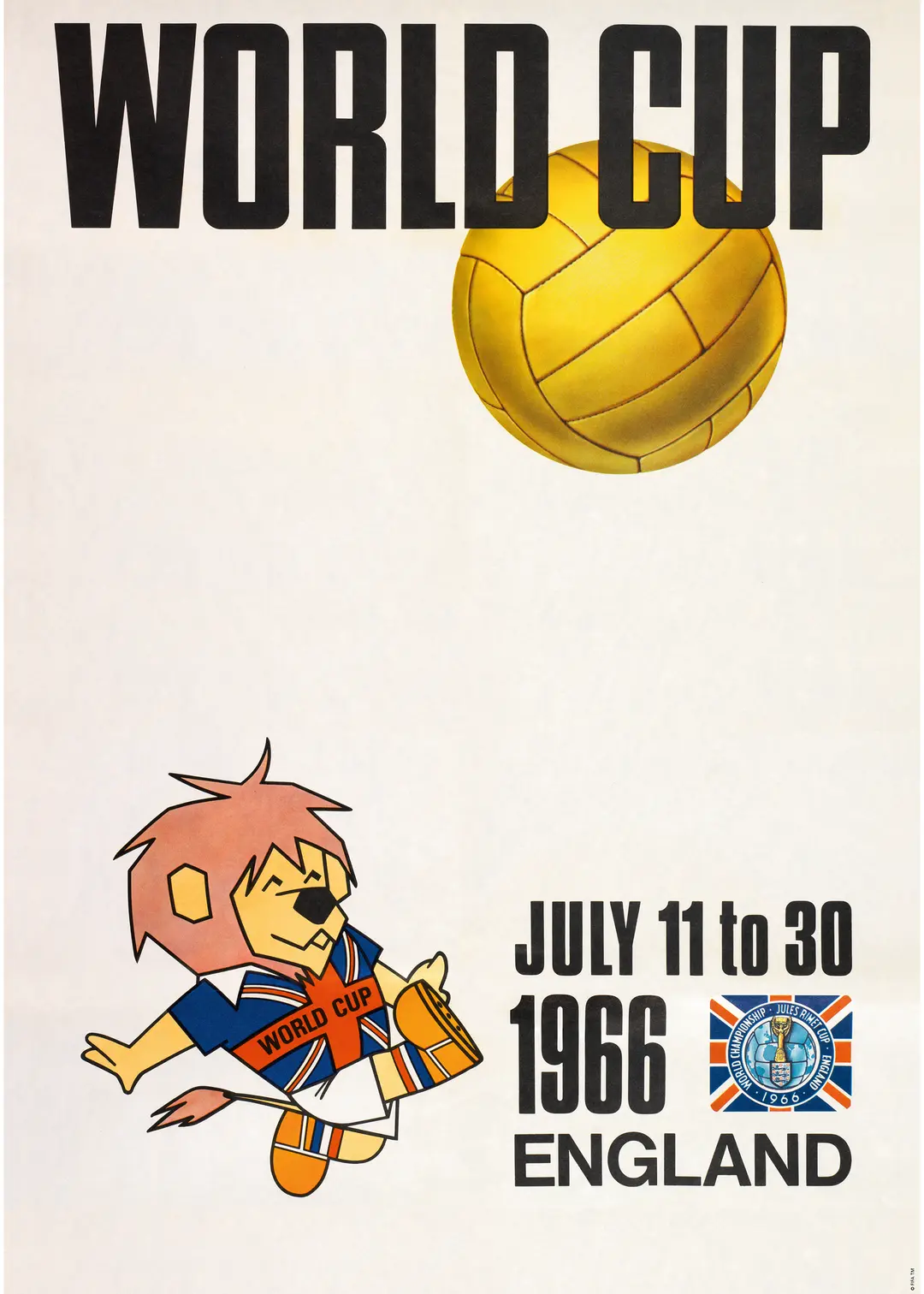
FIFA World Cup Poster, England 1966. Courtesy of the National Football Museum / Priory Collection
This article is part of our ongoing series covering the History and Evolution of the World Cup.
The VIII edition of the FIFA World Cup tournament was about to experience seismic shifts. Some of them occurred before the tournament, others during, and still others in the aftermath of various controversial decisions inside and outside the event itself. Politics again reared its ugly head in the form of massive boycotts from an entire continent. In addition, the competition would see differences in the way European teams had physically and tactically prepared compared to South American teams. This last point would have ripple effects that continue to be felt to this day as teams look to maximize and balance match fitness with tactical approaches and team cohesion.
England, Spain, and West Germany bid for the right to host the tournament. On August 22nd, 1960, England was chosen as the host. This would be the first tournament to be held in a country that was affected directly by World War II, as the previous tournaments had either taken place before the war or were hosted by countries that were either not part of the war theatres or were in neutral regions. It would also be held in the birthplace of the modern version of soccer (or football as it is known in most of the soccer world).
Key reasons for picking England were that they had the best communications and hotel infrastructure, were used to organizing large scale tournaments (the FA Cup being one of them), and their TV networks were more advanced than Spain’s or West Germany’s at the time. This last point would prove to be an inflection point in the symbiotic relationship between broadcast media and FIFA. It was then that FIFA discovered the spigot of revenues that would turn it into a global multi-billion-dollar soccer juggernaut. It was the first World Cup to have selected matches broadcast via satellite to countries on other continents. It would also be the last time that the final would be broadcast in black and white.
This World Cup had its share of curiosities. The Jules Rimet trophy was stolen prior to the tournament, but was recovered by a dog named Pickles four months before the tournament began. This was also the only World Cup in history that did not have matches on Sundays due to religious laws in England at the time, which were eventually repealed ten years later in 1976.
Qualifying
The number of teams competing in the tournament was still held at 16. As before, the host country, England, and the defending champion, Brazil, automatically qualified. The remainder of the 14 teams would be decided among 51 teams that registered for the qualification phases. However, FIFA continued to give preference to Europe and announced that the Confederation of African Football (CAF), the Asian Football Confederation (AFC), and Australia (the Oceania Football Confederation had not yet been formed for qualifying purposes) would only have one guaranteed place.
The distribution by region for all sixteen places (including the host and the defending champion) was:
- Union of European Football Associations (UEFA): 10 places, one of them to England with the other nine places to be contested by 32 teams (including Israel and Syria).
- Confederación Sudamericana de Fútbol (CONMEBOL): four places, one of them to the defending champion Brazil, with the other three places contested by nine teams.
- Confederation of North, Central America and Caribbean Association Football (CONCACAF): one place, contested by 10 teams.
- Confederation of African Football (CAF), Asian Football Confederation (AFC), and Australia: one place, contested by 19 teams.
UEFA, CONMEBOL and CONCACAF had a guaranteed number of places, whereas the CAF, AFC, and Australia had to contest a play-off to determine which confederation would be represented. This very arbitrary decision coupled with FIFA’s decision to readmit South Africa (who already had put in place apartheid policies) caused all African teams to withdraw from qualifying. Syria joined them in solidarity. Africa informed FIFA that unless they had at least one guaranteed place they would again boycott for the 1970 World Cup. FIFA would approve this change for the next World Cup but it would take another 10 years under a new leader, a Brazilian by the name of João Havelange, for FIFA to shake off its Eurocentricity and truly start developing the game at the global level.
As with the previous qualifying round for the 1962 World Cup, two points would be awarded for a win, one point for a draw, and zero for a loss. If the top two teams of any of the qualifying groups were tied in points, an extra playoff game would be required. FIFA had not yet put in place tie breakers such as goal difference or goal average or several other measures currently in place.
Three playoff games were required, one in CONMEBOL and two in UEFA. For the South American Confederation, Chile and Ecuador met in the payoff with Chile winning their match while in Europe, Bulgaria defeated Belgium and Spain defeated the Republic of Ireland.
One surprise was the runner-up from 1962, Czechoslovakia, not qualifying for this World Cup. They finished second with Portugal topping the group.
The final list of the 16 qualified nations was:
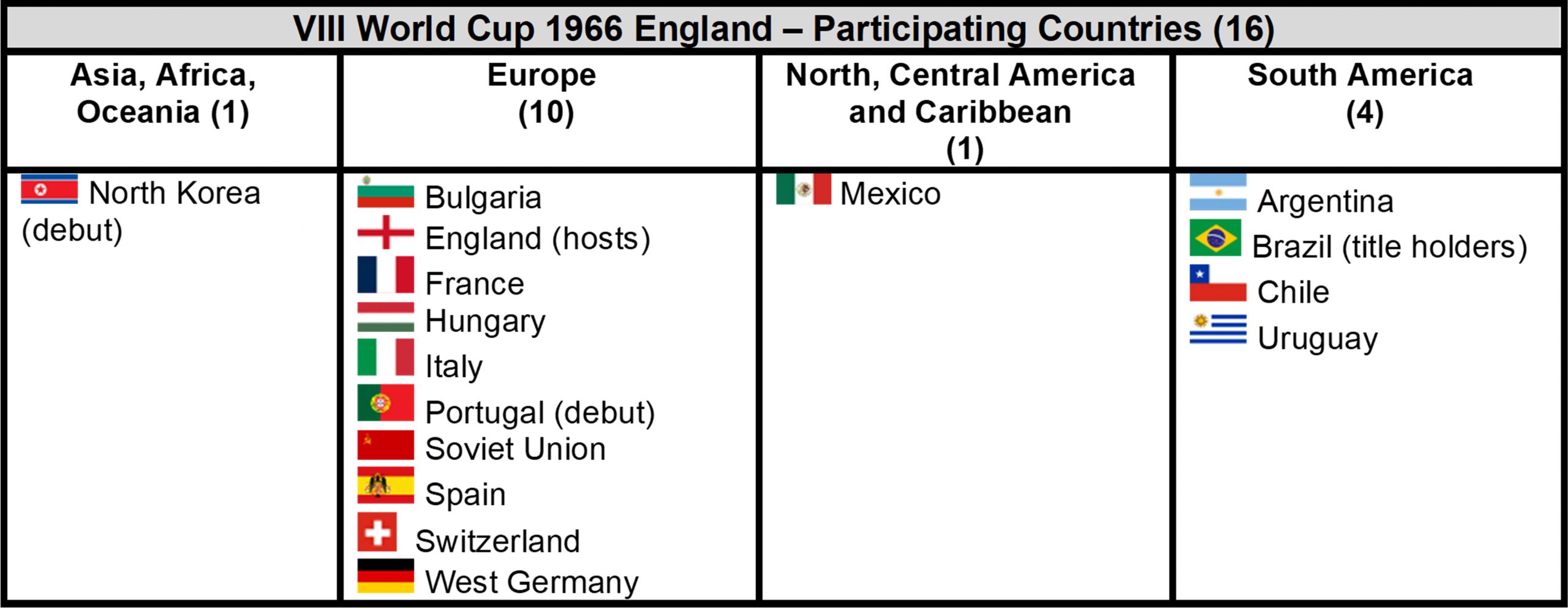
Table developed by Jose F Guerra
The Tournament
The event was held across eight venues, with two of them in London, including legendary Wembley Stadium with a capacity of 98,000. Wembley would also host the most number of games per venue with nine matches, including the opening one and the final.
Once again, the 16 teams were placed in four groups of four, in a round robin format within the group, and the top two teams of each group advancing to the knockout stages. In the event of ties in points, goal average would be used to determine the higher qualified team but if they were still tied, lots would be drawn. In the knockout stages, except for the final, if at the end of 90 minutes the teams were still tied, an extra two periods of 15 minutes each would be played. If they were still tied, lots would determine the winner. The exception was the final game in which if the teams were still tied after regular time and overtime, then the match would be replayed, with an added two periods of 15 minutes of overtime, and lots drawn if still tied at the end of that time.
The final drawing produced the following groups with the ones shaded in green advancing to the knockout stages.

Table developed by Jose F Guerra
Group Stage
The group stage would become memorable for two shocking results: the elimination of the defending champions, Brazil, and the defeat of Italy at the hands of North Korea.
This World Cup also had fewer goals compared to other tournaments as teams began to play much more tactically and defensively.
In Group 1, England, coached by Sir Alf Ramsey, finished atop their group but only managed to score four goals. However, they managed to keep a clean sheet in their three group stage games. Uruguay was the other team to qualify from that group at the expense of both Mexico and France. But there were serious concerns that England, despite having prepared for three years under a carefully structured physical fitness and tactical regime, would not get too far after qualifying for the knockout stages.
In Group 2, West Germany and Argentina qualified easily. However, their match against each other, while finishing in a 0-0 draw, was marred by strong physical game by West Germany and violent behavior by Argentina. In this match, one of Argentina’s players was sent off and would not play in their final group stage game. The “Albicelestes” (as the Argentina team was known) would still have no trouble beating Switzerland 2-0 and advancing in second place of their group, with West Germany on top.
Group 3 saw more violent and physical play, only this time directed at one player: Pelé. In their first group play game Brazil faced Bulgaria. Their roster was an impressive collection of veterans with rising stars. However, their veterans were past their prime and the Bulgarians centered their attention on Pelé. He was taken out through violent kicks, which the referees didn’t call. While Brazil won that game, their next match against Hungary they lost 3-1 without Pelé who was unable to start. Desperate to qualify for the knockout stage, the head coach made several changes for their last group stage match and started Pelé as well. But it wasn’t enough, especially since their star player was nowhere near fit. They were defeated by Portugal 3-1, shocking the world and ending Brazil’s participation in the tournament. Portugal and Hungary advanced.
Group 4 saw a resurgent Soviet Union come out on top of their group. But the shocking surprise was Italy being knocked out by the unknown and mysterious North Koreans. Italy had already underperformed. It was said that their players were not as committed because they were trying to not get injured given their very high compensation from their clubs. But their attitude of thinking they had an easy group, their hyper-defensive tactics, and their inability to come from behind were the real culprits. In a must win game in their last group play match against North Korea, they were surprised and unable to keep up with the speed, agility, aggressiveness, and drive of the Asian team. They lost 1-0 and were eliminated from the tournament. To the surprise of the soccer world, North Korea advanced to the knockout stage along with the Soviet Union on top of the group who won all their three matches.
Knockout Stage
The knockout stages would now see memorable matches. Some because of the high quality of play, others because of comebacks, and others because of the physicality and very inconsistent refereeing.
England and Argentina played a very physical game but the South Americans were outmatched in that aspect and resorted to violent play. Once again, one of their players was sent off but it was controversial (the referee said the Argentine player had insulted him but later admitted he didn’t speak Spanish). West Germany disposed of Uruguay easily 4-0, using their superior physicality and speed to overwhelm the “Celestes” (as the Uruguayan team is known). The Soviet Union defeated Hungary 2-1, but the chronicles of the day say that it was the goalkeepers (GK) that made the difference. Legendary Soviet GK, Lev Yashin, was superb while Hungary’s GK made two mistake that cost them the game. And finally, Portugal met North Korea in what would be one of the greatest comebacks in the history of the tournament. North Korea was ahead 3-0 within the first minutes 25 of the match! But Portugal had a lethal weapon: Eusebio. He scored four goals over the course of the next 55 minutes to seal Portugal’s pass to the semi-final stage.
The south American teams were convinced there was a conspiracy against them because none of the referees for the quarterfinal matches were from South America. FIFA had assigned three from Europe and one from Israel. There’s never been any evidence of a conspiracy at this stage (that would come later) but this was another data point of how FIFA saw this tournament as very “Eurocentric” and was still seeing the rest of the world as not up to their standards.
Semi-finals
The semi-final between West Germany and the Soviet Union was again a very physical encounter, with both teams afraid of making any mistakes that would cost them a trip to the final. The West Germans prevailed 2-1, with the Soviets having had a player sent off in minute 44.
In the other semi-final, England and Portugal played a very lively match, free of the physicality and violence that had been very present during the entire tournament. England won 2-1. However, England, according to the schedule was supposed to play up north in Liverpool, a good 200 miles away. But both the Football Association (England’s soccer governing body) and FIFA decided that England could stay in Wembley. The official reason was it would maximize gate revenue, but it smacked of favoritism (especially since the President of FIFA was the Englishman, Sir Stanley Rous) since England was practically unbeatable at Wembley in that era. England would face West Germany in the final at Wembley Stadium.
England played essentially the same way they had been playing during the entire tournament. Under Sir Alf Ramsey they became known as the “wingless wonders,” using a narrow, disciplined 4‑4‑2 that emphasized structure, shape, and teamwork over individual flair. They used intense defensive pressing, were compact in the midfield, built up through the center (and not the wings) with Bobby Charlton being the orchestrator, and their tactics were so disciplined that they didn’t concede a goal until the semi-finals.
West Germany was highly efficient (a style that would carry them for the next 30 years), disciplined, technically strong in midfield (especially with young Franz Beckenbauer), quick and sharp on counters, direct in attack, and using fast vertical transitions. They used a 4‑3‑3 formation when defending but would switch to a 4-2-4 structure when attacking. This made for an attack that could overwhelm rivals such as Uruguay 4–0 in the quarterfinal and Switzerland 5–0 in group play.
Some of the firsts in this tournament were:
- First World Cup hosted in the English‑speaking world
- First World Cup mascot named Willie
- First hat‑trick ever scored in a World Cup Final
- Birth of the yellow/red card system (concept first conceived but implemented in 1970)
- First time defending champions eliminated in the group stage since 1950 (Italy eliminated)
- First appearance by North Korea and first Asian team to reach the quarterfinals
- First (and only time to date) England became World Champions
Relevant Players
This tournament was packed with players that were either already legend or would go on to be legends. Among them were:
- Bobby Charlton (England) – The tournament’s star midfielder and Ballon d’Or winner (1966).
- Eusébio (Portugal) – Won the Golden Boot with 9 goals with his performance against North Korea (four goals) now legendary.
- Franz Beckenbauer (West Germany) – “Der Kaiser” (The Emperor) was a young emerging superstar who scored four goals and played every match as a midfielder before becoming known as a sweeper.
- Lev Yashin (Soviet Union) – Known as the “Black Spider” is now widely regarded as one of the greatest goalkeepers ever and his play helped lead the USSR to the semifinals.
- Antonio Carbajal (Mexico) – Made his record fifth World Cup appearance during the tournament
The Final
The final was played by two countries that had been at war barely 20 years before, two countries that had been devastated by that war and had risen from that devastation to be not just among the strongest economies in the world but now also among the elite in soccer. And the game would see two different styles as well, but with the European flavor that had been so prevalent in the tournament: fast, physical play, highly competitive, not violent (as many matches had been during this World Cup), and controversial. It would be and continues to be one of the most dramatic and controversial matches in the history of the World Cup.
Wembley Stadium was packed with 96,924 spectators, The Germans struck first through Helmut Haller, but England equalized when Geoff Hurst headed in a Bobby Moore free kick, sending the teams level at halftime. England took the lead late in the second half with a goal from Martin Peters, the only player booked in the match, but West Germany’s Wolfgang Weber equalized at the last minute, forcing extra time. The match became famous for England’s Hurst’s controversial second goal (also known as the “ghost goal”) in the 101st minute, when his shot struck the underside of the crossbar and bounced down near the goal line. After consulting his linesman, referee Gottfried Dienst awarded the goal. England sealed the victory in the final seconds when Hurst completed his historic hat‑trick, making the score 4–2 and securing England’s first, and still only, World Cup title.
Throughout the match, both teams showed the qualities that defined their respective tournament runs. England played with disciplined organization and tactical control, consistent with Alf Ramsey’s celebrated “wingless wonders” system, which emphasized narrow attacking, high work‑rate defending, and intelligent midfield play. West Germany, considered outsiders before the tournament, displayed their trademark resilience and direct play, repeatedly threatening England with quick transitions and determined attacking movements. Their late equalizer at 2–2 highlighted their fighting spirit, while England’s extra‑time surge demonstrated superior stamina and composure under pressure. The match is remembered not for violence (there was only one caution) but for its historic goals, tactical contrasts, and enduring controversies, cementing its status as one of the most iconic World Cup finals ever.
The European physicality, match fitness, fast play, and disciplined tactics would globally impact the soccer world, especially in South America. Teams realized that a more integrated approach to the preparation would be required to be competitive and to win trophies.
The England 1966 World Cup was controversial at several levels. But it set the stage for a dramatic change in physical fitness preparation, tactical discipline, and team cohesion. This would manifest itself four years later during the Mexico 1970 World Cup which will be the next in this series.
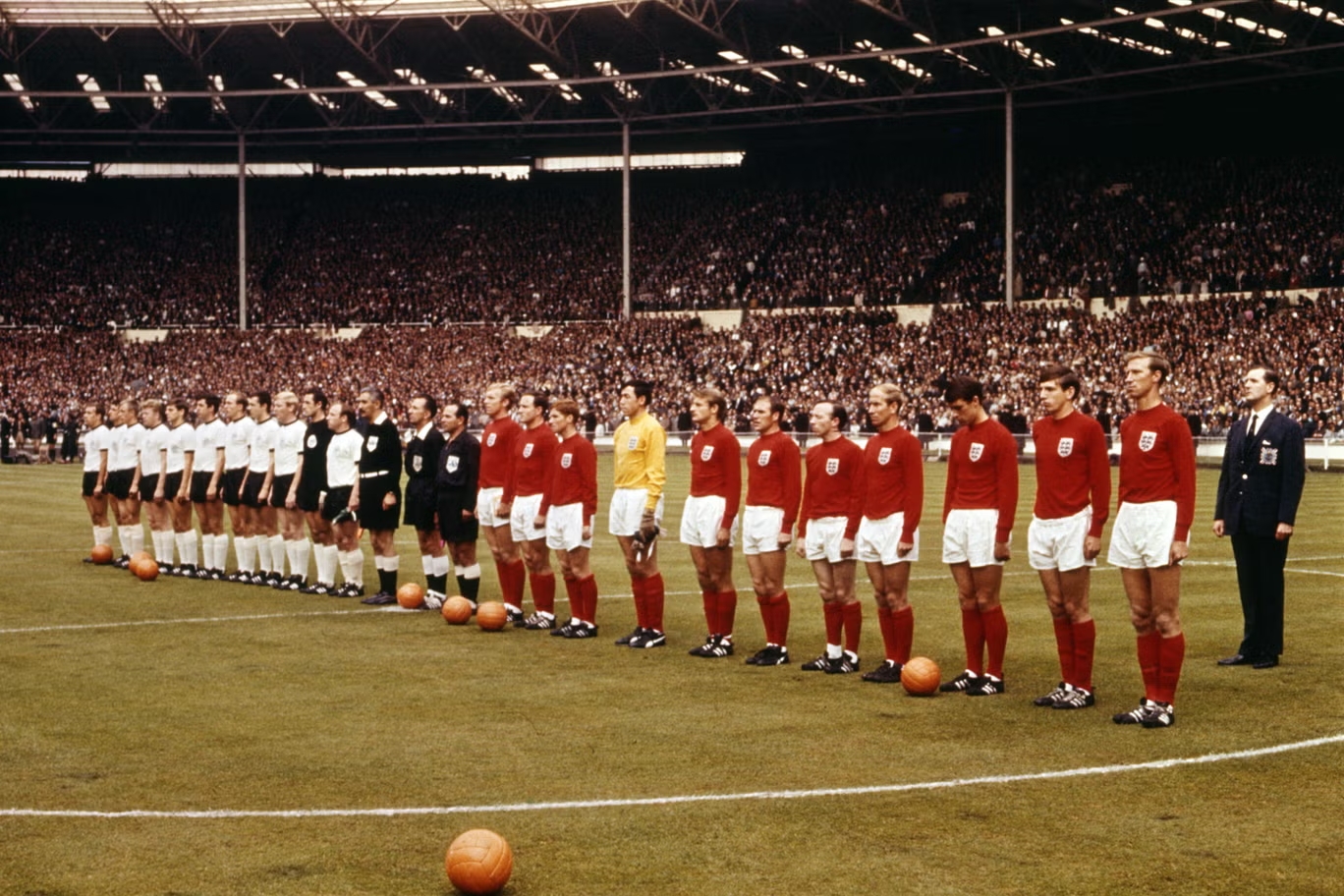
England v West Germany – 1966 FIFA World Cup Final, Wembley Stadium, London. Team lineups before the match, source: Alamy
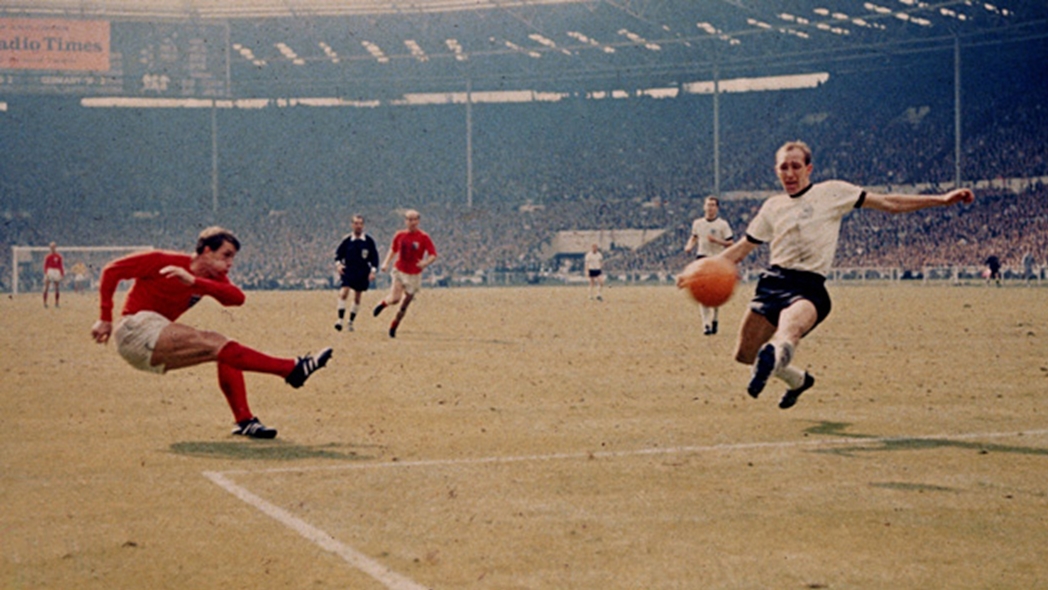
England v West Germany – 1966 FIFA World Cup Final, Wembley Stadium, London. Hurst “Ghost Goal” shot. source: Alamy
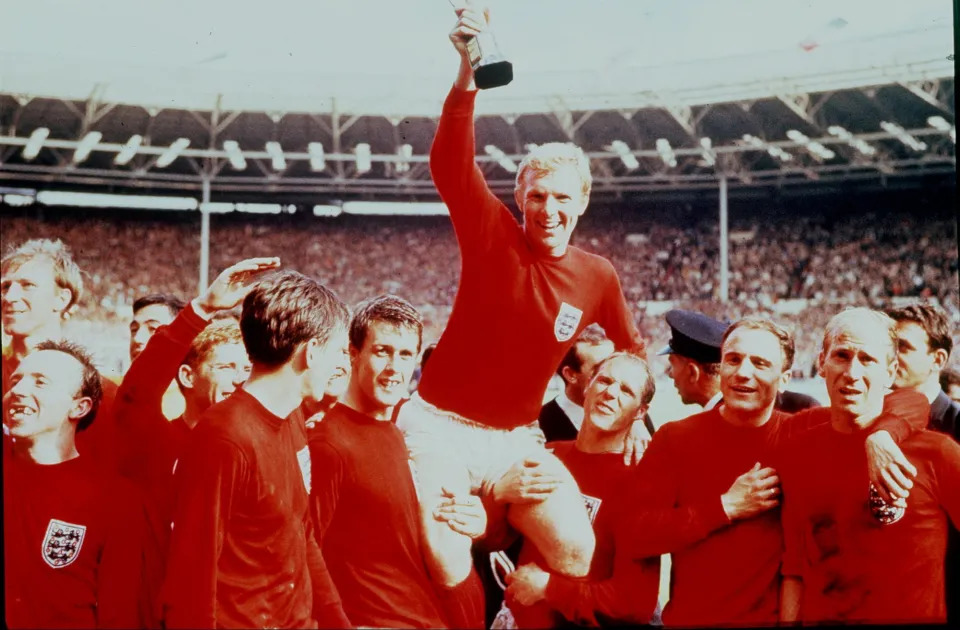
1966 FIFA World Cup Final – England v West Germany, Wembley Stadium, London. England players celebrating after winning the World Cup with captain Bobby Moore lifting the Jules Rimet trophy, source: Alamy

Recommended for you