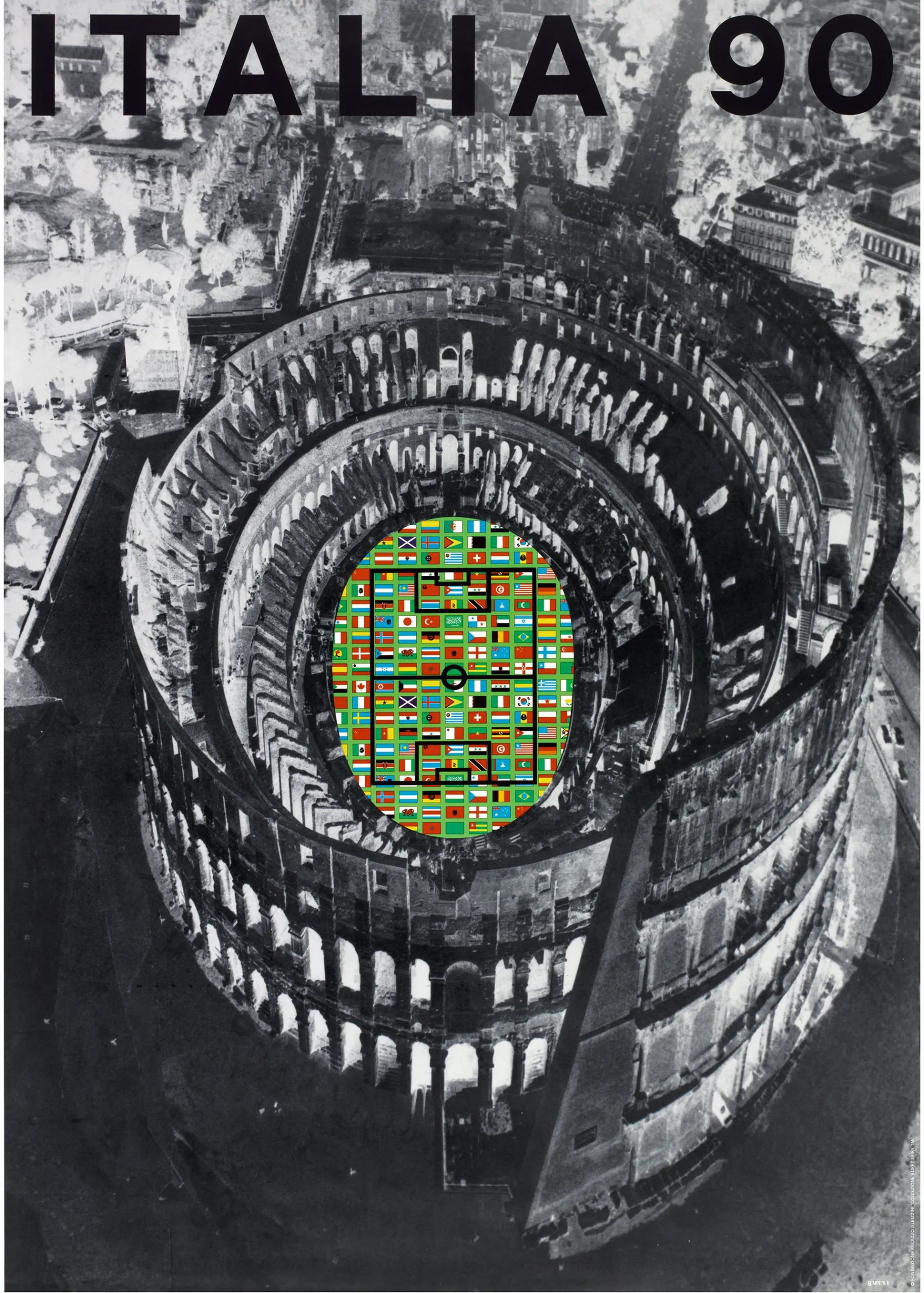
Italia ’90 Official Poster (1990), artwork by Alberto Burri; published by Petruzzi Editore, Italy
Italy would be only the second nation to host the World Cup a second time after Mexico, who held it in 1970 and 1986, but it would not be without the usual controversies now common in FIFA organized events. Italy, the Soviet Union, Austria, England, France, Greece, West Germany and Yugoslavia submitted applications before the July 31st, 1983, deadline. One month later, Austria, France, West Germany, and Yugoslavia had withdrawn their bids, leaving Italy, the Soviet Union, Greece, and England to compete for hosting rights. But then England and Greece withdrew which left only Italy and the Soviet Union. Nonetheless, The decision was supposed to have been made in 1983 but because of the volume of paperwork, it ran into 1984.
On May 19th, 1984, FIFA awarded the 1990 World Cup hosting rights to Italy following an Executive Committee vote in which Italy defeated the Soviet Union 11–5. The rationale for the decision was that Italy had proven hosting experience (1934 World Cup), their infrastructure and stadiums were in place or would be in place by the time the tournament started, they enjoyed broad institutional backing inside FIFA (including from influential European federations), and while never fully acknowledged, the Soviet boycott of the 1984 Los Angeles Summer Olympics negatively affected the USSR’s bid (some Western delegates also expresses a wariness about awarding the tournament to a communist bloc country during heightened Cold War tensions). Soviet state media accused FIFA of political corruption and blamed the organization’s American sponsors (mainly The Coca-Cola Company) for influencing the decision.
In the four years since the 1986 World Cup, much had changed in the tactics, development of the sport outside the usual powers, and the usual favorites. The sport had shifted sharply from expressive, individual‑driven play toward far more compact, disciplined, and defensive tactical systems, heavily influenced by Arrigo Sacchi’s late‑1980s Milan and their emphasis on pressing, zonal marking, and collective team structure. Around the world, soccer continued expanding in participation and professionalism, with regions like Africa and Asia improving competitively, though true global parity had not yet formed by the late 1980s. Europe, meanwhile, consolidated its dominance through stronger domestic leagues, tactical standardization, and UEFA‑driven modernizations, strengthening its elite national teams heading into Italia ’90 . Traditional favorites evolved unevenly: Brazil was transitioning away from pure flair, Argentina remained reliant on Maradona while adopting a more reactive style (and dealing with their aging squad), and Italy, benefiting from club‑level strength, entered 1990 as a leading contender. West Germany emerged as the most balanced and stable powerhouse, building on their 1986 finalist run, with strong tactical discipline. Altogether, the period marked a move toward organization over improvisation and set the stage for the rule changes that reshaped soccer in the early 1990s.
The tournament would be considered one of the poorest in terms of goal scoring and high levels of discipline in terms of combined yellow and red cards (including the first red cards ever issued during a final).
But it would also contribute shocking results, individual vulnerability, tactical turning points, the global expansion of the game, and emotional cultural moments. And it would also create rule changes to make the game more dynamic.
Qualifying
A total of 116 football associations had entered the 1990 World Cup, five less than the previous tournament. Three entries were rejected by FIFA (Belize, Mauritius and Mozambique) due to their outstanding financial debts. With both the hosts and holders qualifying automatically for the finals, 111 nations were therefore scheduled to compete in the qualifying competitions. Seven teams withdrew during the qualifying process without playing a match: Bahrain, India, Lesotho, Maldives, Rwanda, South Yemen and Togo. Mexico was disqualified from the CONCACAF qualifying tournament before playing a game for fielding overage players in the qualifying stages for the 1988 Olympic Games (the Mexican Soccer Federation tried to appeal the decision and shot themselves in the foot because FIFA had only disqualified the youth team but wound up disqualifying all Mexican teams for two years). Libya withdrew during the CAF group stage but had already played in the first round. And finally, during a Chile-Brazil qualifying fixture for CONMEBOL, Chile’s goalkeeper, Roberto Rojas, faked injury which eventually resulted in Chile being banned from the rest of qualifying and from the 1994 World Cup as well.
The total number of teams competing for the 22 spots (Italy as hosts and Argentina ad title holders had automatically qualified) was 102, with the spots allocated as follows:
- Europe (UEFA): Thirteen places were contested by 32 teams.
- South America (CONMEBOL): Two places were contested initially by nine teams (with Argentina already qualified), with one extra place potentially if they won an inter-continental playoff against an Oceania team. The nine teams were eventually reduced to eight because of Chile’s disqualification.
- North, Central America, and Caribbean (CONCACAF): Two places were contested by 15 teams initially, but Mexico was disqualified due to fielding overage players in a U-20 tournament.
- Africa (CAF): Two places contested by 29 teams.
- Asia (AFC): Two places contested by 25 teams.
- Oceania (OFC): Five teams contested for a playoff against a CONMEBOL team.
Costa Rica, the Republic of Ireland, and the United Arab Emirates made their debuts.
Returning after long absences were Egypt, which appeared for the first time since 1934, the United States (which would not miss a World Cup again until 2018) competing for the first time since 1950, Romania who hadn’t appeared since 1970, and Sweden and the Netherlands, both of which last qualified in 1978.
It would also see the last appearance ever for Czechoslovakia, the Soviet Union, West Germany, and Yugoslavia. The first two dissolving as nation states because of the end of the Cold War, the third because of their reunification with East Germany (also because of the end of the Cold War), and Yugoslavia because of a civil war that broke up that nation into multiple ones.
There was only one tie breaker during all the qualifying rounds. France was eliminated due to goal difference with Scotland.
In addition to France, other shocking absences were Portugal, Denmark, Mexico and Chile (the last two already mentioned as to how they got disauqlified).
The final list of nations was as follows:
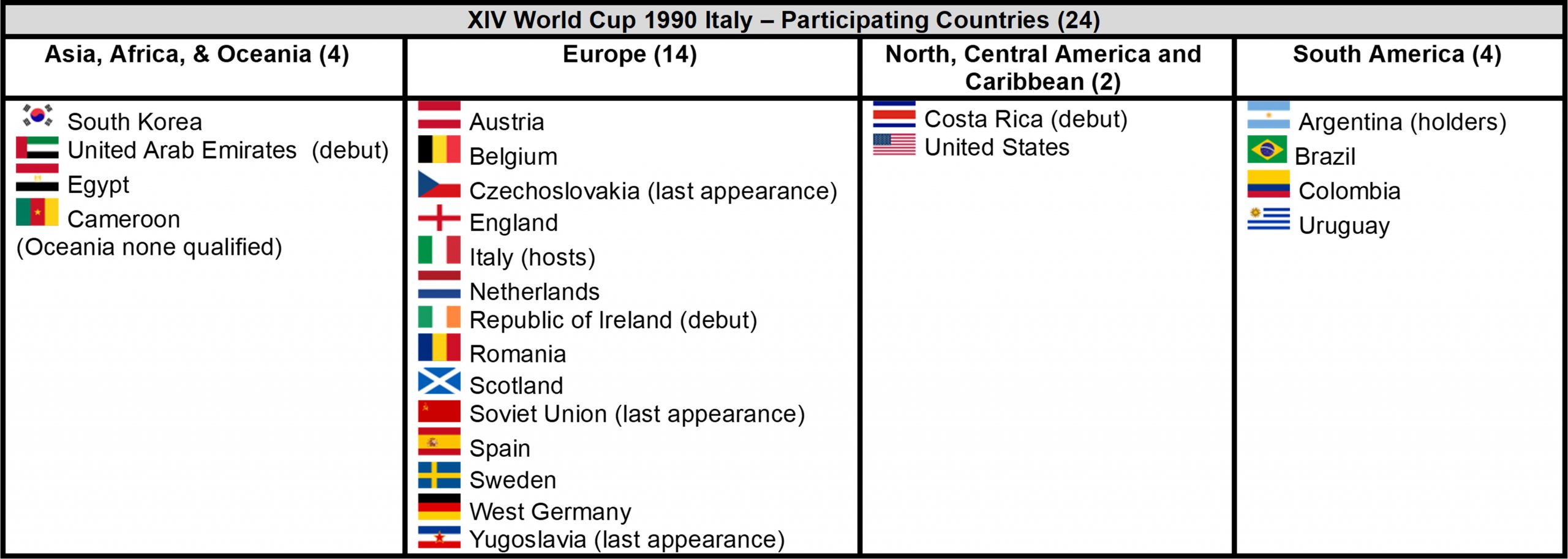
Table courtesy of Jose F Guerra
The Tournament
Twelve cities and twelve stadiums were selected to host matches: four had been used during the 1934 World Cup while two were brand new. The ten existing venues underwent extensive improvements which forced the clubs that played in those stadiums to play their home matches in other stadiums. Due to various structural constraints, several of the stadiums had to be virtually rebuilt to accommodate FIFA requirements.
As with the previous two World Cups, the group stage was organized in a way that any individual group would only play their matches in two cities close to each other. The cities that hosted the most World Cup matches were the two biggest in Italy: Rome and Milan, each hosting six matches, with Milan hosting the opening match between Argentina and Cameroon, and Rome hosting the final between West Germany and Argentina
One nation, England, asked for an exception to play all three of their group matches in Cagliari on the island of Sardiinia. Hooliganism had become a major problem in the English league. Its violent behavior had spilled into the European mainland continent as members of the Hooligan movement followed the English team and clubs during international competitions. England’s government even saw it as a risk in damaging diplomatic relations between their country and Italy. The fears were well founded as several riots broke out during the time England were playing their matches in Cagliari, leading to a number of injuries, arrests and even deportations.
Six seeds were decided before the draw to create the structure for the group stage. They were:
- Italy (hosts, Group A)
- Argentina (holders, Group B)
- Brazil (Group C)
- West Germany (Group D)
- Belgium (Group E)
- England (Group F)
The final configuration of the six groups was the following:

Table courtesy of Jose F Guerra

Table courtesy of Jose F Guerra
The Azzurri (Italy) would have home field advantage, and it showed in the first round. They won all three of their group matches without conceding a single goal. All of a sudden, they were now one of the favorites to win it all. Czechoslovakia finished second after victories over the United States and Austria, losing only to Italy. Austria finished third but did not qualify for the knockout stage, missing out due to an inferior goal difference compared to other third‑placed teams. The United States, returning to the tournament after a 40-year absence, finished bottom after losing all three matches. An interesting story from this group was the sudden emergence of Salvatore ‘Totò’ Schillaci, who had played only one international match before the World Cup, but would become a star during the tournament. There would also be another Italian player that four years later would impact his reputation and his place in the history of the sport. That player would be Roberto Baggio.
The great expectation was whether Argentina (los Albiceletes) would retain its crown after a brilliant 1986 tournament. They were the heavy favorites in Group B but Maradona was dealing with an injured ankle, and their squad had aging players. Many questions were raised when during their opening match against the Indomitable Lions from Cameroon, who managed to defeat them 1-0. It was one of the biggest shocks in World Cup history. African football had arrived on the world stage. Their victory was somewhat marred when Cameroon had two players sent off for violent tackling. They went on to beat Romania and despite a heavy 4-0 loss to the Soviet Union in their last group game, they wound up in first place of their group. Romania would claim second place, edging out the Albicelestes by goal difference. This “tactic” (if it could be called that) would be used by Argentina throughout the rest of the tournament, barely edging out rivals, playing in a very unattractive, unimaginative, and even violent manner.
Group C saw Brazil qualify with three wins out of three, while Scotland crashed out after somehow losing to Costa Rica, and then beating Sweden before running Brazil close. Costa Rica, making their World Cup debut, was a pleasant and head turning revelation. They beat Scotland 1–0 in their opening game, held Brazil to a narrow defeat, and then defeated Sweden 2–1 to advance as group runners-ups. Scotland’s 2–1 win over Sweden was not enough to save them from an early return home as one of the two lowest-ranked third-placed teams. Sweden lost all its three games by the same score, 2-1. This had never happened before, nor has it happened since. Brazil won all of its group stage matches and wound up in first place, but they were a far cry from the free-flowing sides of previous generations, grinding out three narrow 1–0 wins.
Group D featured the most goals of all the groups, largely due to two large wins by West Germany and the defensive inadequacies of a United Arab Emirates side that lost 2–0 to Colombia, 5–1 to West Germany, and 4–1 to Yugoslavia. West Germany, the runner-up from four years before, hit the ground running with a 4–1 thrashing of Yugoslavia, and Lothar Matthäus (released from the purely defensive marking role he had played in 1986) was leading the attacking charge and scored several goals across those first two games. Yugoslavia were solid runners-up, boasting talented players including the young Robert Prosinečki. Colombia qualified as one of the four best third-placed teams, though their campaign was unremarkable in the group stage despite their flair. The UAE, making their World Cup debut, were thoroughly overmatched across all three games and conceded 11 goals in the process.
The winners of Group E were Spain, for whom Míchel hit a hat-trick as they beat South Korea 3–1, tied with Uruguay 0-0, and defeated Belgium 2-1. The Belgians secured second place by winning their opening two games against South Korea and Uruguay comfortably. Uruguay scraped through in third place in dramatic fashion: their advance to the second round came with an injury-time winner against South Korea to edge them through as the weakest of the third-placed sides to remain in the tournament. South Korea was winless throughout, conceding six goals across their three matches, and only managed a single goal in the entire group stage. However, in future tournaments they would go on deep runs, kill the hopes of giant soccer powers, and in general show the world a wide-open attacking style that would make them tournament sentimental favorites.
In tournament that would be defined as one of the worst in terms of scoring and spectacle, Group F was the guiltiest of them all. In all six group games, no team managed to score more than once in a match. England beat Egypt 1–0, the only match with a winner. Only seven goals were scored in all those six games. England won the group, scoring a total of two goals and conceding one. The Republic of Ireland, making their debut in World Cup tournaments, drew all its games, winding up in second place, and became one of the World Cup’s most improbable success stories. The defending European Champions, Netherlands, would advance as one of the best third places teams but only after drawing lots with Ireland since they both had identical points, goal difference, goals for and goals against, and drew their group match.
The knockout stages were calling but the tournament would continue to see highly defensive, cautious soccer. Nonetheless, these rounds would create conditions that would further motivate FIFA and other rules regulating bodies to make modifications and make the sport more dynamic in future tournaments.
In the Round of 16, five of the eight matches went to overtime or penalty kicks (PKs). Argentina edged Brazil 1–0 in one of the biggest shocks, scoring despite Brazil dominating chances throughout the match. Italy continued their disciplined run with a narrow 2–0 win over Uruguay, while West Germany eliminated the Netherlands 2–1 in a bitter contest featuring what is now known as the Rijkaard–Völler incident. During their match, Dutch player Frank Rijkaard spat at West German Rudi Völler twice. The referee didn’t see the first one but after witnessing the second offensive action by Rikjaard, he sent off both players. Because this was before VAR, the rules and guidelines stated that removal of both players was required when an incident became openly hostile and uncontrollable, even if one player was clearly the instigator. Unfair, yes. But this was another instance that forced the sport to make changes.
The quarterfinals maintained the tournament’s tense character, with three of the four matches decided by a single goal or penalties. Italy defeated Ireland 1–0 in Rome, continuing their run of clean sheets but failing to excite the crowd with attacking football. West Germany overcame Czechoslovakia 1–0, maintaining control but again relying on set‑piece efficiency rather than open play. Argentina eliminated Yugoslavia on penalties after a goalless draw, despite playing with ten men for much of the match, reinforcing their willingness to prioritize survival over attacking ambition. England beat Cameroon 3–2 after extra time in one of the most entertaining matches of the tournament, coming from behind and benefiting from two penalties amid debates over refereeing leniency. Cameroon’s exit was bittersweet, having redefined expectations for African teams despite the controversial nature of the defeat.
The semifinals crystallized the defining narratives of Italia ’90: anxiety, penalties, and emotional intensity. Italy lost to Argentina on penalties in Naples after a 1–1 draw, a match defined by crowd division, tactical caution, and Italy’s first concession of a goal in the tournament. Argentina’s goalkeeper emerged as decisive in the shootout, while Italy’s attacking play finally stalled against deep resistance. The other semifinal between West Germany and England ended 1–1 before penalties, with England undone by missed kicks that reinforced their growing shootout curse.
The match between England and West Germany is also remembered both for its tactical tension and for a highly emotional moment involving midfielder Paul Gascoigne. After receiving a yellow card, Gascoigne broke down when he realized he would miss the final if they advanced. It is considered one of the most iconic emotional moments of the 1990 World Cup, embodying both personal devastation and national heartbreak. It was also a turning point for the sport itself as well as the British media. The vulnerability displayed by Gascoigne showed the very human side of the sport but also of the players themselves. They were not just names on rosters. These were human beings with all the passions, foibles, and emotions of any person. It was also a turning point for the British media. Many writers argued that his tears showed authenticity and humanity at a time when soccer players were expected to be stoic and restrained. Several columnists explicitly contrasted Gascoigne’s openness with older ideals of masculinity in English sport, suggesting that the game, and society, might be changing. In retrospect, journalists often cite this moment as an early sign that football culture was becoming more emotionally expressive.
The Final
Argentina and West Germany would face each other again, their epic showdown four years earlier having left an enduring legacy. Two very different styles had clashed, with Argentina’s individual skills coupled with disciplined team play facing the always relentless and disciplined Germans in the Estadio Azteca in Mexico City. Argentina had come out on top four years earlier so West Germany was looking for not just revenge but also a reaffirmation as one of the soccer powers in the world.
This clash would again pit two styles on the pitch. Only this time Argentina was not the talented and cohesive squad of four years before. They had reached the final through very defensive and physical aggression soccer and a lot of luck (they had only won two regular play matches and had won their quarterfinal and semifinal matches on penalty kicks), scoring only five goals across six games before the final match. West Germany had displayed its usual disciplined, tactical, and physical style. They reached the final by scoring 14 goals and conceding five. As with Argentina, they had won their semifinal on PKs but had clearly shown a more aggressive attacking style and the results showed up to that point.
This would be West Germany’s third straight final, a record that would be equaled by Brazil in future tournaments.
The match was played before 73,603 fans who were mostly either rooting for West Germany or against Argentina. This was because Argentina had eliminated Italy and also because of Maradona’s demands from Neapolitan fans (as described before).
The final in Rome unfolded as a tense, attritional contest that embodied the broader character of Italia ’90. West Germany took the initiative almost immediately, pressing higher, holding more possession, and pushing play into Argentina’s half for long periods. Argentina, by contrast, adopted an exceptionally deep and defensive posture, prioritizing compactness, breaking up play with frequent fouls, and slowing the rhythm whenever possible. From early on, it was clear that Argentina showed little attacking intent and appeared content to drag the match toward extra time and penalties, as they had done earlier in the knockout rounds.
As the match wore on, West Germany’s territorial dominance increased, though clear chances remained scarce due to Argentina’s disciplined blocking and constant disruption. The game grew increasingly fractious, with Argentina relying on cynical fouls and time‑wasting, drawing repeated warnings from the referee. Two Argentine players were eventually sent off, making Argentina the first team to finish a World Cup final with nine players on the field. These dismissals reinforced the impression of a side playing at the edge of acceptability, focused almost entirely on survival rather than attack.
It is noteworthy to mention that the central referee, Mexican Edgardo Codesal, had waved off requests for PKs during the game. There had been shirt‑pulling and holding in the box during set pieces, physical challenges that would likely be penalized in modern soccer, and at least one collision involving an Argentine defender stepping across an attacker rather than playing the ball. His performance was consistent with how refereeing was done during the entire tournament which tolerated physical play, punished dissent harshly, and intervened minimally in open play (sometimes abruptly, sometimes inconsistently).
It was because of these refereeing behaviors that the decisive moment five minutes from the end of regular time became controversial when West Germany were awarded a penalty kick that was seen as a “soft call” given how Codesal had managed the game up to that point in the match. Fullback Andreas Brehme calmy converted the PK to give them a 1–0 lead. Argentina, even then, offered little sustained response, lacking both numbers and attacking structure. The final whistle confirmed West Germany as champions, capping a tournament run built on consistency and control rather than spectacle. To this day, the match remains one of the most debated finals in World Cup history, seen by many as a clash between proactive pressure and extreme defensive calculation, with the result ultimately favoring the side that tried to win outright rather than merely endure.
West Germany had won its third world championship, and it would be the last time they would play as a divided country.
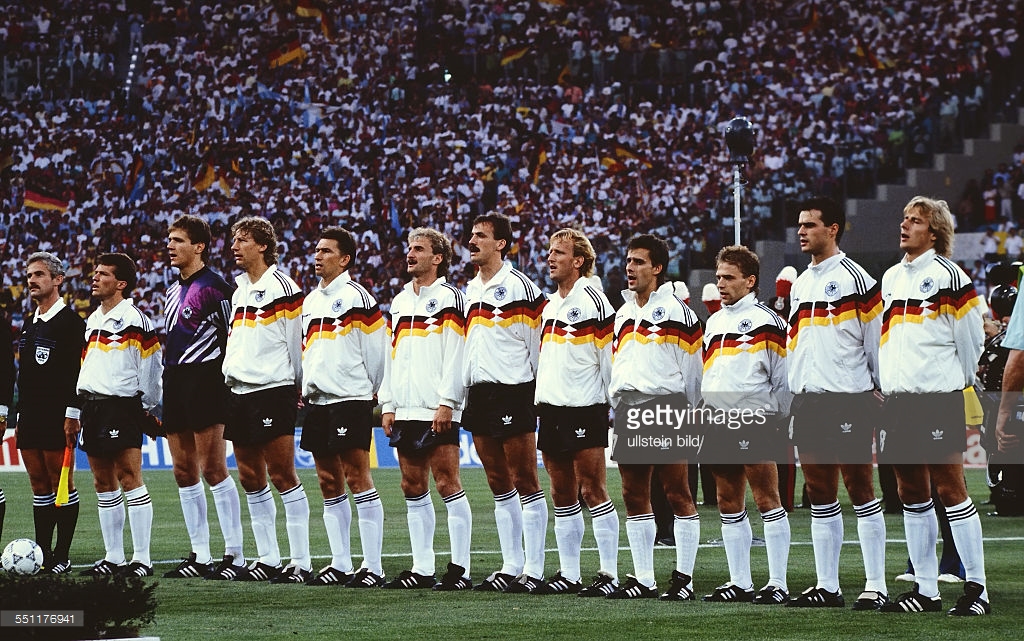
West Germany lineup before final against Argentina. Ullstein bild / picture alliance via Getty Images
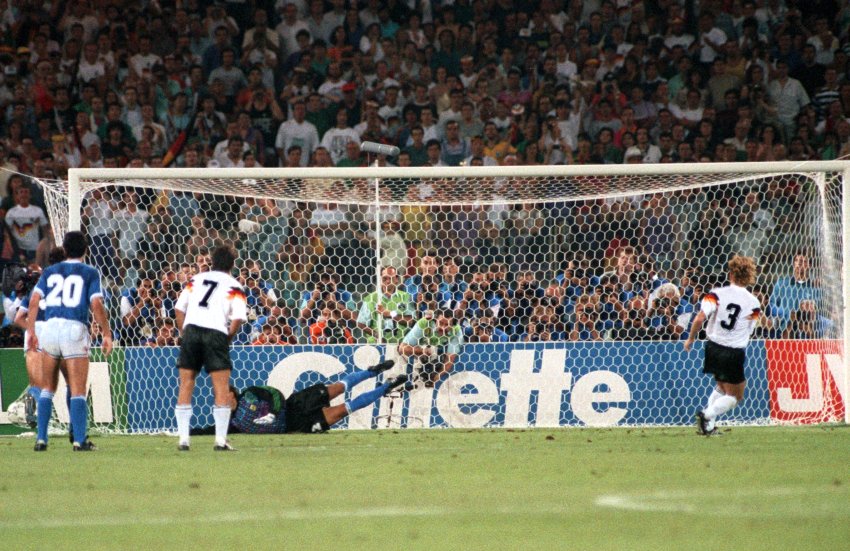
West Germany scores via PK with five minutes left int he final against Argentina. Photographer Bob Thomas / Sports Photography via Getty Images
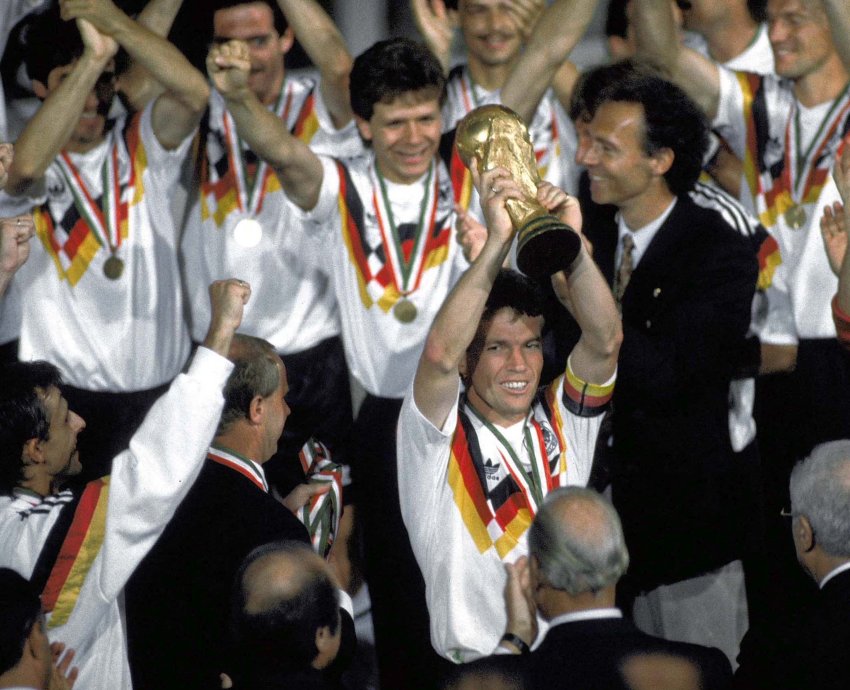
Lothar Matthäus lifts te FIFA World Cup trophy Photographer Steve Munday / ALLSPORT via Getty Images
Firsts in the tournament
- First red cards in a final: Argentina’s Pedro Monzón became the first player to be sent off in a World Cup final (65th minute), followed later by teammate Gustavo Dezotti.
- First African team in quarterfinals: Cameroon made history as the first African nation to reach the last eight, stunning defending champions Argentina in the opening match.
- First person to win as captain and coach: Franz Beckenbauer became the first person to win a World Cup as both a captain (1974) and a manager (1990).
- First defending champion to lose final: Argentina became the first team to reach the final as defending champions and lose (previously, they had won as defending champions or failed to reach the final).
- First finalist not to score: Argentina became the first team in a World Cup final not to score a goal.
- First back-to-back rematch: The 1990 final between Argentina and West Germany was the first (and only) time the same two teams met in consecutive World Cup finals.
- First HDTV broadcast: Italia ’90 was the first World Cup to be officially recorded and transmitted in High-Definition Television (HDTV), a joint effort of Italian broadcaster RAI and Japan’s NHK.
- First official PC game: World Cup Italia ’90was the first officially licensed PC game for the tournament.
Relevant Players
- Lothar Matthäus (West Germany) – Captain and midfield general, led West Germany to the title and won the 1990 Ballon d’Or.
- Salvatore Schillaci (Italy) – Breakout star of the tournament (started on the bench), finished as top scorer (6 goals) and won the Golden Ball.
- Diego Maradona (Argentina) – Defending champion captain, heavily marked and injured but still dragged Argentina to the final.
- Roger Milla (Cameroon) – Icon of the tournament; at age 38, inspired Cameroon’s historic run to the quarter‑finals.
- Gary Lineker (England) – The team’s attacking focal point during their memorable semi‑final run.
- Tomáš Skuhravý (Czechoslovakia) – Prolific striker; joint second‑top scorer (5 goals), dominant in the air.
The low scoring tournament, intense physicality, excessive time wasting, playing not to lose, and pressure from both sponsors as well as broadcasters caused FIFA to make various rule changes for the following World Cup.
And the world was about to be given a spectacle of organization, promotion, high intensity matches, and entertainment unlike it had never seen before. The United State of America would host the 1994 World Cup and things would never be the same again for the “Beautiful Game”.

Recommended for you