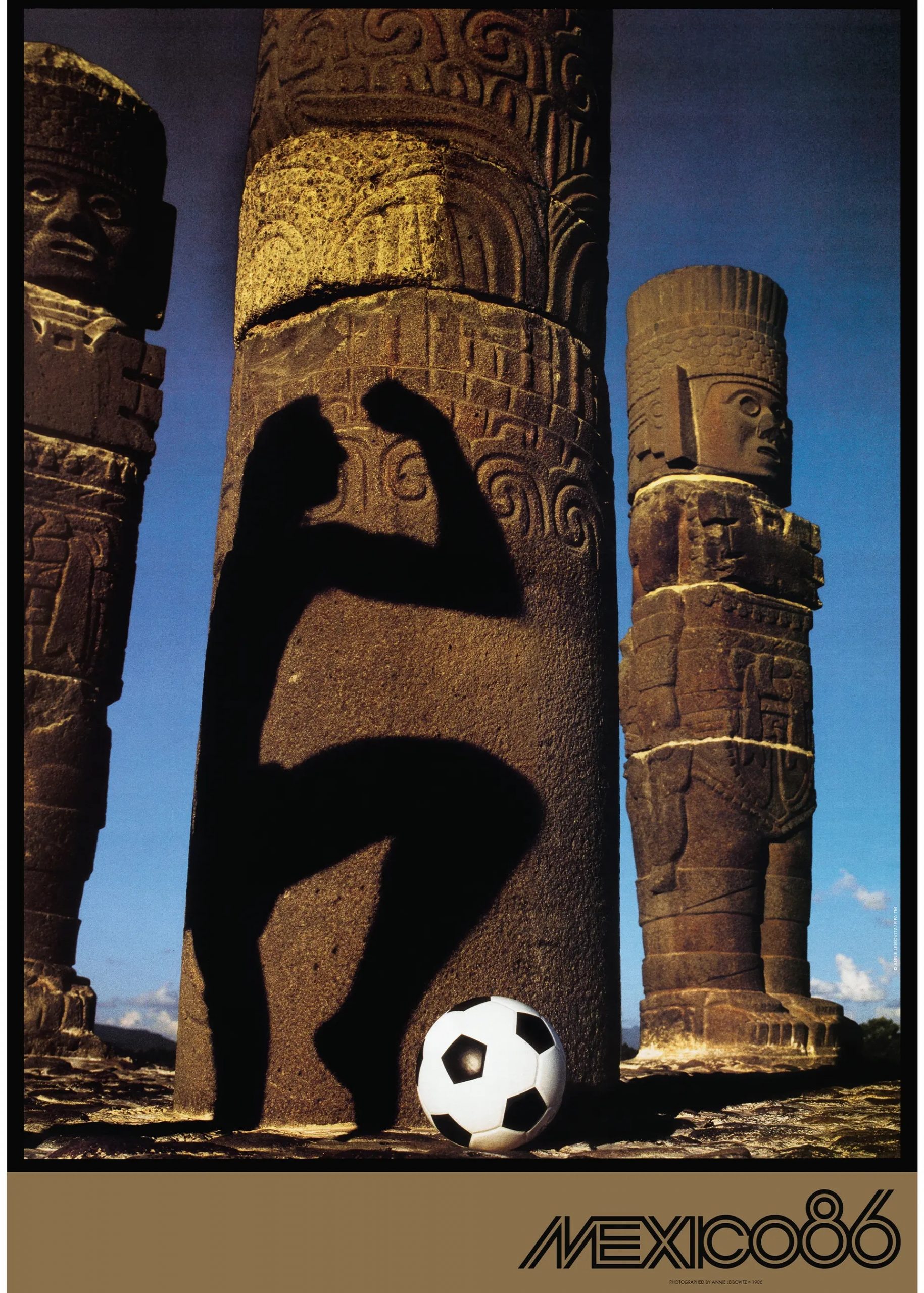
1986 World Cup, FIFA Official poster. Source: design by María Luisa de Moreno.
In June of 1974, Colombia was chosen as the host for the 1986 World Cup, the thirteenth edition. The commitment was for the 16-team tournament that had been in place since 1954. But then, four years later, FIFA announced that the event would be increased to 24 teams. In 1982, Columbia’s new President said they could not afford to host a competition of this size and withdrew from hosting the tournament.
This set in motion a flurry of activity to find a replacement host. Europe was out of the question because they had hosted the previous one (there was an agreement to alternate continents). Brazil was mentioned but did not submit a bid. The three North American countries (Canada, US, and Mexico) submitted bids. The Canadian one was not looked at seriously since they could not meet the stadium size requirements. The US bid was not seriously considered mostly due to political maneuvering by the powerful Mexican media conglomerate Televisa, and because the North American Soccer League had created friction with FIFA in years past due to their insistence on changing the rules of the game to “fit a more American audience” (including placing 35-yard offside lines). In addition, the 1984 soccer matches during the 1984 Summer Olympics had not been well organized, and the US Olympic Committee ignored several of FIFA’s requirements for those games (FIFA organizes soccer for the International Olympic Committee during the summer Olympics). Finally, Mexico had already organized a very successful World Cup in 1970, and had the infrastructure necessary to organize the global event, even with 24 teams. This drama would pale in comparison to what would happen a mere eight months before the inaugural game in 1986.
On September 19th, 1985, at 7:17 am, a devastating 8.1 magnitude earthquake struck Mexico City. There aren’t exact figures but anywhere between 10,000 and 20,000 people were killed (I was already living in Cincinnati and was unable to talk to anyone directly in my family for two weeks due to the extensive damage to the telecommunications infrastructure). This caused FIFA to question whether or not Mexico would be able to recover in time and even suggested pushing the tournament back several months. But the Mexican soccer federation and the organizing committee declared they would be ready, and even gave FIFA officials a tour to show them that the stadiums in Mexico City had not suffered any structural damage.
The world was about to once again witness Brazil’s jogo bonito and West Germany’s relentless and resilient style. But they would also watch as a debutante turned heads with their wide open attacking soccer, an African team win their group, a resurgent Soviet Union whose core was made up of players from Dynamo Kiev (a Ukrainian team that was creating innovative tactics), a host that was playing with a passion that electrified their fans, and the jaw dropping exploits of who was now considered one of the best players in the world at the time, one Diego Maradona.
And this was one World Cup which I would be fortunate enough to attend.
Qualifying
A total of 121 teams entered the 1986 Mexico World Cup qualification rounds, up from 109 for the previous World Cup. As with the 1978 and 1982 tournaments, 24 teams would qualify, with two automatically selected: Mexico as the host and Italy as the defending champions. Due to several withdrawals and one exclusion (Iran), 110 teams wound up playing at least one game for qualifying purposes.
The 24 spots were distributed as follows:
- Europe (UEFA): 13.5 places, 1 of them went to automatic qualifier Italy, while the other 12.5 places were contested by 32 teams. The winner of the 0.5 place would advance to the intercontinental play-offs against a team from Oceania (OFC).
- South America (CONMEBOL): four places, contested by 10 teams.
- North, Central America, and Caribbean (CONCACAF): two places, one of them went to automatic qualifier Mexico, while the other place was contested by 17 teams.
- Africa (CAF): two places, contested by 29 teams.
- Asia (AFC): two places, contested by 27 teams.
- Oceania (OFC): 0.5 place, contested by four teams (including Israel and Chinese Taipei), with the winner of the 0.5 place advancing to an intercontinental play-off against a team from UEFA.
Once again, within each geographic region, teams were organized in groups for qualifying purposes. Tie breakers included total points, goal difference, and total goals scored. In the event of ties in all three criteria, playoff games would be required. However, no playoffs were required as there were clear winners for qualification purposes across all soccer federations.
The final list of nations that qualified for the XIII Word Cup in Mexico was as follows:
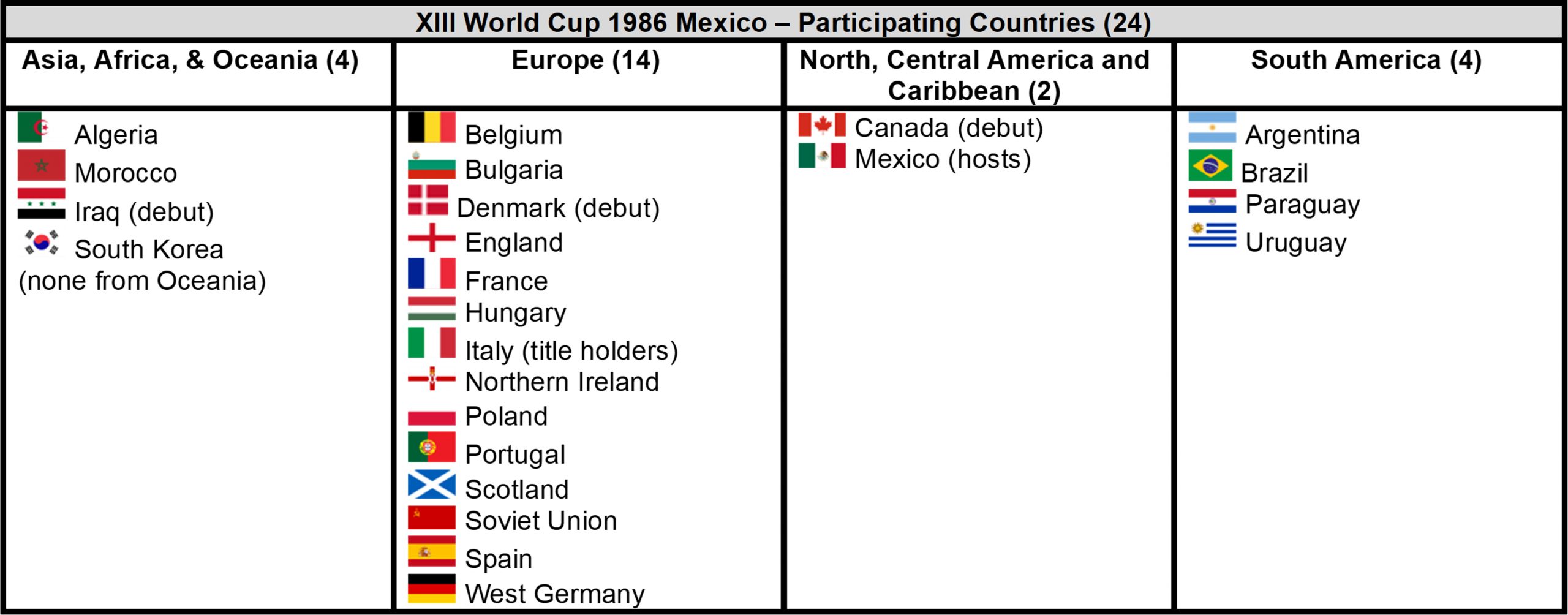
Table courtesy of Jose F Guerra
The Tournament
The tournament was hosted by 11 cities with 12 stadiums, two of them in Mexico City. The Azteca Stadium in Mexico City, the largest stadium used for the tournament, hosted nine matches (including the inaugural and final matches), more than any other stadium used. Because of the immense size of the metropolitan area of Mexico City, a suburb of the megalopolis also had its own professional team with a stadium that met FIFA’s requirements and hosted several games. As a result, the three stadiums within the metropolitan area hosted a total of 16 matches, almost a third of all competitions during the tournament.
Six groups of four would be formed with the draw taking place on December 7th, 1983, in Zurich, Switzerland. Seeded teams were:
- Mexico (hosts)
- Italy (1982 winners)
- West Germany (1982 runners-up)
- Poland (1982 third place)
- France (1982 fourth place)
- Brazil (1982 fifth place)
The final groups configuration was as follows:
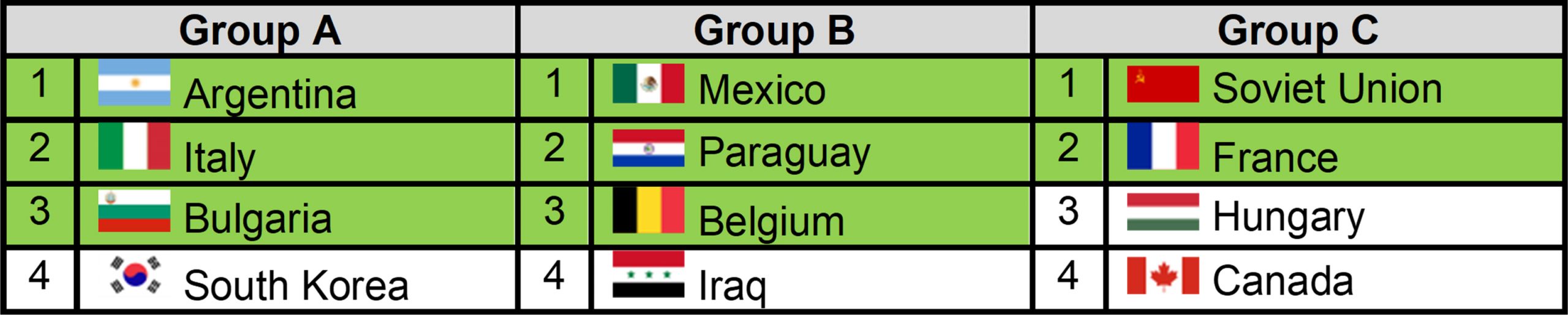
Table courtesy of Jose F Guerra
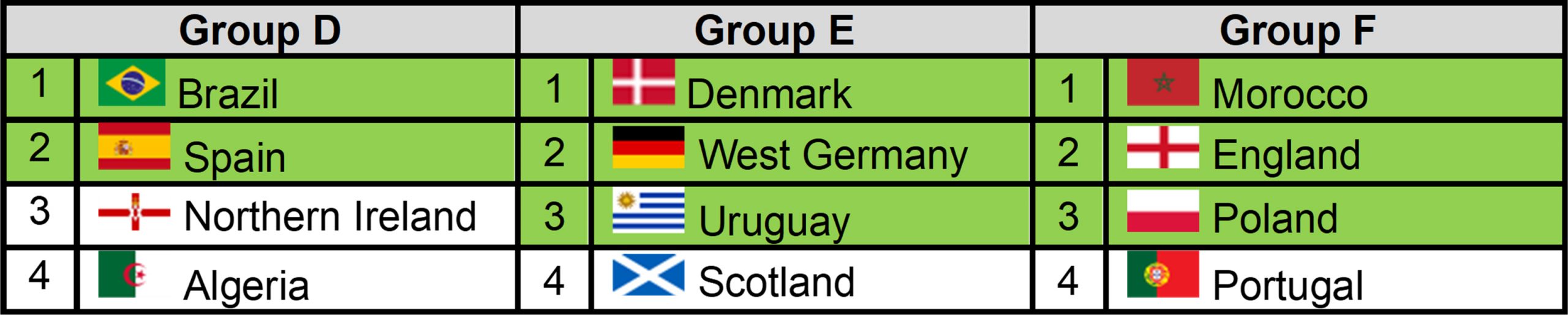 Table courtesy of Jose F Guerra
Unlike the previous two tournaments where new groups were formed after the group stage, this time 16 teams would advance, with the top two of each group and the four best third places, which would then be structured into one-on-one matches in a knockout format. In addition, to prevent any “gaming” of positions (as happened between West Germany and Austria in 1982 in Spain), the two final group matches for each group were played at the same date and time.
Almost every team had to contend with the altitude of most venues, with Toluca being the highest at 8,730 ft. The lowest one was Monterrey at 2,200 ft, but the heat and humidity made for challenging conditions. Morocco spent 40 days in Mexico before the tournament in the city of Monterrey to acclimate and play several friendlies. This would benefit them during the competition.
Group A was expected to be dominated by Italy (title holders) and Argentina. But once again, Italy started out slow, drawing with Bulgaria and then with Argentina, but winning its final match against South Korea. Argentina, with the masterful Maradona, won its first match against South Korea, drew with Italy, and won its final match against Bulgaria. Argentina won the group, with Italy in second and Bulgaria as one of the best third places among all the groups. The title holders, Italy, despite not losing a match, did not impress and were not seen as a team that would make a deep run.
Group B was a toss-up as to who would win it given the relatively equal strength between Mexico, Paraguay, and Belgium (With no chance given to Iraq). But the Mexican team had produced some strong results in their preparation for their home tournament so there were high hopes for a deep run. The hosts started by beating Belgium on a header by their star player, Real Madrid striker and champion scorer of La Liga, Hugo Sánchez. They then tied with Paraguay (with Sánchez missing a Penalty Kick which would have given them the win) and beat Iraq to wind up on top of their group. Paraguay came in second with Belgium becoming another third place.
In Group C, it was expected that the Soviet Union and France would dominate, and they did. The Soviets won their first game against Hungary 6-0, tied with France 1-1, and then beat Canada 2-0. It’s worthwhile to mention that this Soviet team’s core was made from players of Dynamo Kiev from the Ukrainian Republic (back then the Soviet Union consisted of 15 republics). Their coach, Valeriy Lobanovskyi, is one of the most innovative coaches in the history of the sport. He built Dynamo into the most dominant club in the USSR, winning the Soviet Top League eight times and six domestic cups across the 1970s–80s.His approach was scientific, with rigorous physical preparation, collective pressing, strict discipline, and data‑driven training before such methods were standard. Under Lobanovskyi, Dynamo Kyiv became the first Soviet team to win a major European trophy, the Cup Winners’ Cup (1975), and then repeated it in 1986, just weeks before the World Cup. They won their group with France qualifying in second. No third place qualified from this group.
There were great expectations from Group D with Brazil the favorite to win the group and possibly even the World Cup itself. No one expected them to have any difficulty advancing. They won all of their games, scoring five, conceding none, and winding up first in their group. However, this was not the Brazil from 1970 for even from 1982. Nonetheless, they showed their usual mesmerizing individual skills which many felt could carry them a long way. Behind them in second place was Spain, the perennial underachievers in World Cup tournaments, but that this time was star studded across all their lines. No third-place team made it into the knockout stages from this group.
Group E had the two-time World Cup winners Uruguay (los Charrúas) and West Germany (Die Mannschaft) who were expected to dominate the group. But Denmark, which had showed during qualifying an open attacking style that many thought would give them a chance against the two favorites. To the surprise of everyone, Denmark won all its matches and wound up at the top of the group, scoring nine goals and conceding only one (six of those were against los Charrúas). West Germany came in second, and Uruguay qualified to the next round by being one of the best third places (this despite the humiliating loss against Denmark).
And finally in Group F, Poland was expected to again make a deep run as they had done in the previous two World Cups. However, this version of Poland was far weaker, with several of their stars either aging or having retired, and it showed as they had difficulty scoring. England, as with Spain, was another perennial underachiever (except for their 1966 title at home) and was not expected to make a very deep run, but they had a talented squad. Portugal was back in the World Cup after a 20-year absence, but weren’t expected to do much. Morocco was given no chance, but they wound up shocking the world when they won their group with two draws against England and Poland and then beat Portugal. Behind Morocco were England in second place and Poland as one of the best third place teams, qualified for the knockout rounds.
For the first time in World Cup history, there would be a knockout stage with 16 teams (called the “round of 16”). The matches were scheduled as follows:
- Mexico – Bulgaria (Estadio Azteca, Mexico City)
- Soviet Union – Belgium (Estadio León, León)
- Brazil – Poland (Estadio Jalisco, Guadalajara)
- Argentina – Uruguay (Estadio Cuauhtémoc, Puebla)
- Italy – France (Estadio Olímpico Universitario, Mexico City)
- Morocco – West Germany (Estadio Universitario, Monterrey
- England – Paraguay (Estadio Azteca, Mexico City)
- Denmark – Spain (Estadio Corregidora, Querétaro)
I flew from Cincinnati to Mexico City to attend the round of 16 and managed to catch six games in three different stadiums.
Mexico defeated Bulgaria 2-0, with the first goal a spectacular volley in the air outside the box by midfielder Manuel Negrete. The goal was in the running to be named goal of the century, but it was edged out by another one that was also scored during this World Cup. I was at this game and managed to take a picture as Negrete hit the ball for his volley.
The Soviets and the Belgians had a festival of goals with overtime needed for Belgium to win 4-3. It was the end of the run for a Soviet team that had left behind the stodgy, robot-like performances and set an example of how teams would soon be managed.
Brazil unleashed its full arsenal against Poland and won 4-0, ending Poland’s brief deep runs in World Cups.
Argentina and Uruguay played a very hard and physical match ending with the Albicelestes winning 1-0. It was the first time they had met in World Cup play since their very first meeting during 1930 Uruguay World Cup final.
Meanwhile, Italy, who had not shown much in the group stage, went down 2-0 against France. I was also at that match and got to see the elegant and legendary Michel Platini, who scored the first goal of that match. He was an orchestrator in the midfield, directing the flow of the game, and being in full command of the rhythm of the game.
Morocco’s magical run ended against the West Germans, but they took Die Mannschaft to the brink, as the Germans scored with two minutes left, with the final score being 1-0. This would not be the last time that African teams would shock the world and take on perennial powerhouses in surprising ways.
England took care of Paraguay 3-0 and the hopes of the many English fans present in Mexico soared as the possibility of making it to the final seemed very possible.
And finally, in another game I attended, the “Danish Dynamites” (as they were fondly called by the world as a result of their open and attacking style) were playing against Spain in what many thought Denmark would overwhelm the Spaniards. The final score was 5-1…in favor of Spain. Denmark went ahead and we all thought the floodgates would open. But Spain surprised with a furious wave of attacks with their star striker Emilio Butragueno, el Buitre (the Vulture) as he was called, scoring four times.
The quarter finals would see three of the four games go to penalty kicks, with West Germany beating Mexico, France edging out Brazil, and Belgium beating Spain. No other World Cup had ever had this happen nor has it happened again.
The one game that did not go to PKs was one for the ages at a number of levels. Argentina faced off against England. The bad blood between them had been building for a long time, mostly because of the 1966 quarterfinal match which was a very physical and violent game. On top of that, there were non-soccer tensions between these two teams due to the Falkland Islands War that had occurred in 1982. While both sides said the correct things about this being only about soccer, the tensions between fans of both teams forced Mexican authorities to deploy 20,000 police officer (plus an unknown number of soldiers) near, around, and in the stadium. I can vouch for that since I also attended this game.
The match itself was intense, physical, and at times violent. Despite the words of neutrality from both teams before the match, the reality of the situation infected the players. The first half ended scoreless. But in minute 55, a seemingly easy play for the English goalkeeper (GK) turned into one of the most controversial goals in the history of the tournament. As the ball floated towards the GK, Maradona leapt in front him and seemed to head the ball in. But replays showed that he had hit the ball with his hand. Afterwards, Maradona said, “That goal was scored a little bit by the hand of God and another bit by Maradona’s hand”. Ever since then, it became known as the “Hand of God goal”.
But Maradona was not done. A few minutes later, he took the ball just inside his own half and ran the rest of the pitch with the ball seemly glued to his feet, dribbling past six England players (including their GK) and then calmly scoring. We had just witnessed what FIFA would eventually call “The Goal of the Century”.
Four teams would now face off in the semifinals: Argentina against the surprising Belgians and West Germany against France.
West Germany dominated France, with Platini being reduced to a spectator as he was marked closely and not allowed to orchestrate his team as he had been doing throughout the tournament.
Argentina likewise dominated Belgium and beat them 2-0. Maradona was again central as he scored a brace, sending them to the final against the still dominant West Germans.
The Final
Two styles, two great soccer traditions, two teams filled with talent would meet on June 29th, 1986, at Estadio Azteca, to determine the world champion. The skillful Argentinians who weaved flowing plays on the pitch were facing the methodical, physical, and relentless West Germans. Maradona had been instrumental in taking his team to the final after the disappointing run in 1982. Lothar Matthäus from West Germany was the conductor who provided leadership and creativity, but he would also on this day be given the task of marking Maradona.
With Matthäus effectively not creating as he had done during the entire tournament, Argentina was able to get ahead in minute 23. The crowd roared as the sympathies were with the follow Latin Americans. The score remained 1-0 going into halftime, with Argentina in control, even as Maradona was not a factor. In minute 55 the crowd was again brought to its feet as Argentina scored a second goal, with Maradona again not being a factor in that score.
Argentina was in control. All they had to do was manage the game, see it out and be crowned world champions. But this was West Germany they were playing against. The world had seen them come back from one and two goal deficits time and time again to win games. And they didn’t disappoint. At minute 74, the Germans struck and halved the deficit. The crowd again roared only this time in favor of the Germans! Six minutes later the Germans tied and the crowd went wild! Why this seeing switching of sides? While the fans were sympathetic to Argentina as a Latin American country, they were also excited to see the comeback and to all of a sudden expect overtime in a World Cup final (apparently Maradona was angry at being “abandoned” by the Mexican fans, but it was purely a reaction to the drama on the field).
And yes, all of us in the stands expected overtime. The tension could be felt all around. And then Matthäus, who had neutralized Maradona during the entire game, took his attention off of his mark for just a few seconds. That was all “El Pibe de Oro” (The Golden Boy) needed to send a perfect forward pass to his attacking midfielder, Jorge Burruchaga, who outran his defender, waited for German goalkeeper Harald Schumacher to come out and then slipped it by him for the third and winning goal.
Argentina were world champions for the second time. Maradona has consolidated himself as the engine that made them champions, while proving to the world why he was the best player in the world at the time. It would take another 36 years and another extraordinary player for Argentina to again experience the ecstasy of being World Champions. But on this date, Maradona and Argentina had conquered the soccer summit.
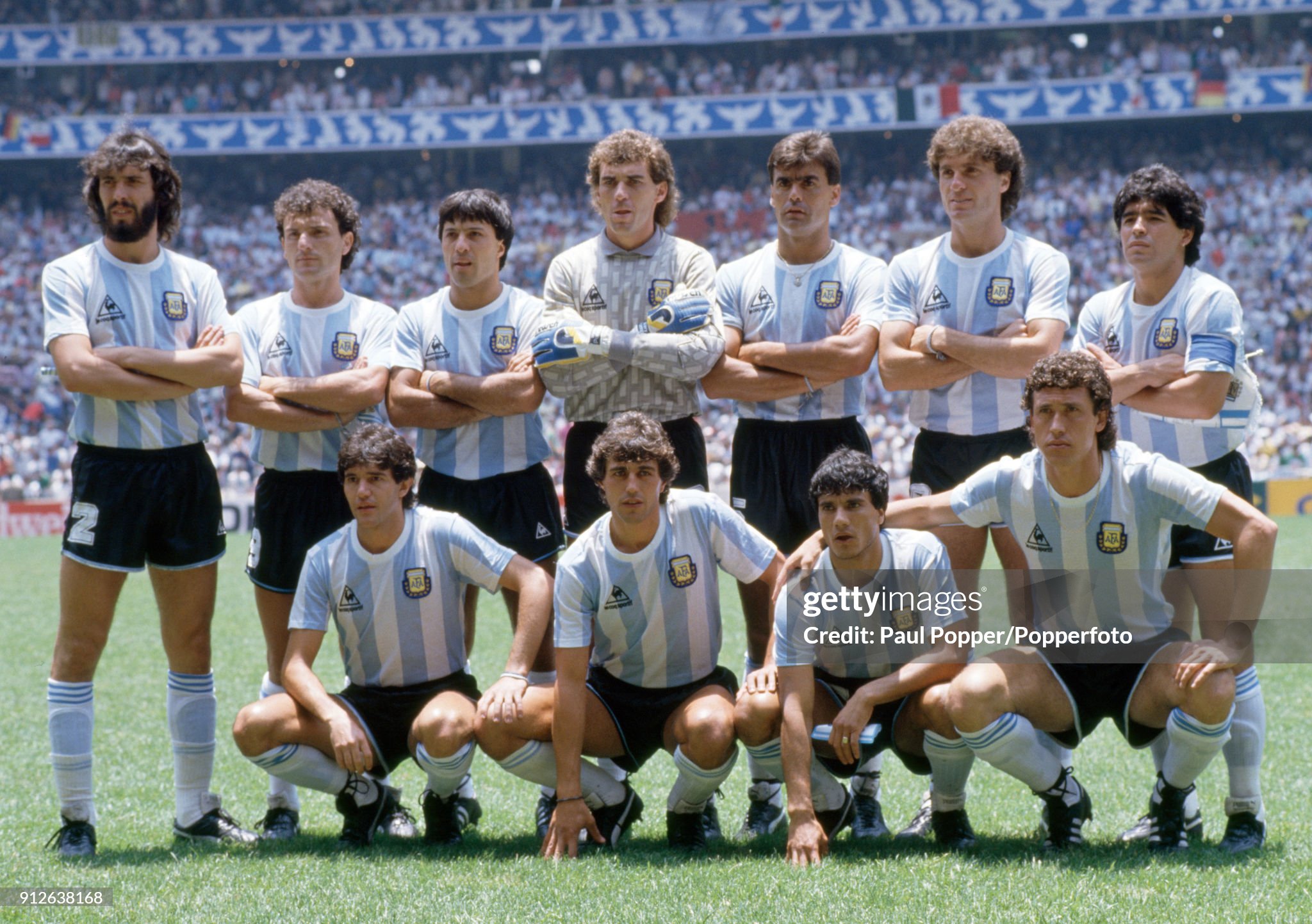
1986 World Cup, Argentina before the final against West Germany. Source: Photo by Paul Popper/Popperfoto via Getty Images)
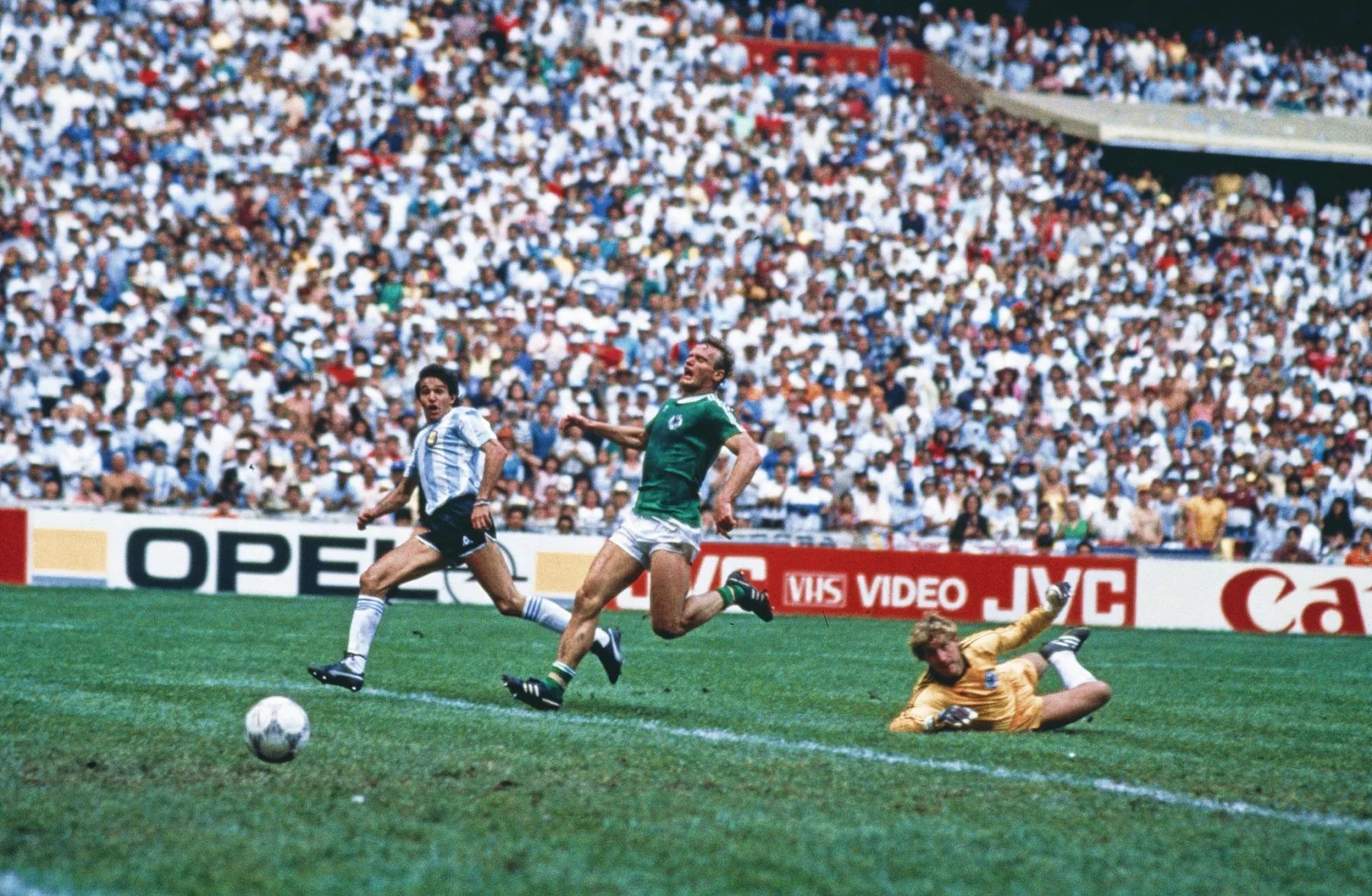
1986 World Cup final, Burruchaga scores the third and winning goal against West Germany. Source. photo by Bob Thomas / Bob Thomas Sports Photography via Getty Images.
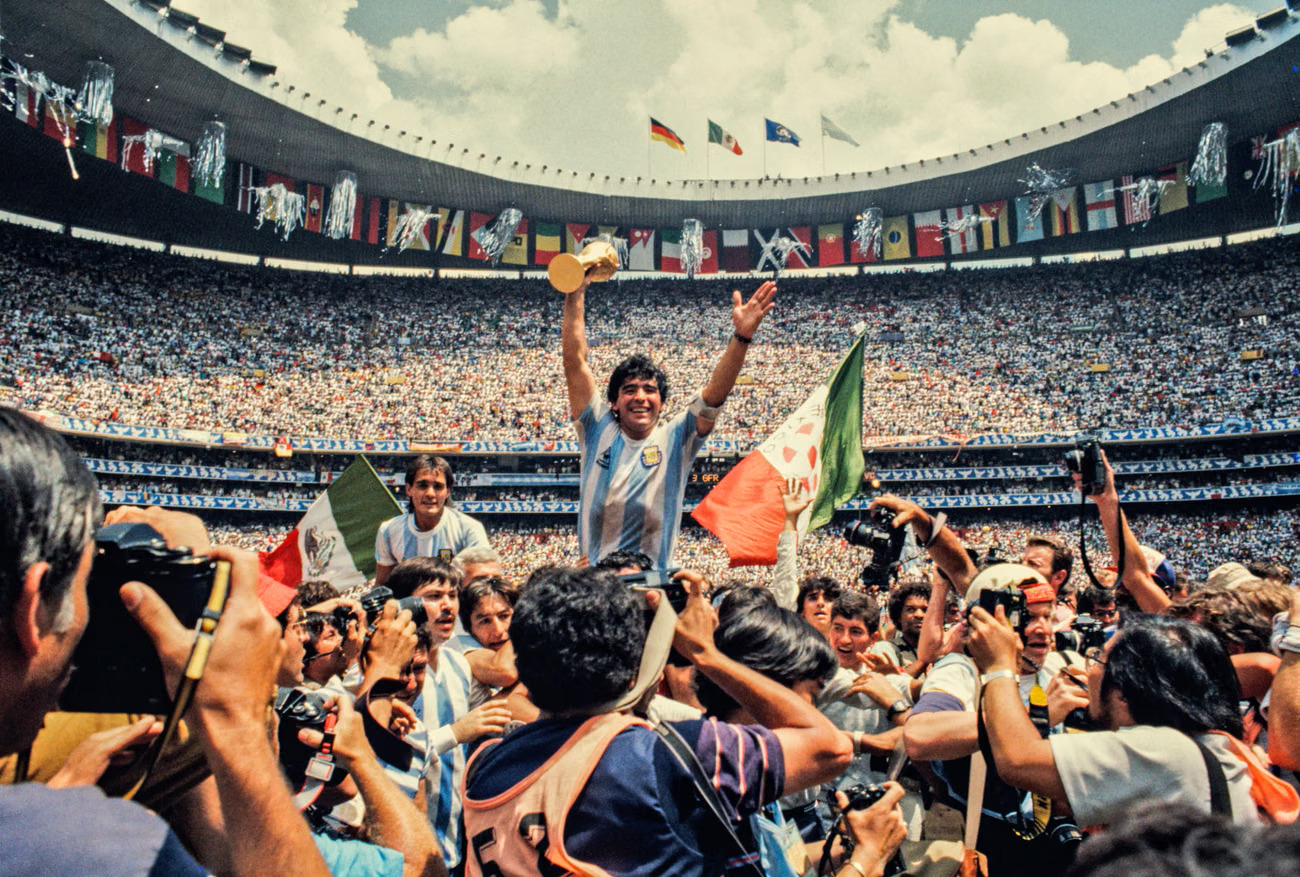
1986 World Cup. Maradona being carried on shoulders, lifting the World Cup trophy. Source: photo by Paul Popper / Popperfoto via Getty Images.
Tournament Firsts:
- First country to host the World Cup twice (1970 and 1986).
- First appearance of the famous “Mexican Wave” on a global stage.
- First World Cup featuring Canada, Denmark, and Iraq.
- First time a coach was sent off, with Paraguay’s Cayetano Ré taking that “honor”.
- Fastest red card in World Cup history with Uruguay’s José Batista being sent off after just 56 seconds vs. Scotland
- First time a team qualified without playing a single home match, with Iraq having to play in neutral territory due to the Iraq-Iran war.
Relevant Players:
- Diego Maradona (Argentina) – The defining player of the entire tournament, with one of the greatest World Cup performances, scoring five goals, having five assists, and helping Argentina win the World Cup for the second time.
- Gary Lineker (England) – Won the Golden Boot with six goals, including a hat‑trick against Poland which rescued England from early elimination and made him the tournament’s top scorer.
- Michel Platini (France) – Even at less than 100% fitness (he played with a painful Achilles tendon injury), he was the creative engine for France, leading them to the semifinals and scoring the equalizer against Brazil that forced the game into PKs after overtime.
- Preben Elkjær (Denmark) – The star of Denmark’s “Danish Dynamites” team, he was explosive, physical, and brilliant, scoring a hat trick against Uruguay and was central to Denmark’s stunning group‑stage run.
- Lothar Matthäus (West Germany) – Germany’s midfield general, providing leadership and a long‑range goal vs. Morocco in the Round of 16 to keep West Germany alive on their route to the final.
- Emilio Butragueño (Spain) – One of the tournament’s biggest breakout stars, scoring four goals against Denmark in the Round of 16, and one of the most iconic individual performances of the tournament.
This had been a World Cup for the ages so there were high expectations for the next one which would be hosted by Italy. Those expectations would not be met and eventually there would be significant changes to the rules to enable more aggressive competition.

Recommended for you