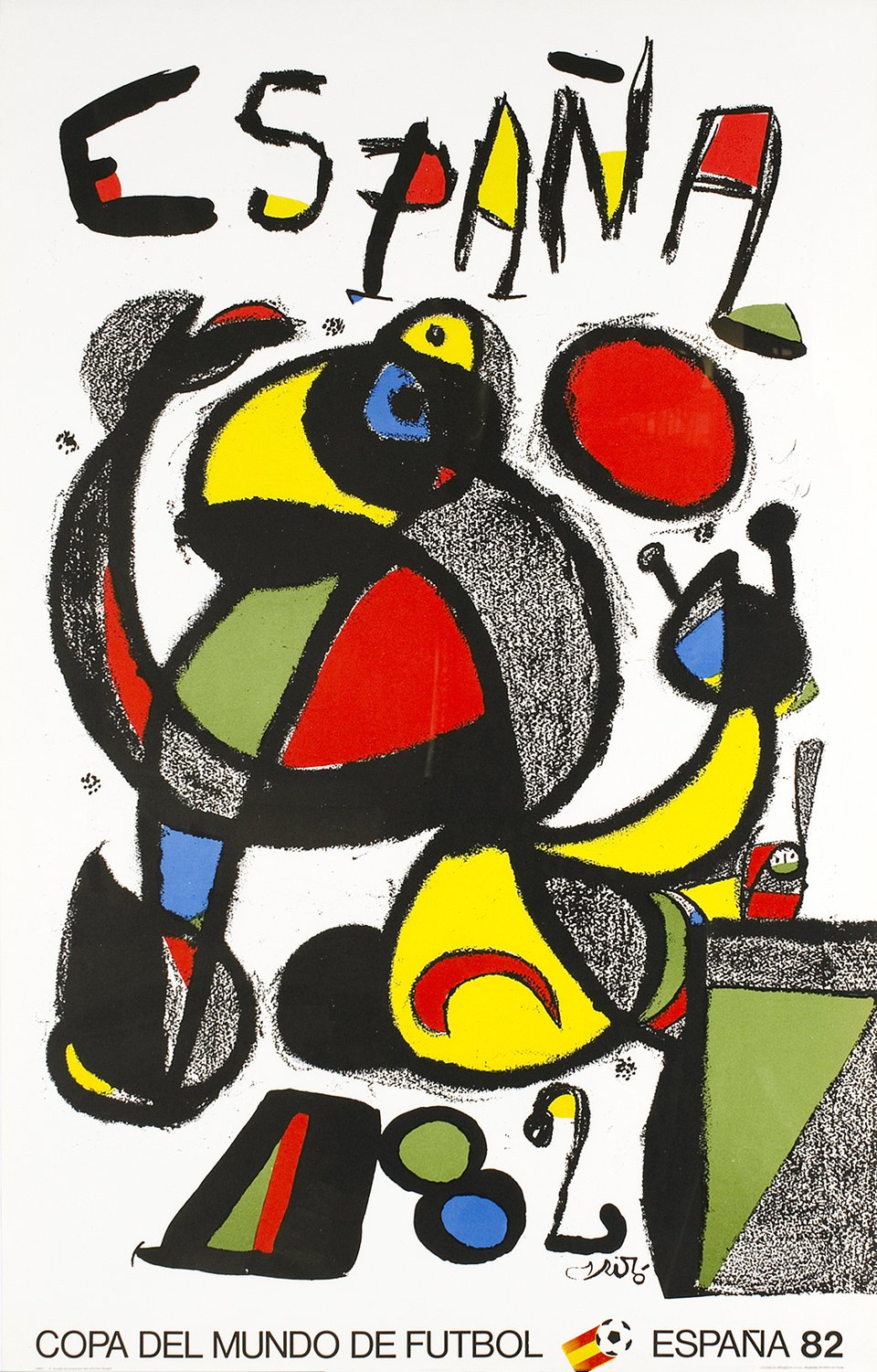
1982 Spain World Cup, Official poster. Author: Joan Miró. Source: National Football Museum, Google Arts & Culture
A country that was passionate about soccer, that had produced great players, and who at the club level had already won European and Intercontinental trophies had been chosen to hold the 1982 XII edition of the FIFA World Cup. Spain would organize and host what would now be an expanded World Cup with 24 teams, instead of the 16 that had been competing since 1954. This new format would create new opportunities for African, Asian, and Central American countries to qualify, with the intent of further developing the sport in those regions. This had been the promise of João Havelange, who had been elected as FIFA President under the commitment of expanding the World Cup to more nations.
Spain had been selected on July 6th, 1966, in London, at the same time that the 1974 and 1978 hosts were selected. West Germany and Spain initially competed for the 1974 competition but ultimately agreed to a deal where Spain would support West Germany for the 1974 tournament and West Germany would then support Spain for its 1982 World Cup bid.
The decision to host the World Cup in Spain was initially very controversial, since in 1966, the nation was still under the oppressive dictatorship of Francisco Franco’s regime. However, with the death of Franco in 1975, Spain had been transitioning to a democracy, and the World Cup was a further incentive and driver to push the country faster into one of the most vibrant democracies in the world.
Spain had lobbied for a World Cup since the early 1960s and by awarding them the tournament in 1966, it gave the country a long lead time to prepare. FIFA also wanted a strong host in Western Europe, and a country that had developed a strong soccer culture and strong stadium infrastructure. Even under the dictatorship regime, Spain had some of the largest stadiums in Europe with the Camp Nou (Barcelona) and the Santiago Bernabéu (Madrid). It also had a very strong professional league (La Liga), with several of their clubs already winning European championships (Real Madrid, Barcelona, Valencia, Atlético Madrid, Zaragoza) and Intercontinental champions as well (Real Madrid, Barcelona).
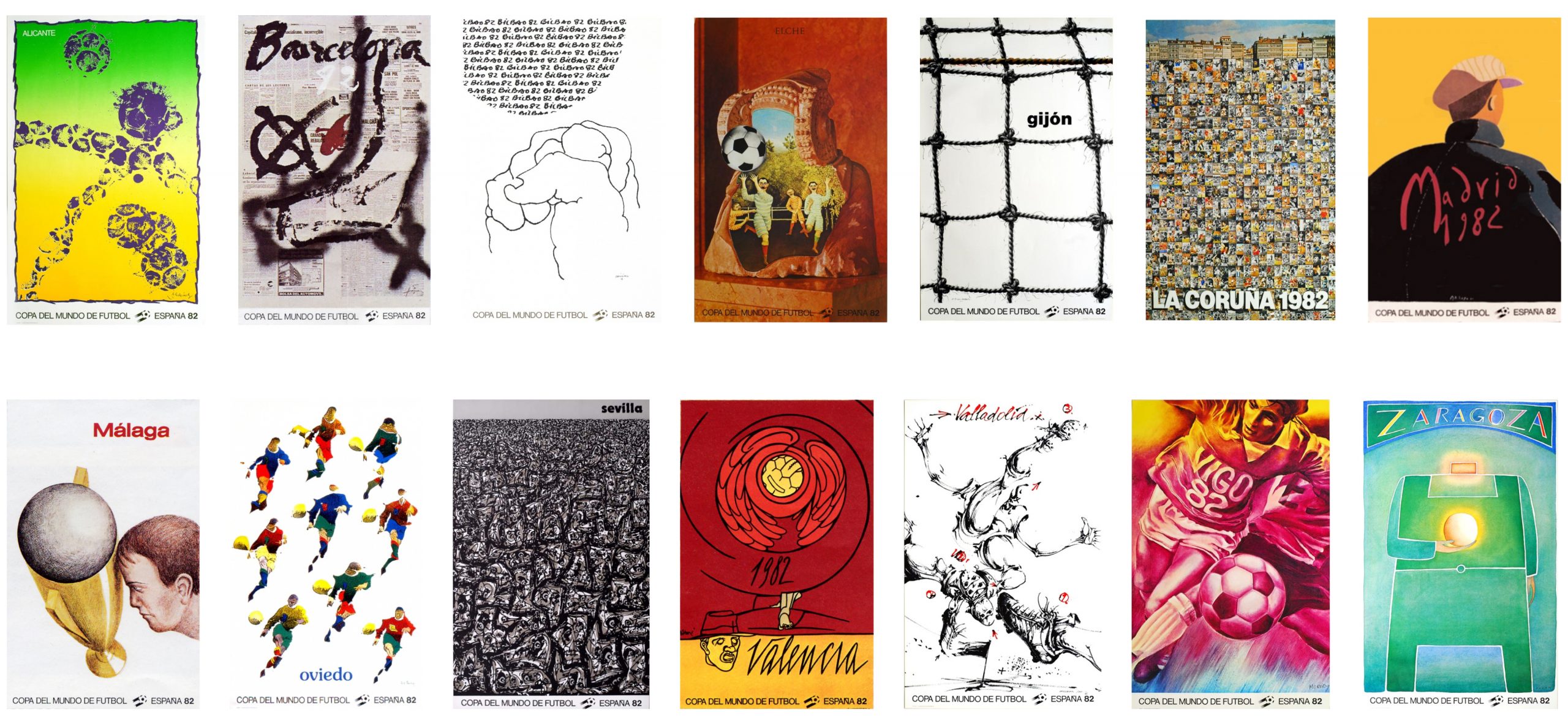
1982 Spain World Cup, host city posters collage. Source: https://ongoalsscored.com/2011/07/14/1982-world-cup-posters
One of the interesting characteristics of this tournament, other than the expansion to 24 teams, was that every host city developed its own poster for the event. While there was an official overall tournament poster, designed by none other than one of Spain’s most famous surrealists, Joan Miró from Barcelona in the province of Catalunya, every city designed its own poster, resulting in a wide variety of styles reflecting the specific city/region in which the competition would take place.
Spain’s men’s national team was known as “La Furia” (The Fury) or “La Roja” (The Red One). The former was for their high physical intensity, fearlessness, refusal to back down, and relentless pressing. The latter for their classic red kits. But La Furia would not be enough in this new world of soccer where physicality and speed were now complemented by more sophisticated tactics and discipline because of the revolution brought about by the Total Football perfected by the Dutch in the previous two World Cups.
Qualifying
A total of 109 teams entered the 1982 FIFA World Cup qualification rounds. They began with a preliminary qualification draw on 14 October 1979 at Zürich, competing for a total of 24 spots in the final tournament, an increase from 16 in the previous World Cups. Spain, as the hosts, and Argentina, as the title holders, qualified automatically, leaving 22 spots open to fill.
The 24 spots for the 1982 Spain World Cup was distributed in the following manner:
- Europe (UEFA): 14 places, one automatic to the host, Spain, while the other 13 places were contested by 33 teams, including Israel.
- South America (CONMEBOL): four places, one to automatic qualifier Argentina, while the other three places were contested by nine teams.
- North, Central America and Caribbean (CONCACAF): two places, contested by 15 teams.
- Africa (CAF): two places, contested by 29 teams.
- Asia and Oceania (AFC and OFC): two places, contested by 21 teams.
A total of 103 teams played at least one qualifying match, with the other six being disqualified for various reasons. This was the last FIFA World Cup qualification that ended in the same year of the tournament until the 2022 FIFA World Cup qualification.
As in previous qualifying rounds, each region organized itself according to their needs. Tie-breaking rules were not applied uniformly across all regions, so while some used total points, goal difference (GD), and the new rule of away goals to determine winners at the end of each stage of the qualification rounds, others did not. However, the winners were clear in every group across all stages and there was no need for any of these tie breakers.
The only “playoff” that was necessary was a one match fixture on neutral ground between AFC (China) and OFC (New Zealand) because they were both tied in points and GD. New Zealand won and qualified.
Teams that were shockingly eliminated were two-time finalist The Netherlands, two-time World Cup winners Uruguay, Sweden, Portugal, Denmark, and Mexico (the last one even more so because CONCACAF was now awarded two spots and Mexico came in third in their qualifying tournament).
The final list of nations qualifying for the 1982 World Cup was:
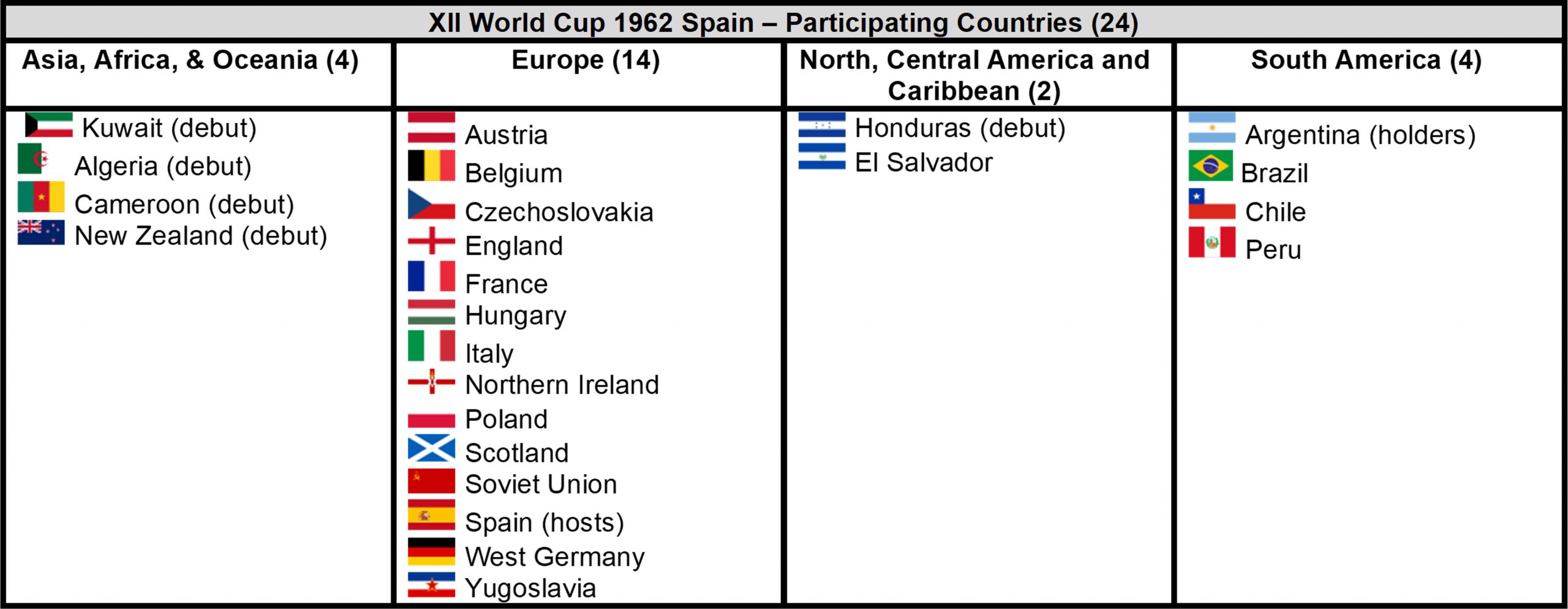
1982 World Cup Participants – Table courtesy of Jose F Guerra
The Tournament
Brazil (A Seleção), Argentina (Los Albicelestes), and West Germany (Die Mannschaft) were favored prior to the tournament. Brazil because it had revamped its lineup and now had a fearsome attack. Argentina because they were the title holders and Maradona was now part of their roster (which he had not been when they won the championship in Argentina four years earlier). West Germany because they were the defending European champions.
Seventeen stadiums in fourteen cities hosted the tournament, a record that stood until the 2002 tournament, which was played in twenty stadiums in two countries
The tournament now had six groups of four whose configuration ended up as follows:

1982 World Cup Group Stage – Table courtesy of Jose F Guerra
In Group 1, Poland would again surprise the world by taking first place, but struggling with draws against Italy (0-0) and Cameroon (0-0). They secured first place by beating Peru 5-1. Italy drew all its matches and scored only two goals during this stage. This convinced the pundits that the Azzurri would not go far in the next phase, given the impressive performance of other teams.
I will take a bit longer to describe what happened in Group 2 because it would produce one of the most infamous games in the history of the competition, which would force FIFA to make changes in subsequent tournaments. West Germany was the hands down favorite to win the group. Austria was a bit of a question mark, and there was curiosity as to how Algeria, a debutante in World Cups, would fare not just against the West Germans and the Austrians, but against Chile, who had a good team but wound up disappointing. Algeria shocked the world when they defeated West Germany 2-1 in their opening match. They then lost 0-2 against Austria and beat Chile 3-2. But because of how the schedule was set up, Algeria played its game against Chile before West Germany and Austria were to play their own last game of the group. Because they knew the results of Algeria-Chile game, both West Germans and Austrians knew that a win by the Germans 1-0 would be enough to secure both of them a pass to the next stages. West Germany scored in minute 10. After that, for the rest of the match, BOTH teams merely kicked the ball around and made no more efforts to score. West Germany was assured a first place with Austria in second, qualifying both for the next phase. The mostly Algerian and Spanish fans (there were few German and Austrian fans in the stands) booed and waves paper currency as a way of implying a match fix. The German press and TV immediately called the behavior “shameful”, with the Germans not helping their cause with their coach Jupp Derwall saying, “We wanted to progress, not play football”. In addition, when fans showed up at the Germans’ hotel to protest, the players threw water balloons at them. This match was played in the northern Spanish city of Gijon, and to this day it is known as “La Desgracia de Gijón” (The Gijón Disgrace). As a result of this farce, FIFA changed the scheduling rules of future competitions so that the last games of each group would be played simultaneously.
Group 3 would produce an initial surprise as Belgium defeated Argentina in the first match. This woke up the title holders and they beat Hungary 4-1 and El Salvador 2-0. Belgium would win and draw their next two matches and wind up on top of the group with Argentina qualifying in second place. But the big news was the game between Hungary and El Salvador where the Hungarians buried the Salvadoreans 10-1. No team since then has scored more goals against an opponent in any World Cup game. In fact, no player has scored a hat trick so quickly as László Kiss did in minutes 69, 72, and 76.
In Group 4 the intrigue was about England who were back in the tournament after missing out the last two. They weren’t considered among the favorites, and their qualifying rounds had not been impressive. Nonetheless, they won all three of their matches against France, Czechoslovakia, and Kuwait, qualifying in first place with France in second. But it was the match between France and Kuwait that gave this group some notoriety. With the French ahead 3-1, they scored a fourth. The Kuwait players protested to the Soviet referee, Miroslav Stupar, because they thought he had blown the whistle and had stopped playing (the whistle they heard came from the stands). Sheikh Fahad Al-Ahmed Al-Jaber Al-Sabah, the Prince of Kuwait who also happened to serve as that country’s football association and was at the match, stormed into the field to argue with Stupar and threatened to pull his team form the tournament. Stupar disallowed the goal, but the French wound up scoring a fourth anyway. This incident ultimately led to FIFA banning referee Miroslav Stupar for life from international matches and fining Fahad (although, the amount was a laughable $10,000).
Group 5 had the hosts playing against Northern Ireland, Yugoslavia, and debutante Honduras. This was considered the easiest group that Spain could have landed in and there were high hopes for them to advance in first place. But the Spanish fans would be disappointed. La Furia Roja barely managed a draw against Honduras 1-1, managed to beat Yugoslavia 2-1, and then were beaten by Northern Ireland 0-1. The Irish would win the group with Spain advancing, barely, due to more goals scored than Yugoslavia (they were tied in points and goal difference).
Group 6 saw “A Seleção” run away with first place. Their jogo bonito was again on full display, with spellbinding and sublime performances that made them even more favorite to win the World Cup. They beat the Soviet Union 2-1 in their first game and then overwhelmed both Scotland (4-1) and New Zealand (4-0), easily taking first lace in their group, followed by the Soviet Union.
The top two winners of all six groups would now be placed into four new groups of three, with the first-place teams of every group advancing to the semifinals to determine the finalists. These groups were not seeded or drawn up randomly. Rather, FIFA used a pre-determined mapping based on the original first‑round group labels. For example, the structure of Group A would include the winner of Group 1, the runner‑up of Group 2, and the winner of Group 6. Similar criteria was used for the other three groups. The final structure was the following:

1982 World Cup Second Stage Grouping – Table courtesy of Jose F Guerra
This configuration guaranteed that three of the semifinalists would be European. There was no collusion or conspiracy. It was simply coincidence because of the criteria used in forming these new groups.
Poland won Group A as it beat Belgium and then tied the Soviets in a game filled with political tension (the Polish government had declared martial law the previous year, silenced the dissident movement Solidarity, and Polish people blamed the USSR). In Group B, West Germany drew with England 0-0 and then beat the hosts 2-0, with Spain effectively eliminated. Group D saw France advance by beating both Austria and Northern Ireland. But it was Group C that left its mark on the tournament as well as the history of the World Cup. It was considered the group of death. Argentina lost both of its matches. But it was the confrontation between the practitioners of the jogo bonito against the famed Azzurri and their catenaccio that produced one of the most memorable games the competition had ever seen. The experts didn’t give Italy any chance given their sluggish group stage performance. But they scored first as their star striker Paolo Rossi struck in minute 5. Seven minutes later Brazil tied through their extremely talented midfielder Sócrates. In minute 25, Rossi again scored for Italy and the score stood 2-1 at the half. Brazil threw all their talent at Italy in the second half and in minute 68, another one of Brazil’s star midfielders, Falcão, scored to tie the game. But in Minute 74, Rossi again scored his hat trick and the score stayed 3-2. Italy would move on and Brazil was eliminated. That Brazilian team is still considered the greatest team never to win the World Cup. They faced a team that all of a sudden found its form and eliminated the three-time champion.
The stage was set for the semifinals, with West Germany facing France and Italy facing the surprising Poles.
Italy disposed of Poland 2-0 and had reached the final, confounding all the pundits. Rossi scored both goals.
But it was France vs West Germany that would also go down as one of the greatest and scintillating matches ever. Regular time ended 1-1, forcing overtime. France scored two quick goals in minutes 92 and 98. It seemed that France was going to the final. But the relentless West Germans, as was their habit in those days, roared back, scoring in minutes 102 and 108. The match went to penalty kicks (PKs) where the Germans prevailed 5-4. A spectacular match, which the great French attacking midfielder Michel Platini called it “my most beautiful game”, was marred by an incident on the pitch. In minute 60, French defender Patrick Battiston ran after a forward pass in a one-on-one play against German goalkeeper Harald Schumacher. The two collided violently and replays clearly showed Schumacher hitting Battiston in the face and then kicking him after the play was over. The goalkeeper got no foul or card called against him. The collision knocked Battiston unconscious and caused two broken teeth and three cracked ribs. Schumacher showed no remorse even after the game. This further incensed Spanish fans who were still angry at “La Desgracia de Gijón”.
But the finalists would now be one of the favorites at the beginning of the tournament, West Germany, against a team no one gave much a chance, Italy.
The Final
90,000 fans packed into the Santiago Bernabeu stadium in Madrid on July 11th, 1982. By all accounts, the crowd was heavily in favor of Italy but more because they were still incensed at West Germany’s farcical game against Austria in the group stage and the unsportsmanlike hit of Schumacher against Battiston. Also, while the temperature wasn’t the blistering 99°F when Italy had played against Brazil in Seville, it was still in the mid 80s.
The first half was a cautious one by both teams and the score was 0-0 at the end of the half. However, earlier in that first half, Italian defender Antonio Cabrini had missed a penalty kick when his shot went wide of Schumacher’s goal. It was the first time a PK had been missed in a World Cup final match. This could have made Italy wilt but as the second half would show, the Azzurri were not fazed.
Rossi put Italy ahead in minute 57, scoring his tournament leading sixth goal. After that, Italy applied its famed (or infamous depending on the fan’s point of view) catenaccio with its lethal counterattacks and ran the Germans ragged. Spanish fans started chanting “olé, olé” as the Italians moved the ball around, the exhausted Germans having run out of ideas. In minute 69, Italy added a second goal through Marco Tardelli on a shot from 30 yards out. Bruno Conti made it 3-0 with nine minutes left through a counterattack. The Germans got a consolation score at the 83rd minute but it was too late.
The team that had started slow and that no one had given any chance, defeated Argentina, Brazil, and Poland to reach the final and beat the mighty West Germans 3-1. It had taken them 44 years, but the Azzurri were once again at the top of the soccer world.
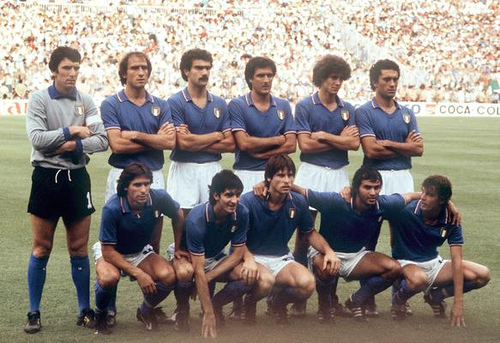
1982 World Cup final – Italy line up. Source: Getty Images
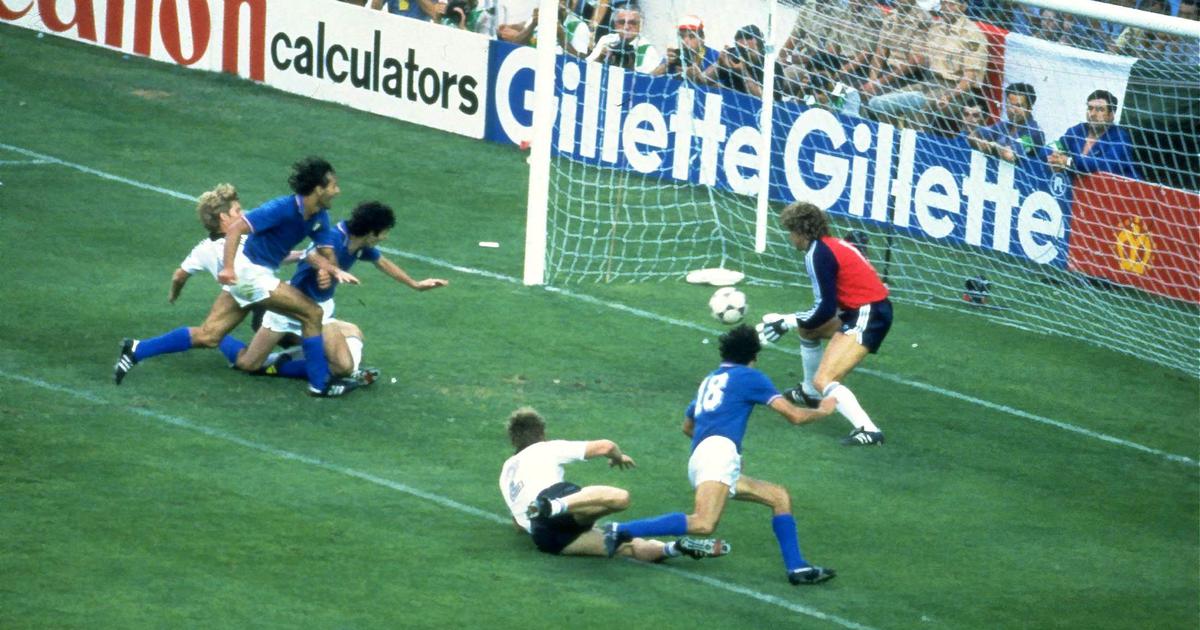
1982 World Cup final – Paolo Rossi of Italy scores against Harald Schumacher. Source: Getty Images.
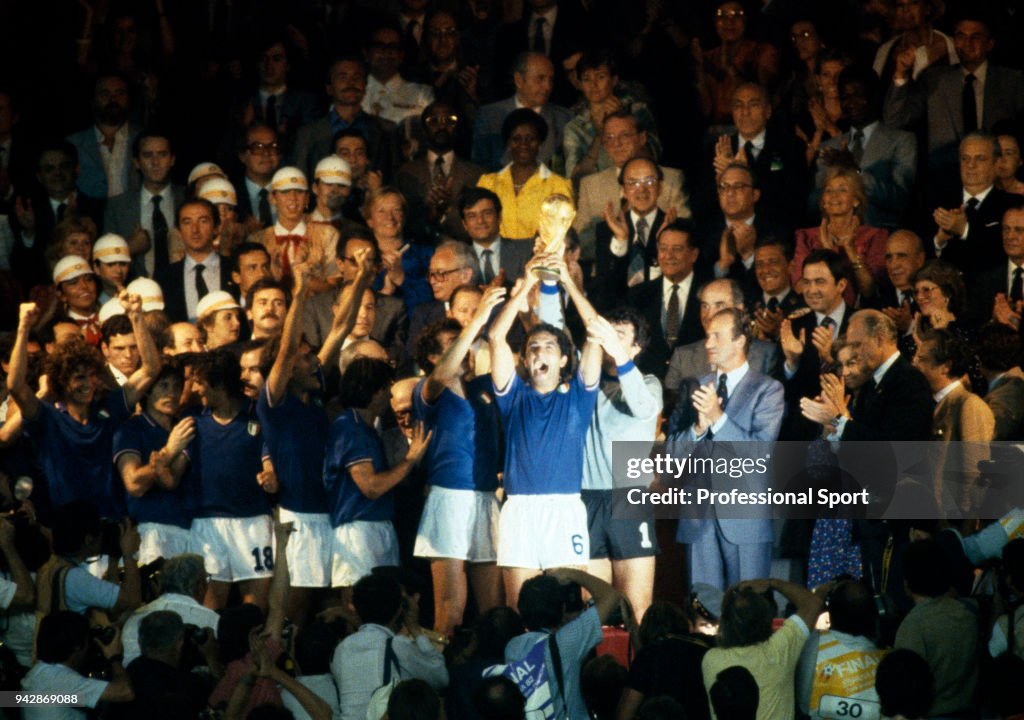
1982 World Cup final – Claudio Gentilelifts the World Cup. Photo by Professional Sport/Popperfoto via Getty Images.
Firsts in the tournament
- First World Cup to feature a penalty shootout, with France and West Germany in their semifinal.
- First World Cup with 24 teams, up from 16.
- First appearances by Algeria, Cameroon, Honduras, Kuwait, and New Zealand.
- First World Cup with total attendance exceeding 2 million.
- First hat trick by a substitute in World Cup history, with Hungary’s László Kiss getting the honors against El Salvador.
Relevant Players
- Paolo Rossi (Italy) – Scored 6 goals, making him the tournament’s top scorer, winning the Golden Boot as well as the Golden Ball (best player of the tournament).
- Karl‑Heinz Rummenigge (West Germany) – Scored 5 goals in the tournament and was a key attacking force, helping his team reach the final.
- Zico (Brazil) – The creative and goalscoring engine of Brazil’s famed 1982 team, and the key playmaker of Brazil’s “Jogo Bonito” side featuring Sócrates, Falcão, and Júnior.
- Zbigniew Boniek (Poland) – The best player of the surprise team of the tournament, Poland, and helped carry them to third place.
- Alain Giresse (France) – Played a central role for France’s elegant, possession-based football and helped lead his team to the semifinals.
- Diego Maradona (Argentina) – One of the greatest players in the sport made his debut in World Cups in 1982 but he struggled due to extremely physical defending.
Four years later, the tournament was scheduled to return to South America. Colombia was getting ready but then something unexpected happened and the World Cup would return for the first time to a country that had already hosted it before.