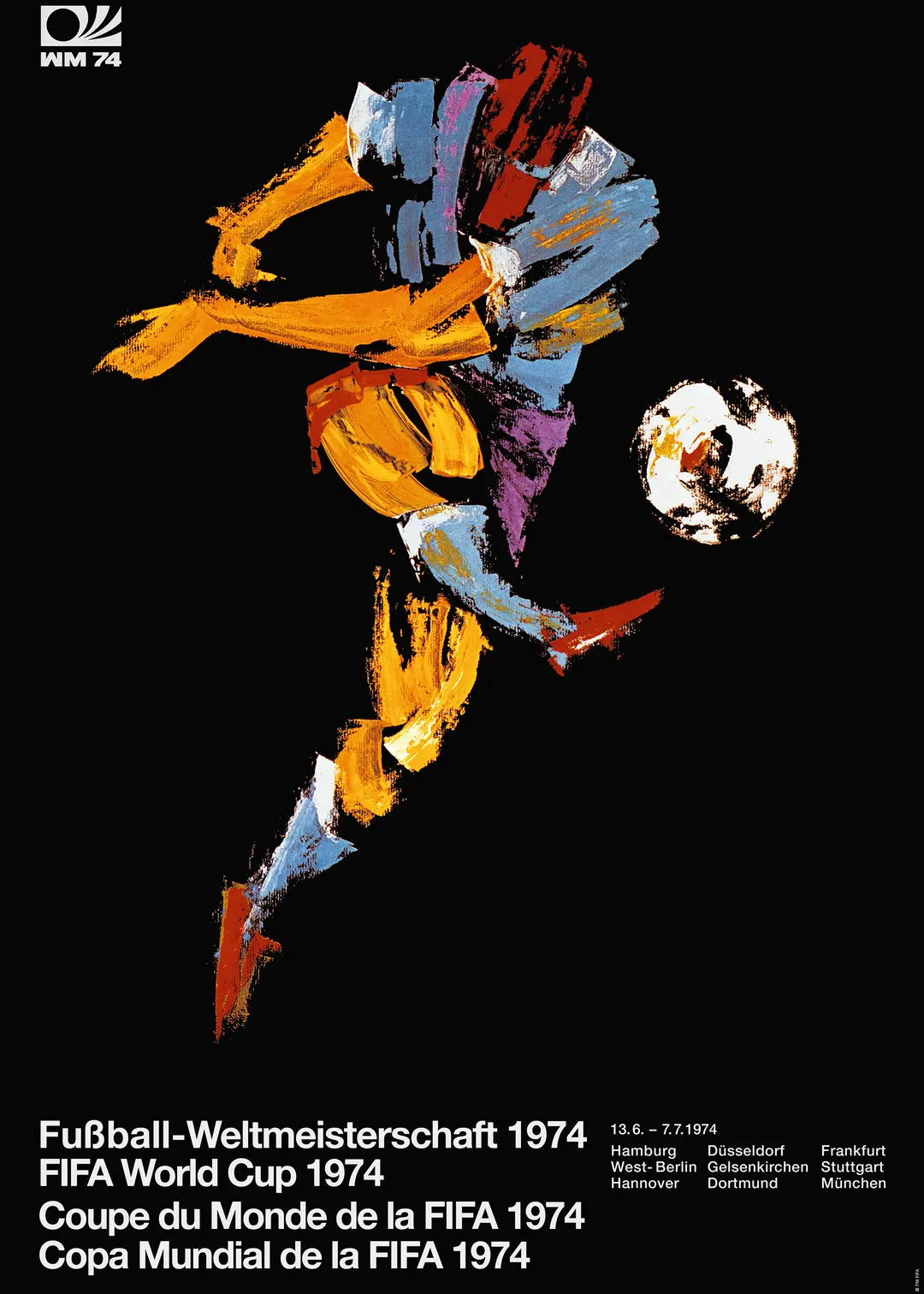
Official poster of the 1974 FIFA World Cup, designed by Horst Schäfer, source FIFA collect marketplace
The tenth edition of the World Cup would see the introduction of a whirlwind style of play, from a nation, that until this tournament, had not been relevant in the sport at the international or club level. In fact, they hadn’t participated in World Cup play since the 1938 edition, a full 36 years earlier. The style would be called “Total Football” and its practitioners would be The Netherlands, under the on-pitch baton of Johan Cruyff.
West Germany was awarded hosting rights in London, England on 6 July 1966. That same day, it was also announced that Argentina would host the 1978 World Cup and Spain in 1982. There is no voting record on how nations cast their ballots for the various hosts. However, what is known is that West Germany had struck an agreement with Spain that if Spain supported the German for the 1974 tournament, West Germany would use all its influence to ensure Europe voted as a block to award Spain the 1982 tournament. Argentina had been promised the 1978 World Cup after losing out to Mexico for the 1970 championship.
Other than the support of Spain, some of the reasons that West Germany was picked included; a rapidly modernizing transportation and communications infrastructure, the nation’s stellar record in these competitions (1954 champion, runner ups in 1966, semi-finalist in 1970), the ability to organize and stage large international events (the country had hosted the 1972 Sumer Olympics), and its status as a model democratic nation (this was especially important at the height of the Cold War).
One item that was front and center was the still fresh shock and trauma from the massacre of Israeli athletes during the 1972 Summer Olympics. West Germany had gone out of its way during that event to make sure visitors and athletes didn’t think they were in a militarized Germany, bringing back the haunting memories of WWII. But the massacre forced a rethink for the 1974 World Cup, resulting in a complete revamp of the security apparatus that to this day influences how the World Cup security is set up. Among the actions that West Germany took were:
- Creation of the GSG 9, Germany’s elite counter‑terror unit
- Expansion and formalization of federal counter‑terror coordination structures
- Influence on special operations forces, leading many countries to establish units modeled after the lessons of Munich
- Heavily guarded stadiums and team accommodations
- Strict access control, surveillance, and coordinated police deployment
- Full integration of federal–state intelligence and security agencies
- A complete shift from the minimalistic 1972 Olympic security approach
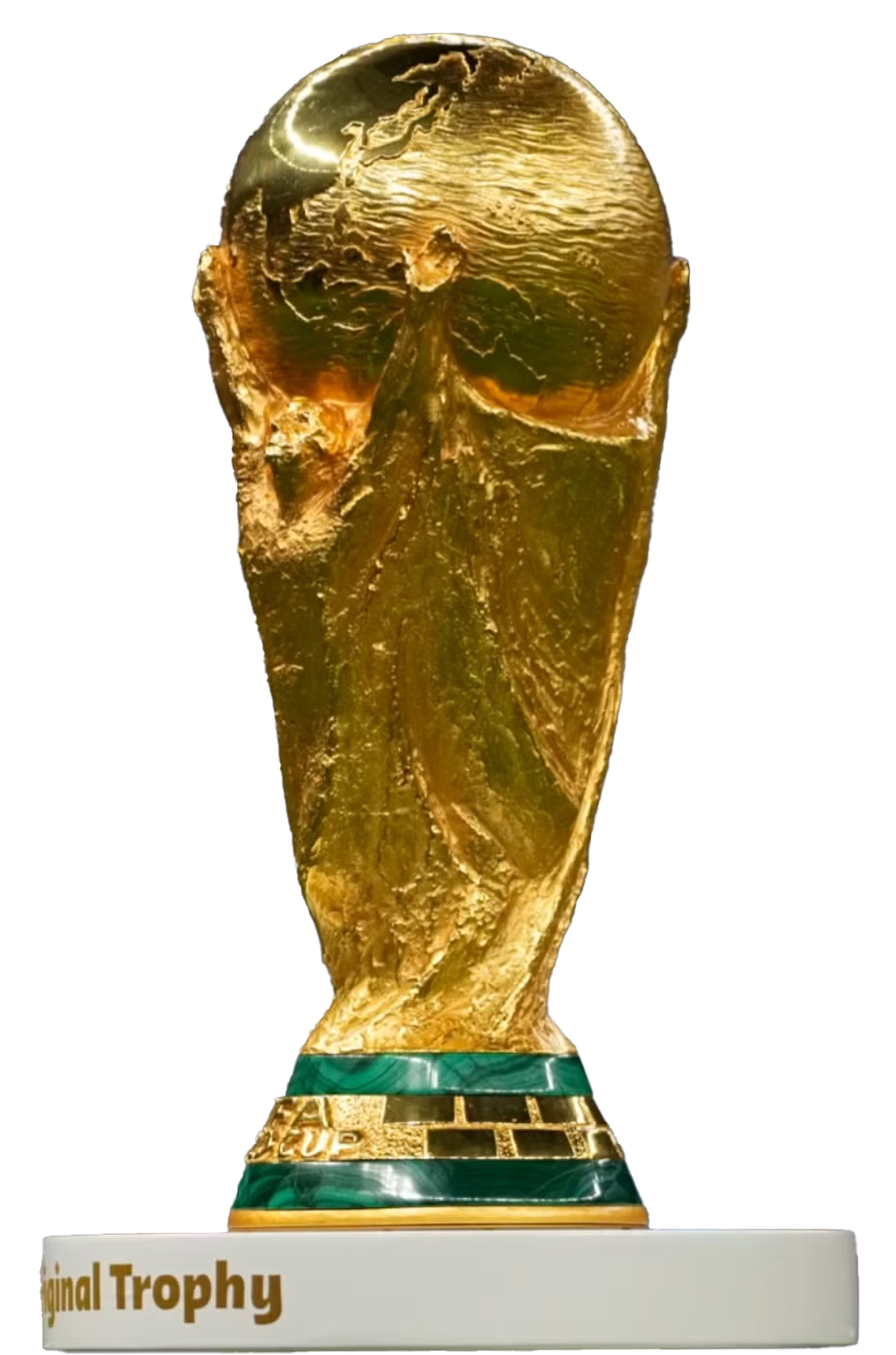
1974 World Cup Trophy, design by Italian sculptor Silvio Gazzaniga, Source: https://www.givemesport.com/world-cup-history-jules-rimet-previous-winners-format-trophy/
The Trophy
The tournament needed a new trophy. With the Jules Rimet Cup now in permanent possession of the three-times world champion Brazil, a new award was needed. A competition was held with 53 submissions received from sculptors in seven countries. Italian artist Silvio Gazzaniga was awarded the commission. The trophy stands 14.4” tall and is made using 11.0 lbs. of 18 karat (75%) gold, worth approximately US$407,725 as of the 25th of August of 2025. Its base is 5.1” in diameter containing two layers of malachite which adds another 2.6 lbs. to the total weight. The trophy is hollow, otherwise, it would weigh close to 150 to 180 lbs. and would be too heavy to lift.
The Cup used to be kept by the winning team until the final draw of the next tournament, but that is no longer the case. Instead, the winners of the tournament receive a bronze replica which is gold-plated rather than gold. Likewise, three-time winners keep the replica instead of the original cup. Germany became the first nation to win the new trophy for the third time when they won the 2014 FIFA World Cup, and Argentina became the second nation following their third win in Qatar at the 2022 FIFA World Cup.
The stage was set for a World Cup that would see the usual dose of surprises, classic games, intense (and sometimes political) rivalries, and an orange whirlwind of Total Football soccer.
Qualifying
Ninety-nine teams entered the 1974 FIFA World Cup qualification rounds, an increase of 32%. A total of 14 places would be disputed, with the hosts (West Germany) and the title holders (Brazil), automatically qualifying. Due to rejections and one disqualification (the Soviet Union which refused to play its second leg of the intercontinental playoff against Chile due to the latter’s military coup), the total number of teams playing at least one qualifying game was 90.
The 16 spots were allocated as follows:
- Europe (UEFA): 9.5 places, one of them went to automatic qualifier West Germany, while the other 8.5 places were contested by 32 teams. The winner of the 0.5 place would advance to the Intercontinental Play-offs against a team from South America (CONMEBOL).
- South America (CONMEBOL): 3.5 places, one of them went to automatic qualifier Brazil, while the other 2.5 places were contested by nine teams. The winner of the 0.5 place would advance to the Intercontinental Play-offs against a team from Europe (UEFA). The winner of the Intercontinental playoff was Chile when the Soviet Union team didn’t show up for the second leg. An amusing anecdote from that match is that Chile was lined up ready to go with no opponent. The team then playfully started moving the ball around until they scored a goal in the empty net to the cheers of the thousands that were attending.
- North, Central America and Caribbean (CONCACAF): one place, contested by 14 teams.
- Africa (CAF): one place, contested by 24 teams.
- Asia (AFC) and Oceania (OFC): one place, contested by 18 teams.
As before, two points went to the winner of these matches, one for a draw, and zero for a loss. Largest number of points per group would determine the winner of the group, and in the event the top two teams were even in points, goal difference would be the tie breaker. If they were tied after considering goal difference, a playoff game would be played to determine the winner.
Three playoff matches would be required for tie-breaker purposes. Sweden against Austria, Yugoslavia against Spain, and Australia against South Korea, all played on neutral ground. The winners were Sweden, Yugoslavia, and Australia.
For the first time, the final qualifying round for a region, CONCACAF, was played in one country, Haiti. Six teams (Mexico, Guatemala, Honduras, Netherlands Antilles, Haiti, and Trinidad and Tobago) qualified for that regional championship to determine the representative to the 1974 World Cup. To the shock of everyone, Mexico came in second and did not qualify (even receiving a 4-0 pummeling from Trinidad & Tobago). Haiti won a decisive game 2-1 against Trinidad & Tobago (T&T) but it was under highly suspicious circumstances. T&T had four disallowed goals. The central referee, José Roberto Henríquez from El Salvador, and one of his linesmen, James Higuet from Canada, were subsequently banned for life by FIFA after a review by the organization (but no official explanation was ever given). This tournament was hosted under the Duvalier dictatorship in Haiti. Some historical overviews suggest the event was “allegedly rigged” in the host’s favor, citing the T&T match as Exhibit A but no actual proof has ever been produced.
Mexico wasn’t the only one that was shockingly eliminated. England, Spain, Czechoslovakia, and the Soviet Union (disqualified) also failed to qualify for the 1974 World Cup.
The final list of teams that qualified for the 1974 X World Cup in West Germany was:
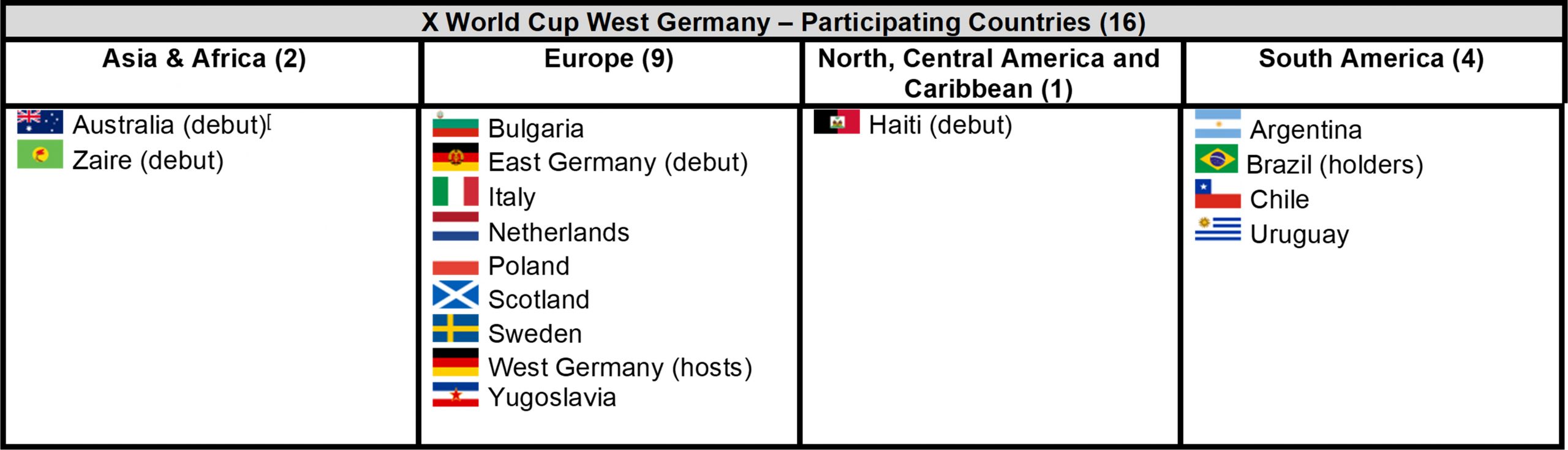
Table courtesy of Jose F Guerra
The Tournament
West Germany used nine stadiums in nine cities, including what was then known as West Berlin (the Cold War was still going on). The largest in capacity was the Olympiastadion in West Berlin with a capacity of 86,000 people and the smallest one in Dortmund, North Rhine-Westphalia with a capacity of 56,000 people.
Four groups of four were again used to distribute the 16 qualified teams. The draw was watched by 800 million people, an indicator of how fast interest in the tournament had globalized in a relatively short period of time. Ahead of the draw, the FIFA Organizing Committee decided that the host nation and title holder) would be seeded and placed respectively into the first position of Groups 1 and 2 prior to the draw. The remaining two top-seeded teams (Uruguay and Italy) would be drawn into the first position of Group 3 and Group 4. It was also decided that South American nations could not play in the same group during the first group stage. In other words, Argentina and Chile drawn from pot 3, could not be drawn into the two groups seeded by Brazil and Uruguay. The biggest eyebrow-raising result was when East Germany was placed in the same group as West Germany. The two teams would meet for the first (and only) time in a World Cup tournament.
The final configuration of the groups was (shaded teams advanced to the next round):

Table courtesy of Jose F Guerra
One major change was made to the format of the competition. Instead of a straight knockout round, the eight teams advancing to the next round would be put in two groups of four, with the teams in first place from each group advancing to the final and the teams in second place playing for the 3rd and 4th places.
In Group 1 the most intriguing match was between the two Germanies. Both had locked in their qualification towards the next round so it was more a question of who took the honors in the international “derby.” But politics also reared its head as both sides were claiming this was a “test” to determine which system was better, the communist or the capitalist. West Germany dominated the game and Gerhard Müller, the top tournament scorer in 1970, hit the upright. But the West Germans were unable to break down the well positioned and disciplined East German backline. Just 13 minutes form the end, Jürgen Sparwasser from East Germany scored after an uncharacteristic lapse by the West German defense and the game ended 1-0 in favor of the East Germans. It was a stinging defeat for the West Germans but one that would wind up benefit them in the next round. To avoid any controversies, Sparwasser exchanged shirts with West German Paul Breitner in the tunnel, out of sight of prying eyes.
Group 2 included the title holders, Brazil, who were one of the favorites to take the title again. But this was a Brazil without most of the stars (including Pelé) that made it a juggernaut four years before. They drew twice at 0-0 for their first two games and then beat Zaire 3-0. But Yugoslavia would demolish newcomer Zaire by 9-0 and that gave them the goal difference over Brazil to qualify for the next round. Scotland would wind up undefeated with a team that some say was the best they had ever assembled but they failed to go on to the next round.
But it was Group 3 that turned heads with the arrival of Total Football by The Netherlands. The concept was simple: every player on the pitch other than the goalkeeper was expected to play any position. The flurry of players moving in and out of positions was at first confusing to anyone watching the match. But there was a method to this seeming madness. Every time a player moved into a different position than their own, another one would move to cover their spot. At times several players would converge in the opposition player holding the ball, but they did it at such speed that the spaces left open were not exploited by the other team. The centerpiece of their system was the great Johann Cruyff. The team was built around him but even he was expected to play within the new Dutch system. They became know immediately as the “Clockwork Orange” for their precision and relentless way of playing the game and their orange uniforms. The Netherlands easily qualified for the next round along with Sweden, who had held them to a nil-nil draw.
Group 4 showed a surprising Polish team win all its three games, one by a score of 7-0 over newcomers Haiti. Italy, as in 1966, failed to get out of the group stage, but this time due to goal difference with Argentina who advanced to the next round along with Poland. The Polish sentimental favorites would continue to delight the world as they kept winning against all odds. Their run would eventually end but for a few weeks, they dared to dream the impossible dream.
The new format for the next round produced the following two groups (green shade went to the final, blue shade played for 3rd and 4th place):
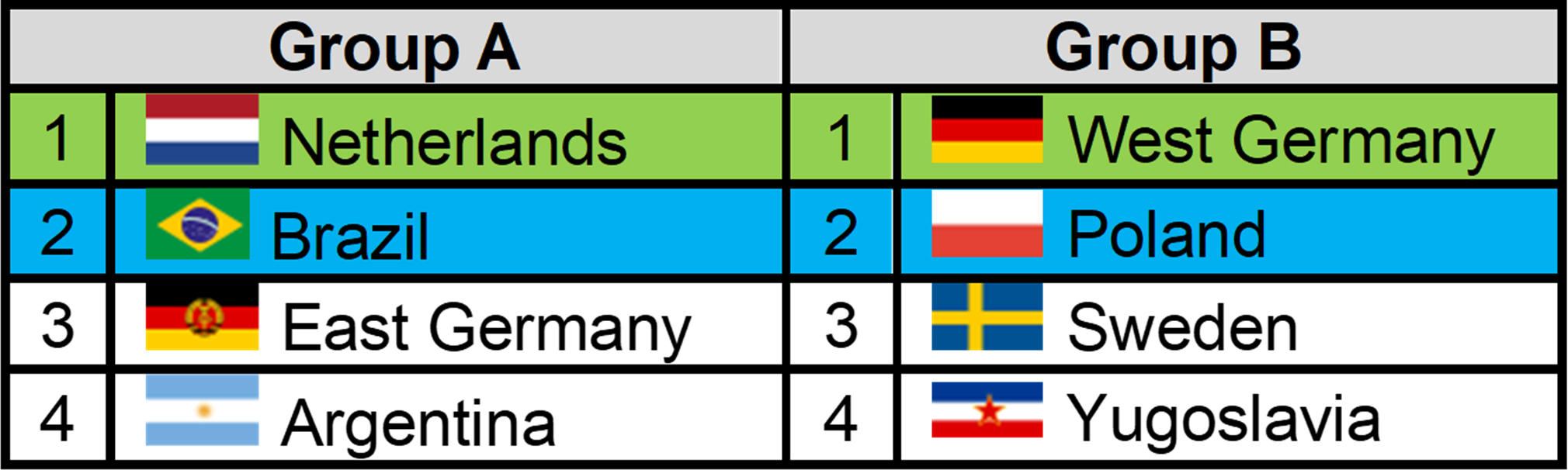
Table courtesy of Jose F Guerra
With the new format now in place of two new groups of four, no one knew what to expect. Would teams be cautious not to lose precious points that might stop them from getting to the final? Would it be more open with teams being aggressive to get to the final? Would there be displays of conformity as teams tried to leverage results from already played games?
The answer was that teams came out playing aggressively, especially The Netherlands and Poland.
The Dutch in Group A overwhelmed its opponents since by then they had now perfected their Total Football approach. They scored eight goals and conceded none. The game against Brazil was very physical and the Brazilians, already behind 2-0, resorted to dirty play to try to stop the orange machine. Dutch midfielder Theo De Jong said after the game that “What the Brazilians did was a shame…When they cannot succeed with ordinary means, they employ brutality”. He could never have suspected that 36 years later in the 2010 South Africa World Cup, the Netherlands would resort to those same tactics in a memorable game.
Meanwhile in Group B, the surprising Poles kept moving along. They won their first two games against Sweden and Yugoslavia and then face the hosts, West Germany, in the decisive game to decide who would come out on top of the group and go to the final. Poland needed a win, but West Germany could play for a draw and go to the final. The Poles started three players that were not 100% match fit due to injuries, but they were not going to miss the most important game in the history of their nation in World Cups. The match was a very clean one with both teams showing off their elegant passing and aggressive attacking. Eventually the relentless West Germans scored, and the game ended 1-0. In 2007, Paul Breitner said “I can remember one game where I’ve always maintained we beat a team which was fundamentally better than us… I mean Poland in 1974.”. But the West Germans were now in the final.
The final was set for the one-time World Cup winner and hosts, the relentless and attacking West Germany, to meet the mighty Clockwork Orange machine to decide who would be world champion.
The Final
West Germany, led by their elegant and extremely skillful midfielder “Der Kaiser” Franz Beckenbauer, was in a position to win the trophy in front of 76,000 loud and excited fans. The Netherlands, led by their magnificent center forward Johann Cruyff were standing in their way. The Germans had scored 11 goals and allowed three in the six previous games. The Netherlands by contrast had scored 14 goals and conceded only one!
The Dutch struck first within the first minute. The West Germans had not even touched the ball when a penalty kick was awarded to The Netherlands. Midfielder Johan Neeskens coolly executed the kick and the Dutch were ahead 1-0. The West Germans seemed overwhelmed by the waves of Dutch players that kept playing their Total Football style.
But then two things happened that turned the tide. The West Germans were known as a team that could be down 2-0 and strike back with their relentless discipline, which would play in their favor. But the second thing that happened was decisive in turning things around for the West Germans. After going up 1-0, some players on the Dutch side wanted to humiliate the Germans because they still had resentment from what happened to their country at the hand of the Germans during WWII. The Dutch started moving around the ball, “toying” with Germany. This caused them to lose focus and intensity, allowing the West Germans to not only regroup, but to bring forward that relentless play that had characterized their side since 1954.
In minute 25 West Germany was awarded a penalty kick. Paul Breitner stepped up and completely fooled the Dutch goalkeeper who didn’t even move as the ball went into his lower right-hand corner of the net. The game was now tied, and it was now the Dutch who seemed bewildered. You could almost see it in their face as if they were asking themselves, “we were dominating them and now we’re tied.” The relentless West Germans kept attacking and two minutes from half time Gerhard Müller got the ball in the box and with three defenders rushing towards him in close proximity quickly fired a shot that went past the Dutch goalkeeper. The score was now 2-1 in favor of West Germany.
The rest of the game saw both teams with opportunities to change the score but the West German lines did not fold, and the great Clockwork Orange Total Football machinery had finally been stopped by the disciplined, relentless, and unflappable West Germany team. They had won their second World Cup, and they were the recipients of the first new World Cup Trophy.
It is worth noting that the Dutch hadn’t actually invented Total Football. The Hungarians, and the Austrians to some extent, already had a version of this style in the 1950s but the Dutch refined, systematized, and globally popularized it.
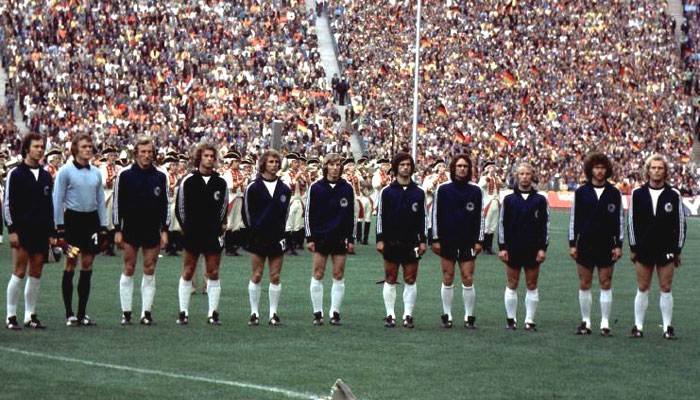
West Germany national team line‑up at the 1974 FIFA World Cup, Munich, Source: Getty Images
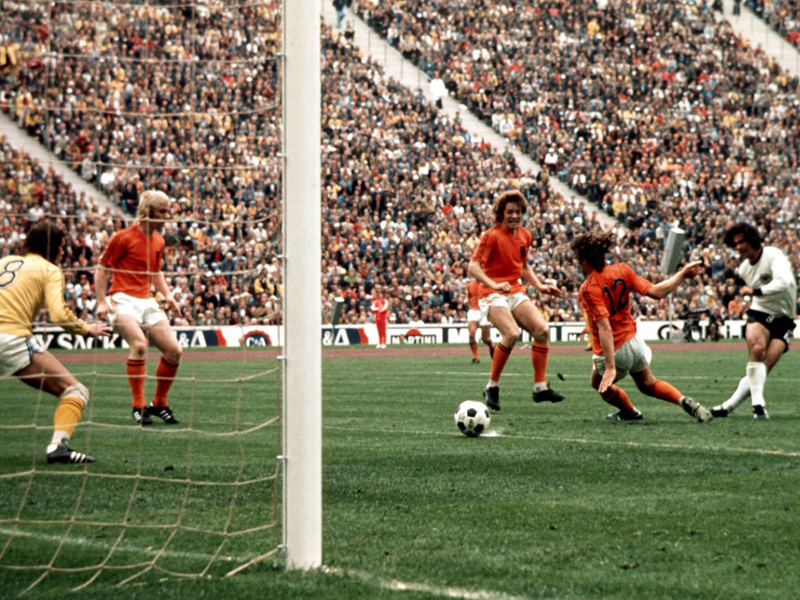
1974 World Cup final, Gerhard Müller shoots to score West Germany’s second and decisive goal against the Netherlands. Source: AP Photo.
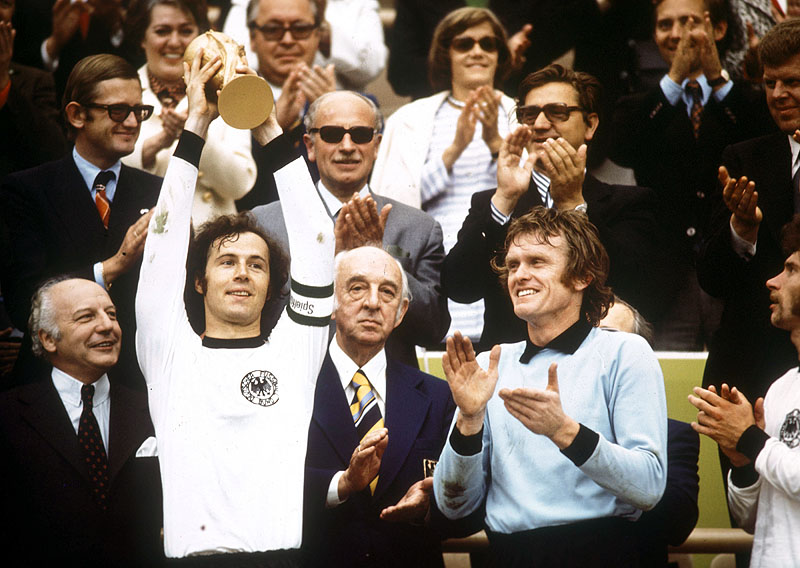
Franz Beckenbauer, captain of the West German team, lifts the FIFA World Cup Trophy. Source: Getty images.
Tournament Firsts
- First Penalty Kick (PK) awarded in a final and the first time two PKs had been awarded in the same final.
- First red card ever issued which was to Chile striker Carlos Caszely in their game against West Germany.
- First time the new World Cup Trophy was awarded.
- First time that a World Cup substitute winner had played for a club outside his home country (Günter Netzer, who played for Real Madrid and came on as a substitute for West Germany during their game against East Germany).
- First and only World Cup appearance for East Germany.
- First World Cup appearances for Australia, Haiti, Zaire.
- First use of a two‑group second stage format.
Relevant Players
- Johan Cruyff (Netherlands) – Widely considered the star of the tournament, leading the Dutch “Total Football” style.
- Franz Beckenbauer (West Germany) – Captain and of the eventual champions, orchestrating the German side with tactical brilliance and calm authority.
- Grzegorz Lato (Poland) Top scorer of the tournament with 7 goals, Lato powered Poland to an impressive third‑place finish.
- Ralf Edström (Sweden) – A key attacking force, Edström scored crucial goals, including in Sweden’s second‑phase victory over Yugoslavia.
- Dragan Džajić (Yugoslavia) – A standout winger and team captain, Džajić contributed assists and remained Yugoslavia’s most influential player.
- Rivellino (Brazil) – A holdover from t he 1970 champions, he was a key creative force for Brazil, scoring multiple goals in the tournament and remained one of the squad’s most influential attacking players.
The 1978 World Cup would be hosted by Argentina where the local fans would pour their passion and support into their team under very difficult political conditions but would once again showcase surprises, shocks, and a fair share of conspiracy theories.