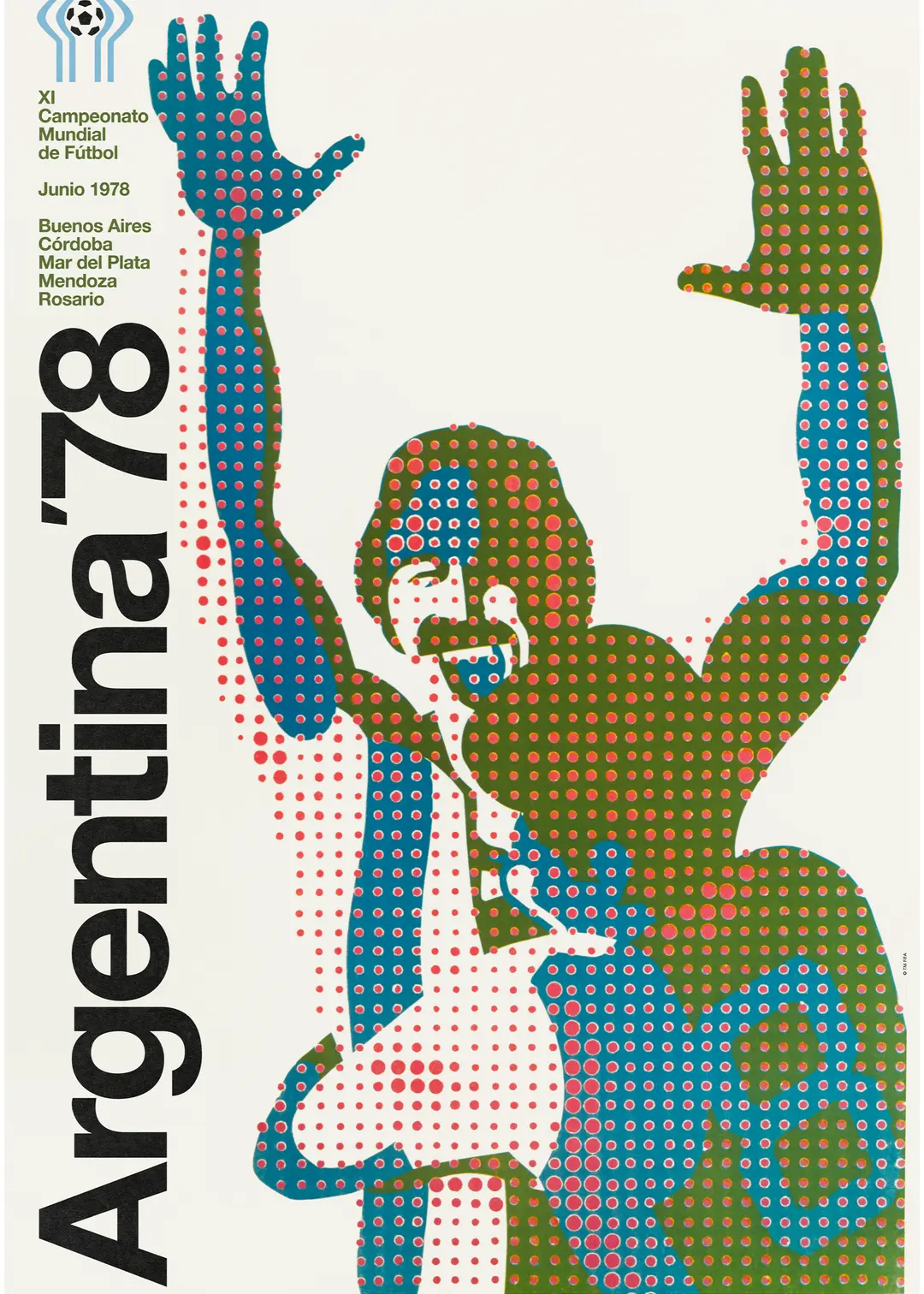
1978 XI World Cup, Argentina, Official Poster
Argentina would host the FIFA World Cup XI. The “Clockwork Orange” Dutch runner ups from 1974 were still turning heads with their total soccer approach. The mighty West Germans seemed like a juggernaut, even if they had lost the European final against Czechoslovakia in 1976 (on penalty kicks). The Italians were on the rise again. Brazil was still playing the “jogo bonito.” And the hosts? Certainly a team of high quality, having made deep runs in several tournaments, but with only one of their players plowing his trade in Europe, striker Mario Kempes, “El Matador.” How would hey fare under the still physical and fast teams from Europe and their main South American competition, Brazil? The world was about to witness the hyperkinetic passion of the Argentinean fan base, roaring their support for their “Albiceleste.”
The tournament was awarded to Argentina after losing out to Mexico in 1970 and Chile in 1962. The soccer crazy nation had something to prove, not just their knowledge and passion for the sport, but to show off the quality of their nation’s national team. Also, it was “South America’s turn” to host the tournament. There had been a tacit agreement starting in 1958 to alternate World Cups between Europe and the Americas. It had been since 1962 that South America hosted the event, 16 years in which the sport had made tremendous advances in tactics, physical fitness, nutrition, and global visibility.
But a very dark side would follow the tournament throughout the matches, in addition to multiple on and off-pitch controversies. All was not well in the nation itself. Two years before, a military junta had taken over the country in a violent coup. FIFA, ever the hyper-political organization, never considered moving the tournament despite pressure from many nations, humanitarian organizations, and even famous soccer players. Some nations even threatened to boycott the event. FIFA didn’t blink, even if they did have concerns given the very visible violence occurring in the country and the rumors, years later confirmed, of the widespread disappearance and torture of dissidents. The event would go on.
General Videla, the head of the military junta, did not like soccer. But he saw an opportunity to distract the people who were not only being affected by the heavy handedness of the military dictatorship but also by the deteriorating economic conditions. So he, along with the other two members of the junta, threw their energies and government money at the event to clean up the venues, improve whatever infrastructure was still required, and put on a façade of a welcoming country where everything was normal.
A curious detail was that Videla did not like the logo of the tournament, which was representative of the previous government administration, the so called Peronista movement after the Peron government that had been deposed by him. He pressured FIFA to change it but the world soccer governing body held steadfast to that design, mainly for economic and marketing reasons (large sums had already been spent developing collateral material for the event, publicity, organization, merchandise, etc.).
Qualifying
A total of 105 teams initially registered to compete for the 14 spots eligible for qualification. Two had already qualified, West Germany as the title holders, and Argentina as the host nation. A total of 10 teams withdrew for different reasons, leaving the qualifying events with 95 teams.
Each region organized their respective qualifying tournaments according to their needs but in general they still followed the format of organizing themselves around groups, competing in a round-robin structure of home and away matches, and then awarding the teams finishing in first place of their groups a place in the World Cup. Where the regional representation was restricted to one team (such as Asia, Africa, or CONCACAF), additional rounds were required to determine the final regional representation. Thirteen teams would qualify within this format with the 14th determined through an intercontinental match between Europe and South America.
Tie breakers were the usual goal difference (GD) or in the event of having the same GD, ties within a qualifying group, additional playoff games as necessary.
The 16 places would be distributed among the continental zones as follows:
- Europe (UEFA): 9 or 10 places. One place went automatically to the title holders, West Germany, while nine places were contested by 31 teams. The team coming ninth in qualifying would advance to the intercontinental play-offs against a team from South America (CONMEBOL).
- South America (CONMEBOL): 3 or 4 places. One place went automatically went to the host nation, Argentina, while the other three places were contested by nine teams. The team coming third in qualifying would advance to the intercontinental play-offs (against a team from Europe (UEFA).
- North, Central America and Caribbean (CONCACAF): 1 place, contested by 16 teams.
- Africa (CAF): 1 place, contested by 26 teams.
- Asia (AFC) and Oceania (OFC): 1 place, contested by 22 teams.
There were no playoff matches required, other than the intercontinental one which was played between Hungary and Bolivia, with Hungry being the winner on a 9-2 aggregate score.
Teams that were shockingly eliminated during qualifying were England (for the second tournament in a row), Uruguay, and Chile.
The final list of the 16 participants was the following:
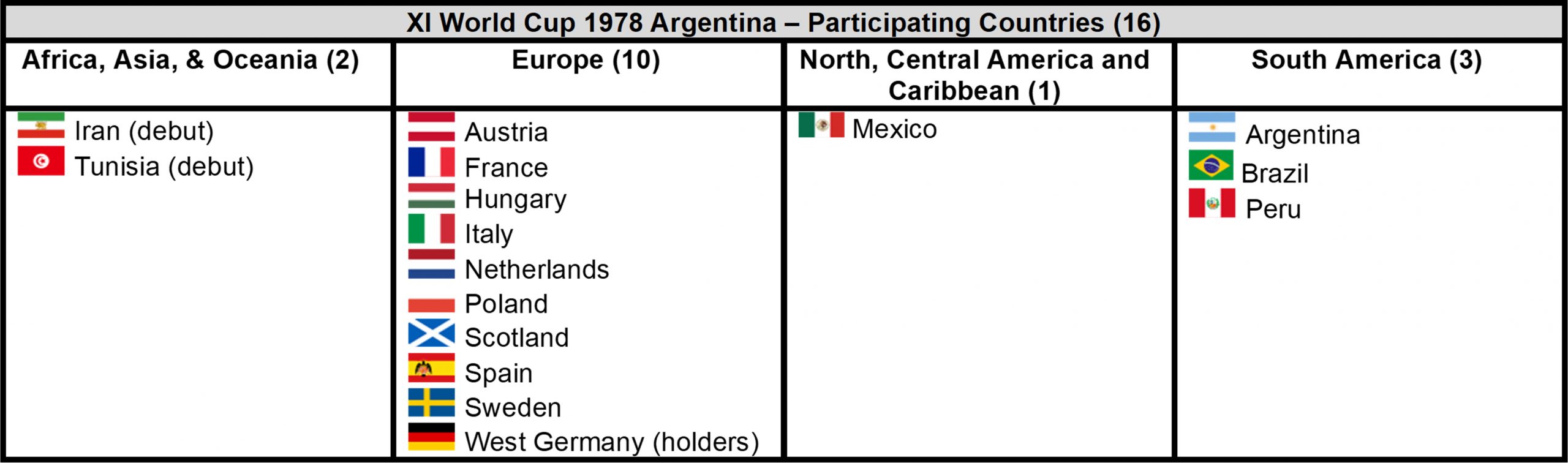
Table courtesy of Jose F Guerra
The Tournament
In 1972, eight venues had been identified for the World Cup, with five promised new stadiums. However, just six were used because two of the new venues were affected by internal conflicts (including intense guerilla and Armed Forces battles), with three new stadiums built.
Of the six venues used, the River Plate Stadium in Buenos Aires was the largest and most used venue, hosting nine total matches, including the final. The Olympic Stadium in Cordoba hosted eight matches, the stadiums in Mendoza, Rosario and Mar del Plata each hosted six matches and José Amalfitani Stadium in Buenos Aires hosted three matches — bringing the Argentine capital and largest city’s total to 12, nearly a third of all the matches played. The World Cup Stadium in Mar del Plata was heavily criticized due to its terrible pitch, which was deemed “nearly unplayable.” The Amalfitani stadium in Buenos Aires, which was refurbished with the completion of press boxes and another section of upper stands but was the least used stadium for the tournament, was praised for its very good pitch. Brazil was forced by tournament organizers to play all three of its first group matches in Mar del Plata; there had been rumors and allegations of the organizers deliberately sabotaging the Minella stadium’s pitch to weaken Brazil’s chances of success.
The teams were again placed in four groups of four (teams shaded would proceed to the next stage of the tournament):

Table courtesy of Jose F Guerra
As in previous tournaments, two points would be awarded for a win, one for a draw, and zero for a loss. Additional criteria were added in case of ties in points and goal difference. In the event of teams tied at the end of the group stage in points and goal difference, goals scored would be the next tie breaker, and then drawing of lots. As it turned out, two of these tie breakers would be used to decide the winners of two of the groups.
Group 1 turned out to be the strongest. Argentina was led by Luis Cesar Menotti, “el Flaco” (the skinny one), who emphasized an aggressive offensive side. He had been named as head coach in 1974 but resigned in 1976 after the military coup. Eventually he was persuaded to stay. He controversially left out a promising bright young 17-year-old talent because he deemed him too young to withstand the pressures of the World Cup. That young player was Armando Maradona who would soon light up the soccer world. Italy had rising young stars as well, while France and Hungary were deemed strong squads. Argentina started slowly in its first two games but won them, surprisingly falling in their last group stage game to Italy 1-0. That defeat would be a blessing in disguise as they went into the next stage of the competition. Italy would top the group, shocking the world because while they had a good team, they weren’t considered a favorite.
In Group 2, the pundits expected West Germany to cruise to first place. But things didn’t start out very convincing for the reining champions. Their first match, against Poland, ended in a scoreless draw. This gave both Mexico and Tunisia motivation to win their match against each other to grab first place. On a personal note, I expected Mexico to pass since a) the team had cruised in its qualifying matches, running over every team and b) the team had obtained impressive results in various friendlies and preparation games in Europe. In a result that shocked the world, Tunisia defeated Mexico 3-1 (while becoming the first African team to ever win a World Cup game). Next, West Germany pummeled Mexico 6-0 and Mexico also lost its final match against Poland, 3-1. But West Germany could only muster a 0-0 result against Tunisia. Poland would win the group.
Group 3 had one of the tournament’s favorites, Brazil. But this was not the Brazil of 1974, let alone 1970. While the talent was still very good, they didn’t have the firepower and impressive teamwork that previous versions of “la Verde‑Amarela” (the Green-Yellow as they are also known for the colors of their country’s flag) had shown. In addition, there were internal clashes between their head coach, Coutinho, and one of the team’s stars, Rivellino (a holdover from the great 1970 team). The lack of firepower showed as they struggled to score and wound up second in the group behind the surprising Austrians on goal difference. Brazil only scored two goals and had one against, but Austria also did not score much, tallying three goals for and two against. Because Austria scored three goals, compared to Brazil’s two in the group stage, Austria was the winner of the group. Brazil was undefeated in the group but had to settle for second place.
Group 4 included the 1974 runner-up, The Netherlands, who were still playing their signature total football. However, without their dominating and charismatic Johann Cruyff (who had retired from playing on the national team) they were not as dominant as they had been. However, they were still the favorites to win the group and one of the favorites to win the World Cup itself. They easily beat Iran but then tied with Peru and shockingly, lost against Scotland. Iran didn’t win a game but did manage a 1-1 draw against Scotland. This mix of results created a three-way tie in the group with goal difference determining the second place. Peru, to the surprise of the experts, topped the group, with The Netherlands coming in second, ahead of Scotland.
As with 1974, the next stage of the competition would not have a straight knockout format. The eight teams that had qualified for the next round would be placed in two groups of four, with the first-place teams of both groups advancing to the final, while the second-place teams would meet for the 3rd and 4th place match.
Group A would be an European affair while Group B would have three South American teams (coincidentally, the three teams that qualified for CONMEBOL) plus the surprising Poles.
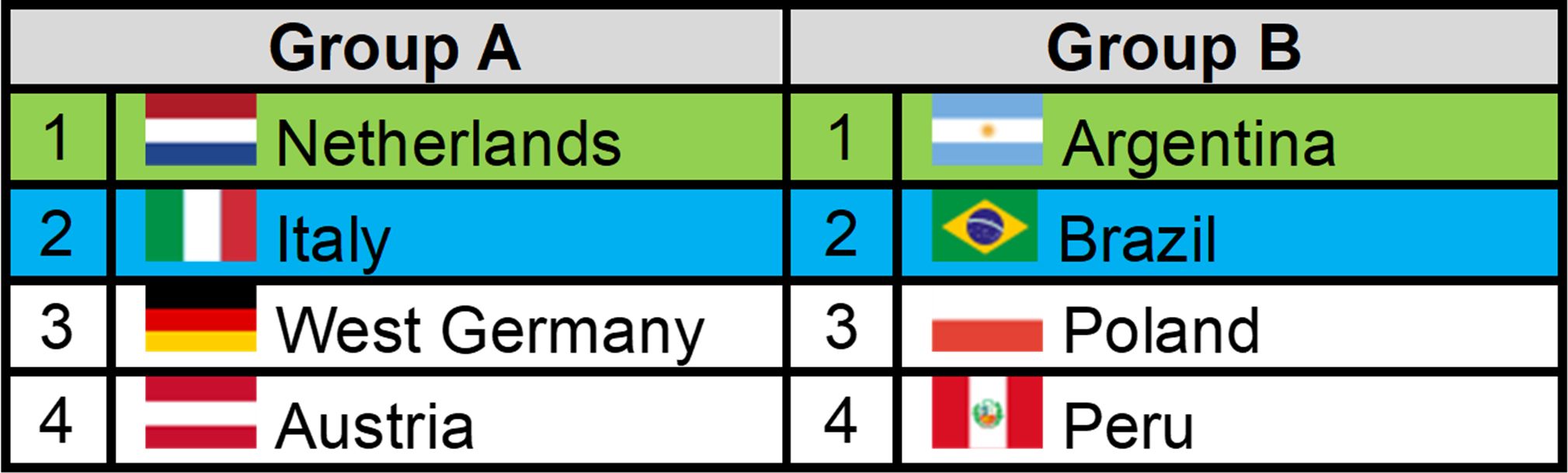
Table courtesy of Jose F Guerra
The Netherlands again showed off their total football prowess by defeating Austria 5-1 while West Germany could only obtain a scoreless draw against Italy. The Dutch then faced off against the West Germans, a highly anticipated match given their final match in 1974, won by West Germany. The Dutch had six players left from their 1974 squad. The West Germans were without their captain, Der Kaiser Beckenbauer, having retired from international play. They also didn’t have Gerhard Müller, who had also retired from international soccer. Nonetheless, the two teams played one of the more exciting matches of the tournament, ending in a 2-2 draw. Italy took care of Austria 1-0 and set the stage for a showdown between the Azurri and the Dutch to determine the winner of the group. Italy had the support of most of the fans due to the large Italian immigrant population of Argentina. And they got ahead early in the game to the delight of the fans. But the Dutch fought back as the game became increasingly physical and the referee (who by coincidence had been a linesman during the 1975 final between these two teams) had to warn both teams. Eventually the Durch tied the game and went ahead with 14 minutes left, leaving the final score 2-1 and ensuring The Netherlands a place in the final for the second tournament in a row.
In Group B there would be drama, not just because old rivals would square off, but also because they knew each other very well. This was due to their regional tournaments as well as certain dislikes such as the one between Brazil and Argentina. In addition, one result in particular would raise eyebrows during the tournament and is still the talk of what exactly happened in that game. Both Brazil and Argentina won their first group matches, 3-0 against Pero and 2-0 against Poland respectively. Argentina’s next match would be against their arch-rivals, Brazil. The match ended 0-0 but it was marred by violence on the pitch. The winner of the group would come down to the last two matches, Brazil against Poland and Argentina against Peru. Because the calendar has been set months before, Brazil would play Poland first and then Argentina would play its match against Peru. The Brazilian protested that it would give Argentinians an unfair advantage because they would know the result beforehand and therefore would be able to change their tactics accordingly. Brazil won 3-1 which meant that Argentina would need to win by at least four goals to advance to the final. To the delirious delight to the entire Argentinean nation, their team won 6-0 and would now advance to the final.
This game has been the subject of much speculation. While there is no concrete evidence that the match was fixed, there were enough coincidences that raised eyebrows back then and that continue to fuel speculation as to the role of the Argentinian military junta (who desperately needed Argentina to win the Cup), supposedly grain shipment agreements between the two countries, the documented visit of Videla to both dressing rooms, and other bits of information, including a sworn statement by a retired Peruvian politician who said the game had been fixed.
I mention this not to create more speculation but to highlight a key talking point about this tournament that continues to this day; it shows how the beautiful game has been embroiled in political controversy from the start, with some tournaments having a bigger impact than others.
The Final
The mood in Buenos Aires the morning of June 2th, 2978, was one of excitement coupled with anxiety. Would the Albiceleste finally deliver on that much desired world championship, or would they again be left on the outside looking in? The last time they had been in a final was in the inaugural tournament in 1930, playing against their rivals from across the river, the Celestes, or Uruguay. And they lost 4-2 in Montevideo, Uruguay. Would they suffer the cruel fate of Brazil in 1950 as the hosts fell in Maracaná stadium, also against Uruguay? Would The Netherlands search for redemption after losing the final four years before be too much for them to overcome?
The game was tense even before it started. Argentina delayed its appearance on the pitch for five minutes in an attempt to throw the Dutch players off balance. The Dutch players protested but the Argentine players in turn protested that René van de Kerkhof was wearing a cast and that he had done it on purpose (even though the player had worn it for several games already due to an injury); the referee forced Kerkhof to put an extra bandage on it, much to the anger of the Dutch.
Argentina struck first in minute 38 to the delirious delight of the 71,000 in the Estadio Monumental in Buenos Aires. Their lethal striker, Mario Kempes, El Matador, had done the honors, shooting 12 yards from the Dutch goalkeeper. The game ended 1-0 in favor of Argentina at the end of halftime. In the second half the Dutch attacked in waves, trying to break down the well-disciplined Argentina backline. Eight minutes from the end of the game, Netherlands tied it up when a cross from van de Kerkhof found substitute Dick Nanninga, who scored. The game seemed to settle into a tense back and forth as both teams were trying to prevent a mistake from handing the game to their opponent. Then with practically no time left a long pass from a Dutch midfielder gets through the Argentine backline. Dutch defender Wim Rijsbergen pounced on the ball trying to reach it as Argentine goalkeeper Fillol came out trying to desperately close the angle. Rijsbergen managed to kick the ball, making it bounce once off the ground and heading toward the Argentina net, only for the ball to hit the post, and then cleared by Argentina. A couple of more inches and the Dutch would have been crowned world champions.
The game went into overtime. Even as I watched the game on TV, you could feel the passion and the intensity of the fans in the stands, cheering on their nation. That passion exploded as Kempes again scored in minute 105 to put Argentina ahead 2-1. But Argentina was not done. With Menotti still yelling at his players to move forward, they scored a third, with a pass from Kempes to his teammate Bertoni. If the Argentine fans had exploded when they first went ahead, now there was delirium, for surely they would finally get that long awaited, and what they believed, deserved world championship. The final score was 3-1 and the Dutch had again fallen short.
The Dutch players did not attend the awards ceremony in protest for having forced van de Kerkhof to wear that extra bandage. But the elation of the Argentine players was one of joy, relief, exhaustion, but pride. They had finally proved to themselves, their nation, and the world that they were the best in world soccer.
Despite the rumors of fixed matches, decisions that favored the hosts, and many other conspiracy theories, there is no doubt that Argentina had one of the best squads in the tournament. They benefited from a very talented group of players, a coach whose philosophy was to aggressively attack while maximizing the talents of each and every one of his players, the support of their passionate fans, and some lucky scheduling. They were a worthy champion but unfortunately, like England in 1966, they will always be haunted by what occurred on and off the pitch.
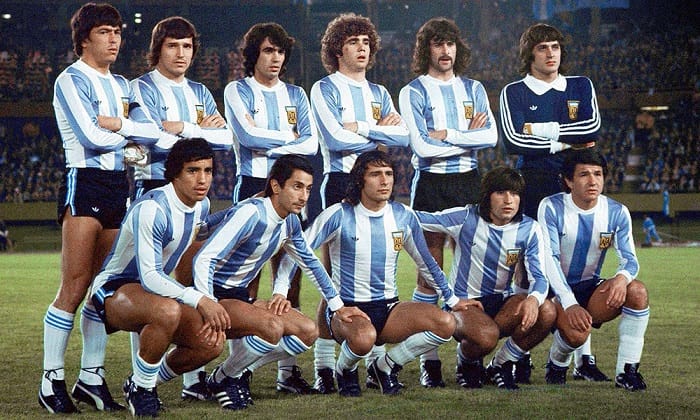
1978 World Cup – Argentina lineup before the final against The Netherlands, source El Gráfico
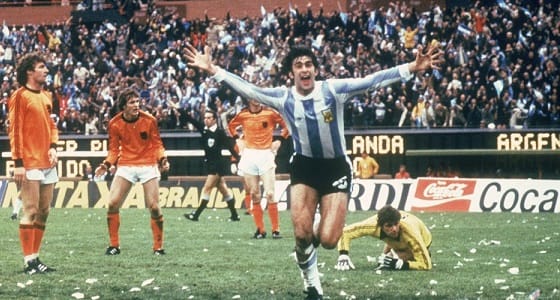
1978 World Cup, Mario Kempes scores against The Netherlands in the final, source El Gráfico
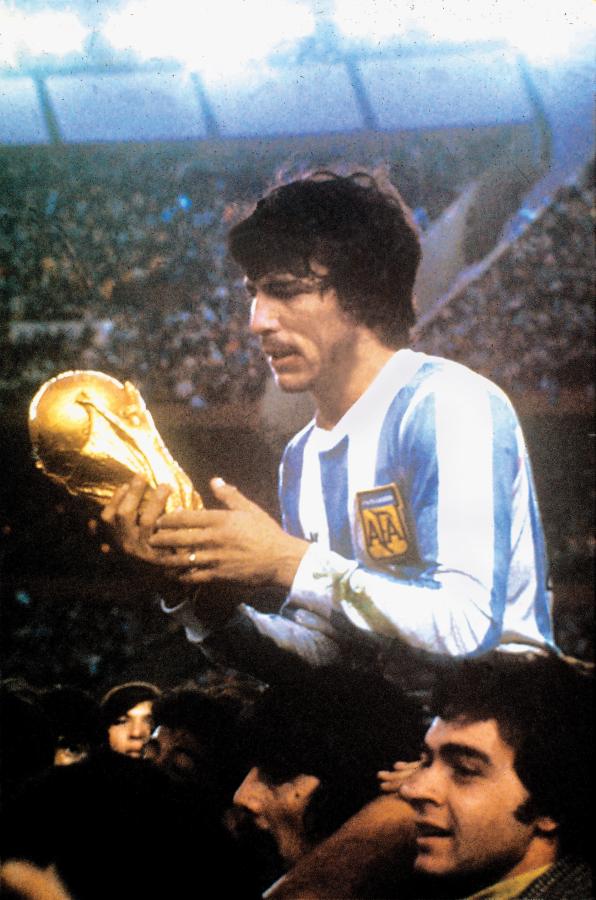
1978 World Cup, Argentina captain Daniel Passarella hold the FIFA World Cup Trophy, source El Gráfico
Tournament Firsts
- First title for Argentina
- First appearance by Iran & Tunisia
- First African win, with Tunisia beating Mexico 3-1
- First broadcast to 100+ countries
- First time an undefeated team that made it past group stage went undefeated and didn’t win the cup (Brazil)
Relevant Players
- Mario Kempes (Argentina) – Top scorer of the tournament with 6 goals (Golden Boot).
- Rob Rensenbrink (Netherlands) – Scored 5 goals, including 4 penalties, making him one of the tournament’s most dangerous forwards.
- Teófilo Cubillas (Peru) – Scored 5 goals, tied with Rensenbrink, one of the standout playmakers of the entire tournament.
- Hans Krankl (Austria) – Scored 4 goals and led Austria to one of its strongest World Cup showings.
- Dirceu (Brazil) – Scored 3 goals and was one of Brazil’s best performers in 1978.
- Paolo Rossi (Italy) – Scored 3 goals, showing early signs of the form that would eventually make him a 1982 World Cup legend.
- Władysław Żmuda (Poland) – Centre‑back and the core of Poland’s defense that advanced to the second group stage; a calm, commanding presence at the back.
- Marius Trésor (France) – Centre‑back elegant stopper and captaincy figure at the back; an ever‑present defensive pillar in their return to the World Cup.
Next up, Spain would host an expanded World Cup, from 16 teams to 24 teams, and witness the “best team ever to not win a World Cup.”

Recommended for you