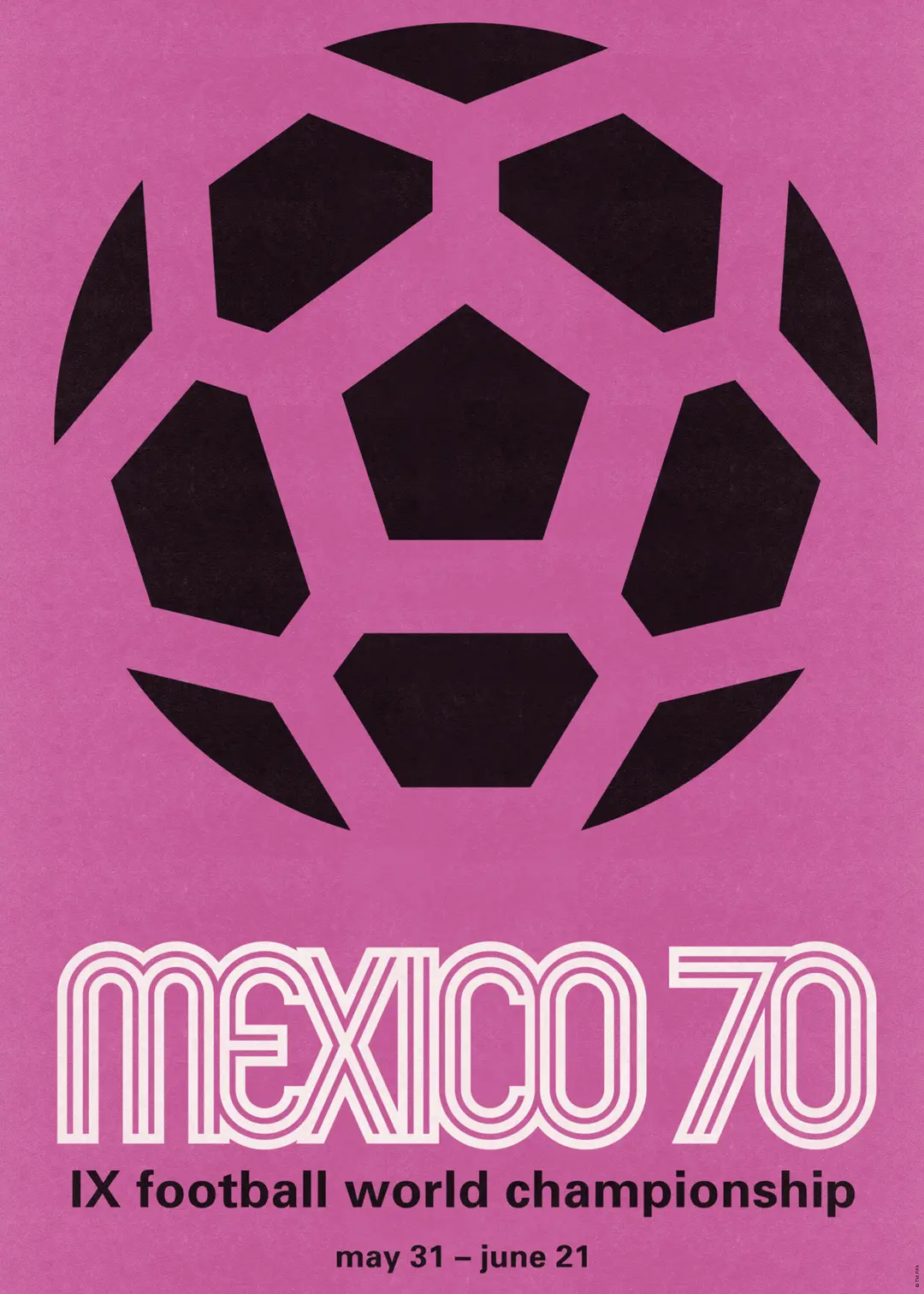
Official poster, FIFA World Cup Mexico 1970 — design by Lance Wyman.
This article is a part of our series covering the history and evolution of the FIFA World Cup. This history is a bit longer than the others ones because it holds a very special place in my life. I will explain at the end but for now, I hope you enjoy it.
For the first time, the World Cup would be held outside of Europe or South America, with Mexico winning the bid against Argentina. There were many doubters given the still prevalent Eurocentric thinking and doubts about Mexico’s organizational and infrastructure capabilities. Critics inside and outside FIFA questioned whether Mexico would be able to upgrade stadiums in time, improve transportation, handle unprecedented attendance and media requirements, and support the first truly global color‑televised World Cup. Another consideration that made countries doubt about Mexico holding a successful tournament was the altitude and prevalent heat during the summer months. But the final vote was 56 votes for Mexico and 32 for Argentina.
Controversies would again overshadow the tournament before the event. There were threats of boycotts and withdrawals due to Israel (Arab and Muslim countries refused to recognize them) and Rhodesia (Arican nations didn’t want to play against an apartheid state) competing during qualifying. A war was fought in Central America between two countries over the result of one of the qualifying games (yes, it sounds like something out of a farse, but it did happen). Two years before the competition, student protests in Mexico City were crushed by combined forces of the Mexican Army, SWAT teams, and a specially trained battalion that would protect the athletes during the 1968 Summer Olympics, putting serious doubts about Mexico hosting the 1970 World Cup. Argentina accused FIFA of “rigging” the bid selection because Mexico had aggressively lobbied the African and Asian nations to vote for Mexico instead of Argentina.
Despite all this turmoil, the IX World Cup would become one of the most memorable in the history of the tournament. While the altitude and heat did affect some teams, for the most part they all prepared for the geographic and weather conditions. Some of that was spill-over from how European teams had physically pushed around non-European ones during the 1966 World Cup. But much of that preparation was due to advances in physical fitness science, tactical preparations, better information available about other teams’ capabilities, and the beginning of the true globalization of the sport.
Television signals would go out in color for the first time to a global audience. A more vibrant view would now allow a the world to watch different styles clash, be dazzled by individual play, witness some of the greatest games ever played in World Cups, and experience one last time the magic of “O Rei Pelé” (King Pelé). It would also be the last time that the tournament competed for the Jules Rimet Cup which would be replaced by a different trophy four years later.
Qualifying
Seventy-five teams registered to enter the 1970 FIFA World Cup, with 73 required to qualify (Mexico as the hosts and England as the title holders automatically qualified). Due to rejected entries and withdrawals, 68 teams eventually participated in the qualifying stages, including eight for the first time, to fight for 14 spots. Also, Africa, and Asia were finally guaranteed one spot each instead of having to compete for one spot for both continents. Since Mexico automatically qualified, this meant that CONCAF would have two nations competing from the region in the tournament for the first time.
The distribution by region for all sixteen places, with the host and title holders, was:
- Europe (UEFA): Nine places, one of them went to automatic qualifier England, while the other eight places were contested by 29 teams.
- South America (CONMEBOL): Three places, contested by 10 teams.
- North, Central America and Caribbean (CONCACAF): Two places, one of them went to automatic qualifier Mexico, while the other one place was contested by 13 teams.
- Africa (CAF): One place, contested by 13 teams but FIFA rejected the entries of Guinea and Zaire, leaving 11 teams.
- Asia and Oceania (AFC/OFC): One place, contested by 7 teams (including Rhodesia who was placed in this region after the refusal of other CAF teams to play them due to apartheid policies).
As with the 1966 qualifying rounds, the teams would be organized in groups by soccer confederation, with the top team of every group qualifying for the World Cup. The same points system of two for a win, one for a draw, and zero for a loss was used. If at the end of the qualifying rounds teams were tied in points, a playoff match in a neutral country would be played to determine the winner (neither goal average or goal differential was used as a tie breaker). If that playoff game ended in a tie, then the game would be replayed again, as many times as necessary since there would be no overtime, no penalty kicks, and no coin toss or drawing lots.
Fortunately, there would be no need for a replay of a playoff game. The only official playoff game was between Czechoslovakia and Hungary, with both ending the qualifying stage tied in points. Czechoslovakia won 4-1 and went on to compete in the 1970 World Cup.
There was another “playoff” event but not because two teams were tied. Rather, the Asian (AFC) and Oceania (OCF) regions had to compete for one spot. The winners of those regions had been Israel and Australia, and they would compete in a two-leg format. Israel won at home 1-0 and then tied in Australia 1-1, earning them a spot In the World Cup for the first and only time since then. Shortly after the World Cup, Israel was expelled from the AFC due to political reasons and became part of EUFA.
One very ugly incident occurred during CONCACAF qualifying. Honduras and El Salvador needed a playoff match to determine the winner that would go on to the final round in CONCACAF qualifying. Rising political and land dispute tensions (nothing to do with soccer) between the two countries were coming to a head. After El Salvador beat Honduras in overtime in Mexico City (the playoff required neutral ground), the tensions exploded. El Salvador’s government declared war launched a full military invasion of Honduras on July 14th, 1969. Estimates are that the combined losses of both nations were 1,500 armed forces personnel and 2,000 civilians. A very sad, maddening, and inexplicable chapter which is no known as “the football war.”
The final list of countries that qualified was as follows:
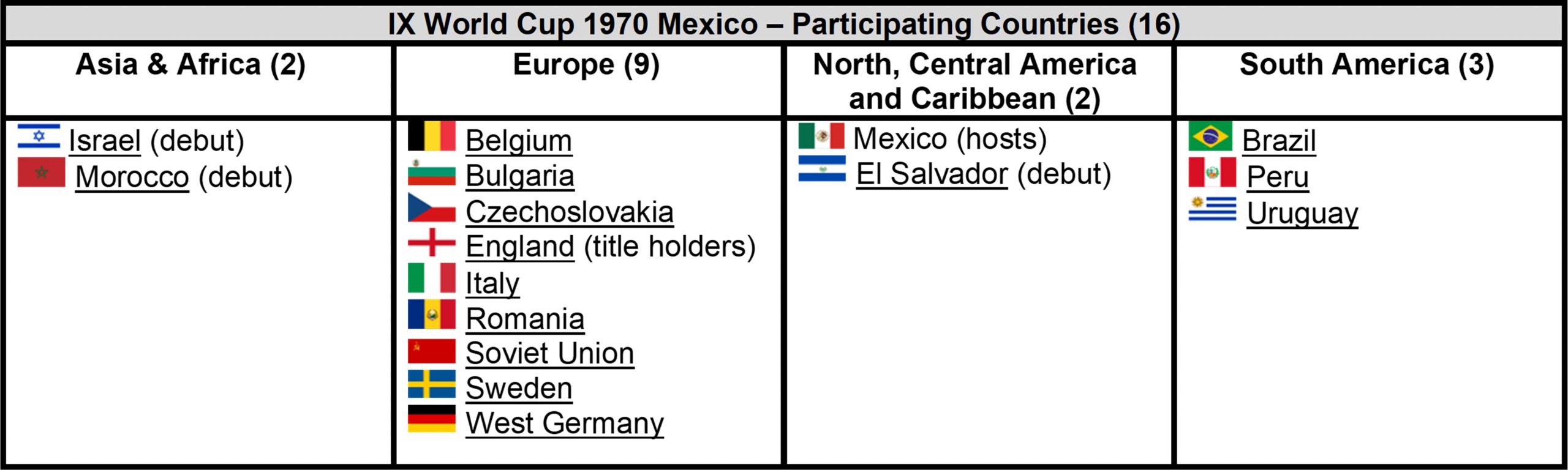
Table courtesy of Jose F Guerra
The Tournament
Mexico used five different cities with five stadiums to host the event. The largest one, which would hold the most games, was the Estadio Azteca in Mexico City with a capacity of 107,247 and the smallest the Estadio Nou Camp in the city of León with a capacity of 23,609. All five venues differed in altitude with the highest one being the Estadio Luis Dosal in the city of Toluca (state of Mexico) at 8,730 ft, and the lowest the Estadio Camp Nou at 5,955 ft. All venues at over a mile high.
Once again, the teams were distributed in four groups of four but with a twist. Because FIFA couldn’t come to an arrangement with all the nations as to which ones would be seeded (as was standard practice), they announced the day of the drawing on January 10th, 1970, that there would be no “pre-seeding” other than England in Group 3 as the title holders and Mexico as the hosts in Group 1. The rest of the 14 qualified teams would be put in pots (for draw purposes) and their composition decided by the FIFA Organizing Committee as they took into account the teams’ strengths and even political considerations. The final structure of the pots ensured that teams grouped within the same pot would not meet each other before the quarterfinals at the earliest.
As before, teams would be awarded two points for a win, one point for a draw, and zero for a loss. The tie breaker would be goal differential. If they were tied in points and goal differential then a coin toss would decide the winner of the group.
The final group draw created what became known as the “Group of Death” as it included England, Brazil, Czechoslovakia, and Rumania, with the first three considered powerhouses. That was the first time that moniker would be used for a group and now almost every World Cup since then has had some type of “Group of Death.”
The drawing produced the following groups with the ones shaded in green advancing to the knockout stages:

Group Stage
Group 1 fixtures were all played in the Estadio Azteca. It saw El Salvador receive a total of nine goals in three games without scoring once. The hosts managed a draw against mighty Soviet Union in the inaugural game of the tournament, then buried El Salvador 4-0, and finally beat Belgium 1-0 in their final group stage game to qualify for the first time in their history to the quarterfinals. Both Mexico and the Soviet Union were tied in points and goal differential. This meant that a coin toss would decide the winner, with the Soviets coming out on top. Mexico would need to play in a different venue other than the Estadio Azteca (where they had played all their group stage games) which would be a decisive turn for the team in the tournament.
Group 2 fixtures were played in the cities of Toluca and Puebla and was the most boring group of them all. Just six goals were scored across all six fixtures with Italy winding up in first place, having scored just one goal in their three games! Uruguay came in second, having scored two goals and received one against. Italy with four points would stay in Toluca while Uruguay would need to travel to Mexico City and face the Soviets. One important injury happened during Uruguay’s first match against Israel. Their star player, Pedro Rocha, was injured in minute 12 and was unable to play the rest of the tournament. While Uruguay made a deep run, their tactical plan relied heavily on Rocha because the squad lacked a true center‑forward, and the team was “armed for Pedro.” He was expected to produce goals from distance, dominate aerially, and carry the scoring load. After his injury, Uruguay struggled to score in the rest of the tournament.
Group 3 saw the most exciting matches, all of which were played in Guadalajara. Above all was the spectacle of Brazil’s “jogo bonito” (beautiful game) which seemed to flow across the pitch with their star players dazzling with individual dribbling, passing, and shooting. Their biggest weakness was in their goalkeeper, but given that Brazil only received seven goals in six games that was a relative one. England as the title holders again showed their tactical discipline, speed, and physicality. Czechoslovakia, the runner ups from 1962, were a disappointment and didn’t win or draw any of its matches. Romania managed to beat the Czechs but were overmatched by both Brazil and England.
The best game of this group was the clash between England and Brazil. It could have gone either way but a brilliant team and individual play allowed Jair to score the lone goal of the match. Earlier in the game, a perfect cross on England’s backline by the same Jair into the box was headed by Pelé in the most perfect way. But as the ball was heading towards the lower right-hand corner of the net, England’s keeper, the great Gordon Banks, somehow managed to dive, hit the ball, and send it straight up and over the crossbar. To his day, Pelé and others on that Brazilian team say it was the best save they have ever seen. Brazil won the group with three wins and England with two. Brazil would stay in Guadalajara and England would travel to the city of León where an old foe would be waiting for them.
Group 4 fixtures were all played in the city of León. The surprising Moroccans gave a strong battle to West Germany and Bulgaria, but were defeated by Peru 3-0. The West Germans, who were the favorites to win the group, surprisingly fell behind in their first two matches against Morocco and Bulgaria, but managed to eventually win those games. Peru was playing with a heavy heart as the day the World Cup started on May 31st, 1970, their country was hit by a devastating earthquake that killed about 70,000 people. It was the worst natural disaster the country had ever experienced. Just two days later they had their first match against Bulgaria and fell behind 2-0 only to come back and win it 3-2. In their next game they beat Morocco 3-0, ensuring their pass to the quarterfinals. Their last match was against West Germany which they lost 3-1 but by then the world had seen a very open and aggressive style of playing that made their matches very exciting to watch. Peru would travel to Guadalajara to face the two-time champions, Brazil. West Germany would stay in León and lie in wait for their nemesis form the 1966 final, the title holders, England.
Quarterfinals
The quarterfinals would see one blowout and three matches whose results went almost to the end.
The Soviet Union faced off against two-time champion Uruguay in Mexico City. The match went into overtime and the South Americans won 1-0 by scoring in minute 117.
Italy met against Mexico in the city of Toluca and overwhelmed the hosts by a score of 4-1. Their famous “catenaccio” style (highly disciplined defensive play) coupled with their fast counter attacks were too much for Mexico.
West Germany had been waiting four years for a replay of the 1966 final in London against England. They and the soccer world were convinced that England won that match through dubious refereeing calls. The match went into overtime after West Germany came back from a 0-2 deficit and the Germans won with a goal by Gerhard Müller in minute 108 to the delight of the ecstatic crowd. It is important to note that the English did not gain the sympathy of their host due to their arrogant and aloof behavior towards the fans and the country in general. This is why in every game they played, the crowd was overwhelmingly in support of whatever team they played against.
Finally, in a festival of scoring, Brazil beat Peru 4-2 but the scoring went back and forth, with Peru still behind 3-2 with 15 minutes left. It was a feast to the eyes to watch two teams with an open style of play, brilliant teamwork, jaw-dropping dribbling, and all out attacks on both sides. One of them had to be eliminated, but Peru left a lasting positive impression because of their style of play and the passion they showed playing for their devastated country.
Semifinals
The semifinals saw three former two-time world champions in Brazil, Italy, and Uruguay, against a one-time winner in West Germany. One way or another, the Jules Rimet Cup would be won by a former champion.
Brazil and Uruguay played what was probably the most physical of the tournament, but not violent. Despite 20 years having passed since the “tragedy of Maracaná,” the Brazilian players were clearly nervous at the start of the match, many of them thinking about that match that had haunted the nation. Matters didn’t improve when Uruguay scored first 19 minutes into the match. But eventually Brazil’s superior skills won the day with the final score standing at 3-1. Of note is that during that match, Pelé made a brilliant play that is still talked about. Around minute 70, Pele received a forward pass and rushed towards it, with the Uruguayan goalie, the best in the world at time, rushing out to cut the angle. Pelé faked him out so badly that the goalkeeper leaned towards his right while the ball went to his left. But Pelé never touched the ball! He went around the goalie, caught up with the ball, and with a wide open net…he missed! The angle was impossible but the play was brilliant in the way he had faked out Uruguay’s goalkeeper.
The other semi-final would prove to be epic. West Germany and Italy travelled to Mexico City for their match. The Italian catenaccio would meet the high scoring German machine. Something would need to give. But what followed would be eventually called the “game of the century.” Italy went about its usual tactical play of defending and counter attacking. Germany attacked in waves as Italy’s defensive positioning held. But Italy scored early in minute eight. The rest of the game would be Germany trying to desperately penetrate Italy’s packed lines. And just as the whistle was about to signal the end of the game, Germany tied with no time left. The Azteca Stadium exploded in joy as most were rooting for Germany after Italy had routed Mexico in their previous game. No one was sure what would happen in overtime but no one was prepared for the dizzying display that both teams would show. West Germany went ahead and then Italy scored twice. The Germans tied the game at three and then Italy would score their fourth with nine minutes left in the second overtime. The final score was 4-3 and while the fans in the stadium were not happy with the result they all realized they had witnessed an extraordinary match.
The stage was set for the final. Two two-time champions with two diametrically opposed styles of play would meet in the final And the Jules Rimet Cup would be permanently won by one of the teams since the founder of the tournament, Jules Rimet, had stipulated that whoever won it three times would win it permanently.
The Final
June 21st, 1970. Two teams, two different styles, one European, the other South American. Both two-time winners of the Jules Rimet Cup. Both still feeling the sting from being eliminated in the group stage four years before in England. Who would prevail?
Brazil dominated from the outset and struck first in minute 18. The score came from a throw-in to Rivelino who then crossed the ball into Italy’s box in a pinpoint manner, and Pelé seemed to levitate in the air as he executed a towering header, defeating both his defender, who tried to block his eyes with his arm, and the Italian goalie, who was considered one of the best in the world. A magnificent showcase of Brazilian teamwork and individual skills. It was also Brazil’s 100th goal in World Cups.
The game settled into Italy trying to use its counter attacks, but Brazil’s lines held. Then eight minutes before halftime, a Brazilian center back tried to backheel a pass sent to him and only wound up giving it to an Italian forward who raced ahead. The Brazilian goalie came out in haphazard manner and Italy scored. The game was tied 1-1 as they went into the dressing room. Once again, Brazil’s suspect backline and goalie had given Italy life before the half.
But in the second half, Brazil hit the accelerator. The combination of their tactical and individual brilliance, the precision in their passing, their dominance in the midfield and forward lines, and the exhaustion of the Italians due to their brutal semi-final game and the heat, was too much. The Brazilian scored three unanswered goals, with the final one considered one of the greatest ever scored. Six different players touched the ball before the seventh scored the fourth and final goal. Pele was the sixth player to touch it and when he passed it to his captain, Carlos Alberto, he didn’t even look where he was. He just knew he’d be there to kick it in from just inside the corner of the box. It was an exclamation point goal to an exclamation performance throughout the tournament.
Brazil had now won the Jules Rimet Cup and would get to keep it. But what would follow four years later in West Germany as that nation hosted the next World Cup would be a revolution unlike anything seen before. The introduction of Total Football.
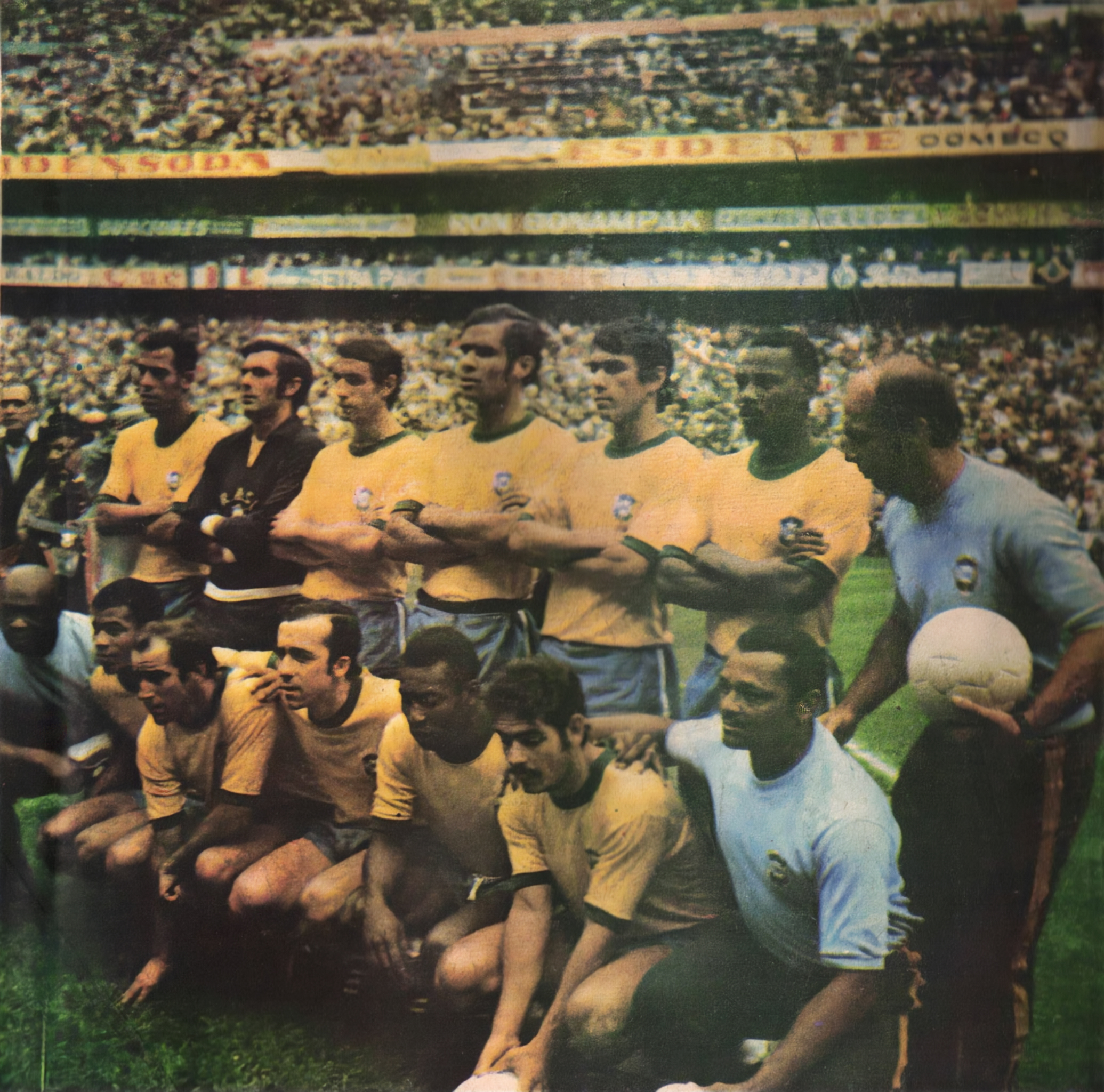
1970 World Cup, Brazil lineup before final against Italy. Source: Diario de Mexico Excelsior.
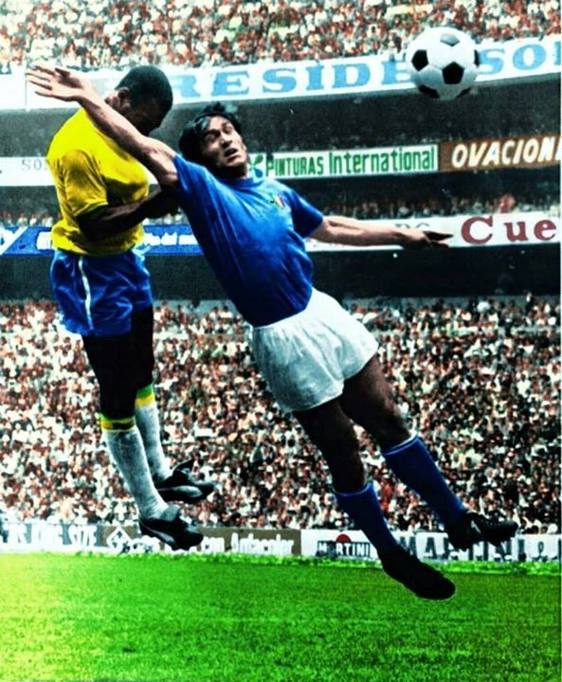
Pelé scores first goal in final against Italy. Source: Diario de Mexico Excelsior.
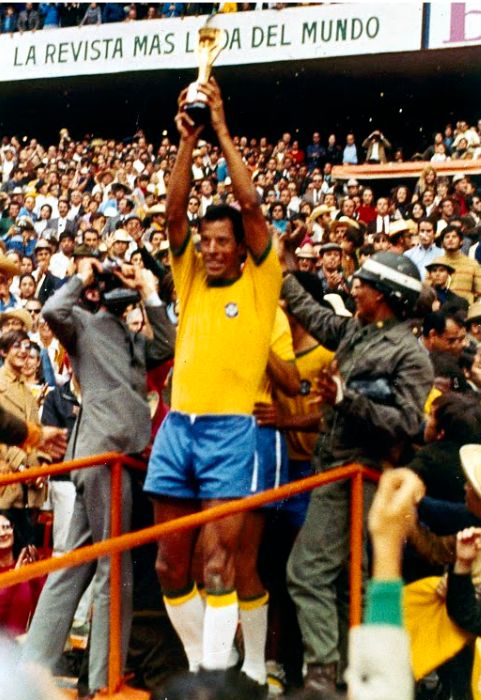
Carlos Alberto lifts Jules Rimet trophy in the Estadio Azteca. Source: Google Arts & Culture / Museu do Futebol.
Tournament First
- First substitute when Anatoliy Puzach of the Soviet Union became in the second half (no substitutes had been allowed in previous World Cups whatsoever).
- The first substitution of a goalkeeper during the Rumania – Brazil match with the Rumanian goalkeeper having that “honor.”
- First World Cup 1970 to be broadcast in color.
- First World Cup with an officially sponsored ball, manufactured by Adidas and called the Telstar.
- First time use of yellow and red cards for caution and expulsions (no red cards were issued during the tournament, a record that still stands).
- First and only time one player from the same team scored in all matches, with Brazilian forward Jair doing the honors.
- First and only time the champion won all matches in the tournament as well as all qualifying matches.
- First time the host team qualified for the knockout stages without conceding a goal (Mexico).
- First time a team won the World Cup three times.
- First and only time five goals were scored in overtime during the Italy-West Germany semifinal.
- First and only time a player won three World Cups (Pelé).
- First and only time that the champion team (Brazil) defeated the European (Italy) and South American (Uruguay) reigning continental champions alongside the tournament’s defending champions (England).
Relevant Players
- Pelé (Brazil) – The architect of Brazil’s legendary attack, the most influential player of the tournament.
- Giacinto Facchetti (Italy) – Captain and defensive cornerstone of the team that reached the final.
- Gerd Müller (West Germany) – Top scorer with 10 goals, including two hat-tricks.
- Teófilo Cubillas (Peru) – Breakout star with five goals and a symbol of Peru’s emotional and successful run.
- Ladislao Mazurkiewicz (Uruguay) – Widely considered the best goalkeeper of the 1970 tournament.
- Bobby Moore (England) – England didn’t repeat as champions, but Moore was arguably the best defender in the entire tournament (especially against Brazil).
Some Personal Thoughts
Before I end this history, I wanted to first express a couple of thoughts.
First of all, thank you to those who have been reading these histories and for your positive and encouraging comments.
Second, this particular World Cup holds a special place in my life for two reasons:
- It was the first one I ever watched. It was mesmerizing as a young teenager to watch the magic of Pelé, the Brazilian samba-like “Jogo bonito,” the relentlessness of the West Germans, the tactical brilliance (albeit not very exciting) of the Italian “Catenaccio,” the wide open play of the Peruvians, the euphoria of an entire Mexican nation as the team progressed for the first time to the quarter finals, watching the game of the century between the Italians and the West Germans, and seeing the Brazilian captain lift the Jules Rimet Cup which would be forever in Brazil’s possession.
- I watched the opening game on TV of that World Cup on May 31st, 1970, one day after learning that my father had passed away from cancer. I don’t remember much of that game and it’s a blur as to what I was feeling. I do remember slowly enjoying the rest of the tournament and creating in my mind images of games, players, results, and key plays that will forever be with me, even if it was in the shadow of a great loss to me, my siblings, and my mother.