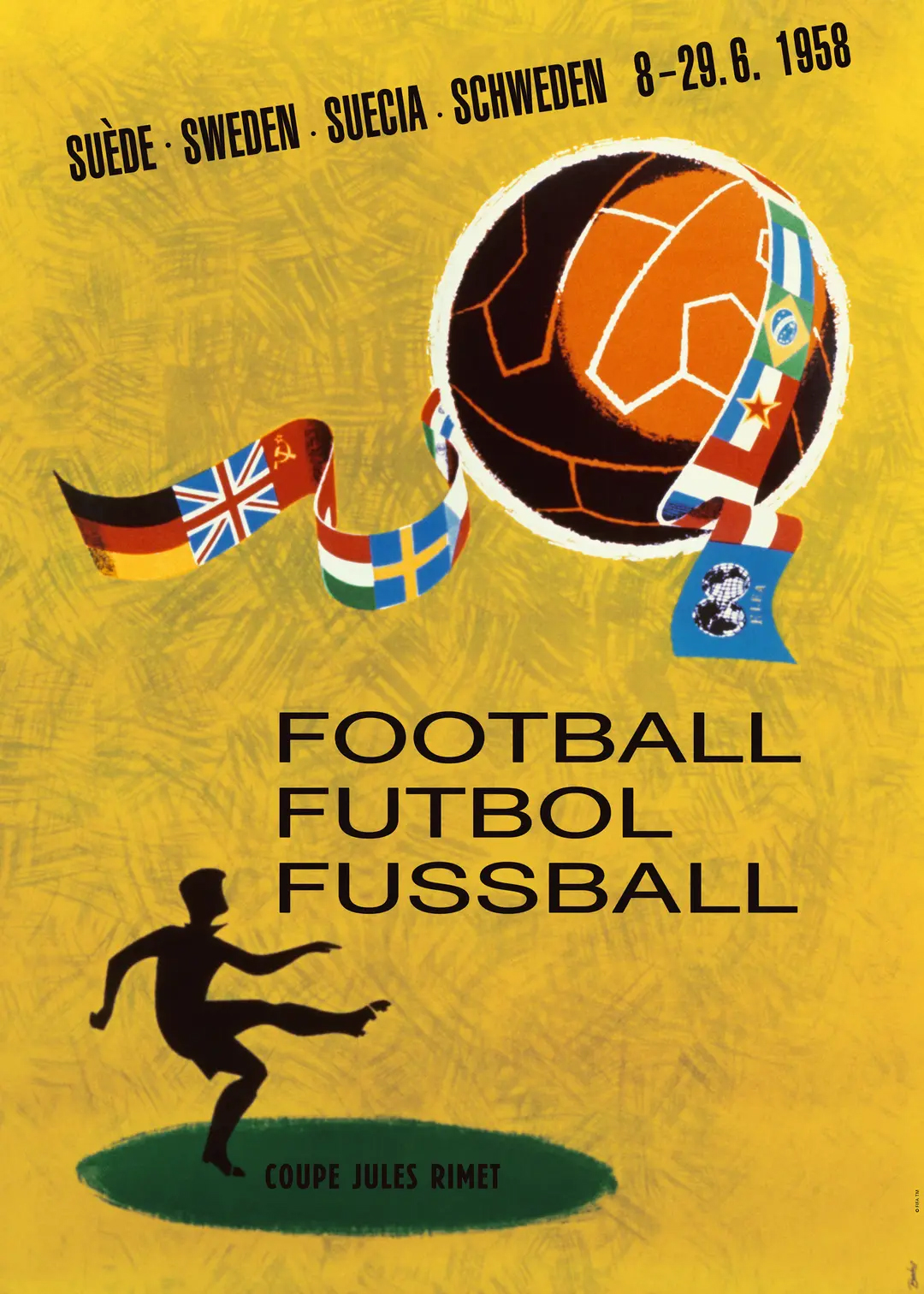
1958 Switzerland World Cup Poster (design by Beka, source Public Domain)
This article is part of a continuing series about the history and scope of the FIFA World Cup.
Argentina, Chile, Mexico, and Sweden expressed interest in hosting the 1958 tournament. In the end, Sweden was awarded the tournament unopposed on June 23rd, 1950. This caused anger in South American soccer confederations because, once again, the championship would be held on the European continent two times in a row. It was after that decision that FIFA finally decided to alternate the tournament between the European and American continents.
As in previous tournaments, there would be controversy and surprises before and during the event. There was also a tragedy that deeply affected one of the British Isles teams. As the world got to know more teams, clear favorites started to emerge. These included:
- Brazil for their devastating attack and flair.
- West Germany as the defending champions.
- Hungary because they were still seen as a world powerhouse for innovation and scoring.
- Soviet Union (USSR) as winners of the 1956 Olympic gold medal known for their discipline, athleticism, and tactics
- England as they were considered a strong team based on reputation.
- Argentina as they had historically been dominant in South America and had won the 1957 Copa América with a phenomenal attack.
The tournament would also see the emergence of a super star who would go on to become the greatest player in the sport the world had ever seen. His 5’8″ height and thin frame made it look like he would not be a threat, given the European teams’ height, weight, physicality, and athleticism. But he would confound everyone and would become an instrumental piece in Brazil’s attack and fluid style of play.
Qualifying
The qualifying rounds for the four previous World Cups had differed widely, with controversial rules and many withdrawals. This VI edition of the World Cup would have 55 teams interested in participating, with 16 eventually qualifying. It was because of this that FIFA divided qualifying into separate geographic regions given the larger number of teams. From this tournament onwards, FIFA divided the teams into several continental zones, assigned a pre-determined number of places in the final tournament to each zone, and delegated the organization of the qualifying tournaments to its confederations. In 1958, these zones consisted of:
- UEFA (Union of European Football Associations) for European teams
- CONMEBOL (Confederación Sudamericana de Fútbol) for South American teams
- NAFC (North American Football Confederation) for Canada, US, and Mexico
- CCCF (Confederación Centroamericana y del Caribe de Fútbol) for Central American and Caribbean teams
- CAF (Confederation of African Football) for African teams
- AFC (Asian Football Confederation) for Asian teams
The OCF (Oceania Football Confederation) which did not exist at the time would eventually include Australia, New Zealand, Papua New Guinea, and several other island states but in 1958 they had not been certified by FIFA or did not have a national team.
The different qualifying zones were distributed in the following way:
- Europe (UEFA) was assigned 11 places, with two of them automatic qualifiers in Sweden (the host nation) and West Germany (defending champions), with the other nine places contested by 27 teams.
- South America (CONMEBOL) was assigned three places, contested by nine teams.
- North America, Central America and the Caribbean (NAFC/CCCF) were assigned only one place contested by six teams.
- Africa (CAF) and Asia (AFC) were assigned only one place and contested by 11 teams (including Israel, Cyprus and Turkey).
However, FIFA also imposed a rule that no team would qualify without playing at least one match because many teams qualified for previous World Cups without playing due to withdrawals of their opponents. Israel had won the African and Asian zone because the teams refused to play against due to their nations not recognizing the existence of Israel as a sovereign nation. FIFA then required Israel to enter a play-off against a team from Europe who initially did not qualify, with the winner of this play-off qualifying. That team was Wales and to this date remains the only team in World Cup play to have been eliminated and then eventually qualify.
With Wales, all four teams from the so-called “Home Nations” (called that way because they were the first nations in the world to create soccer federations) of England, Scotland, Wales, and Northern Ireland all qualified for the tournament for the first and only time since.
Surprise eliminations during qualifying included Uruguay, Italy, Spain, and Austria through losses of key games; Turkey by withdrawal since they were placed in the CAF/AFC group and they, legitimately, protested that they instead belonged in UEFA; and, Egypt, Sudan, and Indonesia were disqualified for refusing to play against Israel.
The following 16 teams qualified for the 1958 World Cup tournament:
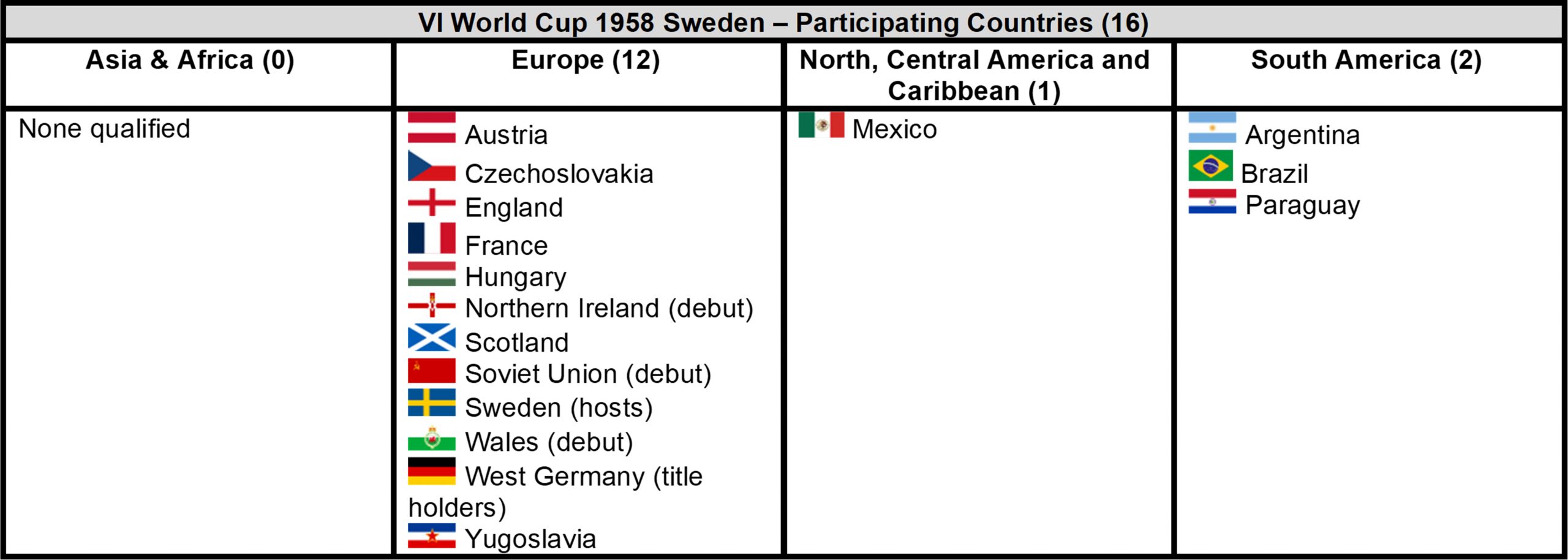
1958 World Cup Participants, table done by Jose F Guerra
The Tournament
The 16 teams were again grouped into four groups of four, with each group having nations from different geographic areas: one Western European team, one Eastern European team, one British Home Nation team, and one team from the Americas. The matches would be played in twelve cities in Sweden. The final would be played at the Råsunda Stadium in the capital city, Stockholm.
For the first time, the teams would play a round robin during what is now known as the group stage. A win gave the team two points, a tie one point, and a loss zero points. AS with the previous World Cup, if second ad third place were tied in points at the end of group play, a playoff game would be held between those two teams. If at the end of the playoff game they were still tied, goal average would be used to determine the winner.
The group stage produced some shocking results, the most prominent ones being Northern Ireland, who were making their debut, beating powerful Czechoslovakia 1-0 in group play, Argentina losing 1-6 against Czechoslovakia, Wales tying 1-1 against Hungary, Paraguay defeating Scotland 3-2, and Austria tying 2-2 against England. This last result would be a consistent theme for the English team of underperforming in World Cups despite high expectations.
Of the four groups, three required playoffs to determine the second-place team. These matches were Northern Ireland vs Czechoslovakia (with the Northern Irish again defeating Czechoslovakia only this time by a score of 2-1), Wales vs Hungary (with Wales winning 2-1), and the Soviet Union vs England (with the USSR beating England 1-0).
Unfortunately, all three teams that won their playoff matches wound up being eliminated in the next match in the knockout round because they did not have enough time to recover. This would cause the tournament to again change and go strictly by goal average in the next World Cup in the event there were tied teams at the end of group stage.
The eight teams that qualified for the next round were Brazil, Wales, France, Northern Ireland, Sweden, USSR, West Germany, and Yugoslavia. Brazil and Sweden would play the final but their route to that game was somewhat different in degree of difficulty.
Brazil had the rougher route since they had to play a very stubborn Wales (but they did have the advantage of Wales having played an extra game) and a very tough France who eventually had the scoring champion of the tournament in Just Fontaine. Sweden had an easier route facing an exhausted Soviet Union (due to their extra playoff game) and a depleted West Germany.
It would be remiss to not mention a star that was born during this World Cup. A teenager who would not play until the third game of group stage, but who would dazzle the world with his incredible all-around skills: 17-year-old Adson Arantes do Nascimento, universally known as Pelé. His abilities astounded everyone that watched him. He could dribble in ways that defied logic. His passes were pinpoint. His shots were powerful and uncannily on target. And his individual play would leave opposition players wondering what had just happened as he left them behind. He would only get better as the years passed, culminating in an extraordinary show of dominance in the 1970 World Cup, which would be his last one.
Some of the firsts in this tournament were:
- First Nordic Host
- First World Cup appearances by Wales, Northern Ireland, and the Soviet Union
- First (and only) time where all four Home Nations teams (England, Scotland, Wals, and Northern Ireland) competed
- First time Italy failed to qualify (beginning of an up and down performance during qualifying and World Cup competitions for the Azzurri)
- First scoreless draw (England and Brazil played to a 0-0 draw) in group play
- First time Brazil won a World cup
- First major use of the 4-2-4 tactical lineup
- First time a single player, Frenchman Just Fontaine, scored 13 goals, a record that has yet to be beaten
The Manchester United Tradegy
On February 6th, 1958, Manchester United was returning to England after playing a match in the European club championship tournament. Their plane stopped in Munich to refuel and due to weather conditions attempted three times to take off. On the third try it crashed. Manchester United at that time supplied several core players to the England team. The crash killed eight Manchester United players, several of whom were prominent England internationals or strong national‑team prospects. These included club captain Roger Byrne, highly regarded midfielder Eddie Colman, striker Tommy Taylor, and the extraordinarily gifted Duncan Edwards, who survived the crash but died 15 days later. The loss of these players removed some of England’s most talented and experienced footballers during a critical phase of international competition. This affected the performance of England during the 1958 World Cup and even thought they were eliminated in the playoff game against the USSR, they still managed to obtain three draws in group play. But one of the survivors of that crash, Bobby Charlton, would eventually help England reach the pinnacle of the sport.
Relevant Players
- Pelé (Brazil) – the 17-year-old phenom of the tournament, scoring in the quarterfinal, a hat‑trick in the semifinal, and twice in the final (including a mind-boggling pass to himself over the head of a Swedish defender and then a pinpoint shot for his first goal in the final)
- Just Fontaine (France) – The French striker set the still‑standing record for most goals in a single World Cup with 13 goals in 1958.
- Agne Simonsson (Sweden) – One of Sweden’s standout forwards, he scored 4 goals and played a key role in helping the hosts reach the final
- Helmut Rahn (West Germany) – Contributed six goals during the tournament, remaining a major attacking force for the defending champions
- Peter McParland (Northern Ireland) – A crucial figure for Northern Ireland, McParland scored 5 goals, helping his nation make an impressive debut run
- Lajos Tichy (Hungary) – He delivered four goals and was Hungary’s most dangerous attacking player during the group stage
The Final
Both teams’ usual colors were yellow so a draw was arranged to decide who would get to wear their team colors. Brazil refused to attend the drawing, so Sweden won and chose yellow. Brazil was going to wear white, but the players remembered that in 1950 the home team, Brazil, wore white in the final and lost against Uruguay 201 in the famous “Maracanaço.” The staff eventually bought 22 blue T-shirts and sewed the Brazilian emblem on them.
There was great expectation because while Brazil had dazzled with their free-flowing play and individual brilliance, Sweden had shown an organized team shape, simple and effective passing sequences, direct attacks down the wings, and an emphasis on collective discipline over individual creativity. In other words, two very different styles of play: a European no-nonsense approach and a Latin-flavored “jogo bonito” (beautiful game in Portuguese).
The stadium was packed. The Swedish monarchs, King Gustaf VI Adolf and his wife Queen Louise Mountbatten, were in attendance and even walked down to the pitch to shake hands with each player from both teams.
Sweden took the lead in the first minute after an excellent finish by captain Nils Liedholm. The lead did not last long, as Vavá equalized just 5 minutes later. On 32 minutes, Vavá scored a similar goal to his first to give Brazil a lead 2–1 at the break. In the second half, Brazil started to further control the game through its masterful weaving of plays, moving the ball around, showing the collective brilliance of their free-flowing style, and confounding the Swedes with their individual dribbling. Ten minutes into the second half, Brazil went further in front thanks to a brilliant goal scored by Pelé. He took control of the ball inside the penalty area, chipped the ball over the defender then smashed it past a helpless Kalle Svensson. Halfway through the second half Brazil went 4–1 up with a goal scored by Mário Zagallo. Simonsson pulled one back for Sweden with 10 minutes remaining but it was far too late. Pelé sealed the 5–2 victory for Brazil with a headed goal in stoppage time.
Brazil were now world champions and had achieved that which they had wanted for so long. After the humiliating blow of losing the final at home in 1950, the ghosts had been exorcised.
Three curious details from the final that get lost in the admirations and celebrations of this Brazilian soccer milestone were:
- When the Brazilian captain, Hilderaldo Bellini, lifted the trophy, he was not doing it to celebrate. Rather, a reporter had asked him to lift it so he could take a picture. This started the now well-known image of World Cup champions’ captains lifting the cup above their heads.
- Brazil’s longtime masseur, Mário Américo, famous for his colorful personality, stole the ball from the referee’s hands at the end of the game (he would so again in another tournament, but we will mention that in the next World Cup history).
- Pelé recalled that when Brazil lost the final in 1950, he saw his father cry for the first time in his young life, so he promised him he would one day win a World Cup for him (his father was still alive and saw his son fulfill his promise).
Our next history will take us to Chile, where the country was hit by a devastating earthquake two years before the tournament.
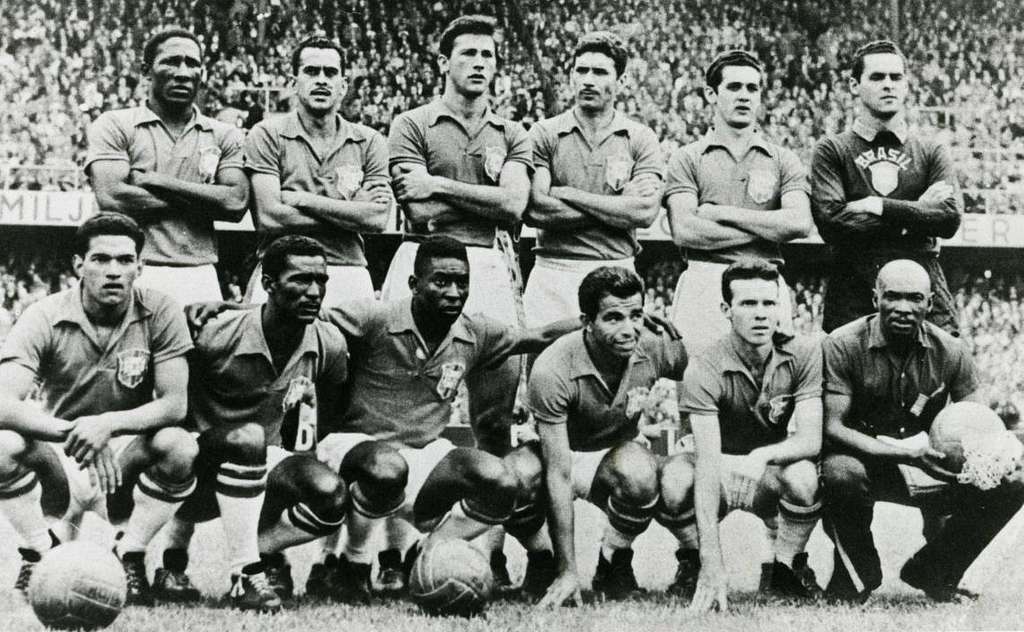
The Brazilian team before the final match against Sweden (Photo by Popperfoto via Getty Images.)
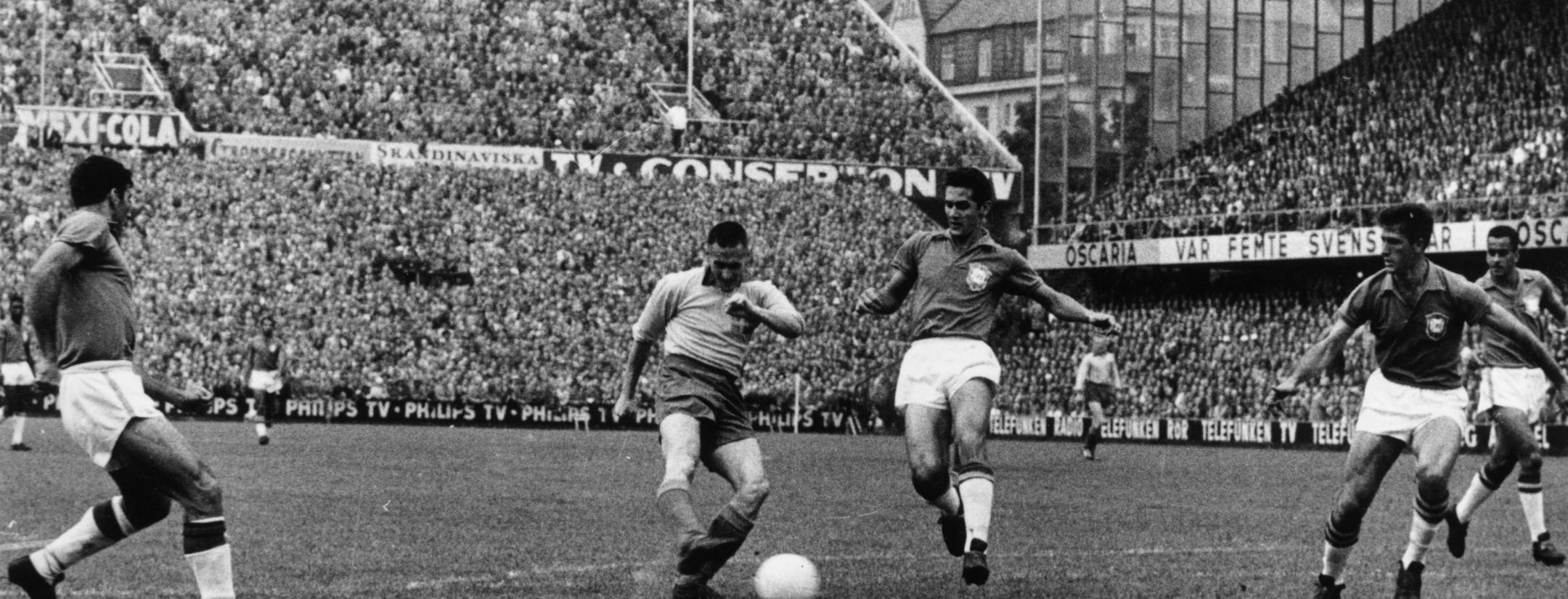
Action during the 1958 World cup final between Brazil and Sweden (Photo by Popperfoto via Getty Images)
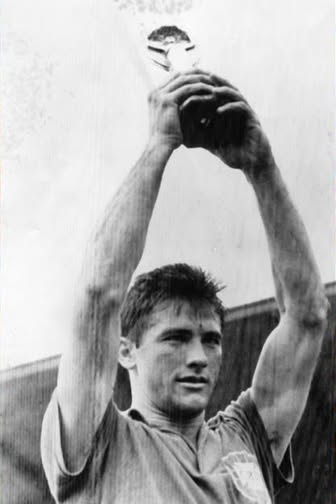
Brazilian captain, Hilderaldo Bellini, lifting the Jules Rimet trophy (Photographer unknown, source Public Domain)

Recommended for you