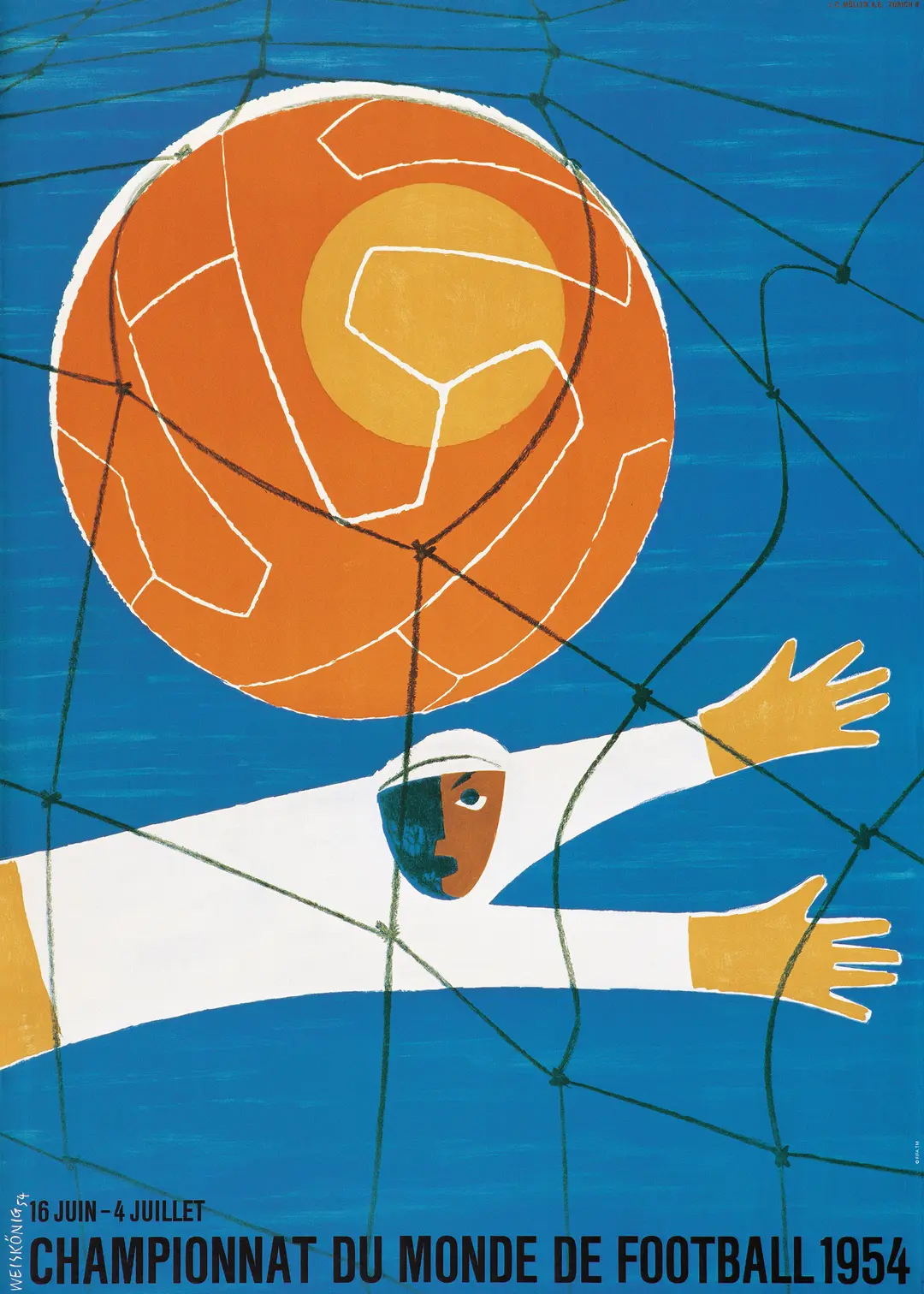
1954 World Cup poster, designed by Werner Weiskönig, Switzerland, published by J.C. Müller AG, Zürich, source Artifiche Swiss Poster Gallery
This article is a part of our ongoing series about the history and evolution of the FIFA World Cup.
Switzerland hosted the fifth World Cup. They had been awarded the event in 1946, the same day that FIFA had awarded the 1950 tournament to Brazil. Going into the tournament, Hungary was the heavy favorite. They had what was considered the best team ever seen on the pitch, with players that would become legends over time. A year before at Wembley Stadium, England hosted the “Magnificent Magyars” (the nickname for that Hungarian team), in what was called “The Game of the Century.” That name was given to the match because England had only lost once at Wembley and the British also thought that, despite the setbacks in the 1950 World Cup, they still played the best soccer in the world. Hungary crushed England 6-3 and in a second game a few months later they were again decisively beaten 7-1 in Budapest, Hungary.
This set the stage for what would be a tournament with exciting games, controversy, and record goal-scoring. The event had the highest average goals scored per game and the highest number of total scores in one game in the men’s tournament (the record was broken during the 2019 Women’s FIFA World Cup when the United States beat Thailand 13-0).
Qualifying
World Cup interest was still growing with 44 nations expressing intent to participate. Thirty-nine ultimately registered, but only 33 played at least one qualifying game due to rejection of applications or withdrawals. Uruguay and Switzerland did not have to compete for qualification since they were the defending champion and the hosts respectively. Hungary did not play a single qualifying game because their rivals, Poland, withdrew. Germany and Japan were again allowed to compete. For Germany there were two teams, East and West due to the partition following World War II, but only West Germany entered a team.
Europe was allocated 11 places, the Americas two, and Asia one. One African team, Egypt, and one Asian team, Israel, were placed with European teams for qualification purposes. A peculiarity of these qualifying games was that if teams were tied in points at the top of their group at the end of their qualification, they would have an additional playoff game but if they were still tied at the end of that game they would draw lots to decide the “winner.” This happened between Spain and Türkiye, with Spain “losing” in the lot draw so they were eliminated.
The following 16 teams qualified for the final tournament:
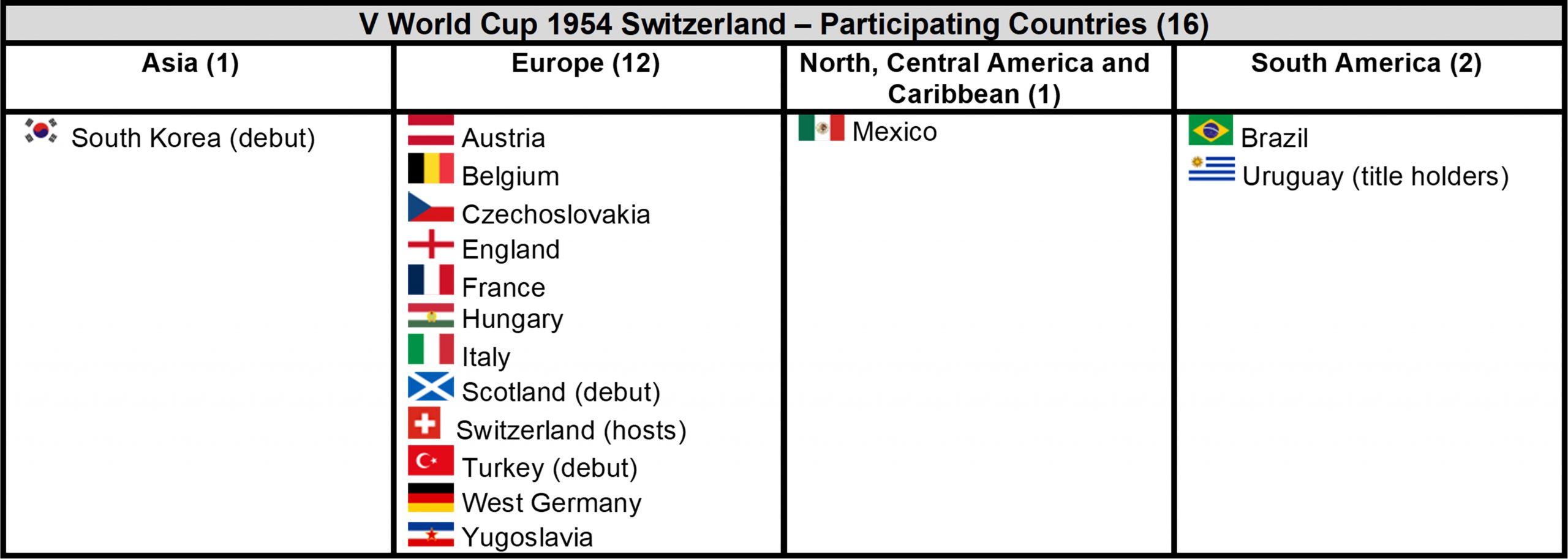
1954 World Cup participants, table developed by Jose F Guerra
The Tournament
The event was held in six venues across six cities for the tournament’s 26 matches. The 16 teams were placed in four groups of four, with two seeded and two non-seeded per group. The top two at the end of group stage advanced to the knockout stages. However, the format was not a round robin as it had been in Brazil. Instead of the usual three games per team (for a total of six games per group), only four matches were scheduled for each group, each having a seeded team against an unseeded team. In addition, overtime, which was not used in group play in Brazil in 1950, would occur if a match was tied at the end of 90 minutes. If the match was still tied at the end of 120 minutes, the tie would stand. A win would earn the team two points, a tie one point, and a loss zero.
If at the end of this stage the top teams were tied in points they would need an extra playoff to decide who would be the team that finished at the top of the group (there were no tie breakers such as goal differential, head-to-head results, or other of the many tie breakers that are used in the modern game).
Two of the four groups wound up requiring ended up requiring play-offs, one between Switzerland and Italy, and the other between Turkey and West Germany. In each match, the unseeded team (Switzerland and West Germany) repeated an earlier victory against the seeded team (Italy and Turkey) in group play. This caused considerable criticism since both West Germany and Switzerland had to play an extra game which other teams from the other two groups did not. Because of this, newly elected FIFA President Rodolphe William Seeldrayers announced that this group format would no longer be used in future World Cups.
During the group stage, the heavily favored Hungarians, who had not lost in 32 consecutive games across various competitions, defeated the West Germans 8-3. However, the German head coach had rested most of his starters since the game was already meaningless with his team already qualified for the next round and he wanted to observe Hungary’s tactics up close in case they met again in in the knockout stage (these teams would again face each other in the final). Also, Hungary’s Ferenc Puskás was injured and could not play the next games until the final.
Another notable group stage match was between Brazil and Yugoslavia which ended 1-1 but was considered one of the best games of the tournament due to the high technical ability of both teams.
Brazil, Yugoslavia, Hungary, West Germany, Uruguay, Austria, England, and Switzerland all advanced to the next stage.
Hungary had the more difficult path having to play Brazil and Uruguay to get to the final. The match against Brazil is considered one of the most violent ever in World Cup history. Hungary won 4-2 and had another tough match against Uruguay in their semi-final faceoff defeating them 2-1 in overtime.
West Germany had a somewhat easier route defeating Yugoslavia 2-0 and then Austria 6-1, advancing to the final where they would face the heavily favored Hungarians.
Some of the firsts in this tournament were:
- First televised World Cup with large-scale broadcast infrastructure
- First finals for Turkey and Scotland
- First (and only) use of extra time in group matches
- First advancement by drawing of lots
- First brothers to score in same match in the semi-final of West Germany against Austria
- First independent Asian nation (South Korea) to participate
Relevant Players
This list doesn’t do justice to the many players that had outstanding impactful performances during the 1954 World Cup, but it is a good sample:
- Sándor Kocsis (Hungary) – Scored tournament‑leading 11 goals
- Erich Probst (Austria) – One of the World Cup’s top scorers with six goals
- Josef Hügi (Switzerland) – Scored six goals, including key strikes in high‑scoring matches such as the 7–5 quarterfinal against. Austria
- Max Morlock (West Germany) – Scored six goals and played a decisive role in Germany’s championship run, including the final against Hungary
- Carlos Borges (Uruguay) – Scored 4 goals, helped the defending champions reach the semifinals with strong attacking play
- Raúl Cárdenas (Mexico) – Mexico struggled, but Cárdenas was one of their most recognizable and influential players at the tournament
The Final
Approximately 62,500 people crowded into the Wankdorf Stadium in Berne, Switzerland.
Hungary was heavily favored due to their unbeaten streak of 32 games and the fact that West Germany’s team was made up of amateur players. Hungary had beaten tougher teams than West Germany on their way to the final. The West German players were virtually unknown, whereas the names of Ferenc Puskás, Sándor Kocsis, Nándor Hidegkuti, Zoltán Czibor, Josef Bozsik, and Gyula Grosics were already legendary and struck fear into opposing teams.
In addition, Hungary had shown the world what would be known in the coming decades as “Total Football,” a tactical setup where any outfield player can take over the role of any other player. It emphasizes fluidity, positional interchange, and collective intelligence rather than fixed positions. While Hungary had not yet reached the sophistication of future teams such as The Netherlands in the ’70s or Spain’s “tiki-taka” from 2008 to 2012, it was revolutionary at the time.
The game started as was expected with Hungary going ahead 2-0 in less than 10 minutes, with Puskás and Czibor scoring. But the West Germans would show the world what would become a staple for them over the next 40 years: resilience, grit, relentless drive, and miraculous play. They scored their first goal in minute 10 and eight minutes later tied the game. The score was 2-2 at halftime.
Hungary responded by taking control of the game and creating multiple chances. But the West German backline and their goalie repeatedly denied them. In minute 84 the West Germans struck again, and the match was now 3-2 in their favor. Just two minutes later, Puskás appeared to have tied the match from Kocsis pass but it was ruled offside. In the final minute of the game, Czibor had another chance to equalize, but his shot from close range was again stopped by the West German goalkeeper, Turek.
Without taking anything away from the West Germans, there is compelling circumstantial and testimonial evidence suggesting that injections happened during the matchday and may have involved stimulants. In addition, the tying goal that was ruled offside towards the end is still disputed to this day as to whether or not the call was correct.
Regardless, the Magnificent Magyars had been defeated after 32 straight games without losing. The West Germans would start a streak that would see them become one of the most feared teams in the soccer world.
It would also be the last World Cup over which Jules Rimet, the founder of the World Cup tournament and President of FIFA from 1921 to 1954, would preside.
Next up, the Verde-Amarela (“Green-and-Yellow”) Brazilian team would dazzle the world and show off a 17-year-old prodigy that would mesmerize the next several tournaments.
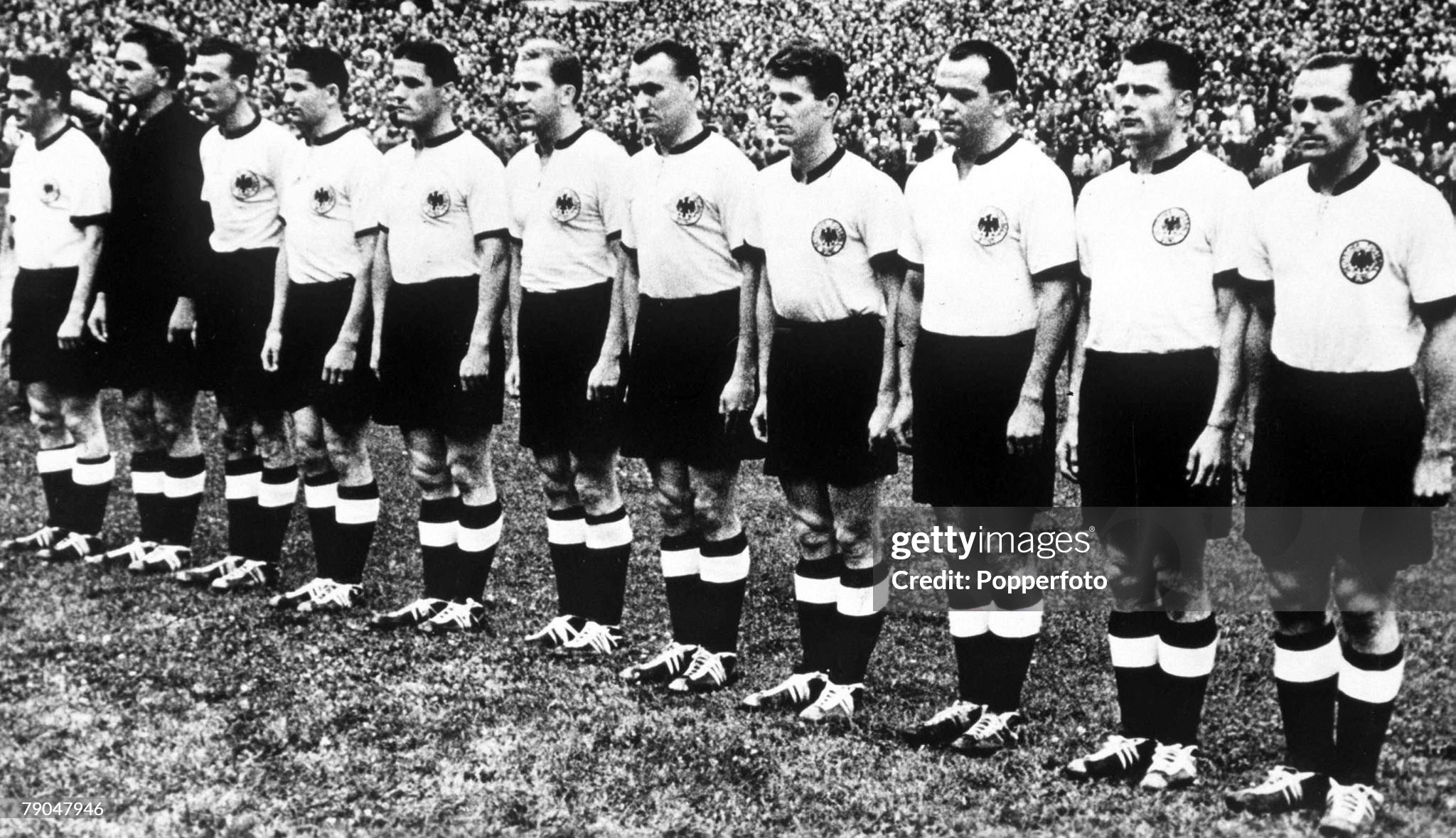
World Cup Final, 1954, Berne, Switzerland, 4th July, 1954, West Germany 3 v Hungary 2, West Germany team line up before the match (Photo by Popperfoto via Getty Images/Getty Images)
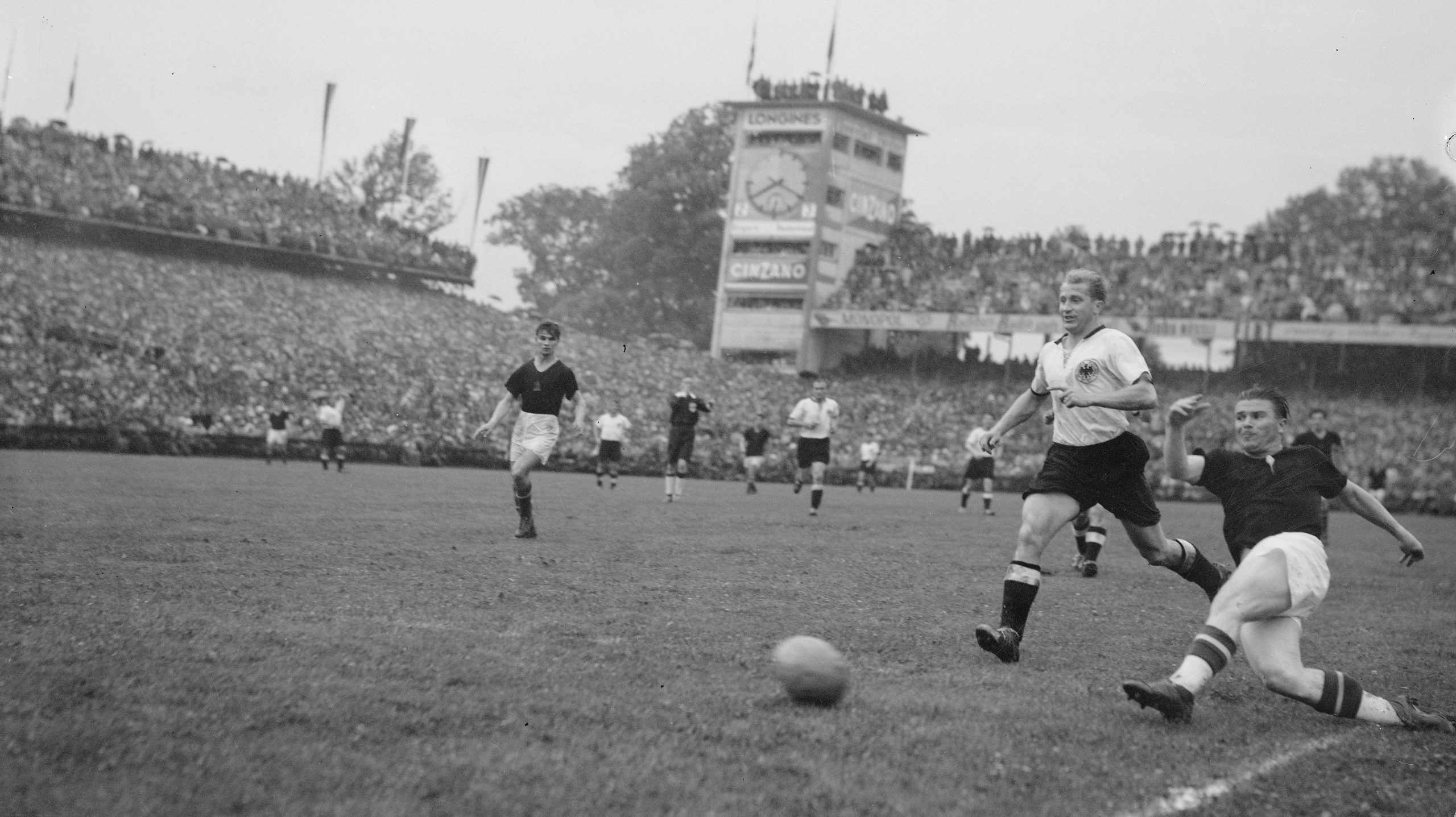
Action during the West Germany vs Hungary final at the 1954 World Cup Final (photographer unknown, source ETH-Bibliothek, public domain)
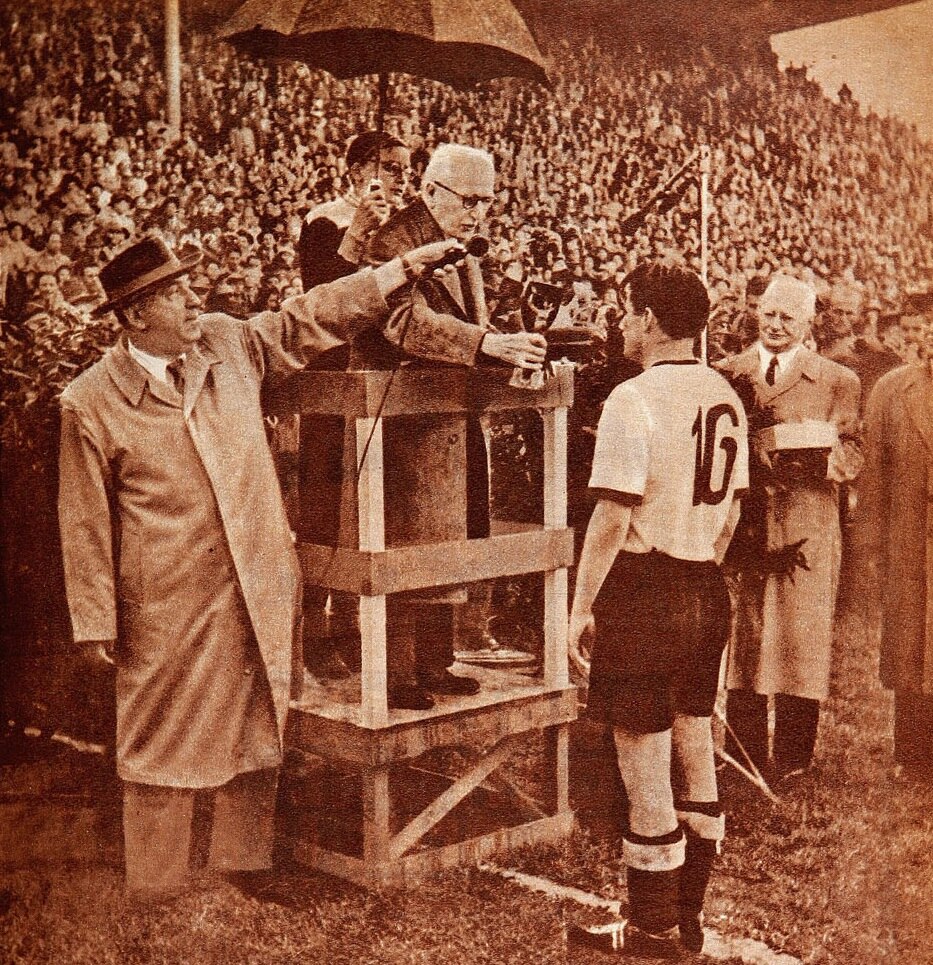
Jules Rimet delivers the Jules Rimet Cup to Fritz Walter, West Germany captain, after the 1954 World Cup final (photo published in Estadio magazine, 17 July 1954, public domain, Wikimedia Commons)

Recommended for you