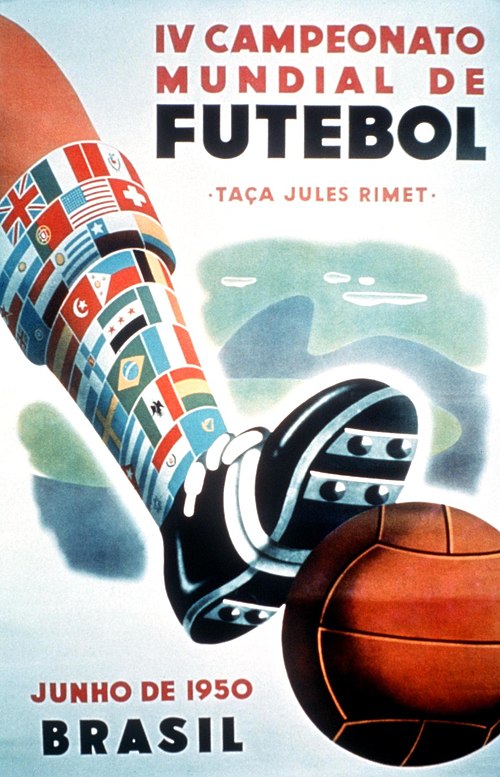
1950 Brazil World Cup Poster (design by J. Ney Damasceno, source Public Domain)
This article is the fourth installment of our FIFA World Cup History series.
The fourth edition of the World Cup was the first after the devastation of World War II. FIFA was very eager to restart the tournament, but there was little interest given the harsh economic conditions still lingering after the global conflict. European countries were still recovering, and the tournament was in danger of not being held. However, Brazil submitted a bid at the 1946 FIFA Congress and offered to host if it was held in 1950 (FIFA wanted it held in 1949). Both Germany and Brazil had submitted bids for the 1942 World Cup but the war prevented the tournament from being held between 1939 and 1949.
As with previous tournaments, controversy and politics would haunt this World Cup as well. Germany and Japan were excluded as they were banned due to their aggressions and economic issues stemming from the war. Most Eastern European countries (including 1934 finalist Czechoslovakia and 1938 finalist Hungary) boycotted the event except for Yugoslavia who had distanced itself from the Soviet Union, which also did not participate.
Qualifying
Thirty-four countries participated in qualifying matches for the 1950 World Cup, down from 37 for the 1938 tournament. This was mostly due to the economic effects of World War II.
Argentina, Ecuador, and Peru withdrew after the qualifying draw, with Argentina citing disputes with the Brazilian Football Confederation. This meant that Chile, Bolivia, Paraguay, and Uruguay qualified from South America by default. In Asia, the Philippines, Indonesia, and Burma all withdrew, leaving India to qualify by default. In Europe, Austria withdrew, claiming its team was too inexperienced. Belgium also withdrew from the qualifying tournament. These withdrawals meant that Switzerland and Turkey qualified without having to play their final round of matches.
Unlike the last time the World Cup was held in South America, most of the European top nations in football would partake. By this time transatlantic flight had emerged and made the long trip easier. Italy would, however travel by sea after the tragic air disaster that the year before wiped out the entire Torino football team.
England, after finally joining FIFA four years before, conditioned their participation by demanding that their qualification would be through their 1949–50 British Home Championship as a qualifying group, with the top two teams qualifying. England finished first and Scotland second.
However, France, India, and Turkey withdrew for economic reasons. With those three countries excluded, 13 teams out of a possible 16 wound up participating in the tournament.
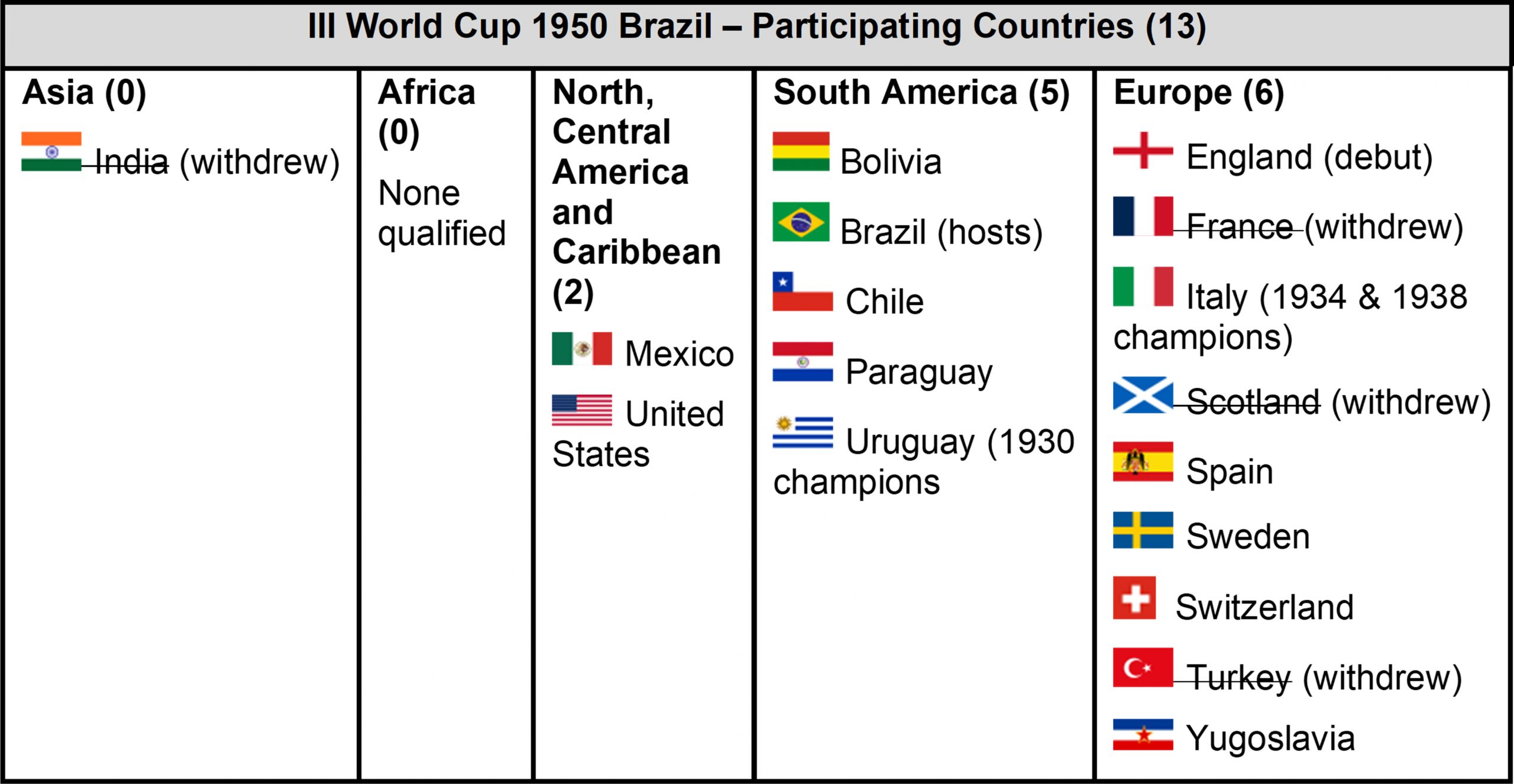
1950 World Cup Participants, table done by Jose F Guerra
The Tournament
For the first time, the knockout format in the first stages would no longer be used. Instead, Brazil proposed a group stage where teams would be placed in four groups of four teams. Teams would play a round robin format which would guarantee them playing more than one match, while increasing ticket sales revenues, which Brazil needed to help finance the infrastructure and stadium costs it had incurred to host the event. Each win would earn the team two points, a tie one point, and a loss zero points. If at the end of the group stage there were tied teams, extra games would be played as necessary. Although FIFA initially refused, they relented when Brazil threatened to pull out of hosting. This basic format, with some tweaks for subsequent phases, continues to this day.
Because three teams had withdrawn, this left some groups asymmetrical, with one group having three teams (Sweden, Italy, and Paraguay) and another group having only two (Uruguay and Bolivia). Six venues were used for this World Cup, but there was little logic in terms of how teams moved around, with some travelling long distances just for the group stage games. Regardless, the attendance broke records with an average of 61,000 fans per game, a milestone that would not be broken until the 1994 World Cup held in the USA.
There was great anticipation for England. The world still considered the British Isles soccer the best, so automatically England were considered one of the favorites. But the sport has a way of bringing arrogance down to earth. In their first game of the event, they faced the United States, which was comprised of mostly amateurs and semi-pro players. To the shock of the world, the USA beat England 1-0 on a goal by Larry Gaetjens of Haitian origin. England would again lose 1-0 this time against Spain and were knocked out of the tournament.
Italy, the two-time defending champion, was also considered one of the favorites. But this was not the Italy of previous tournaments. They had been decimated by the airplane crash of their league team Torino a year before and did not make it our of the group stage. This would be the start of uneven performances by the Italian team who would be eliminated in group stages or not even qualify for World Cups over the next 75 years.
Four teams qualified, one from each group: Brazil, Spain, Sweden, and Uruguay. They would also play a round robin format with the team having the most points winning the World Cup (this was the one and only time this format was used).
Some of the firsts of this tournament were:
- First World Cup after WWII
- First tournament without a single-match final (more on that below)
- First use of the “Jules Rimet Cup” name
- First time India qualified but withdrew
- First early elimination for Italy
- First time for England playing in a World Cup
- First and only World Cup match with a ~200,000-person crowd
- First and only two‑stage group-format World Cup
Relevant Players
- Obdulio Varela (Uruguay)
- Ademir de Menezes (Brazil)
- Gunnar Nordahl (Sweden)
- Telmo Zarra (Spain)
The Final
Because the four winning teams of each group (Brazil, Sweden, Spain, and Uruguay) would play another round robin to determine the champion, two games were actually played on July 16th, 1950 at 3:00pm: Sweden vs Spain and Brazil vs Uruguay. Neither Spain nor Sweden had any chance of catching Brazil or Uruguay in the standings, so it came down to the Brazil-Uruguay match. Going into the last two games the standings were the following:
- Brazil – 4 points
- Uruguay – 3 points
- Spain – 1 point
- Sweden – 0 points
A tie would guarantee Brazil the championship. The team, the people, the media, and the government were so confident that they were going to win given their devastating attack that they began calling them the champions before the game. They even made gold medals with the names of every Brazilian player on the team. The game would be held at legendary Maracaná Stadium where a record 205,000 fans would attend.
Before the match, the Uruguayan head coach, Juan López, told his team in the dressing room that their best chance of surviving the powerful offensive line of Brazil would come through adopting a defensive strategy. After he left, Varela stood up and addressed the team himself, saying “Juancito is a good man, but today, he is wrong. If we play defensively against Brazil, our fate will be no different from Spain or Sweden.”
The game started the way everyone expected, with Brazil attacking in waves. Uruguay’s defensive lines held, but two minutes into the second half, Brazil scored. A tie was all that was needed for Brazil to triumph, and many thought the game was decided. But something happened that was not widely reported. Uruguay’s captain, Varela, calmly walked to the back of his net, picked up the ball, and went to argue with the central referee. His intent was to cool the ambiance in the stadium and give his team a chance to recover from the shock. The people in the stadium were at first surprised and then angry. By the time Varela went back to midfield and placed the ball at the center spot, the ambiance had chilled in the stadium. He turned to his team and said “Now, it’s time to win!”
In the 66th minute Uruguay scored the tying goal and the stadium went somewhat silent. Then 11 minutes from the end of the game, Edgardo Ghiggia scored the go-ahead goal. The stadium was shocked and in total silence. Jules Rimet, the president of FIFA, had already left his place in the box and was making his way to award the trophy to Brazil since at that moment the game was tied and he assumed they would win it. Years later he said as he got to the lower levels he wasn’t sure what was going on because of the silence in the stadium. He said that he was in a daze when he handed the trophy over to Uruguay, not quite comprehending what had happened. The game had ended 2-1 in favor of Uruguay.
To this day, some people call it the “tragedy of Maracaná” but Brazilians call that game “O Maracanaço” (Portuguese for “The Maracanzo”).
Next up will be the 1954 World Cup held in Switzerland which would see the magnificent play of the Hungarian team who were known as the “Magnificent Magyars”.
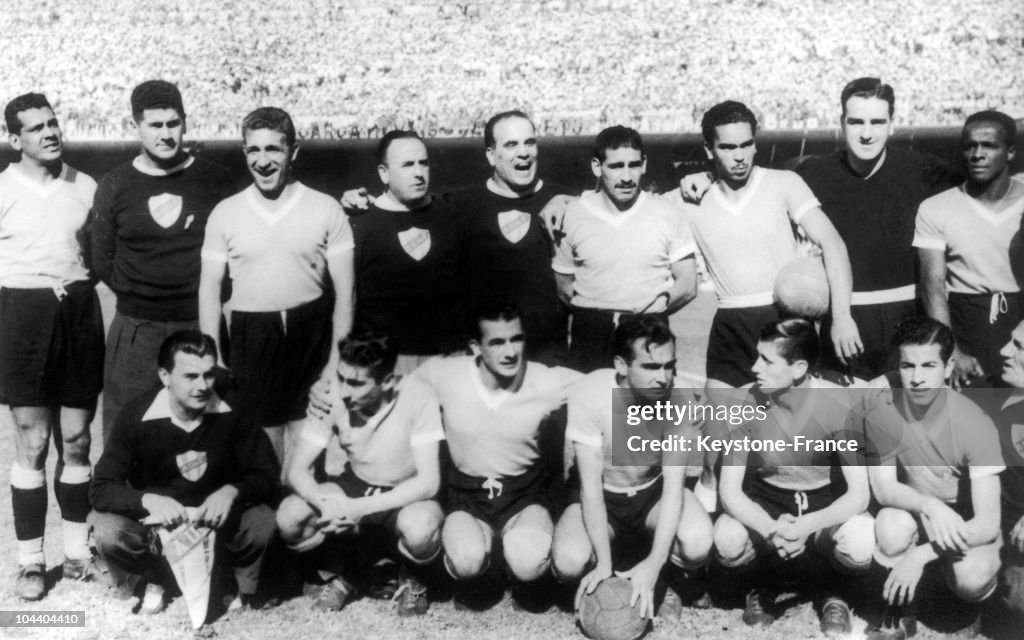
The Uruguayan team before the World Cup finals. Uruguay won the match by 2-1. (Photo by Keystone-France/Gamma-Keystone via Getty Images)
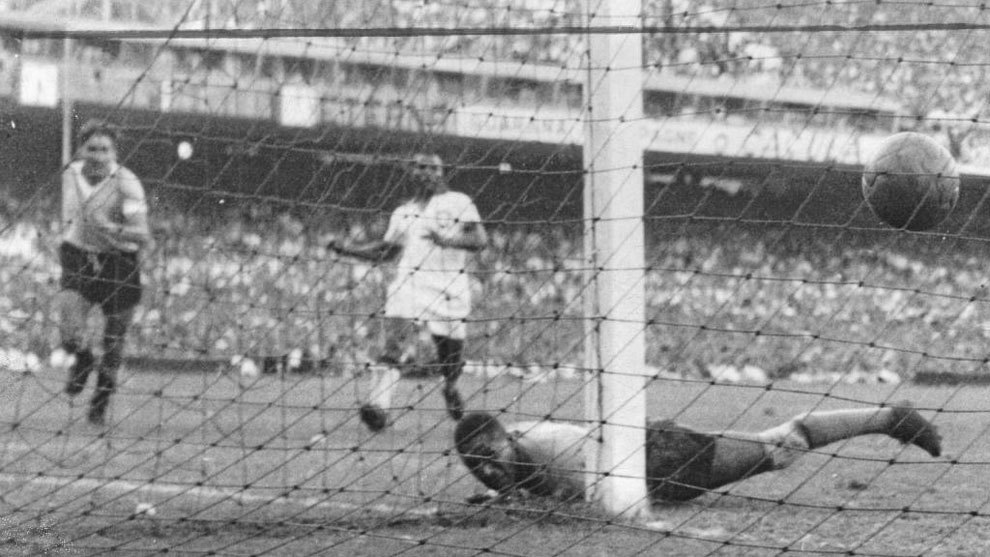
Action from the 1950 World Cup final between Brazil and Uruguay, Edgardo Ghiggia scoring the go-ahead goal (photographer unknown, source public domain)
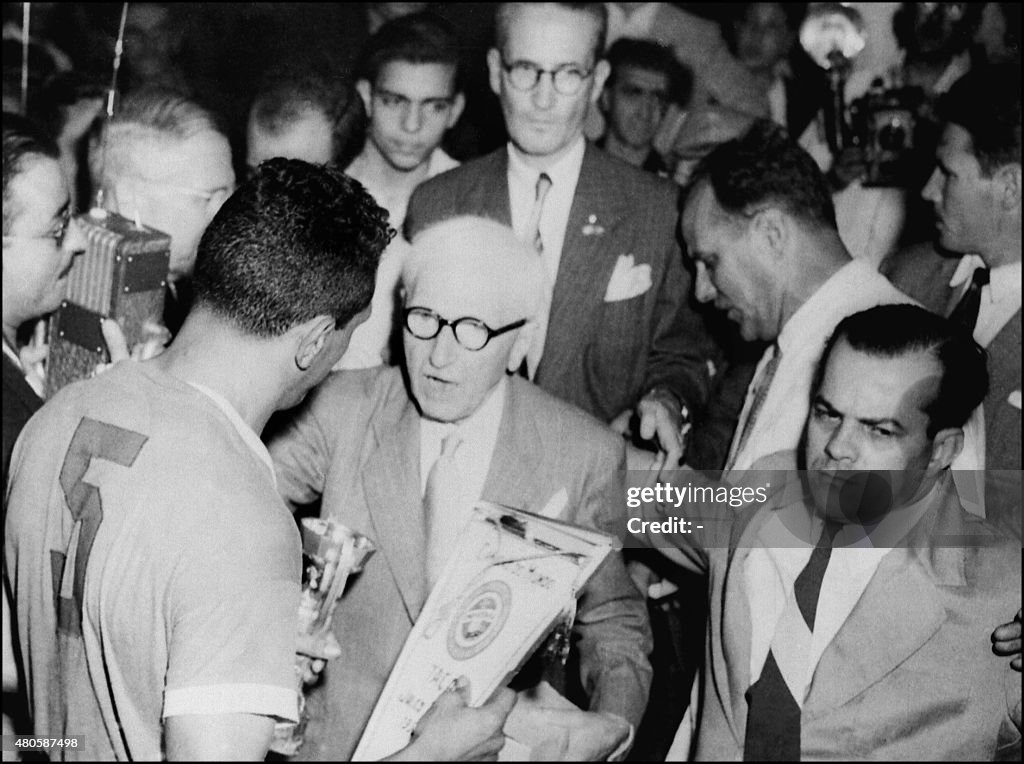
The president of the Federation Internationale de Football Association (FIFA), Frenchman Jules Rimet (C) presents the Jules Rimet trophy to Uruguay’s national soccer team captain Obdulio Varela (5) after Uruguay beat Brazil 2-1 in the final of the World Cup 16 July 1950 in Rio de Janeiro. (Photo by AFP) (Photo by -/AFP via Getty Images)

Recommended for you