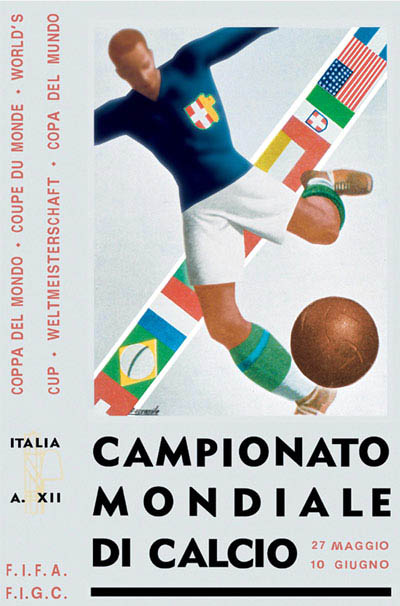
1934 Italy World Cup Poster by Filippo Tommaso Marinetti, source Public Domain
After the great success and entertaining games of the 1930 World Cup in Uruguay, the interest in hosting and participating in the World Cup tournament increased significantly. Two countries submitted bids to host the event: Sweden and Italy. Italy was selected as host and 32 teams entered the competition, a 146% increase in interest compared to 1930. It was the first World Cup for which teams had to qualify to take part. Despite their role as hosts, Italy (also known as the Azzurri for their blue uniforms) were still required to qualify, the first and only time the host nation was not granted automatic qualification.
Qualifying
The qualifying heats resulted in 16 teams winning the right to be a part of the second quadrennial World Cup. However, it was not without controversy.
Reigning World Cup holders Uruguay declined to participate, in protest at the refusal of several European countries to travel to South America for the previous World Cup. As a result, the 1934 World Cup is the only one in which the reigning champions did not participate. England, Scotland, Wales and North Ireland again refused to participate. Their view was that their own International Championship was a far better World Championship than the one to be staged in Italy.
Argentina, the defending runner-up from 1930, experienced internal turmoil on their team. The Argentine Football Association (AFA) had introduced professional football, but by 1934, tensions between the AFA and the professional league were high. The professional clubs refused to release their players for the national team. This caused the AFA to have no choice but to select a roster composed entirely of amateur players from smaller, regional clubs.
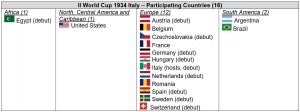
Of the 16 teams that qualified, 12 of the 16 places were allocated to Europe, three to the Americas, and one to Africa or Asia (including Turkey). Only 10 of the 32 entrants, and four of the 16 qualified teams (Brazil, Argentina, United States and Egypt, the first African team to qualify for a World Cup finals tournament), were from outside Europe. The last place in the finals was contested between the United States and Mexico only three days before the start of the tournament in a one-off match in Rome, which the United States won.
The final list of participating countries was:
The Tournament
For the first time, the tournament was broadcast live on radio in 12 of the 16 participating countries.
But politics made its presence in ugly fashion as Mussolini went out of his way to make it all about fascism in his country. While never proved, there were reports and rumors of him personally selecting referees for key matches, telling the Italian team they needed to win at all costs, and in general making the tournament about the “superiority of the fascist system.” It would not be the only time when politics inserted itself into the beautiful game.
The matches would be played in eight cities, in eight stadiums. The final would be played in Rome on Stadio Nazionale PNF that had a capacity of 47,300 (PNF was an abbreviation for Partito Nazionale Fascista).
The group stage used in the first World Cup was discarded in favor of a straight knockout format. If a match was tied after ninety minutes, then thirty minutes of extra time were played. If the score was still tied after extra time, the match was replayed the next day.
The eight seeded teams – Argentina, Brazil, Germany, Italy, the Netherlands, Austria, Czechoslovakia and Hungary – were kept apart in the first round.
Some matches were marred by unacceptable violence which was mostly blamed on the referees’ unwillingness to stop that kind of play. Specifically:
- Austria vs Hungary – The quarterfinal match was characterized by numerous fouls and rough tactics. Observers noted that it resembled a “brawl” rather than a football match, with both teams engaging in physical confrontations. Hungary’s Imre Markos was sent off for a foul, but many felt that other players also deserved similar punishment due to the violent nature of the game. Heavy tournament favorites Austria won 2-1. The Hungarian players surrounded the referee after the match and blamed him for their defeat.
- Italy vs Spain – Another quarterfinal match was also one of the most violent. The game ended tied 1-1 and was replayed the very next day. The first match saw several players injured due to violent play with the score ending at 1-1. The game was replayed the very next game with intense physical confrontations, leading to multiple injuries among players from both teams. At least three Spanish players had to leave the field due to injuries. Italy took that match and won 1-0.
In Uruguay 1930 all teams had used the 2-3-5 formation. In this World Cup two different systems would be used: W-M and the Método. The W-M formation has been invented in England and was a 3-2-2-3 shape while the Método used a 2-3-2-3 formation and was developed by Italian coach Vittorio Pozzo. This formation turned out to be the most successful in the tournament.
Italy and Austria played in the first semifinal in what is described as a thrilling and intense match. The Azzurri started to cement their reputation as a strong defensive team which kept Austria’s vaunted attack at bay and eventually won the match 1-0.
Czechoslovakia and Germany played the other semifinal in another riveting match which not only highlighted the tactical prowess of Czechoslovakia but also underscored the intense spirit of World Cup football. Germany won the match 3-2, securing what would be the first of many awards to come.
For the first time a third place match was played where Germany defeated Austria 3-2 (four years later, Austria would be folded into the German team due to being annexed).
Relevant Players
- Giuseppe Meazza (Italy)
- Oldřich Nejedlý (Czechoslovakia)
- Matthias Sindelar (Austria)
- Raimundo Orsi (Argentina)
The Final
The hosts, as with Uruguay, again made it all the way to the final where they met Czechoslovakia. The Czechs, once again surprising the pundits of the day, went ahead in the second half but Italy tied it with nine minutes left in the game. The game went into overtime, the first time a final had gone into extra time in a final, where Italy eventually won 2-1.
Next World Cup history will show how Italy became the first repeat champion.
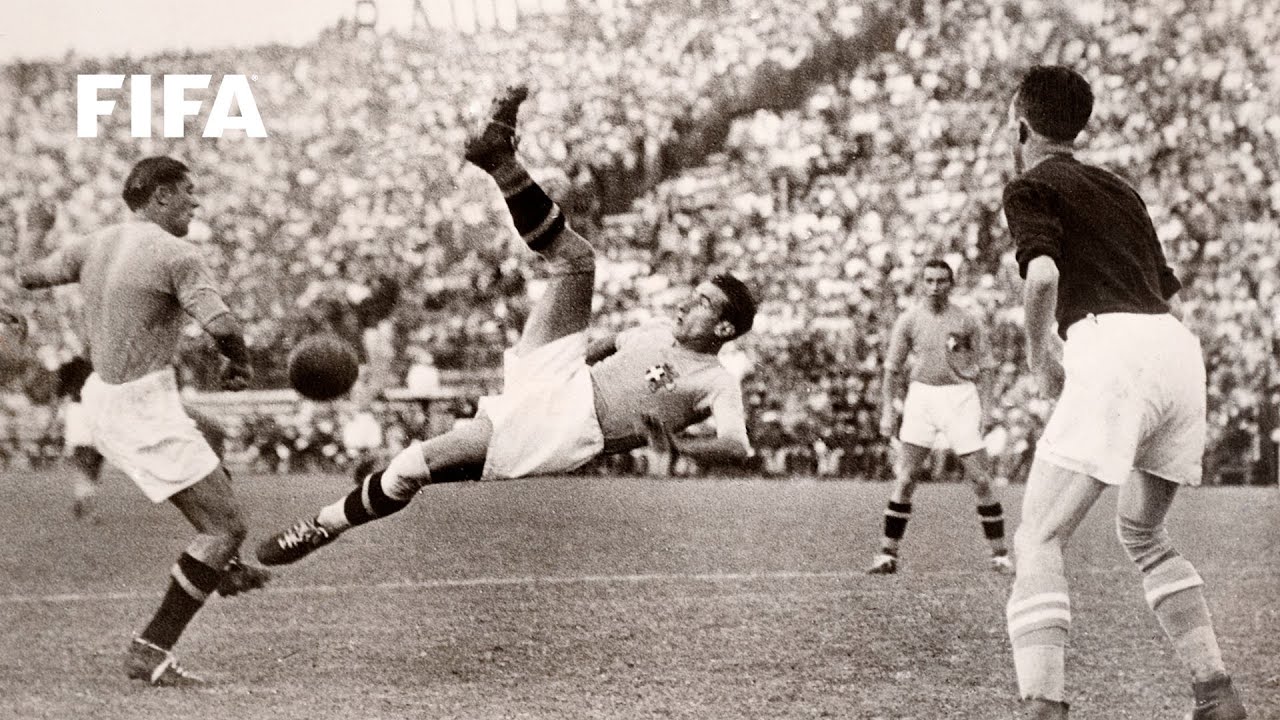
Action from the World Cup Final between Italy and Czechoslovakia, (photographer Popperfoto, source Getty Images)
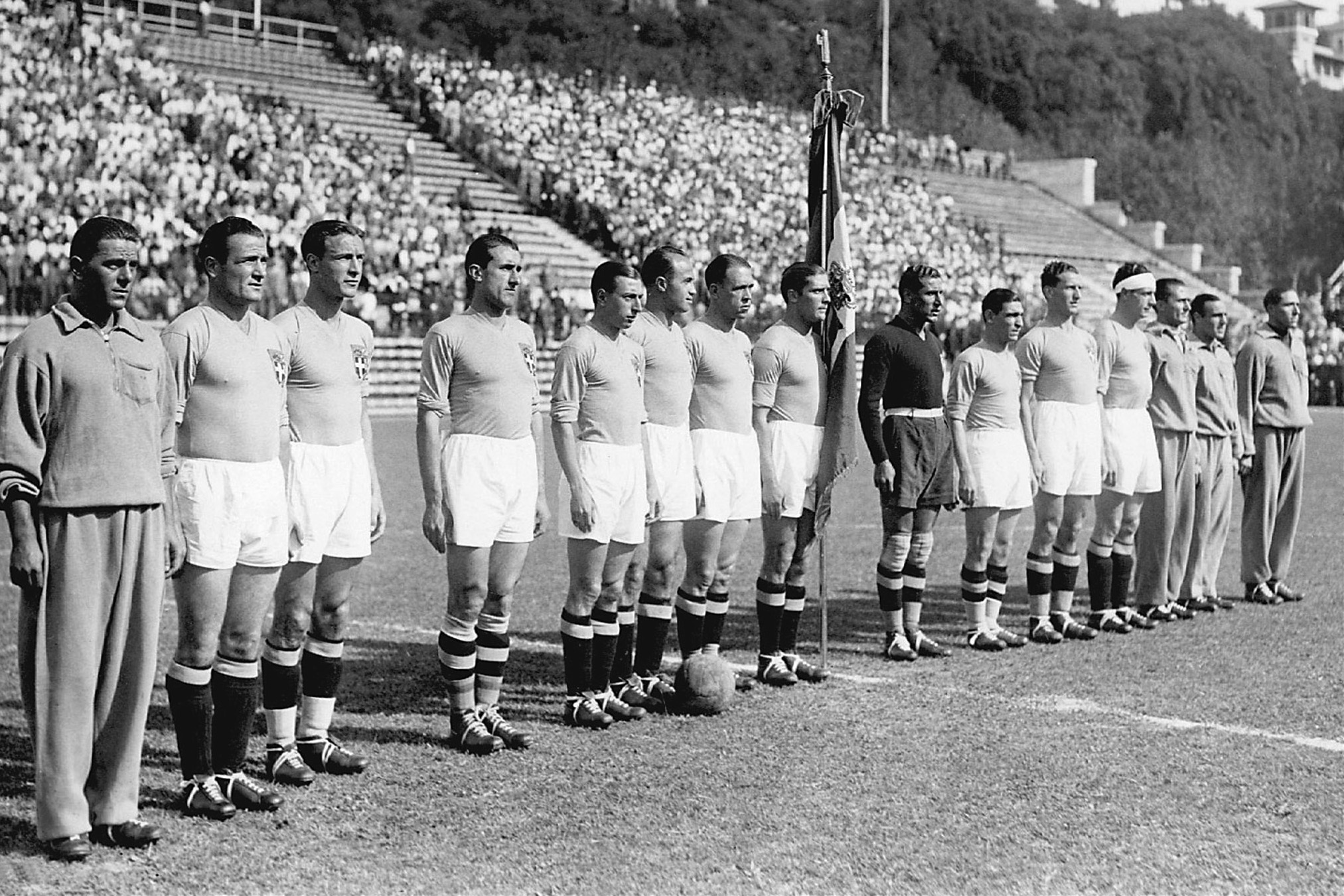
Italy line up before the final against Czechoslovakia, (photographer unknown, source Getty Images)
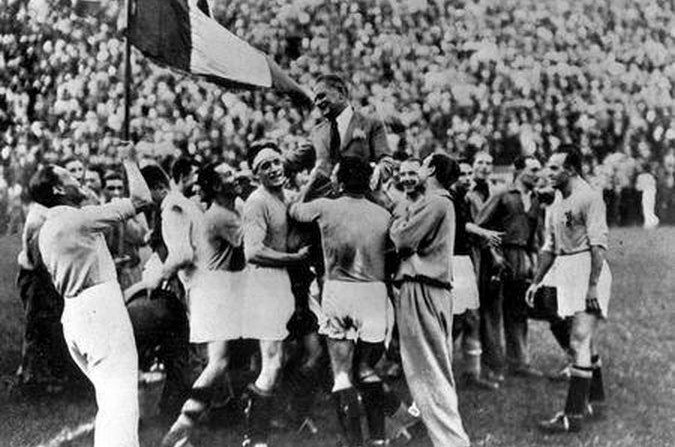
Italy World Champion, II World Cup, in Italy, (photographer unknown, source Public Domain)

Recommended for you