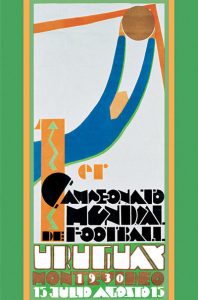
1930 Uruguay World Cup Poster by Guillermo Laborde, source Wikipedia
This is the first of a weekly series of the history of World Cups. We start with the first one held in 1930 and we will end with a preview of this year’s XXXIII edition that will be held in the USA, Canada, and Mexico.
The first FIFA Men’s World Cup was the brainchild of then president of the global soccer organization, Jules Rimet.
England may have invented the “Beautiful Game” but the honor of hosting the first ever FIFA World Cup went to Uruguay (the Uruguayan soccer team is known as the “Charrúas”). For those that are familiar with the history of soccer overall, this may seem like an odd choice. After all, soccer was thriving in England and its Football Association (FA) was considered one of the best if not the best in the world. But several factors drove FIFA to award hosting rights to Uruguay. Among them:
- Uruguay had won the 1924 and 1928 summer Olympics soccer gold medals (which is why this would be the Charrúas’ third kick)
- They had also offered to cover all the expenses of participating teams, including travel and accommodation
- Finally, the country was celebrating the centennial of their Constitution
Qualifying
All 41 FIFA affiliated countries at the time were invited to participate, and it would be the only time when no qualifying games would be held. The intent was to have a 16-team tournament and in the event they exceeded that number, a “second division” tournament would be held simultaneously. The affiliated soccer associations were given until February 28th, 1930, to confirm their attendance.
However, by that date no European countries had confirmed, and two Asian countries, Japan and SIAM (modern-day Thailand), had withdrawn. Seven South American countries (Argentina, Bolivia, Brazil, Chile, Paraguay, Peru, and Uruguay) and two North American ones (Mexico and the USA) had confirmed. With personal appeals from FIFA President Jules Rimet, four European countries (Belgium, France, Romania, and Yugoslavia) accepted the invitation which brought the total to 13 countries. Egypt had accepted but missed the steamboat that was going to take them to the tournament.
Uruguay had extended a personal invitation to the FA (comprised of the British Home Nations of England, Northern Ireland, Scotland and Wales) even though they had withdrawn from FIFA in 1920. They rejected it, and years later it was discovered that the FA felt their tournaments were of much higher quality and prestige for them to bother going to this first World Cup.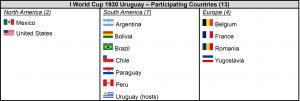
The Tournament
The original trophy was called “Victory.” It was officially renamed in 1946 to the “Jules Rimet” cup to honor the FIFA President. Jules Rimet stipulated that whoever won the Cup three times would keep it.
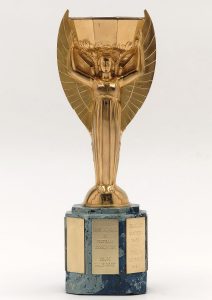
World Cup Jules Rimet Trophy (1930 – 1970) Photographer unknown, photo courtesy of artsandculture.google.com
Fifteen referees were assigned to this World Cup of which six were from Uruguay. One referee was from Romania and also the head coach of Romania! Another referee was from Bolivia, and he also happened to be the head coach of the Bolivian team!
The 13 teams were divided into four groups, one group of four and three of three. Some of the interesting results from this first set of World Cup matches were:
- The US beat Belgium 3-0 and then Paraguay by the same score with the first hat trick ever in a World Cup by US player Bert Patenaude
- Uruguay’s first match was not played until five days into the tournament due to construction delays of the Centenario Stadium
- In a match between Argentina and France, the referee blew the game ending whistle with six minutes left
- The first penalty kick (PK) of a World Cup was awarded to Chile during their match against France with the French goalkeeper saving the PK
From the group matches, four teams (Argentina, United States, Uruguay, and Yugoslavia) went directly to semifinals since the first place of every group qualified to the next round.
The four group winners, Argentina, Yugoslavia, Uruguay and the United States, moved to the semi-finals. The two semi-final matches saw identical scores. The first semi-final was played between the United States and Argentina on a rain-drenched pitch. The United States team, which featured six British-born players, lost midfielder Raphael Tracey after 10 minutes to a broken leg as the match became violent. The final score was 6-1 in favor of Argentina.
In the second semi-final, there were shades of the 1924 Summer Olympics match between Yugoslavia and Uruguay. Here, though, Yugoslavia took a surprise lead through Đorđe Vujadinović. Uruguay then took a 2–1 lead. Shortly before half-time, Yugoslavia had a goal disallowed by a controversial offside decision. The hosts scored three more in the second half to win 6–1, with Pedro Cea completing a hat-trick.
There was no third-place game at the time but due to results and goal differential, the US was officially given third place of the 1930 World Cup in a report published by FIFA in 1986.
Relevant Players
- José Nasazzi (Uruguay)
- Guillermo Stábile (Argentina)
- Bert Patenaude (USA)
- Manuel Rosas (Mexico)
The Final
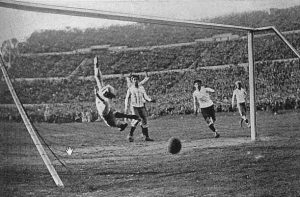
Uruguay 4th goal vs Argentina, Photographer Unknown, Public Domain From book “Album – Primer Campeonato Mundial de Football” (Argentine Football Association Library)
The soccer ball was a point of contention since both teams wanted to use their own so FIFA intervened and decided that one team’s ball would be used in the first half and the other team’s in the second half. Uruguay faced off against Argentina. The stadium gates opened at 8:00 am, six hours before kickoff, and by noon it was filled to capacity with 93,000 attendees. The hosts went ahead in the first half but Argentina scored two goals and went into halftime leading 2-1. But the hosts stormed back and scored three unanswered goals in the second half, becoming the first FIFA Men’s World Cup champion by a score of 4-2. It was a repeat of the 1928 Summer Olympics final.
Uruguay manager Alberto Suppici was 31 at the time and still holds the record for being the youngest coach of a FIFA World Cup winning team. Jules Rimet himself, president of FIFA, presented Uruguay with the World Cup Trophy which would later be named after him.
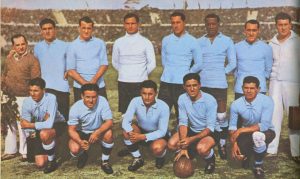
Uruguay World Champion, I World Cup in Uruguay Photographer Unknown, Source Public Domain
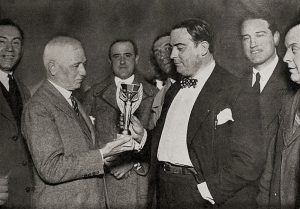
Jules Rimet presenting the World Cup trophy to Uruguay Federation President Raul Jude. Photographer Unknown, Public Domain From book “Album – Primer Campeonato Mundial de Football” (Argentine Football Association Library
Next history will be about how Italy started to make its mark as a soccer powerhouse during the 1934 World Cup held in Italy.
Title photograph courtesy of Brian Mack.

Recommended for you